
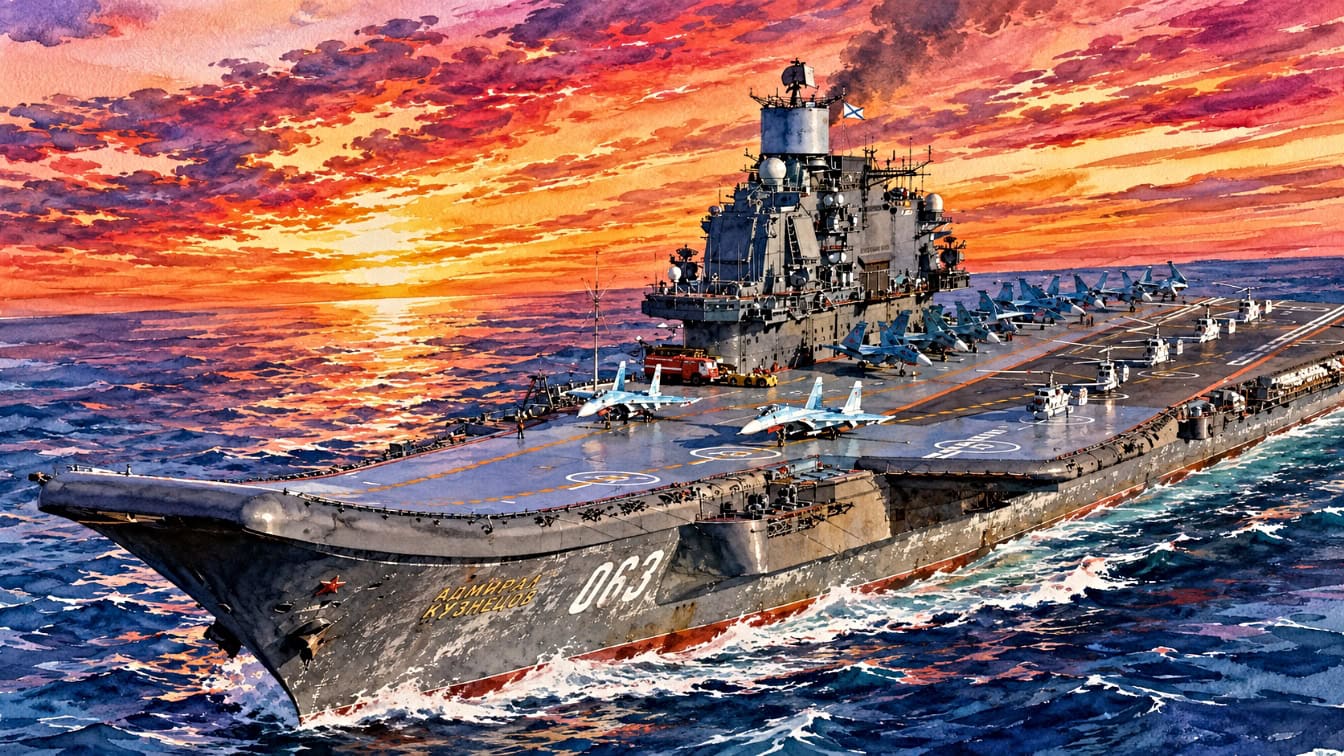
Why Is Russia Scrapping Its Only Aircraft Carrier, The Admiral Kuznetsov?: Russia is moving to scrap or sell its only aircraft carrier, the Admiral Kuznetsov, because eight years and a fortune in repairs have failed to fix a ship whose boilers are now beyond economic salvage, and because the country can no longer justify the cost of a vessel that has been a national embarrassment for most of its life. The Kuznetsov was meant to be the symbol of Soviet, and then Russian, naval power — a carrier to stand against America’s. Instead, it became the most cursed warship of the modern era: a vessel that smoked so heavily it could be seen at a distance, sailed to its only combat deployment trailing a tugboat in case its engines failed, lost two fighters into the sea in three weeks, survived a crane crashing through its flight deck and a fire that killed workers, and has not sailed since 2017.
This is the account of how that ship reached the edge of the scrapyard, and why its end likely means Russia is finished with carrier aviation for a generation.
A Carrier Born From Cold War Ambition

Admiral Kuznetsov. Image Credit: Creative Commons.
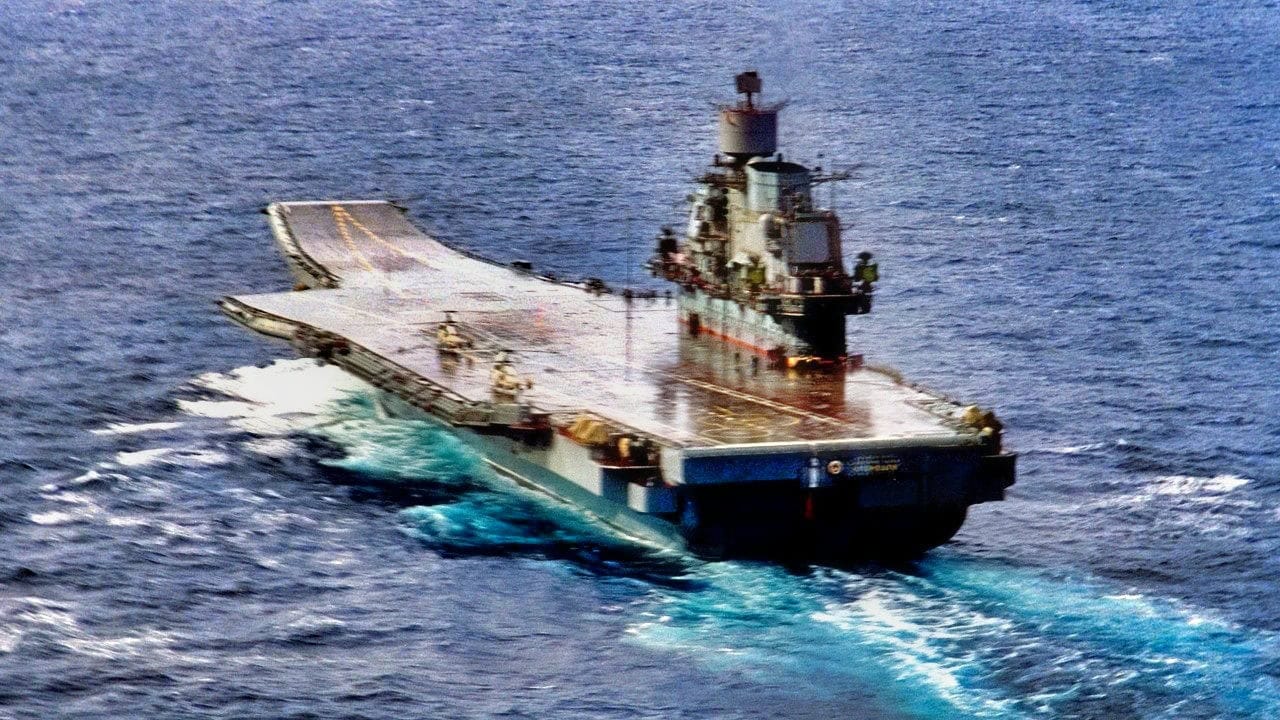
Admiral Kuznetsov Aircraft Carrier Russia. Image Credit: Creative Commons.
The Kuznetsov was conceived in the late Cold War as part of a Soviet bid to build a true blue-water navy capable of challenging the United States across the world’s oceans. The Soviet Navy had operated helicopter carriers and small vertical-takeoff aircraft carriers since the 1960s, but it had never built a ship capable of launching conventional fixed-wing fighters, as American carriers had since World War II.
The new vessel, designated Project 1143.5, would change that. Construction began in 1982 at the Black Sea shipyard in Mykolaiv, in what was then the Ukrainian Soviet Socialist Republic, and the ship was launched in 1985 before formally entering service in 1991, just as the Soviet Union that built it collapsed. The timing was its first misfortune: the carrier meant to project the power of a superpower entered service at the moment that superpower ceased to exist, passing to a Russian Navy that could barely afford to run it.
The design carried a compromise that would limit the ship for its entire career. Rather than the steam catapults American carriers use to fling heavily loaded aircraft off the deck, the Kuznetsov relied on a ski-jump ramp — a curved bow that lets fighters take off under their own power but caps the weight of fuel and weapons they can carry, holding down both their range and the rate at which the ship can generate sorties.
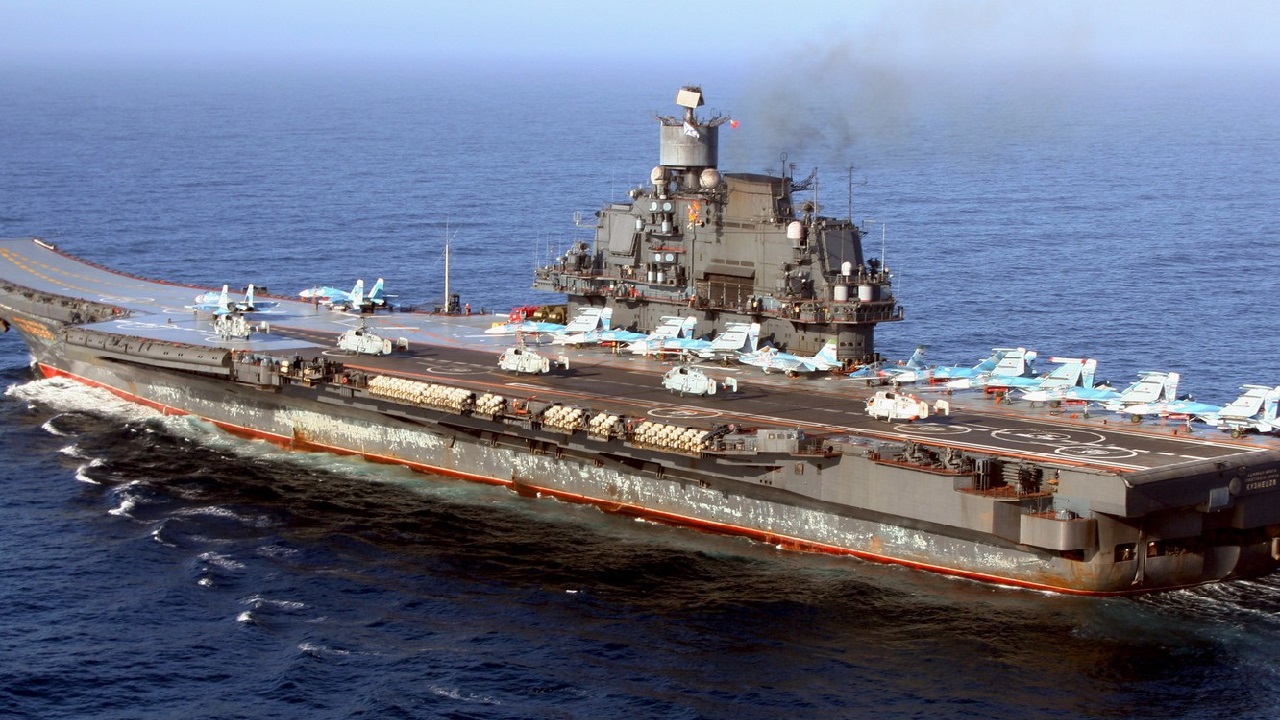
Admiral Kuznetsov Aircraft Carrier. Image Credit: Creative Commons.
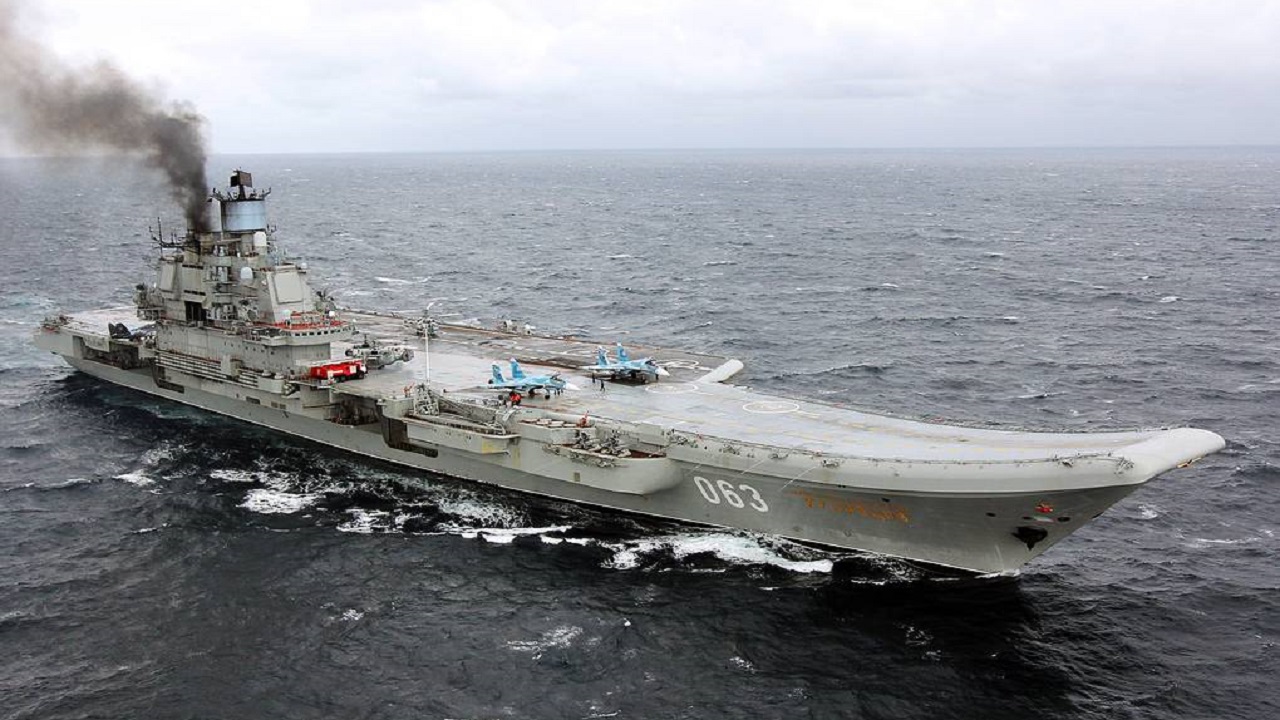
Russian Navy Northern Fleet Press Office/TASS/Russian State Media
The Soviets classified it not as an aircraft carrier but as a “heavy aircraft-carrying cruiser,” a hybrid bristling with its own heavy anti-ship and air-defense missiles, designed to fight as a warship in its own right rather than serve purely as a floating airbase. It was a category of vessel that was never a true supercarrier, and the ski-jump that defined it ensured the Kuznetsov could never match the air wing of the American ships it was built to rival.
The Propulsion Nightmare At The Heart Of The Curse
Almost every disaster in Kuznetsov’s history has traced back to its engines. The ship runs on mazut, a thick, heavy fuel oil, fed through pressure-fired boilers that were temperamental from the start and grew worse with age.
The most visible symptom was the smoke: the boilers belched dense black exhaust visible at a great distance, a signature so distinctive it drew open mockery whenever the carrier sailed past Western coastlines.
Behind the smoke was a deeper unreliability. From its first long-range deployment in the mid-1990s, the Kuznetsov was shadowed by an ocean-going tugboat, and that escort was not a courtesy. It was a tacit admission by the Russian Navy that the fleet’s flagship was expected to break down at sea, and it did, repeatedly, sometimes left dead in the water until it could be restarted or towed.
That single fact — a carrier that cannot reliably sail without a tug standing by to rescue it — captures the gap between what the Kuznetsov was meant to be and what it was. There is an irony buried in the escort, too.
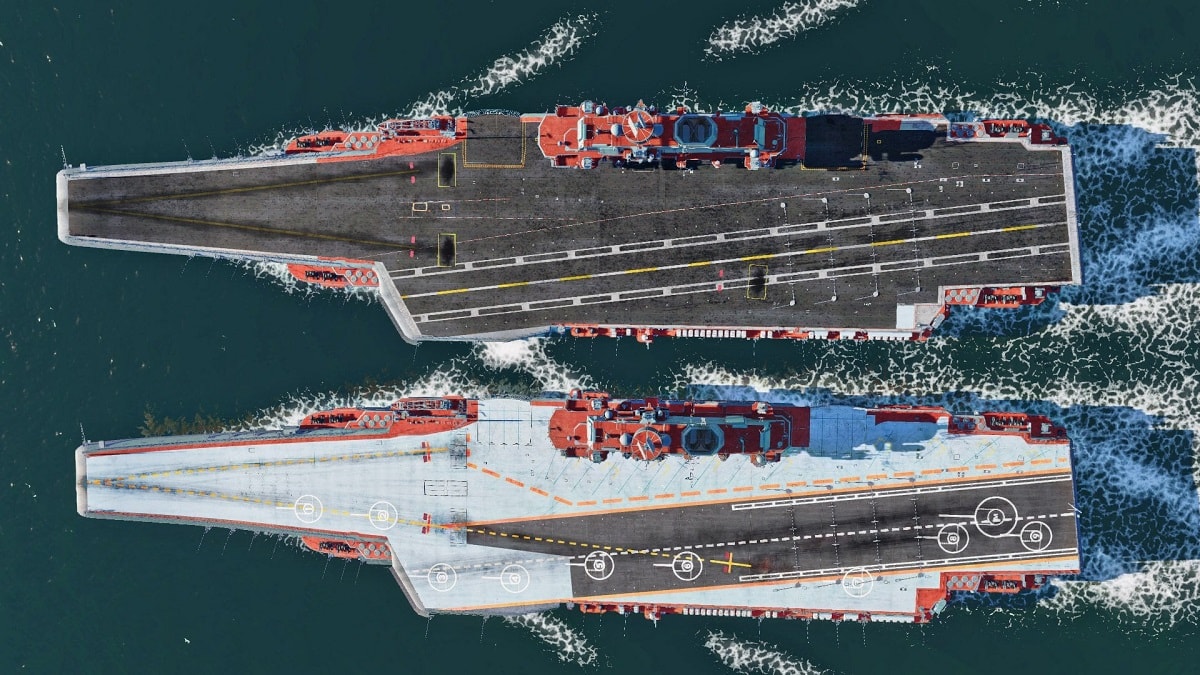
Admiral Kuznetsov. Image: Creative Commons.
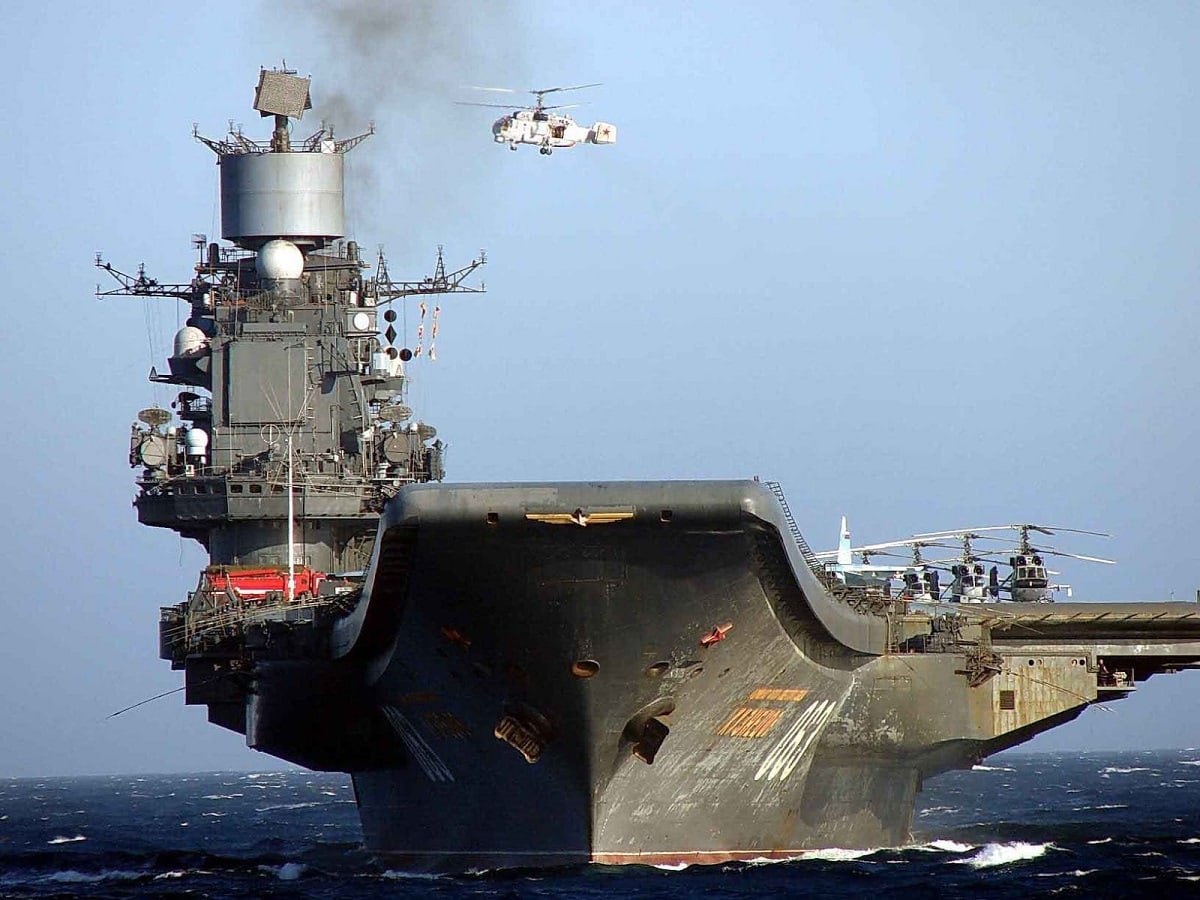
Admiral Kuznetsov. Image Creative Commons.
The same type of ocean-going tug that accompanied the Kuznetsov was used in 2005 to haul the carrier’s unfinished sister ship, the Varyag, from Ukraine to China, where that hull was completed and commissioned as the Chinese carrier Liaoning. The boilers are now the ship’s death sentence. Engineers concluded that returning the Kuznetsov to service would require replacing all of its aging high-pressure boilers, a job deemed economically unviable — and the boilers were of a type originally built in Ukraine, which sanctions and the war have placed far out of Russia’s reach.
The Syria Deployment: One Combat Mission, Two Lost Jets
The Kuznetsov made its first and only major combat deployment in late 2016, some twenty-six years after it was commissioned, sailing to the eastern Mediterranean to support Russian operations in Syria.
The voyage out was a spectacle: the carrier transited the English Channel in October 2016 under the watch of NATO observers, trailing its signature black smoke and its ever-present tug. Once on station off the Syrian coast, it began flying strike sorties against rebel and ISIS positions in the Aleppo region. Then the mission unraveled in the most public way possible.
On November 14, 2016, a MiG-29K crashed into the Mediterranean while approaching the carrier to land; the pilot ejected and was recovered, and the Russian Defense Ministry attributed the loss to a technical fault, with subsequent reporting pointing to a failure in the ship’s arresting gear.
Three weeks later, on December 5, a Su-33 rolled off the deck after the arresting cable snapped as the fighter returned from a mission, again with the pilot ejecting safely. Both losses came down to the same culprit — the cross-deck arresting cables that are supposed to stop a landing aircraft — and the arresting wire was officially confirmed to have failed in the second crash.
The humiliation was steep enough that the Russian Navy relocated much of the carrier’s air wing to the Khmeimim land base in Syria to continue the campaign from solid ground. The one time the Kuznetsov was called on to do the job it was built for, it dropped two of its scarce fighters into the sea and sent the rest ashore.
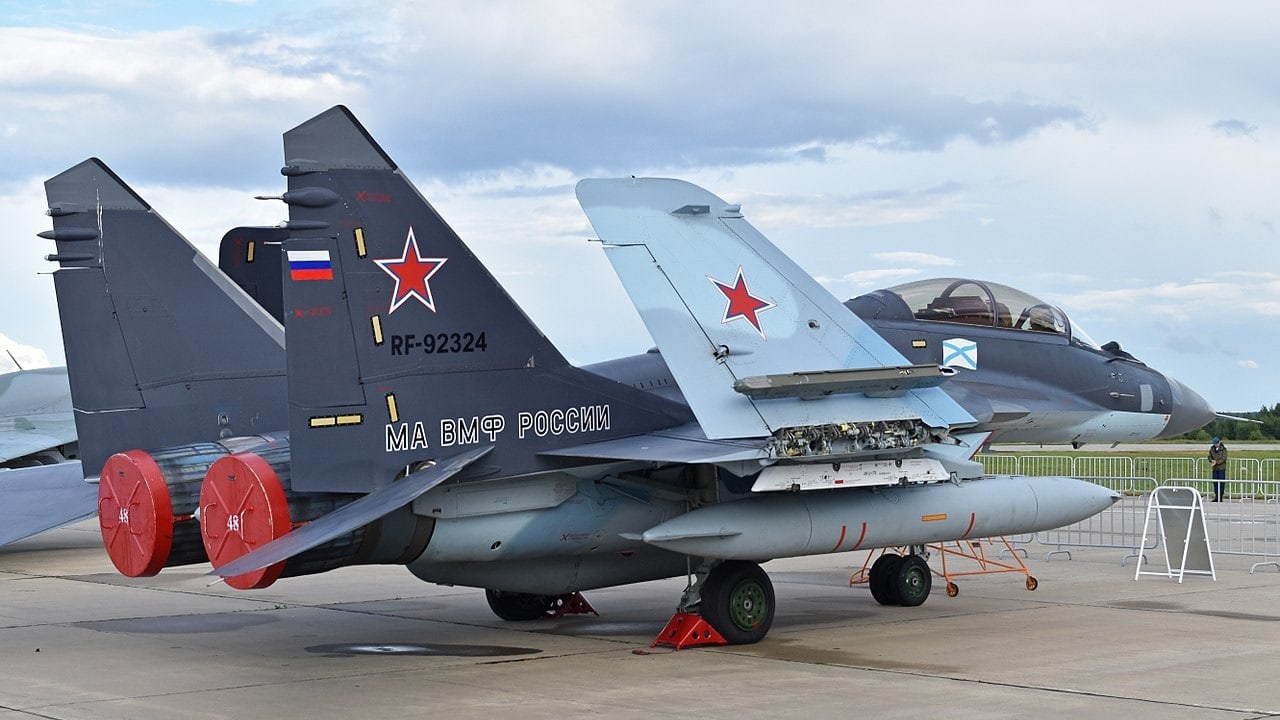
Naval variant of the second generation MiG-29, with the NATO codename ‘Fulcrum-D’. Reported to be operated by the 100th Independent Shipborne Fighter Aviation Regiment (OKIAP) based at Severomorsk. On static display at the Aviation cluster of the ARMY 2017 event. Kubinka Airbase, Moscow Oblast, Russia.
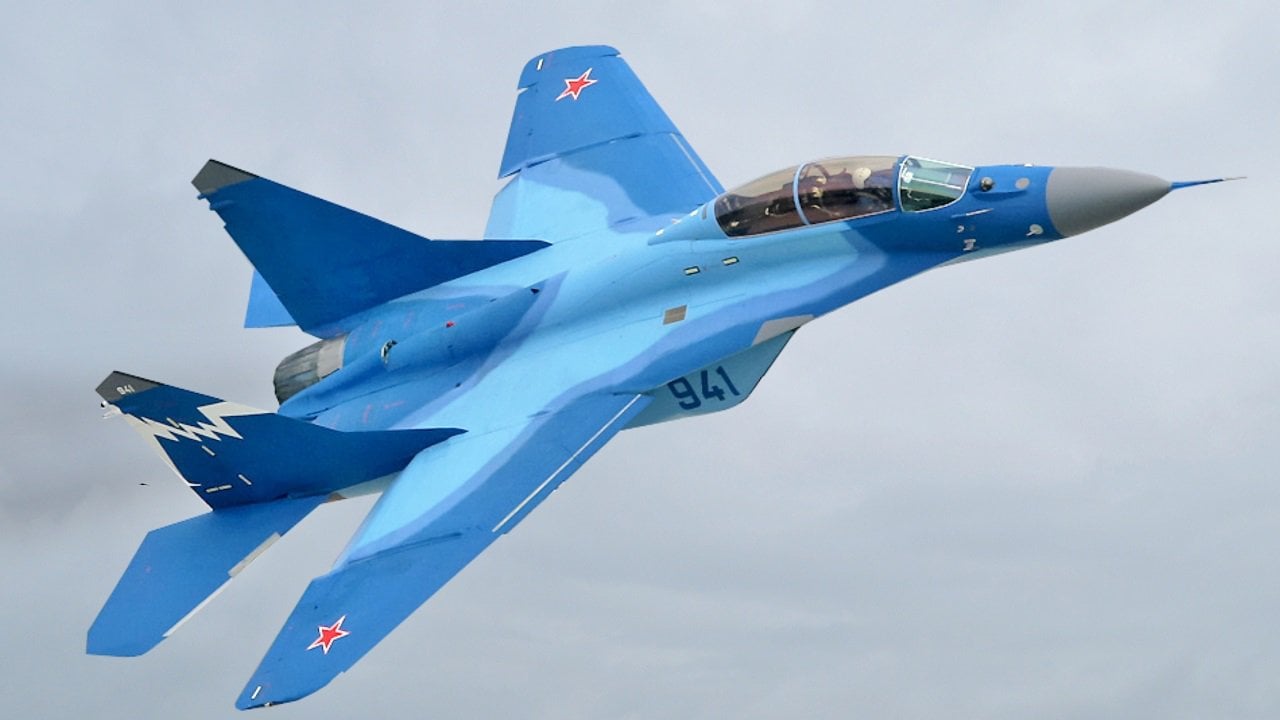
MiG-29K. Image Credit: Creative Commons.
A Repair Cycle Defined By Disaster
The Kuznetsov returned from Syria in 2017 and entered what was meant to be a multi-year overhaul to extend its service life by a decade or more — new boilers, modernized air defenses including the Pantsir-M system, overhauled sensors, and a reinforced flight deck. The plan came apart almost immediately, and the repair period became a catalog of catastrophe worse than anything the ship suffered at sea.
The first disaster struck on October 30, 2018. The Kuznetsov was sitting in the PD-50, one of the largest floating drydocks in the world and the only facility in northern Russia capable of holding a ship of its size, when a power failure caused the drydock to sink beneath the carrier.
As the dock went down, one of its 70-ton cranes toppled onto the flight deck, punching a hole several meters across; one shipyard worker was killed and others injured, and the carrier was floated clear at the last moment. The loss compounded itself because the PD-50 was the only drydock in the region large enough to service the Kuznetsov, forcing Russia into a years-long project to merge and enlarge two smaller docks at the 35th Shipyard just to have somewhere to put the ship. The carrier did not enter that improvised drydock until May 2022.
The accidents continued. In December 2019, welding sparks ignited fuel during repair work, and the resulting fire killed at least two people and injured more than a dozen, causing extensive damage; some Russian accounts put the toll higher still.
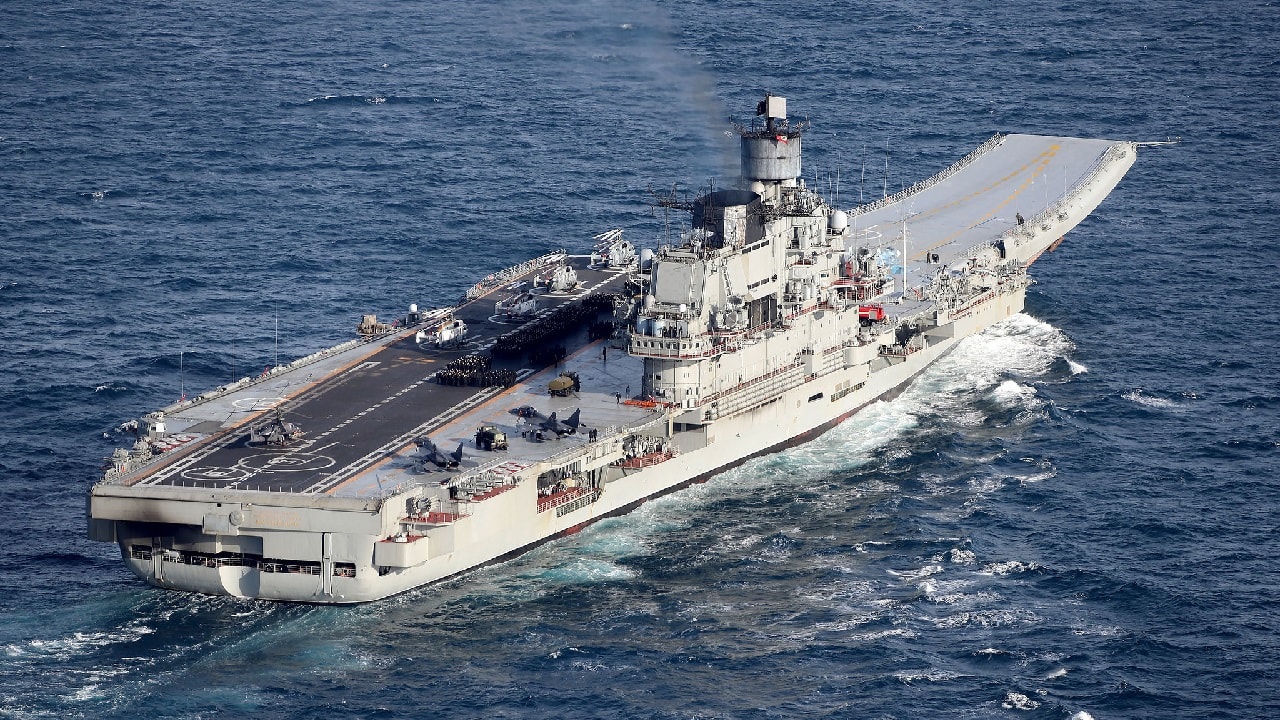
Aircraft Carrier Admiral Kuznetsov. Image Credit: Creative Commons.
A separate, smaller blaze broke out aboard the ship again in December 2022 during repairs, and reporting noted these were not even the first fires in the carrier’s history — an earlier one had struck while it was anchored off Turkey in 2009. The repair effort was also beset by corruption: in 2021, the director general of the overseeing shipyard was arrested for embezzlement. Through it all, the completion date receded year after year, the costs climbed past hundreds of millions of dollars toward an estimated billion, and the Kuznetsov never left port. It has not sailed since 2017.
The End: “No Point Repairing It Anymore”
By the summer of 2025, Russia’s own shipbuilding leadership signaled that the effort was over. Andrei Kostin, chairman of the state United Shipbuilding Corporation responsible for the refit, told the newspaper Kommersant that there was no point repairing the carrier anymore, calling it an extremely costly asset at more than forty years old and saying the realistic options were to sell it or dismantle it.
Days later, the Russian outlet Izvestia reported that the Navy’s leadership had effectively decided to halt modernization and was weighing decommissioning the ship outright, on the grounds that large carriers had become too vulnerable to modern weapons to justify the expense. The carrier’s crew was reportedly reassigned, with some sent to fight in Ukraine — a clear signal that the Navy no longer expected the ship to need a crew.
The status as of today remains deliberately short of a final, executed decision, and that hedge matters because Russia has staged face-saving “repairs resuming” announcements on this ship before. What is confirmed is that the overhaul is suspended, the carrier sits moored and deteriorating in Murmansk, and the boiler verdict has removed any realistic path back to service.
By early 2026, the ship was widely considered finished, the eight-year refit having consumed as much as a billion dollars by analysts’ accounts and returned the carrier to service. If the repair effort is not resumed, the Kuznetsov will be formally withdrawn and sent for scrapping or sale, with the causes stated plainly by analysts and Russian reporting alike: budget strains from the war in Ukraine, the recurring accidents, the corruption, and the sanctions that cut off the spare parts a foreign-built propulsion plant requires.
What It Means: The End Of Russian Carrier Aviation
If the Kuznetsov is scrapped, the strategic consequence is stark and immediate. Russia would become the only permanent member of the United Nations Security Council without an operational aircraft carrier, and given the state of its shipbuilding industry, it would likely remain so for a decade or more.
The country that pioneered the ski-jump carrier would be exiting fixed-wing carrier aviation entirely, with no replacement under construction and no realistic prospect of building one while the war in Ukraine consumes its military budget.
Russian experts are divided on whether that even matters. One camp argues Russia should abandon traditional carriers altogether and invest in surface drones and unmanned systems, the weapons that have reshaped naval warfare in the Black Sea; the former Pacific Fleet commander, Admiral Sergei Avakyants, publicly called the large carrier an expensive and ineffective naval weapon whose day has passed.
Another camp notes that Russian naval doctrine still nominally calls for carrier strike groups, and there has been talk of someday acquiring Chinese J-35 stealth fighters or developing a naval version of the future Su-75 for a carrier that does not yet exist. The debate is largely academic because the industrial capacity to build a modern carrier is precisely what Russia lacks.

Su-57 and Su-75 Checkmate Russian Air Force.
The sharpest measure of that decline is the contrast with the ship’s own siblings. The Kuznetsov’s unfinished sister, the Varyag, became China’s Liaoning, and China went on to build a second carrier of the same basic design, the Shandong, and then a third, the Fujian, this one fitted with the electromagnetic catapults the Kuznetsov never had. India operates a carrier of comparable Soviet lineage and is expanding its fleet.
The nations that adopted and improved the Soviet carrier design are building more of them; the nation that created it can no longer keep a single one afloat.
The Verdict: Ambition Meets Industrial Reality
The Admiral Kuznetsov stands as the clearest symbol of the distance between Russian naval ambition and Russian industrial reality. It was conceived to project a superpower’s strength across the oceans and entered service as that superpower dissolved.
It was built with a ski-jump that capped its airpower from the first day. It ran on a propulsion plant so unreliable it could not sail without a rescue tug, and it spent a career trailing black smoke and breaking down. Its single combat deployment cost it two aircraft due to its own failed arresting gear. Its overhaul sank a drydock, dropped a crane through its deck, burned its workers, and ran for eight years without putting the ship back to sea. The boilers that doomed it cannot be replaced at a price Russia is willing to pay.
The honest reckoning is that the extension Russia kept promising itself would never arrive. The hulls and the machinery genuinely were at the end of their lives, which is why the ship was bound for retirement regardless of how the politics played out, and keeping it nominally on the books a little longer only postponed the admission that it was finished. The deeper lesson is about a navy, not a ship: Russia can no longer build a carrier, and the Kuznetsov proved it can no longer even maintain one.
Whether the final order says “scrap” or “sell,” the Admiral Kuznetsov has reached the end of a long and unlucky life, and when it goes, it will take Russia’s place among the world’s carrier powers with it.
About the Author: Harry J. Kazianis
Harry J. Kazianis (@Grecianformula) was the former Senior Director of National Security Affairs at the Center for the National Interest (CFTNI), a foreign policy think tank founded by Richard Nixon based in Washington, DC. Harry has over a decade of experience in think tanks and national security publishing. His ideas have been published in the NY Times, The Washington Post, The Wall Street Journal, CNN, and many other outlets worldwide. He has held positions at CSIS, the Heritage Foundation, the University of Nottingham, and several other institutions related to national security research and studies. He is the former Executive Editor of the National Interest and the Diplomat. He holds a Master’s degree focusing on international affairs from Harvard University. Harry is Editor-In-Chief of 19FortyFive.

