
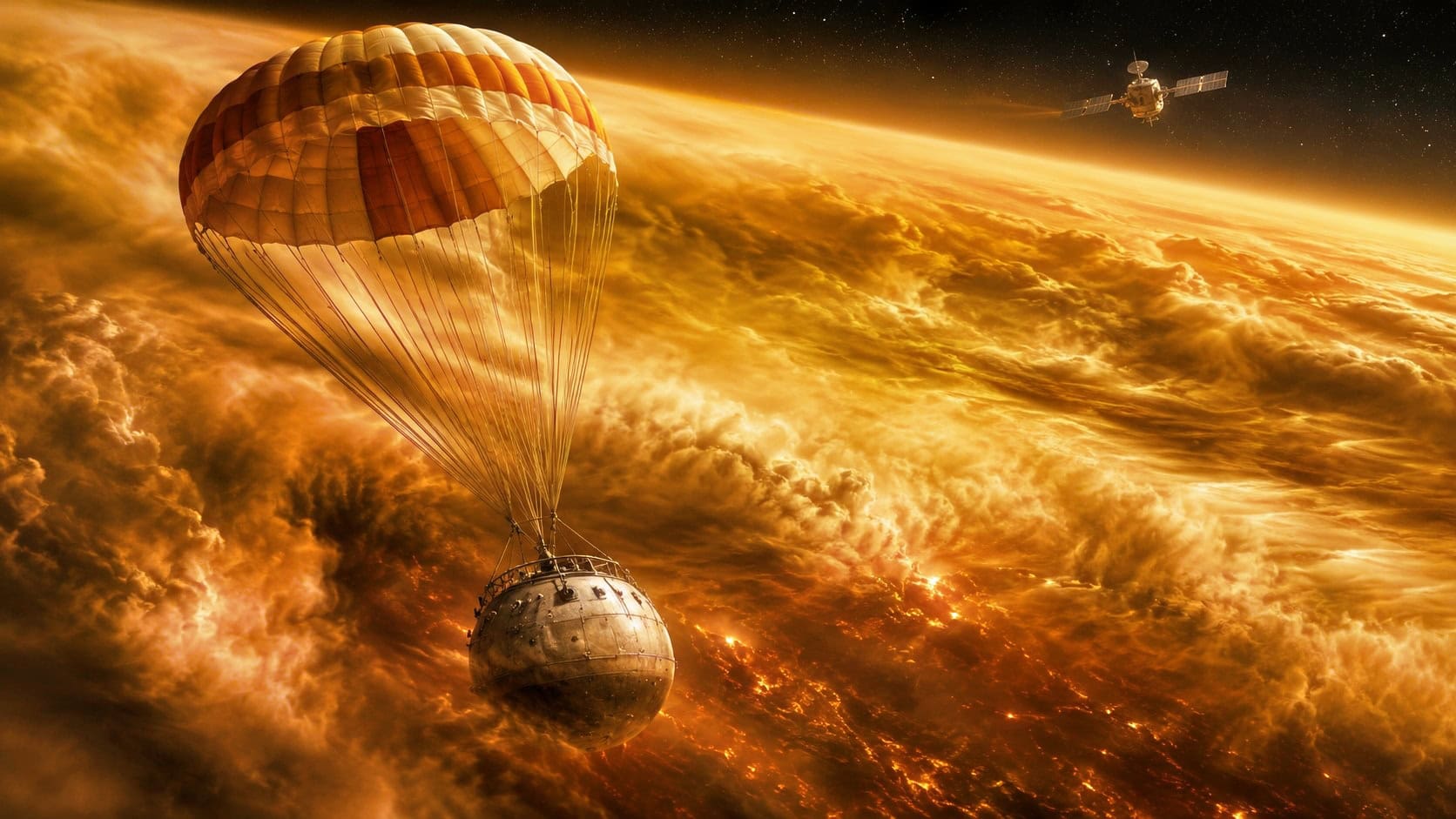
In October 1967, the Soviet Union announced one of the great firsts of the space age. Its Venera 4 probe had descended through the clouds of Venus and reached the surface of another planet, a Soviet machine standing on alien ground. The claim was wrong. Venera 4 had been crushed by the weight of Venus’s atmosphere at roughly 17 miles above the surface, transmitting temperature and pressure readings all the way down until the pressure exceeded what its hull could withstand and it went silent, far short of the ground it was supposed to be resting on. What exposed the error was not Soviet candor but an American spacecraft. NASA’s Mariner 5 swept past Venus a single day after Venera 4’s plunge, and its measurements showed a surface so hostile that the Soviet probe could not have survived to reach it. The mission the USSR sold to the world as a triumph was, in truth, the discovery of just how murderous Venus is, a finding so severe it forced Soviet engineers to throw out their assumptions and rebuild every Venus probe that followed.
Six Years Of Dead Probes
NASA Discover Space Shuttle. This photo was taken back in 2025 and is original to 19FortyFive.com
By 1967, the Soviets had been sending spacecraft to Venus for six years and had lost all of them.
Venera 1, launched in February 1961, went dead in flight and drifted silently past the planet.
Venera 2, launched in November 1965, failed around the time of its flyby.
Venera 3, launched days after it, became the first to strike another planet when it hit Venus in March 1966, but its systems had already failed, so it returned no data at all. It was a crash, not a mission.
Several earlier attempts had failed even more completely, and in keeping with Soviet practice, the worst of them were never announced as planetary missions, hidden instead behind generic labels.
The work had passed to a bureau that would define Soviet planetary exploration. After the program’s founder, Sergei Korolev, died in 1966, responsibility for lunar and planetary probes went to Georgi Babakin and the Lavochkin design bureau, a shop known for meticulous testing and careful workmanship.
Babakin redesigned the troubled spacecraft, replacing its liquid thermal-control system with a gas-based one, and decided to focus everything on a pair of landers for the 1967 Venus launch window, aiming to beat the Americans to the surface.
NASA Discover Space Shuttle. This photo was taken back in 2025 and is original to 19FortyFive.com
A Hull Built On A Guess
The problem was that nobody knew what Venus was actually like. To Soviet scientists, it was Earth’s twin, a similarly sized world hidden beneath permanent clouds, and the hope was that something close to Earthlike conditions lay below.
The estimates of surface pressure were almost useless in their spread, ranging from a few times Earth’s atmosphere to hundreds of times it, with surface temperatures guessed anywhere from a couple of hundred to nearly five hundred degrees. Working from the optimistic end of that range, Lavochkin built Venera 4’s descent capsule to survive about 25 atmospheres of pressure. It was a guess, and it was wrong by a wide margin.
The Mission That Reached Venus
Venera 4 launched on June 12, 1967, on a Molniya rocket from Baikonur, briefly orbiting Earth before its upper stage sent it toward Venus. Its twin, launched five days later, never made it out of Earth orbit after a rocket stage failed, and the Soviets concealed that failure under the label Kosmos 167, the same trick they would use years later for other failed Venus probes.
After a 128-day cruise across some 338 million kilometers, the carrier released its roughly 840-pound capsule, which entered the atmosphere on the night side of Venus on October 18, 1967.
The entry was violent. The heat shield reached around 11,000 degrees Celsius, and the deceleration peaked at roughly 300 times the force of gravity, while thermal control kept the capsule’s interior near minus 8 degrees Celsius.
NASA Discover Space Shuttle. This photo was taken back in 2025 and is original to 19FortyFive.com
A parachute was deployed at about 52 kilometers up, and the probe began radioing home the first direct chemical analysis of another planet’s atmosphere. What it found overturned the Earthlike picture.
Rather than the nitrogen-rich air many had expected, Venera 4 measured an atmosphere that was 90 to 93 percent carbon dioxide, with only traces of oxygen and water vapor, and the carrier confirmed Venus has almost no magnetic field. This was a genuine and important first. Venera 4 was the first spacecraft to travel through the atmosphere of another planet and return measurements from within it.
93 Minutes, Then Silence
The probe transmitted for about 93 minutes as it descended, returning 23 sets of readings while the atmosphere around it grew steadily denser and hotter than anyone had planned for. The signal cut out at an altitude of roughly 26 kilometers, about 17 miles up, where the temperature had climbed to 262 degrees Celsius, and the pressure had reached around 22 atmospheres, right at the edge of what the hull was built to survive. The capsule had been overwhelmed well above the ground.
The Soviets misread their own data. The probe carried a radar altimeter, and based on an extrapolation from a single radar reading, the team concluded the capsule had descended all the way to the surface before falling silent.
The Soviet press announced that Venera 4 had not only returned data from Venus but had reached its surface, a historic Soviet landing on another world. It was not a fabrication so much as a hopeful error, an honest misreading of a signal that stopped at an altitude they took to be the ground. The doubts came quickly, because the descent had taken longer than expected, and the measured pressures hinted the probe might have run out of survivable margin before it ever touched down.
Mariner 5 Tells The Truth
The answer arrived from the other superpower. NASA had taken a backup spacecraft from its Mars program, removed the imaging system since no camera could see through the clouds, added a sun shield, and sent it to Venus as Mariner 5. It was a flyby, not a lander, carrying instruments to study the planet from a distance, and it reached Venus on October 19, 1967, a single day after Venera 4’s descent.
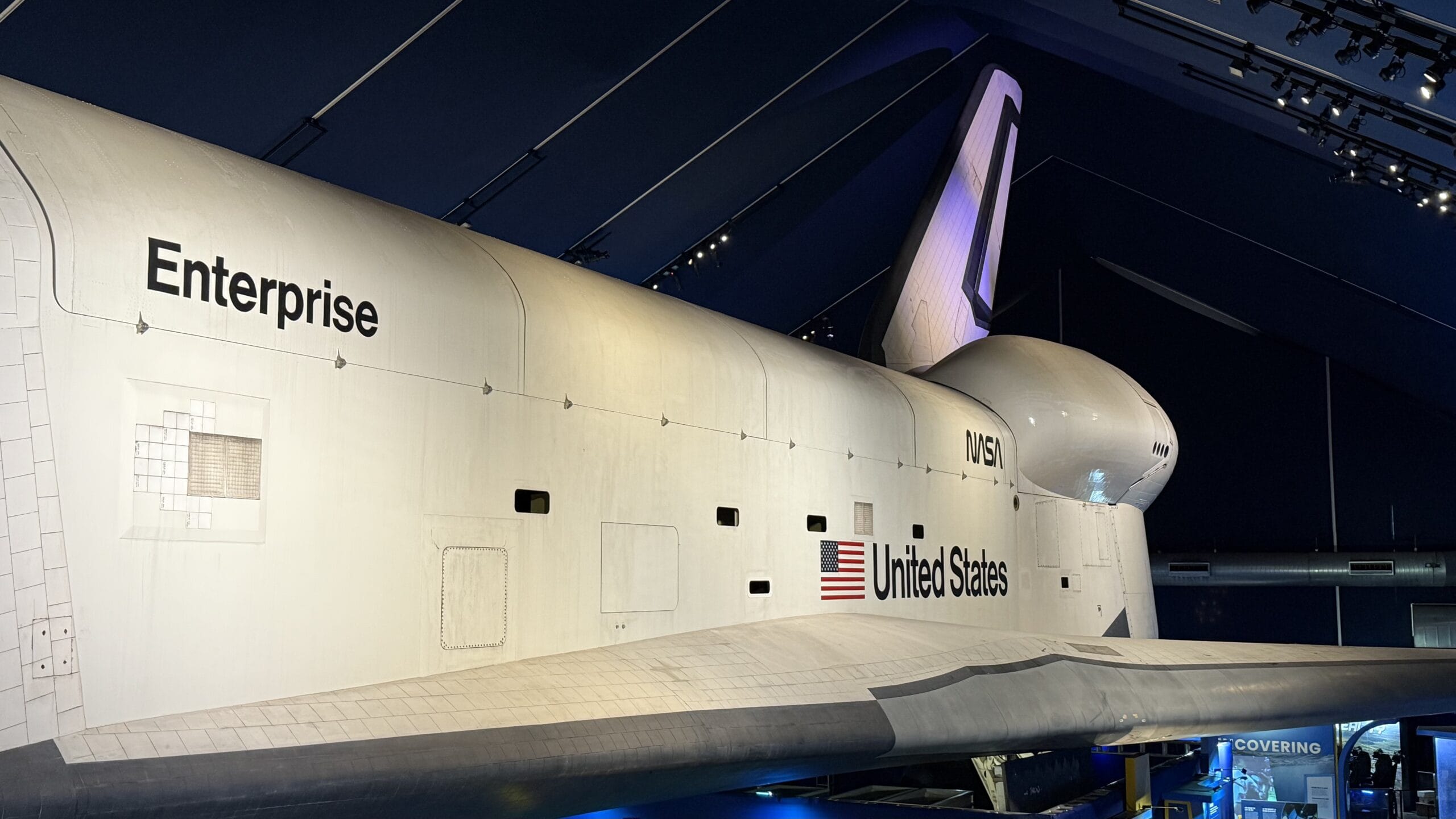
Enterprise Space Shuttle on USS Intrepid. Taken by 19FortyFive.com in 2025.
As Mariner 5 passed behind the planet, its radio signal cut through the Venusian atmosphere on the way to Earth, and the way the atmosphere bent and weakened that signal let scientists measure its true density. The result was brutal.
The instruments indicated a surface temperature of 527 degrees Celsius and a pressure of 75 to 100 atmospheres, three to four times what Venera 4’s hull could survive. Two of the mission’s scientists, Arvydas Kliore and Dan Cain, worked through the numbers and concluded that Venera 4 had either come down on a 15-mile-high peak that ground radar had not detected, or, far more likely, had stopped transmitting before it reached the solid surface at all.
When they used the planet’s known radius as the true ground level and projected the Mariner 5 data down to it, the Venera 4 readings fit perfectly at the altitude where the probe went silent, not at the surface. The Soviet probe had been crushed by pressure well above the ground, and the claim of a landing was retracted.
Enemies Sharing Their Data
What happened next did not fit the era’s usual pattern. Instead of fighting a propaganda battle over whose probe had done what, the two sides pooled their results. In March 1968, American and Soviet scientists met at Kitt Peak National Observatory in Arizona to exchange data and compare findings from their two spacecraft, in one of the first international conferences ever held to discuss results from planetary missions.
Venera 4 measured the atmosphere directly from the inside during its descent. Mariner 5 had measured it remotely, from above, as it passed by. Taken together, the two datasets formed the first comprehensive profile of the Venusian atmosphere, and the two countries jointly published the findings. At the height of the Cold War, with the moon race still on, the rival programs that had just contradicted each other over Venus sat down and assembled the answer together.
The British also had a quiet hand in the story. The radio telescope at Jodrell Bank had tracked the encounter, and a recording of the final seconds of Venera 4’s signal was later handed to the Soviet cosmonaut Valery Bykovsky during a visit to the observatory that October, a small artifact of how tangled the era’s competition and cooperation really were.
The Failure That Conquered Venus
Venera 4’s death rewrote everything the Soviets thought they knew. They now understood Venus as a furnace under crushing pressure, nothing like the twin of Earth they had imagined, and Babakin’s bureau set out to build for the planet that actually existed.
The next two probes, Venera 5 and Venera 6, launched in 1969, were strengthened and stripped down to dive as deep as they could as dedicated atmospheric probes. They lasted 53 and 51 minutes and still succumbed to the heat and pressure before reaching the surface, but they fell far deeper than Venera 4 had, confirming just how extreme the lower atmosphere was.
Then came the probe built specifically around the lethal lesson. For Venera 7, Lavochkin engineers designed a far more robust lander, a titanium sphere rated to survive roughly 180 atmospheres, a margin so large it sacrificed nearly everything else aboard, and on December 15, 1970, it became the first spacecraft to land on another planet and transmit from its surface. Every Soviet triumph that followed traces back through that design to what Venera 4 paid for.
The first photographs from the surface came from Venera 9 in 1975, and the first color images from Venera 13 and 14 in the early 1980s, all of them resting on the knowledge that a crushed probe had brought in 1967. As one history of the program put it, every subsequent lander sent to Venus, and arguably to other worlds, owes something to that battered first probe.
Venera 3 had reached another planet but returned nothing. Venera 4 returned the data that mattered most, which was the measure of exactly how hostile Venus is, and it did so while dying in a way that told Soviet engineers precisely how to build a machine that would not.
The probe the Soviet Union announced as a landing was instead the most consequential failure in the history of planetary exploration, and the proof of what it had really done had to be supplied by the rival superpower flying past one day later.
About the Author: Harry J. Kazianis
Harry J. Kazianis (@Grecianformula) was the former Senior Director of National Security Affairs at the Center for the National Interest (CFTNI), a foreign policy think tank founded by Richard Nixon based in Washington, DC. Harry has over a decade of experience in think tanks and national security publishing. His ideas have been published in the NY Times, The Washington Post, The Wall Street Journal, CNN, and many other outlets worldwide. He has held positions at CSIS, the Heritage Foundation, the University of Nottingham, and several other institutions related to national security research and studies. He is the former Executive Editor of the National Interest and the Diplomat. He holds a Master’s degree focusing on international affairs from Harvard University.

