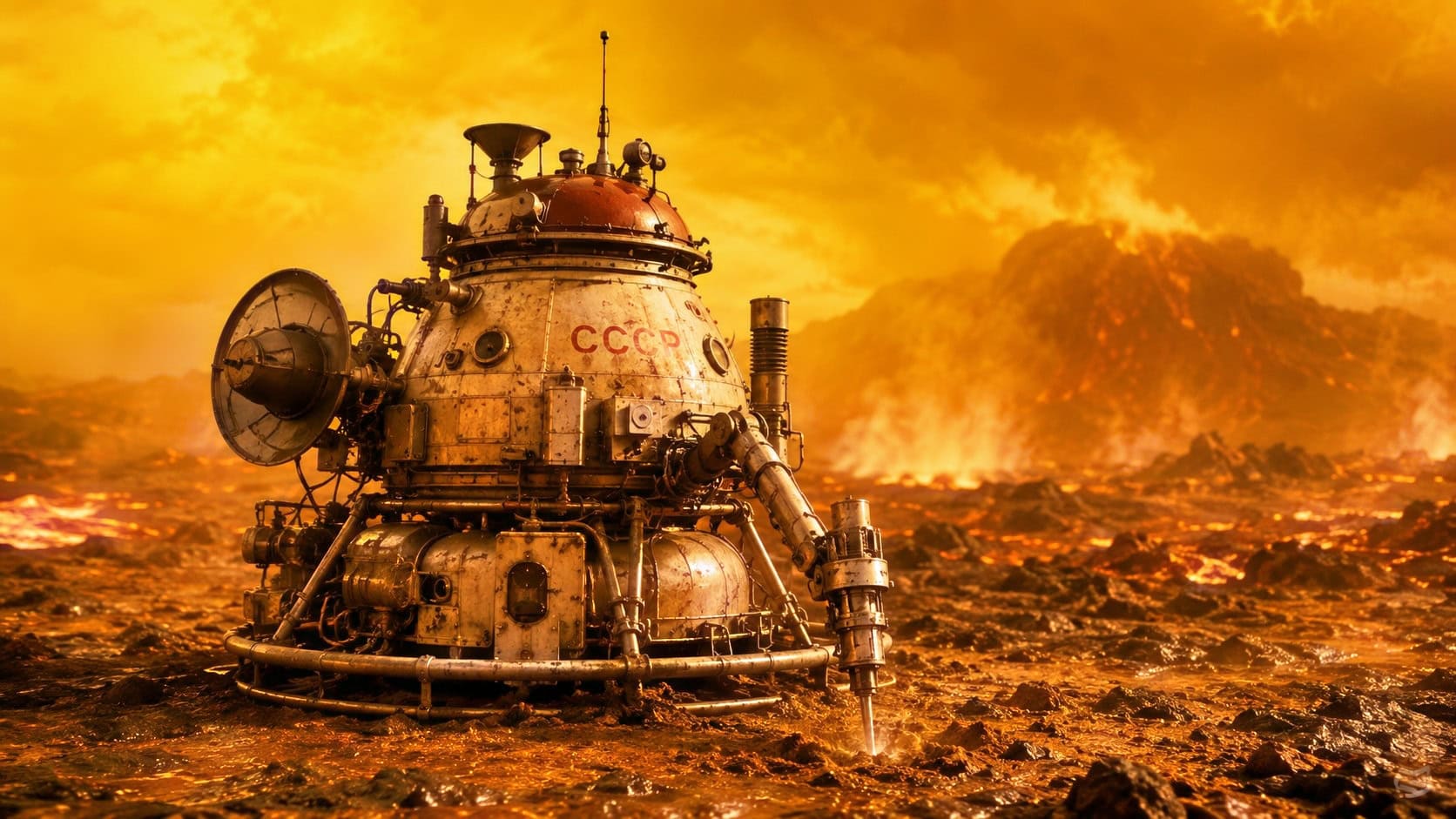
It’s one of the greatest engineering feats ever achieved during the Space Race. It also remains one of the surprisingly underappreciated feats.
Perhaps that’s because we’re talking about the Venera 13 mission to Venus, and it was a Soviet mission.
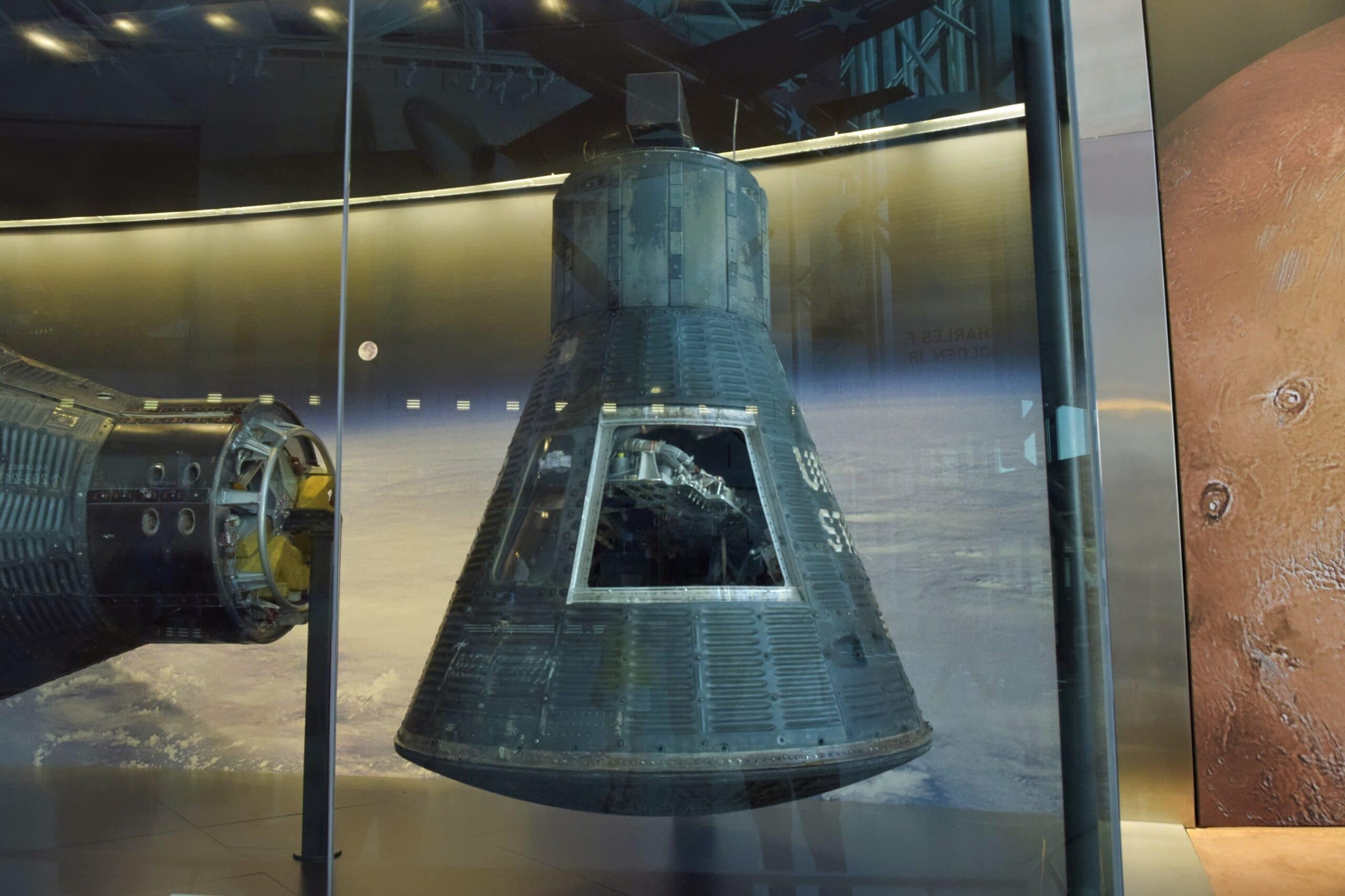
Apollo 11 Original Command Module. 19FortyFive Photo Taken on 6/24/2026.
While most people associate planetary exploration with NASA’s Mars rovers, the USSR accomplished something arguably even more difficult in 1982: it landed a spacecraft on the most hostile planetary surface in the Solar System.
It conducted meaningful science before the environment utterly destroyed the spacecraft.
Landing On Hell
On March 1, 1982, Venera 13 descended through Venus’ soup-like atmosphere after a four-month journey from Earth.
Engineers had designed the lander to survive only for half an hour after touchdown. Instead, the machine kept working for 127 minutes!
In that time, at the landing site, the probe encountered an 869-degree Fahrenheit surface temperature (that’s hot enough to melt lead).
An atmospheric pressure of around 92 Earth atmospheres, equivalent ot being nearly one kilometer beneath Earth’s oceans.
And an atmosphere comprised almost entirely of carbon dioxide with sulfuric compounds and corrosive chemistry.
No electronics are naturally happy in that environment. Every second the spacecraft remained alive represented a victory for Soviet engineering.
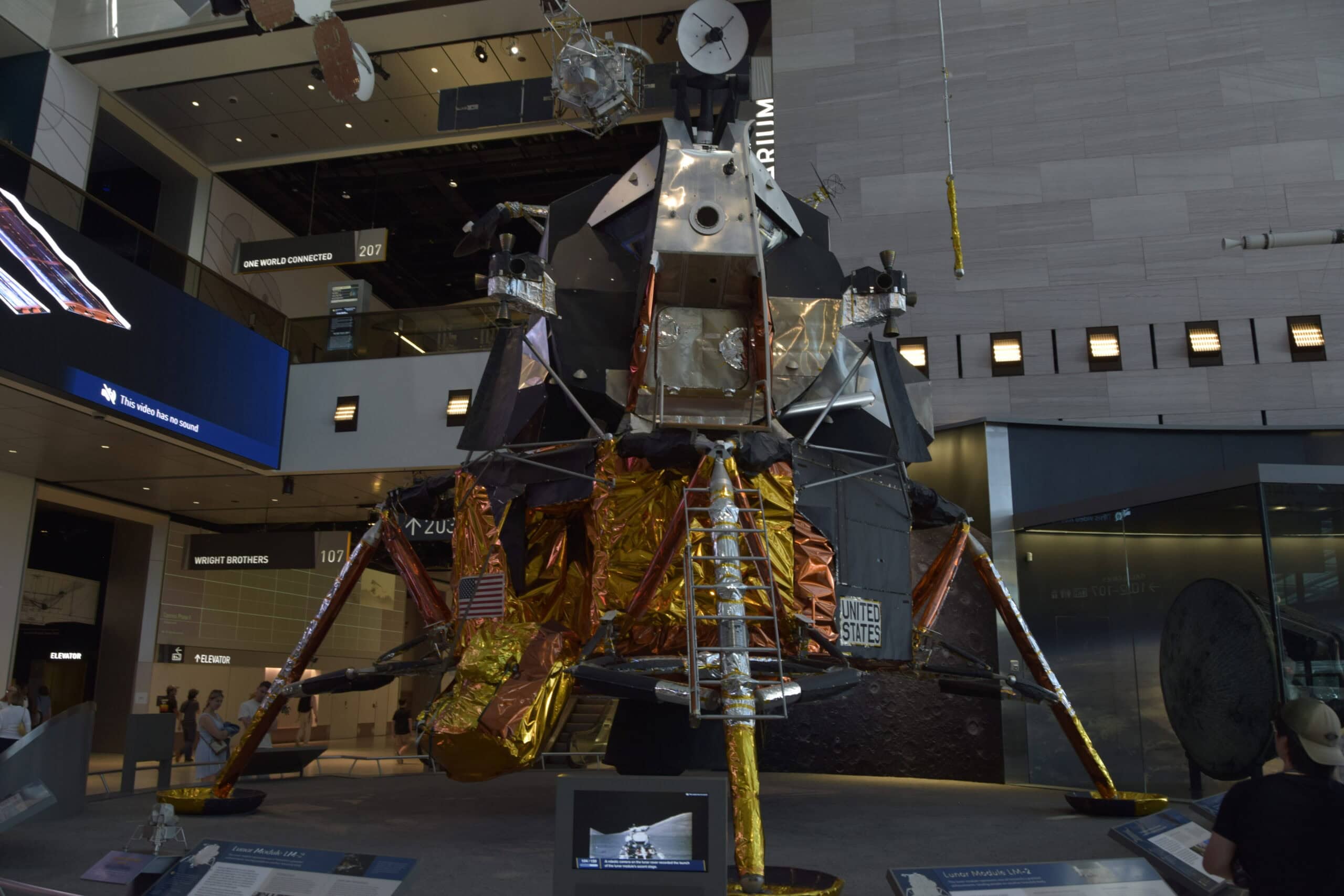
Apollo 11 Lander. 19FortyFive.com Photo.
How Venera 13 Survived
The spacecraft wasn’t cooled with refrigerators or exotic systems.
Instead, Soviet engineers relied largely on brute-force engineering: a thick titanium pressure vessel, extensive thermal insulation, phase-change cooling materials that absorbed heat as they melted, and components engineered to tolerate enormous pressure differences.
Eventually, physics always wins.
Heat slowly penetrated the lander until the electronics exceeded their operational limits.
Rather than failing catastrophically on landing, Venera 13 gradually “cooked to death.” That it lasted more than four times as long as expected remains remarkable.
The First Color Photographs from Another Planet
This is probably Venera 13’s most famous accomplishment. Earlier Soviet probes had returned black-and-white images. But Venera 13 transmitted the first color photographs ever taken from the surface of another planet.
Because of those incredible photographs, scientists everywhere learned the truth about Venus’s surface. Fractured slabs of volcanic rock dominated the planet’s surface, and orange-yellow skies ruled the horizon, dark volcanic soil peppered the ground, too.
Those images remain iconic because, more than 40 years later, they are still among the clearest photographs ever taken from Venus’ surface.
Venera 13 Didn’t Just Take Pictures
The lander carried an impressive scientific payload. After landing, it deployed a mechanical drill and collected a soil sample.
It then transferred the sample into a sealed analysis chamber. Once inside that chamber, the system performed X-ray fluorescence analysis.
Scientists concluded that the surface rock resembled volcanic basalt and gabbro, reinforcing the image of Venus as a geologically active volcanic world.
For a spacecraft expected to survive half an hour, this represented an extraordinary amount of science.
Recording Venusian Wind
More interestingly, the probe recorded the sound of the Venusian wind and transmitted it back to Earth. Soviet engineers installed microphones on the outside of the probe.
Those microphones captured the wind interacting with the spacecraft, as well as other sounds of the craft interacting with the environment.
These recordings became the first recordings ever made on the surface of another planet.
Later digital processing has attempted to isolate the ambient wind from the spacecraft’s mechanical sounds, giving modern listeners perhaps the closest thing humanity has to hearing what Venus actually sounds like.
Because the original recordings contained substantial spacecraft noise, modern signal processing–including Python-based analysis–can better separate atmospheric sounds from mechanical vibrations than was possible in 1982.
A Planet That Destroys Spacecraft
Venus is arguably harder to explore than Mars. After all, while sending humans to Mars has proven more difficult than even people like Elon Musk initially thought, humanity can at least reliably send unmanned systems there.
But in Venus’ case, while much closer to Earth than is Mars, the atmosphere and surface are so inhospitable that even unmanned systems struggle to perform.
Whereas Mars offers thin atmosphere, cold temperatures, and dust, Venus presents crushing pressure, extreme temperatures, corrosive atmosphere, and no practical way to use conventional electronics for extended periods.
Meanwhile, Mars rovers can survive for years on the surface of the Red Planet. If one is lucky, probes on Venus can last maybe less than two hours.
Why Haven’t People Returned to Venus?
One surprising point about Venusian exploration, as noted in a Space.com article, is that no spacecraft has landed on Venus since the Soviet Venera and Vega programs of the early 1980s.
Orbiters have continued studying the planet, but no nation has successfully returned another operating surface lander in decades.
That’s because landing on Venus is an extraordinarily difficult prospect (and, therefore, expensive). Any modern mission must build electronics capable of operating in the severe heat or make a spacecraft that can be cooled (or simply accept a shortened lifespan).
NASA and other space agencies are now developing high-temperature electronics that could someday allow Venus landers to survive not for two hours–but for weeks or even months.
The Bigger Picture
Venera 13 represents the high-water mark of the Soviet Union’s extraordinarily successful Venus exploration program.
While the United States dominated lunar exploration with the Apollo 11 moon landing, the USSR quietly became the unrivaled master of Venus.
Taken together, those accomplishments remain among the greatest robotic exploration achievements of the Cold War.
Venera 13 proved that humanity could briefly operate on what is, in many respects, the most hostile planetary surface in the Solar System–and return a scientific treasure before the planet inevitably claimed the spacecraft.
About the Author: Brandon J. Weichert
Brandon J. Weichert is the Senior National Security Editor at 19FortyFive.com. He also manages The Weichert Brief on Substack. Weichert also hosts “National Security Talk” on Rumble. He is the author of four bestselling national security books, the most recent of which is A Disaster of Our Own Making: How the West Lost Ukraine (Encounter Books). Follow him via Twitter/X @WeTheBrandon.