
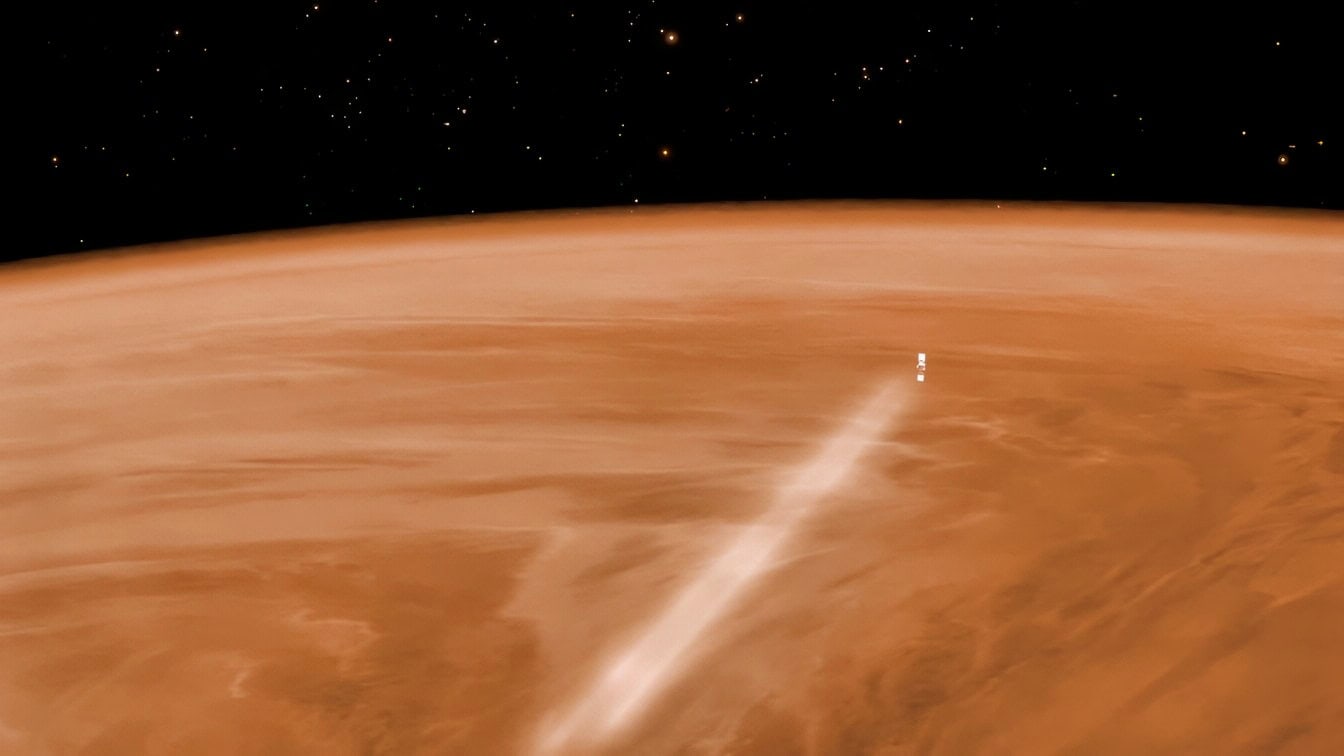
Venus Express launched on November 9, 2005, becoming ESA’s first dedicated mission to Venus.
Originally designed for a 500-day mission, it survived more than eight years before finally succumbing to Venus’s crushing atmosphere in late 2014.
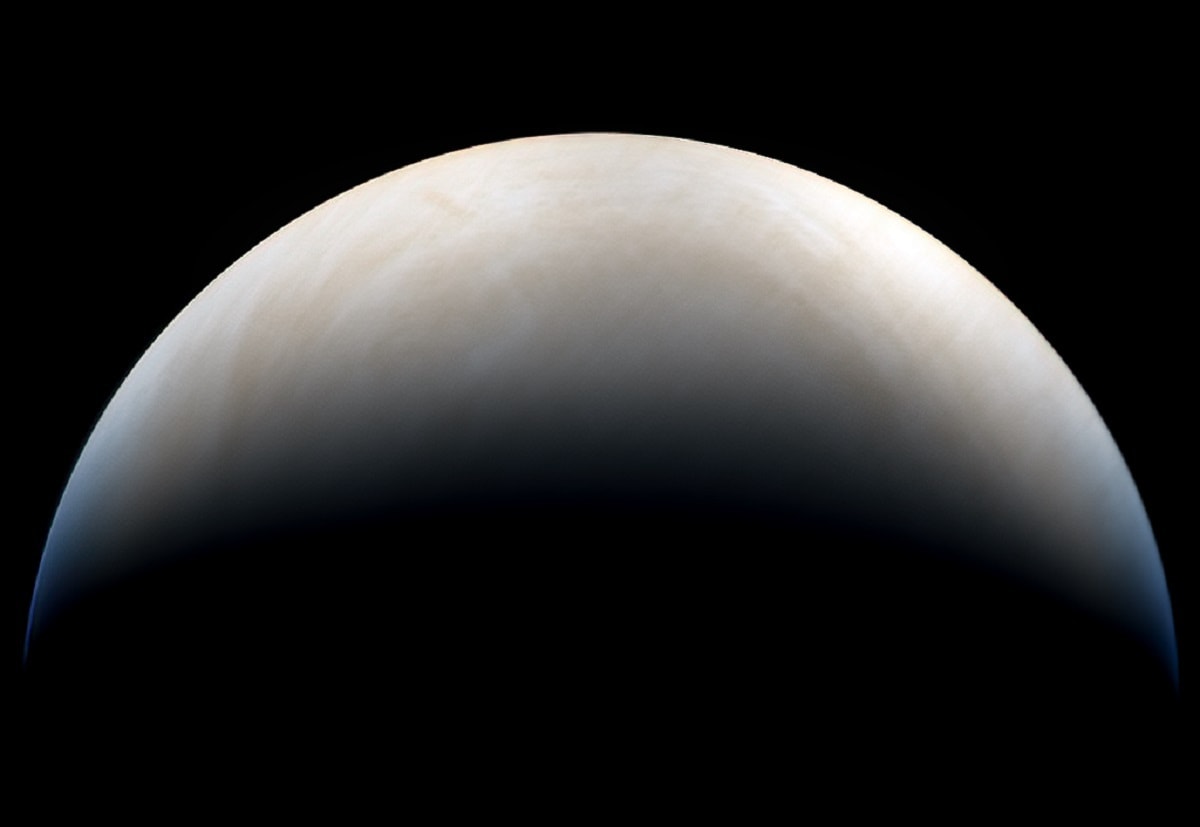
Venus. Image: Creative Commons.
By reusing hardware from previous missions, ESA produced one of its most cost-effective planetary probes while generating a massive step forward in the scientific understanding of our sister planet.
Building the Venus Express
Rather than build an entirely new probe, ESA chose to reuse the proven Mars Express spacecraft bus.
This extensive use of existing hardware and spare scientific instruments from Mars Express and Rosetta dramatically reduced the costs and development time for Venus Express.
The engineering challenge wasn’t redesigning the spacecraft, but rather adapting a Mars spacecraft to survive one of the harshest thermal environments in the solar system.
Accordingly, new thermal blankets, gold-coated insulation, and redesigned solar arrays enabled operations under roughly four times the solar intensity experienced around Mars.
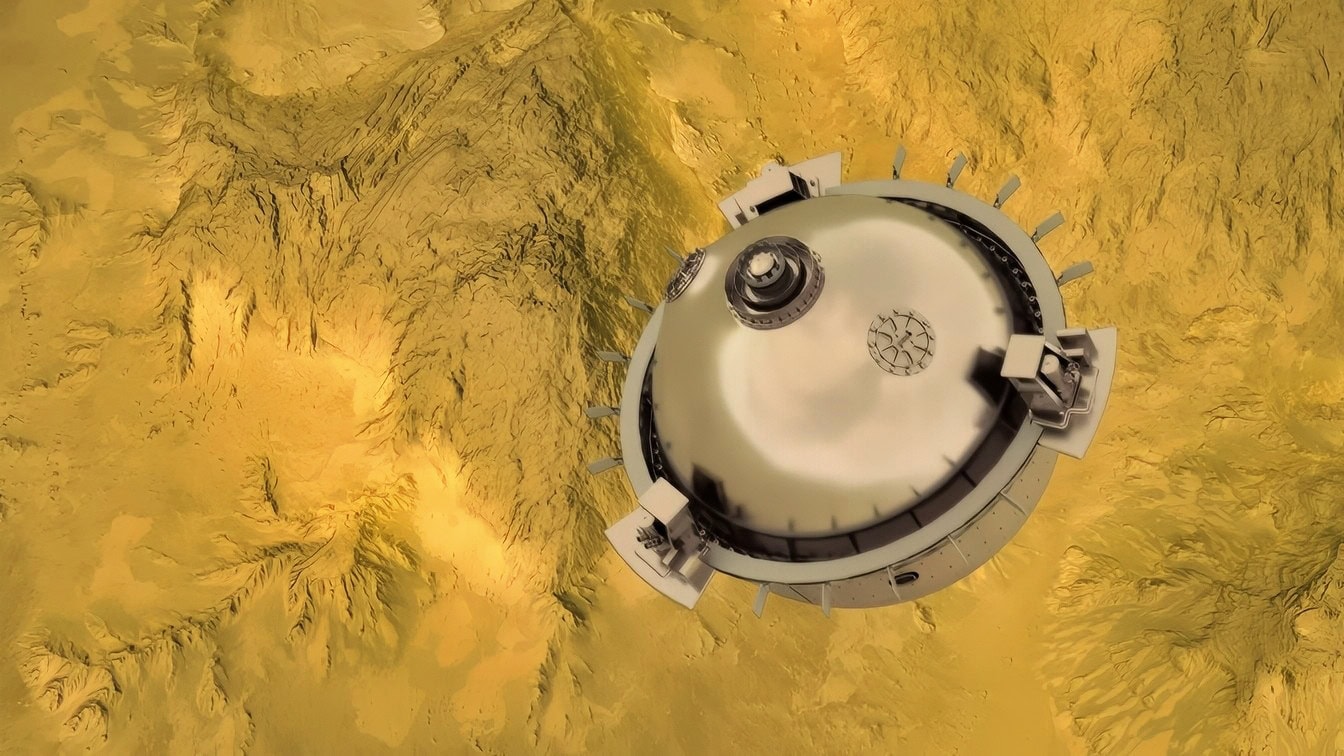
NASA Venus Lander Artist Rendition Picture
Headed for Venus
Venus Express was launched aboard a Russian Soyuz-Fregat rocket from Baikonur on November 9, 2005, before completing a 153-day interplanetary cruise.
The spacecraft then entered Venus’s orbit on April 11, 2006, entering a highly elliptical 24-hour polar orbit that allowed repeated global observations while minimizing exposure to the planet’s extreme heat.
The insights gleaned from the probe were significant; Venus Express overturned the notion that Venus was simply a static, geologically dead world.
It was the first spacecraft to fully characterize the planet’s massive double-eye south polar vortex, revealing an atmosphere far more dynamic than previously believed.
The spacecraft measured powerful high-altitude winds and rapidly changing weather systems that existed despite Venus’s slow planetary rotation.
The spacecraft produced one of the most complete atmospheric datasets ever collected for another planet.
Venus Express also helped explain one of the planet’s greatest atmospheric mysteries: super-rotation.

Venus Transit In Front of the Sun NASA Photo
Although Venus itself rotates incredibly slowly, taking 243 Earth days to complete one rotation, its upper atmosphere circles the planet in only about four Earth days.
Venus Express tracked wind speeds exceeding 220 mph, revealing an atmosphere that effectively races around the sluggish planet beneath.
What drives this phenomenon? Scientists are still debating. Regardless, Venus has naturally become a hotspot for the study of atmospheric circulation.
Comparisons to Earth
One of the mission’s biggest discoveries involved elevated concentrations of deuterium, or heavy water. These measurements strengthened evidence that Venus may once have possessed substantial quantities of liquid water, and that over time, a runaway greenhouse effect likely evaporated those oceans while solar radiation stripped lighter hydrogen into space.
If true, Venus became the solar system’s ultimate example of climate evolution taken to extreme extents, which obviously presents significant scientific insights for Earth’s climate as we grapple with the greenhouse effect ourselves.
The spacecraft also deployed infrared instruments that detected localized thermal anomalies and changing sulfur dioxide concentrations.
These observations provided some of the strongest evidence yet that active volcanism may still be reshaping Venus today. If that is confirmed, Venus joins Earth as one of the few rocky planets with ongoing volcanic activity.
Concluding the Mission
By 2014, Venus Express had exceeded its design life many times over. Not bad for a recycled platform.
Having gotten their investment’s worth, ESA decided to experiment more adventurously and deliberately lowered the spacecraft into the upper atmosphere during an ambitious aerobraking campaign to collect unique atmospheric measurements.
This caused the spacecraft to repeatedly skim to an altitude of roughly 80 miles before controllers attempted to raise its orbit. But the spacecraft had exhausted its fuel supply, leaving the probe unable to maintain orientation or communications.
ESA declared the mission complete in December 2014; the spacecraft’s orbit gradually decayed until it burned up in Venus’s unforgiving atmosphere.
Legacy of the Venus Express
Venus Express fundamentally reshaped our scientific understanding of Earth’s nearest planetary neighbor, demonstrating that innovative engineering and hardware reuse can produce a world-class interplanetary mission while cutting costs.
The discoveries from Venus Express continue to influence our current exploration of Venus, including ESA’s planned EnVision orbiter, which will build on the foundation of the recycled Venus Express.
About the Author: Harrison Kass
Harrison Kass is a writer and attorney focused on national security, technology, and political culture. His work has appeared in Tablet, City Journal, The Hill, The Spectator, and The Cipher Brief. He holds a JD from the University of Oregon and a master’s in Global & Joint Program Studies from NYU. More at harrisonkass.com.