
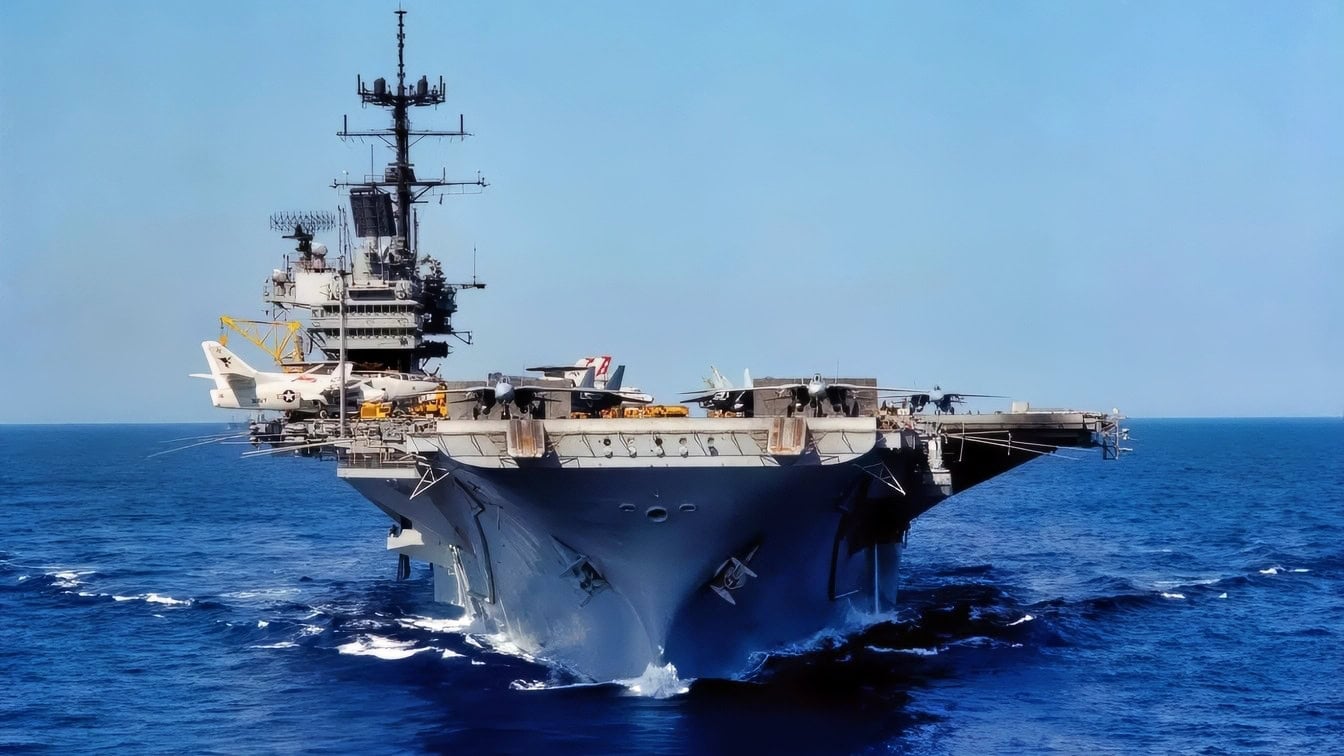
One Zuni Rocket Crossed 100 Feet of US Navy Aircraft Carrier USS Forrestal’s Flight Deck. The Fire Killed 134 Men – One five-inch Zuni rocket crossed roughly 100 feet of USS Forrestal’s crowded flight deck on July 29, 1967. The rocket did not explode. It did not need to.
It ruptured an external fuel tank on an A-4E Skyhawk and sprayed JP-5 across aircraft armed for a strike against North Vietnam. Burning rocket propellant ignited the fuel. Ninety-four seconds later, an old 1,000-pound bomb exploded in the firefighting team.
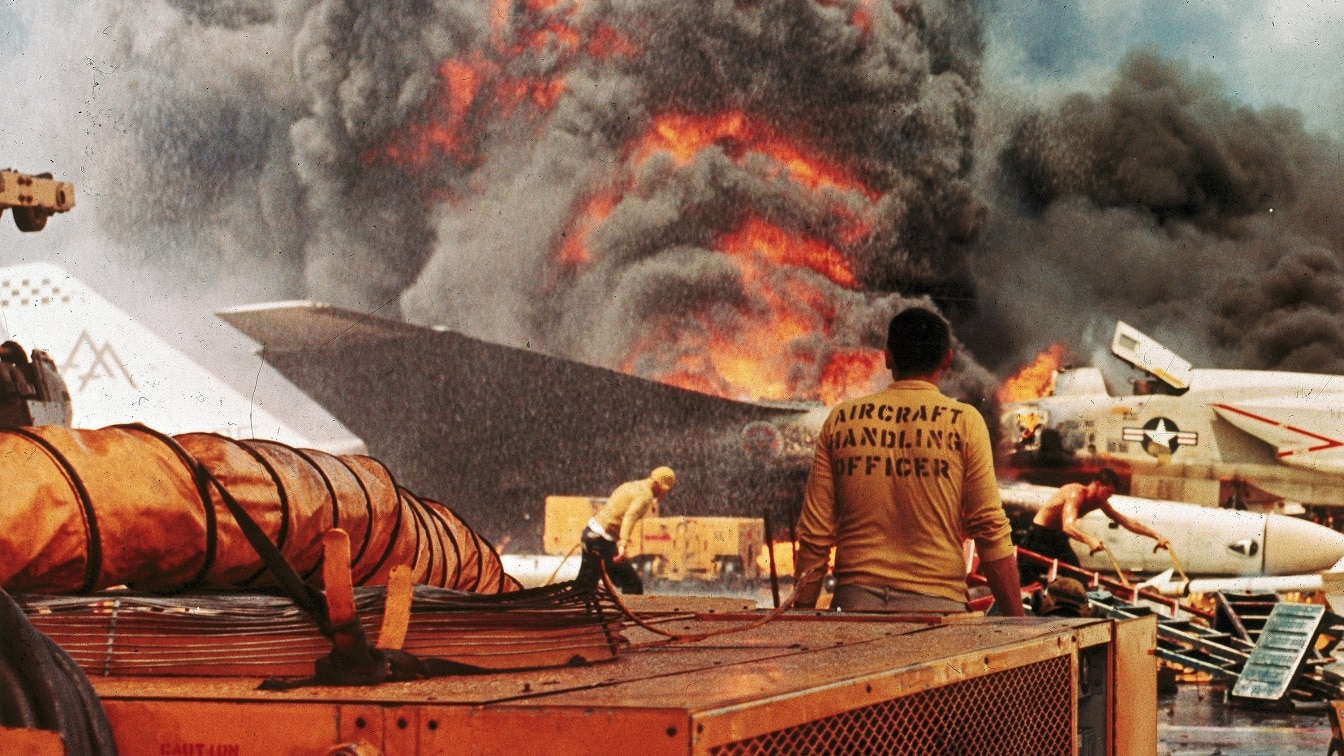
US Navy Aircraft Carrier USS Forrestal on Fire.
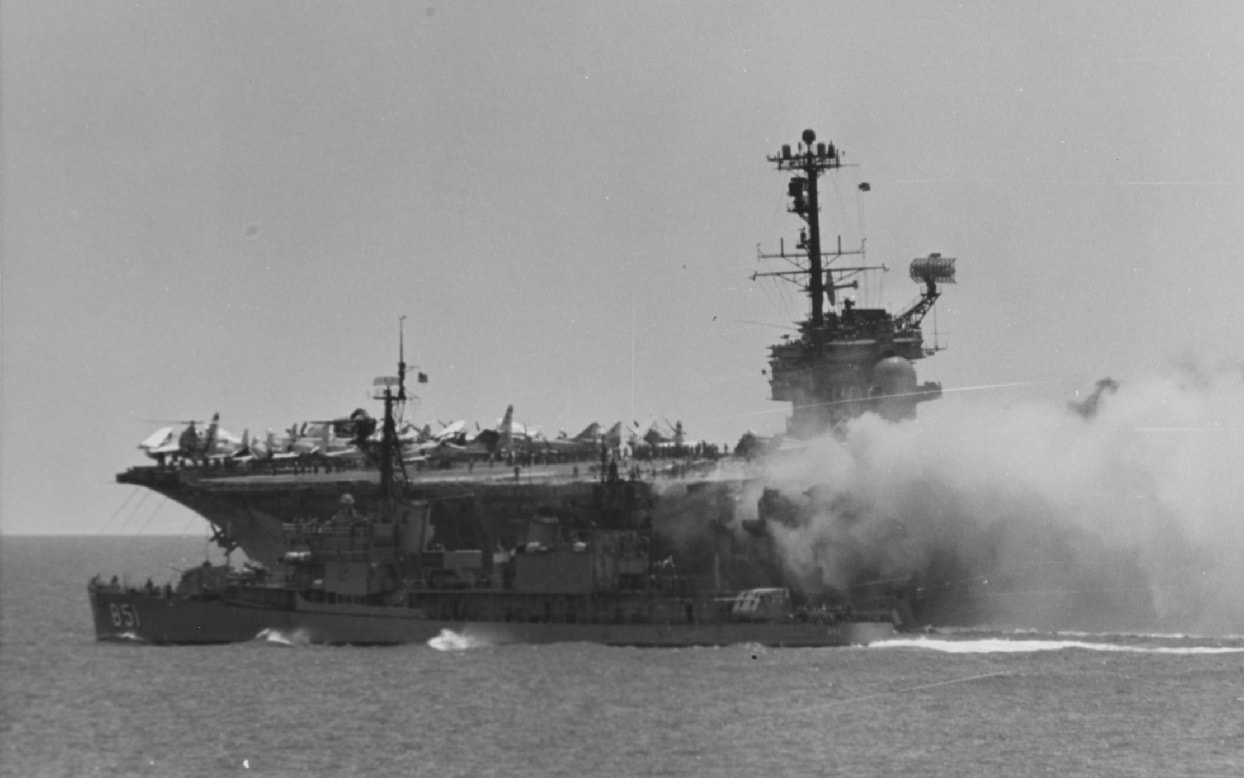
USS Forrestal on fire in 1967. Image Credit: US Navy.
The resulting fire killed 134 sailors and aviators, seriously injured 161, destroyed 21 aircraft, and damaged 40 more. The Naval History and Heritage Command calls it the second-worst loss of life aboard a U.S. Navy ship since World War II.
Forrestal survived because hundreds of men ran toward the fire after the first trained team was nearly wiped out. Their response saved the ship. The disaster exposed failures in ordnance design, flight-deck procedure, and Navy-wide firefighting training.
Forrestal Was Five Days Into Combat
USS Forrestal was the Navy’s first purpose-built supercarrier and the first Atlantic Fleet carrier to fight from Yankee Station. She arrived on July 25, 1967, and flew more than 150 sorties over the next four days without losing a plane.
On July 29, the air wing prepared its second strike of the day. More than 20 aircraft crowded the aft flight deck with engines running, tanks full, and bombs, rockets, and ammunition loaded.
At about 10:51 a.m., an F-4B Phantom II from Fighter Squadron 11 sat on the starboard quarter carrying Zuni rockets. As its pilot transferred the jet from external to internal electrical power, a brief voltage spike reached one rocket motor.
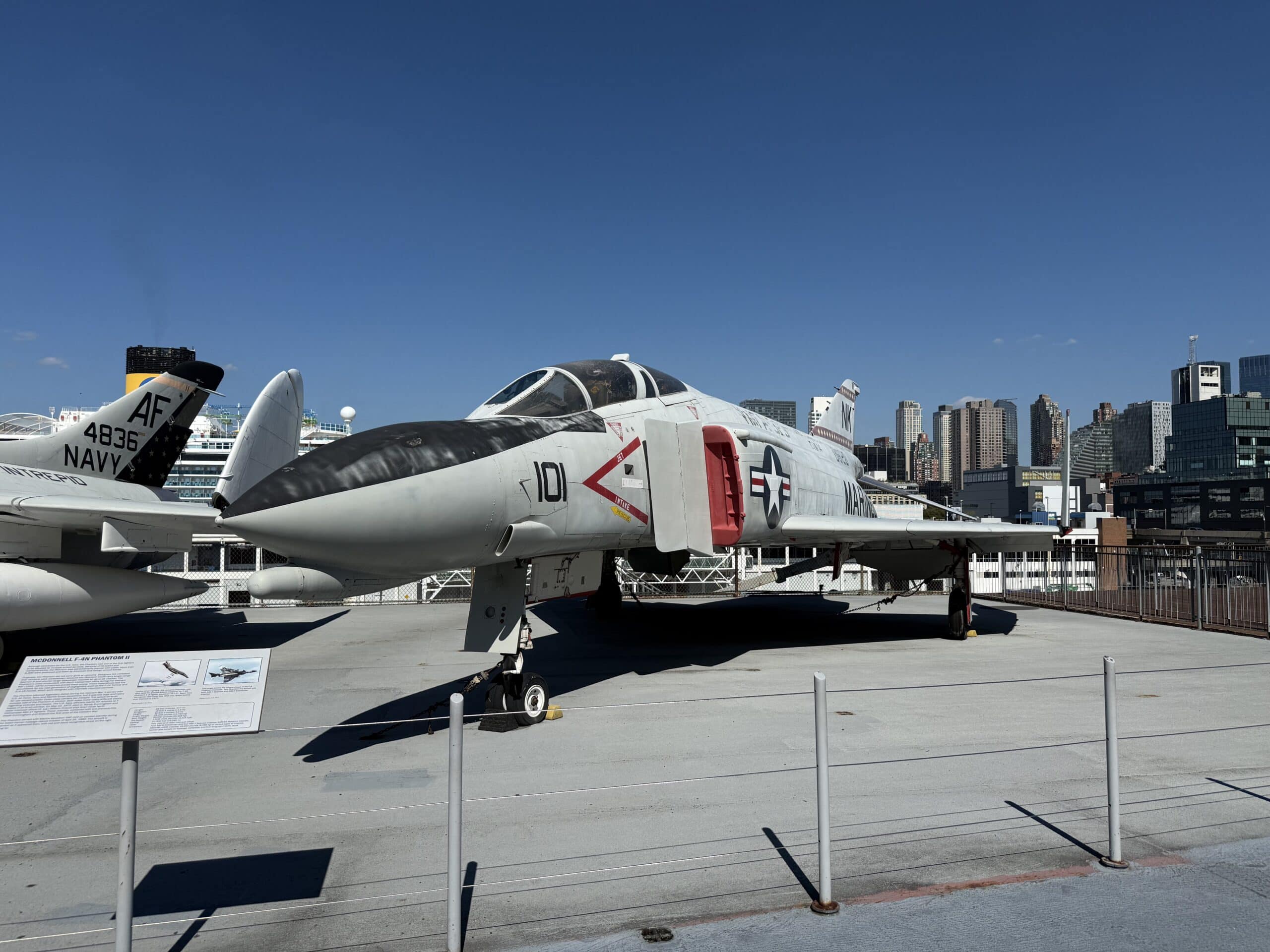
F-4 Phantom. 19FortyFive.com Photo.
Two safeguards were supposed to block such an event. The rocket pod’s electrical “pigtail” was not meant to be connected until the aircraft reached the catapult. A safety pin was supposed to remain fitted until the final moments before launch.
On the Phantom involved in the accident, neither safeguard protected the launcher. Crews had begun connecting pigtails early because doing so at the catapult slowed launches. The safety pin was no longer in place. The Navy investigation found equipment defects and outdated technical guidance, but the result was plain: the electrical spike reached a rocket with nothing left to restrain it.
The Zuni Hit a Fully Fueled A-4 Skyhawk
The Zuni fired from the Phantom’s port-side pod and raced diagonally across the deck. The official inquiry identified the struck aircraft as A-4E Skyhawk No. 405, flown by Lieutenant Commander Fred White.
The warhead failed to detonate because its arming system worked. Its motor and fragments still tore open the Skyhawk’s roughly 400-gallon external tank. Burning JP-5 spread beneath White’s aircraft and neighboring A-4s.
At least one 1,000-pound AN-M65A1 bomb fell into the flames. This was not the modern Mk 83 weapon used in Forrestal’s training. It was a thin-skinned bomb manufactured in 1953 and filled with Composition B explosive.
Forrestal had received 16 of the old bombs the previous day. Modern weapons were in short supply because the air war was consuming them faster than factories supplied replacements. The old bombs showed signs of deterioration, and shipboard ordnance personnel regarded them as dangerous.
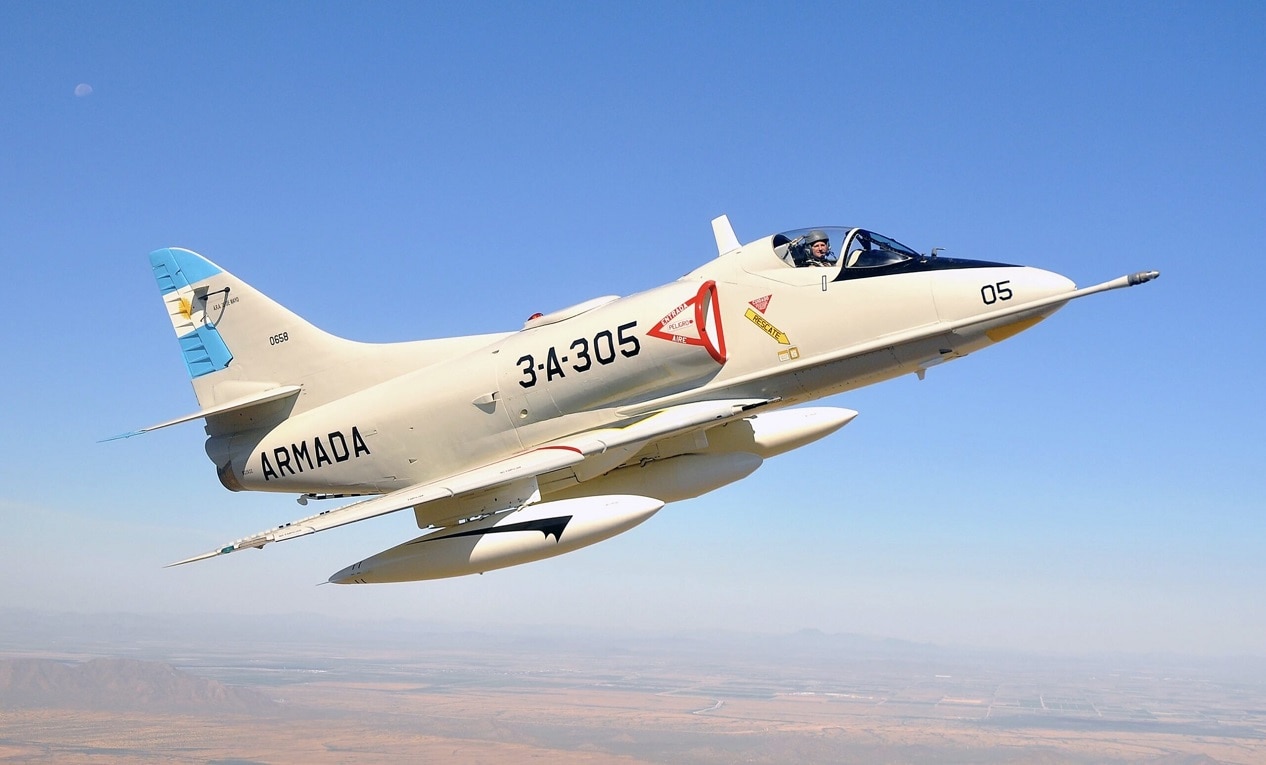
A-4 Skyhawk
The First Bomb Exploded After 94 Seconds
Chief Aviation Boatswain’s Mate Gerald W. Farrier led Damage Control Team Eight onto the flight deck 54 seconds after the fire began. He attacked the bomb with a Purple-K dry chemical extinguisher while hose teams moved in behind him.
Training with newer bombs suggested a fire would take around ten minutes to produce a cook-off. Farrier and his men had less than two.
The bomb casing split, and its explosive began burning. Farrier ordered his men back, but the weapon detonated 94 seconds after the rocket launch. The blast killed Farrier and nearly his entire specialized team. A second bomb exploded nine seconds later.
More explosions followed. Fragments and wreckage tore across the flight deck. Rockets, missiles, cannon ammunition, and ejection seats added smaller detonations. Seven large holes opened in the armored deck.
Around 40,000 gallons of jet fuel were burned across the aft deck and poured through the holes into the hangar bay and crew spaces below. Fifty of the men who died had been asleep in their racks.
Sailors Fought Two Different Fires
The flight-deck fire was visible and reachable by hoses. The fires below were trapped inside dark compartments filled with smoke, toxic fumes, and burning fuel floating on water.
The loss of Farrier’s team created another problem. Most sailors aboard Forrestal lacked formal firefighting instruction. The Navy had moved away from the World War II practice of training nearly everyone and concentrated expertise inside specialist teams.
Untrained sailors took over hoses. Some applied foam, which blankets burning fuel and cuts off oxygen. Others used seawater, washing away sections of the foam and moving fuel toward holes in the deck.
Their actions were not a failure of courage. Men pushed bombs and rockets overboard, carried wounded shipmates away from burning aircraft, and entered smoke-filled spaces with limited protection. Nearby ships recovered men from the sea. USS Rupertus moved close alongside and directed its hoses onto Forrestal.
The flight-deck fire was controlled in about an hour. Below-deck fires kept burning until 4 a.m. on July 30.
Forrestal Suffered More Than $131 Million in Material Losses
Only 28 of the 134 dead had been on the flight deck. Fire, smoke, and fuel entering spaces below produced most of the fatalities.
The carrier lost 11 A-4E Skyhawks, seven F-4B Phantom IIs, and three RA-5C Vigilantes. A U.S. Naval Institute accounting placed ship repairs at $72 million, destroyed aircraft at $44.5 million, aircraft repairs at $10 million, lost ordnance at $1.95 million, and destroyed supplies and equipment at $3.15 million. The total exceeded $131 million in 1967 dollars.
Forrestal received emergency work at Subic Bay before returning home. More than 300 welders rebuilt her burned aft sections at Norfolk Naval Shipyard. The carrier returned to sea after six and a half months, according to the Navy’s repair history.
The Navy Relearned Why Every Sailor Must Fight Fires
Nine months earlier, a magnesium flare fire aboard USS Oriskany killed 44 men. Both accidents showed how one ignition source became lethal inside a carrier packed with fuel, explosives, and thousands of people.
After Forrestal, firefighting instruction expanded across the fleet. Sailors learned how foam and water behave on fuel fires, how to isolate compartments, use breathing equipment, and continue damage control after specialist teams were lost.
The Navy tightened Zuni handling rules, removed old bombs from the supply chain, and strengthened explosive-safety reviews.
Carrier flight decks received improved washdown and foam systems. Weapons were redesigned and tested to resist heat, impact, and sympathetic detonation, helping shape the modern insensitive-munitions program.
The changes faced a hard test in January 1969, when USS Enterprise suffered another Zuni-related flight-deck fire. Eighteen explosions killed 28 sailors and injured 314, but the crew contained the fire faster. Enterprise also lacked Forrestal’s deteriorated Korean War bombs.
Training films built from Forrestal’s flight-deck camera footage became required viewing. “Learn or Burn” and “Trial by Fire” showed sailors what happened when foam lines, hose teams, ordnance handling, and compartment control failed to work together.
Later disasters proved written lessons still required enforcement. USS Bonhomme Richard burned for four days in 2020 after breakdowns in training, readiness, and the use of installed firefighting systems. The Navy scrapped the ship.
Forrestal returned to service in April 1968 and remained in the fleet until 1993.
She never returned to Vietnam. At Naval Station Norfolk, the Navy’s firefighting school still carries Gerald Farrier’s name.
About the Author: Harry J. Kazianis
Harry J. Kazianis (@Grecianformula) was the former Senior Director of National Security Affairs at the Center for the National Interest (CFTNI), a foreign policy think tank founded by Richard Nixon based in Washington, DC. Harry has over a decade of experience in think tanks and national security publishing. His ideas have been published in the NY Times, The Washington Post, The Wall Street Journal, CNN, and many other outlets worldwide. He has held positions at CSIS, the Heritage Foundation, the University of Nottingham, and several other institutions related to national security research and studies. He is the former Executive Editor of the National Interest and the Diplomat. He holds a Master’s degree focusing on international affairs from Harvard University.