
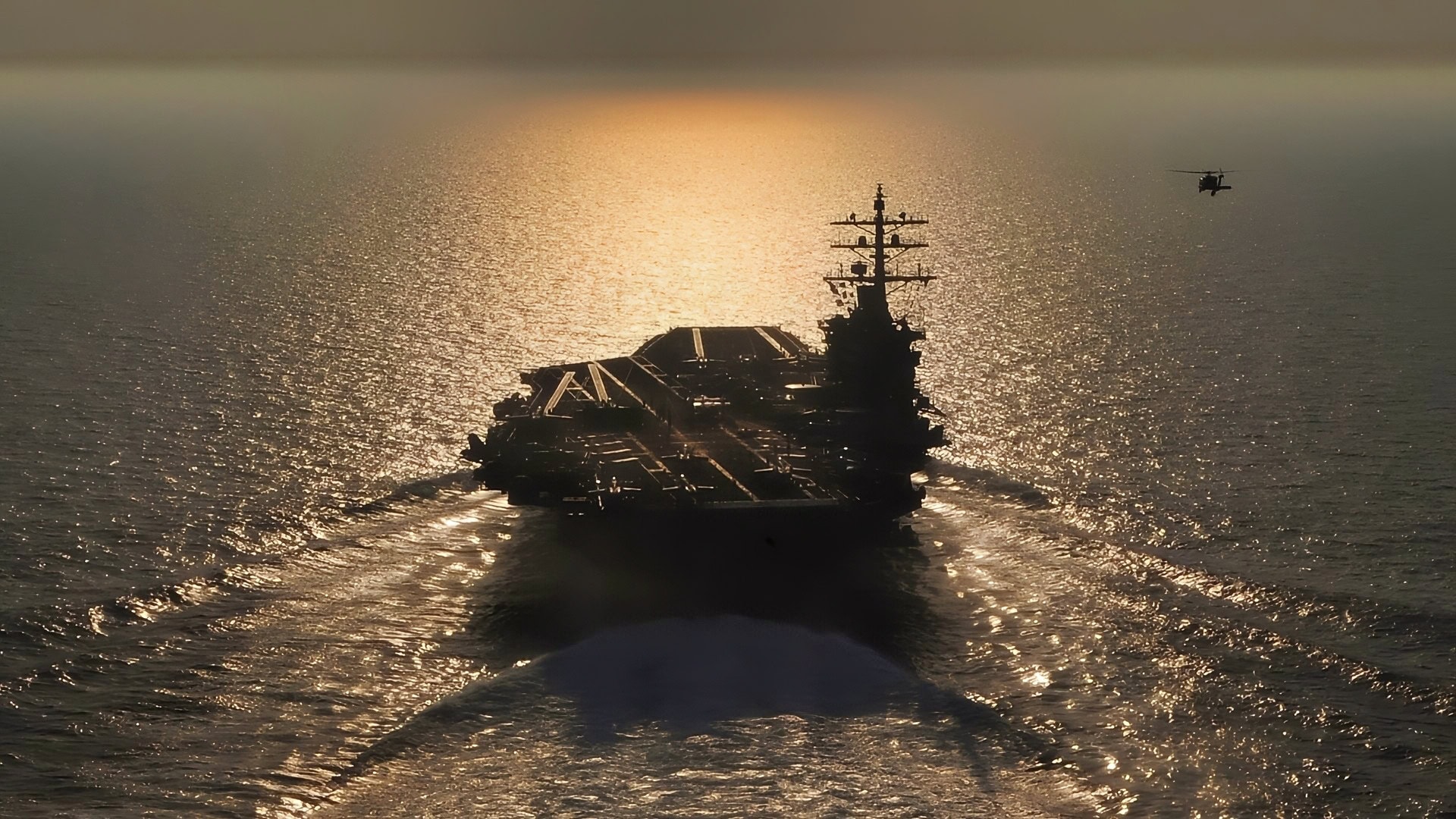
The US Navy has been built around large aircraft carriers for the past 85 years. Since the devastating Japanese attack on Pearl Harbor, the US Navy has relied on the power projection of the aircraft carrier to protect US interests around the world.
The thinking was that large carriers carrying up to 5,000 US sailors were more cost-effective: one large supercarrier had the same number of aircraft as two smaller carriers but required fewer personnel than the two would.
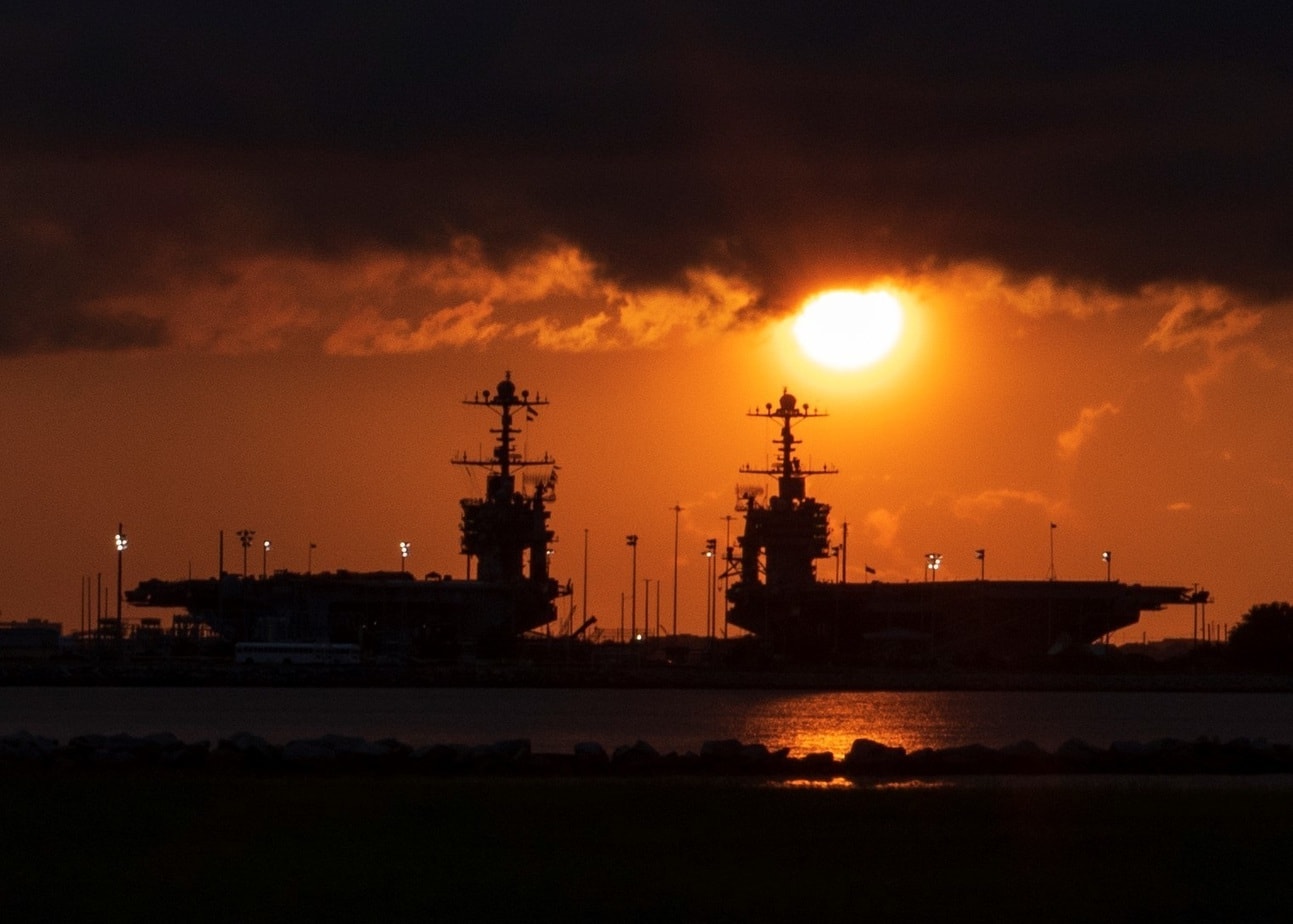
NORFOLK (Aug. 16, 2019) The Nimitz-class aircraft carriers USS Dwight D. Eisenhower (CVN 69), left, and USS John C. Stennis (CVN 74) moored at Naval station Norfolk. Making port at Naval station Norfolk is a routine activity for aircraft carriers.
A modern aircraft carrier costs about $13 billion, plus between $2 and $3 billion more in operating costs. Plus the fact that each carrier requires its own carrier strike group
The Navy Wants More, But Doesn’t Have Enough
Today, the US operates 11 supercarriers, ten of the aging Nimitz-class and one of the modern Ford-class. Federal law (10 U.S.C. § 5062) requires the Navy to maintain a minimum of 11 operational carriers.
The Navy also operates nine amphibious assault ships that support a small number of F-35B Vertical/Short Take-Off and Landing (V/STOL), Short Take-Off Vertical Landing (STOVL), Vertical Take-Off and Landing (VTOL), tilt-rotor, and Rotary Wing (RW) aircraft operations.
The Navy wants more carriers, but doesn’t have enough, nor the support ships that make up the carrier strike groups.
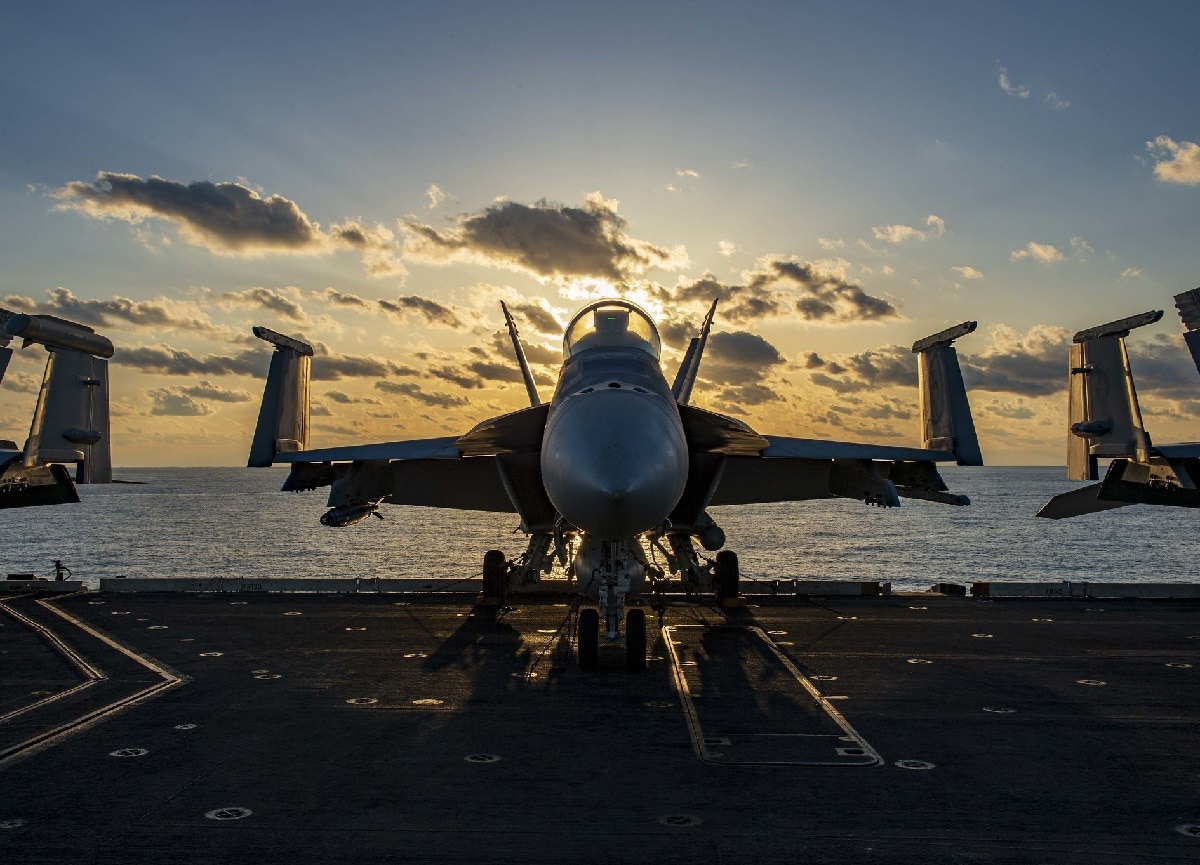
MEDITERRANEAN SEA (March 26, 2021) An F/A-18E Super Hornet attached to the “Gunslingers” of Strike Fighter Squadron (VFA) 105 sits on the flight deck aboard the Nimitz-class aircraft carrier USS Dwight D. Eisenhower (CVN 69) in the Mediterranean Sea, March 26, 2021. The IKE Carrier Strike Group is on a scheduled deployment in the U.S. 6th Fleet area of operations in support of U.S. national interests and security in Europe and Africa. (U.S. Navy photo by Mass Communication Specialist Seaman Jacob Hilgendorf) 210326-N-OB471-1130
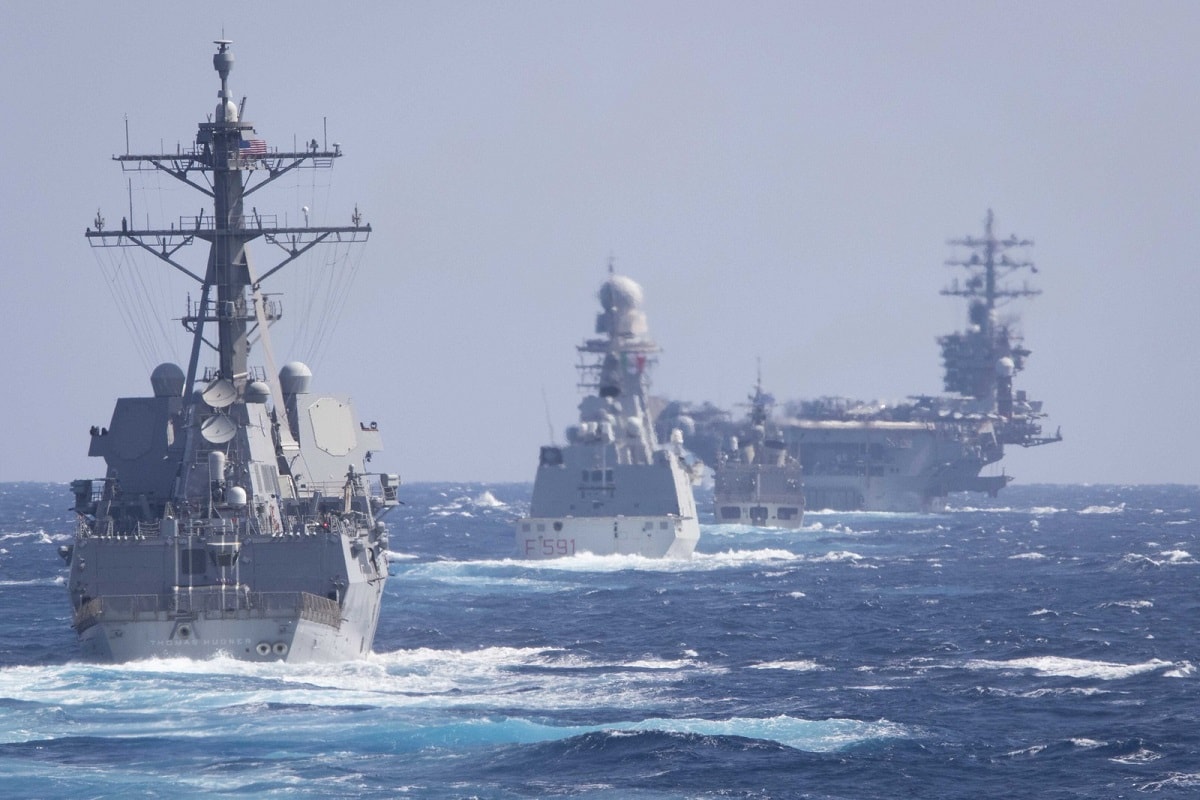
MEDITERRANEAN SEA (March 11, 2021) The Arleigh-Burke class guided-missile destroyer USS Thomas Hudner (DDG 116), left, the Italian navy Carlo Bergamini-class frigate ITS Virginio Fasan (F 591), the Hellenic Navy Hydra-class frigate HS Psara (F 494) and the Nimitz-class aircraft carrier USS Dwight D. Eisenhower (CVN 69), right, are underway in formation, March 11, 2021. The Dwight D. Eisenhower Carrier Strike Group on a routine deployment in the U.S. 6th Fleet area of operations in support of U.S. national interests and security in Europe and Africa. (U.S. Navy photo by Mass Communication Specialist 2nd Class Kaleb J. Sarten) 210311-N-QD512-3060.
Will the Navy Have 12 Carriers Soon, or Will It Drop to 10?
The Navy will soon have a 12th carrier, although the USS Nimitz (CVN-68) will not be retired this year and will remain in active service until at least 2027, according to the USNI.
This extension ensures the Navy stays at 11 carriers until the next Ford-class ship, the USS John F. Kennedy, arrives in early 2027.
However, if the Kennedy, which has already suffered several delays, is delayed any further, the carrier fleet will drop below the Congress-mandated number to just 10.
Simultaneously, the Navy is coordinating with the War Department and the U.S. Congress to increase the fleet from 11 to 12 aircraft carriers. The Navy is expected to save $4 billion by contracting the USS Enterprise (CVN-80) and USS Doris Miller (CVN-81) together, according to Breaking Defense.
Carrier Aviation Is Changing With The Advent Of Drones
The Navy’s ambitious plans call for 60 percent of its carriers to be uncrewed by 2030. By incorporating the unmanned MQ-25 Stingray and the Collaborative Combat Aircraft (CCA), also known as the “loyal wingman,” the Navy isn’t viewing drones as merely supporting carrier aviation; it plans to make them the backbone of the Carrier Air Wing of the Future (CVW-F).
Humans on board the ships and naval aviators will serve as battlefield managers.
The U.S. Navy’s Air Wing of the Future is an upgraded mix of stealth jets, drones, and support aircraft designed to operate in dangerous, contested areas.
The core aircraft of the Air Wing will consist of the F-35C Lightning II, a stealth fighter jet that uses advanced computers to track targets; the F/A-18E/F Super Hornet, an older multi-role fighter jet still used for daily strikes; the EA-18G Growler, an electronic warfare aircraft that blocks enemy radar and electronic signals; and the CMV-22B Osprey, a tilt-rotor aircraft that delivers cargo and mail to the ship.
The new drones and tech include the MQ-25 Stingray, an unmanned drone built to refuel other jets in mid-air, the F/A-XX, a planned sixth-generation manned fighter jet still in early design, and the Collaborative Combat Aircraft, the extra robotic “loyal wingmen” the Navy and Air Force are researching for future battles.
Would Conventionally Powered Carriers Save Money?
While a conventionally powered aircraft carrier saves money on initial building costs and avoids multi-billion-dollar nuclear overhauls, it requires expensive marine fuel and regular replenishment at sea.
Conventionally powered ships do not need complex nuclear reactors. This saves billions of dollars during initial construction.
It also avoids the expensive, time-consuming mid-life Refueling Complex Overhaul (RCOH), which costs upwards of $3 billion. Conventional ships avoid this specific expense.
Conventional carriers have a much shorter range than nuclear carriers and must burn massive amounts of oil or diesel to move. They need frequent refuels from a logistics fleet of oil tankers.
Because conventional ships must carry fuel for their own engines, they have less room for jet fuel, bombs, and missiles.
According to the 1998 GAO Report, nuclear power carries a life-cycle cost premium, though the Navy disputes the exact size of that premium.
However, because they are not required to perform the long-term maintenance of nuclear carriers, they can provide a greater forward presence.
About the Author: Steve Balestrieri
Steve Balestrieri is a National Security Columnist. He served as a US Army Special Forces NCO and Warrant Officer. In addition to writing on defense, he covers the NFL for PatsFans.com and is a member of the Pro Football Writers of America (PFWA). His work was regularly featured in many military publications