
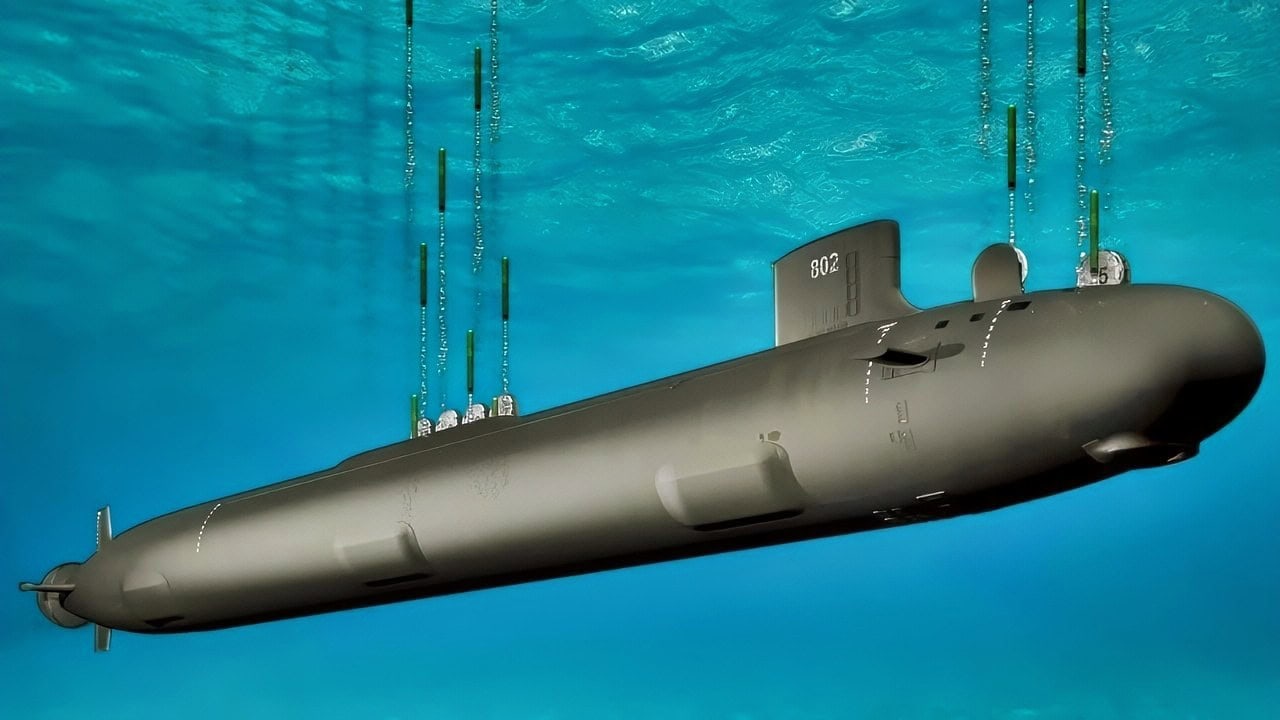
$348 Billion And 17 Months Late: Columbia-Class SSBNs Face A Schedule Crunch
The District of Columbia is the capital city of the United States of America. It is therefore a point of national pride, as embodied in the monuments that attract tourists around the globe, from the Lincoln Memorial and the Jefferson Memorial to the Washington Monument and the World War II Memorial. It is fitting, then, that the U.S. Navy should name its latest series of nuclear-powered ballistic missile submarines (SSBNs) the Columbia-class.
However, the Columbia-class SSBNs are being plagued by delays and ballooning cost overruns, serving as a reminder of the dysfunction that also sometimes characterizes its namesake.
Columbia-Class in Crisis?
Depending on the source, the Columbia submarine program is costing the U.S. taxpayer $348 billion over its entire lifecycle. Despite all that money, the boats are lagging behind. The lead boat of the class, the USS District of Columbia (SSBN-826), is now projected to be delivered 17 months late, in 2029.
The Columbias’ woes sound a familiar note—one ringing throughout the American shipbuilding enterprise:
-The Navy is desperately short of the estimated 140,000 skilled workers needed to build the new boats. The service has run the BuildSubmarines recruiting push, which is sponsored by the Department of the Navy in tandem with the BlueForge Alliance, since November 2022. As the mission statement declares, “The Navy is on a once-in-a-generation journey to completely transform its nuclear-powered submarine fleet and maintain its critical undersea advantage. … And there’s not a moment to spare.”
-The American shipbuilding industry as a whole is a shell of its former self, which prompted President Donald Trump’s to issue Executive Order 14269, Restoring America’s Maritime Dominance.
Not All Bad News Part I: News from 2025
Fortunately, not all the news is bad.
USNI News reporter Caitlyn Burchett in November quoted an anonymous Navy spokesperson who said that, “This significant milestone marks completion of the majority of NNS’ work on SSBN-826. With all of SSBN-826’s major modules at EB, the boat will begin final assembly and testing.” Burchett also cited General Dynamics Electric Boat CEO Phebe Novakovic, who said during an October call that the future District of Columbia was about 60 percent complete and added that, “‘By the end of this year, we’ll have all the major modules at Groton ready for assembly and test.’”
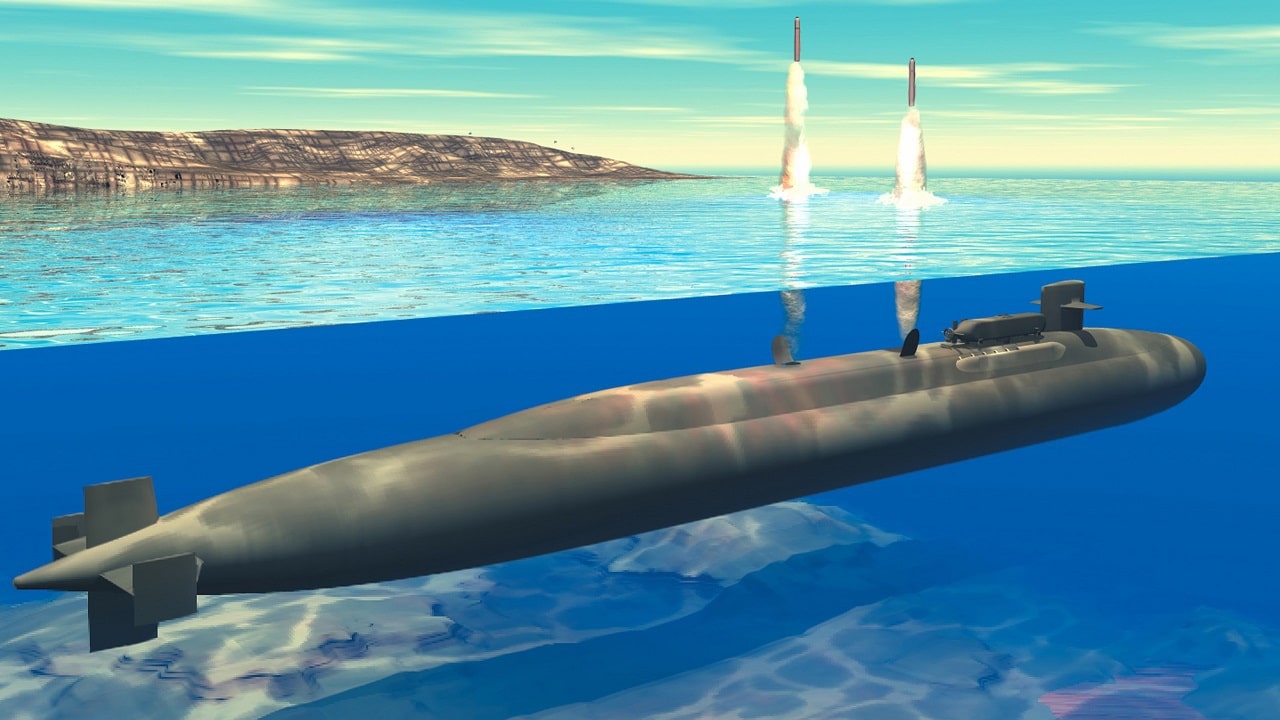
Artist’s concept of an Ohio-class SSGN launching Tomahawk Land Attack Missiles.
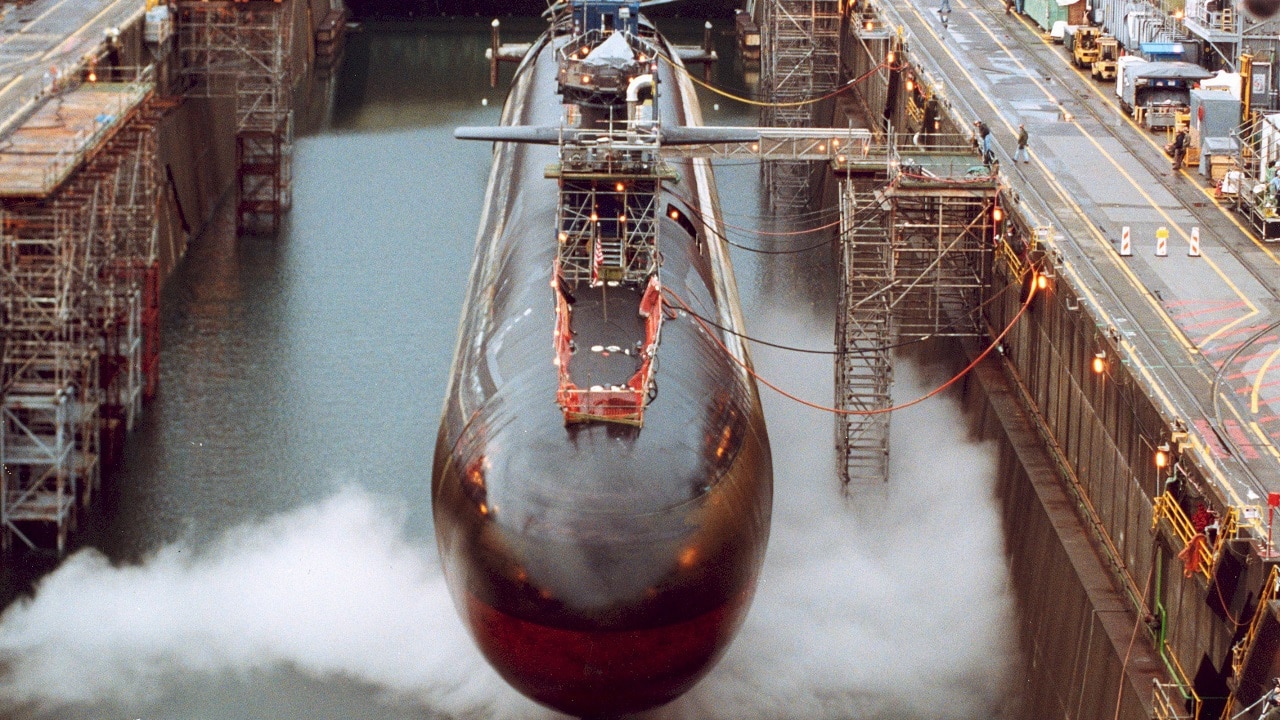
Puget Sound Naval Shipyard, Wash. (Aug. 14, 2003) — USS Ohio (SSGN 726) is in dry dock undergoing a conversion from a Ballistic Missile Submarine (SSBN) to a Guided Missile Submarine (SSGN) designation. Ohio has been out of service since Oct. 29, 2002 for conversion to SSGN at Puget Sound Naval Shipyard. Four Ohio-class strategic missile submarines, USS Ohio (SSBN 726), USS Michigan (SSBN 727) USS Florida (SSBN 728), and USS Georgia (SSBN 729) have been selected for transformation into a new platform, designated SSGN. The SSGNs will have the capability to support and launch up to 154 Tomahawk missiles, a significant increase in capacity compared to other platforms. The 22 missile tubes also will provide the capability to carry other payloads, such as unmanned underwater vehicles (UUVs), unmanned aerial vehicles (UAVs) and Special Forces equipment. This new platform will also have the capability to carry and support more than 66 Navy SEALs (Sea, Air and Land) and insert them clandestinely into potential conflict areas. U.S. Navy file photo. (RELEASED)
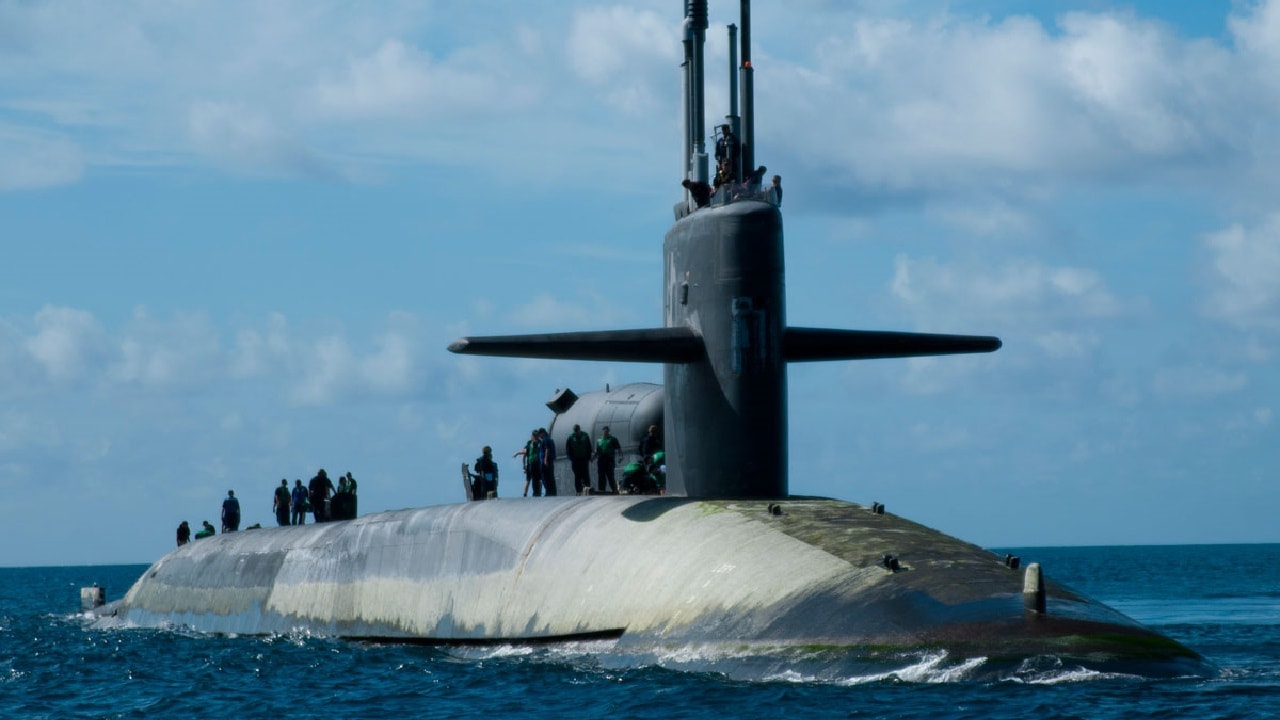
Ohio-class submarine. Image Credit: Creative Commons.
Meanwhile, in November, MilMag staff writer Rafał Muczyński reported that steelcutting and keellaying for the second submarine of the class, the USS Wisconsin, has already taken place.
In other words, at least the Columbias are being built, slowly but surely, which is more than can be said for the SSN(X) program.
Moreover, on November 17, Naval Sea Systems Command published information on the contract awarded five days prior to General Dynamics Electric Boat.
The contract, valued at nearly $2.3 billion, is for additional advance procurement and construction of the hulls of five Columbia-class submarines, from the future USS Groton (SSBN-828) through the yet-to-be-named ships SSBN-832.
Not All Bad News Part Deux: 2026 Progress Report
Alexander Soule of CT Insider reported in January that, “Entering 2026, Electric Boat got … a [new] floating dry dock the length of two football fields that will serve as the cradle for a new fleet of nuclear missile subs for the U.S. Navy.
“Work on the future USS District of Columbia is now proceeding inside a new assembly building at the southernmost end of the shipyard.”
Meanwhile, just two days ago (as I type these words), Nick Wilson of Inside Defense reported that the prestigious defense firm Leonard DRS—the sole producer of electric-drive propulsion system components for the Columbias—was poised to cut the ribbon on a $120 million facility in South Carolina that will soon begin assembling propulsion equipment for the boats and add a much-needed capacity boost to “the pained submarine industrial base.”
About the Author: Christian D. Orr, Defense Expert
Christian D. Orr is a Senior Defense Editor. He is a former Air Force Security Forces officer, Federal law enforcement officer, and private military contractor (with assignments worked in Iraq, the United Arab Emirates, Kosovo, Japan, Germany, and the Pentagon). Chris holds a B.A. in International Relations from the University of Southern California (USC) and an M.A. in Intelligence Studies (concentration in Terrorism Studies) from American Military University (AMU). He is also the author of the newly published book “Five Decades of a Fabulous Firearm: Celebrating the 50th Anniversary of the Beretta 92 Pistol Series.”