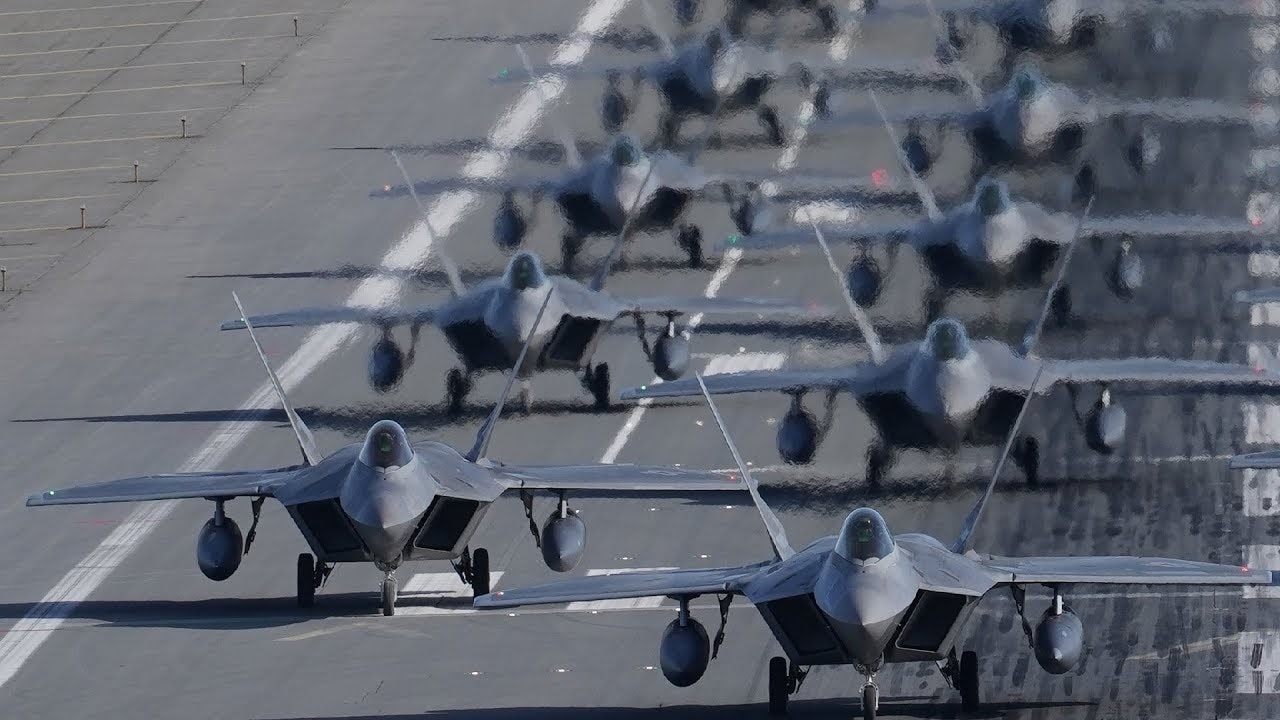
Synopsis: Talk of an “F-22 Super” is less about a new airframe and more about keeping the Raptor relevant while no replacement is in production.
-The focus has been steady modernization: software refreshes, radar refinements to the APG-77, improved electronic protection, and integration of weapons like AIM-9X and AIM-120D.
-Increment upgrades expanded targeting and added GPS-guided strike options through better mapping, pushing the jet beyond pure air-to-air.
-Connectivity has improved with the ability to receive Link 16 data, while emissions are managed to preserve stealth.
-Sustainment remains central, especially diagnostics and the labor-intensive upkeep of stealth coatings that degrade over time.
F-22 Super Has a Message: Stealth-Coating Sustainment Is the Real Fight
A major focus is sustainment—diagnostics and the demanding upkeep of stealth coatings that degrade and require recurring repair.
The F-22 Raptor already is arguably the stealthiest fighter jet in existence. Now, the Raptor is primed for upgrades that could integrate new capabilities to the jet—at least according to U.S. President Donald Trump.
“We’re going to do an F-55 and – I think, if we get the right price, we have to get the right price – that’ll be two engines and a super upgrade on the F-35, and then we’re going to do the F-22,” Trump said, speaking to a group of business leaders in Doha earlier this year.
“I think the most beautiful fighter jet in the world is the F-22 but we’re going to do an F-22 Super and it’ll be a very modern version of the F-22 fighter jet,” Trump added. “We’re going to be going with it pretty quickly.”
Upgrades for the F-22 Raptor have been in the works for some time already. “There’s no limitation on the airplane itself that drives it. That will be a decision in terms of force management and how soon any replacements or other technologies might come along, so we’re posturing beyond seven years,” OJ Sanchez of Lockheed Martin explained to Defense One. “We’re continuing to think, ‘How do we keep the airplane relevant?’”
Though Sanchez acknowledged that the future of the F-22 Raptor is somewhat curtailed by the prohibition on its export, the head of Lockheed Martin’s secretive Skunk Works division did highlight how many aircraft outlive their originally planned service lives—in part due to operational necessity, and in part thanks to thoroughgoing modernizations that keep them relevant. Sanchez himself qualified on the F-15 and F-22, both air-superiority fighters.
“It’s less about how long is it going to be in service and more about the unique capability that it brings to ensure air superiority, wherever it’s needed…so the Air Force has asked us to move forward with that modernization program, and then we’ll see how long the aircraft endures,” Sanchez said.
Though the Air Force has previously tried to retire some of its F-22 fleet, citing age and high maintenance costs, Congress has put the kibosh on efforts to divest Raptors, in part because there is currently no replacement in production.
When the Raptor entered service in the mid-2000s, it was an amalgamation of late Cold War planning and reflected an emphasis on penetrating and dominating contested airspace against a near-peer adversary: at that time, the Soviet Union. And while the Raptor is indeed one of the world’s leading air-superiority fighters, it lacked the mission flexibility, networking capabilities, and growth that other post-Cold War fighters emphasized.
Big Upgrades
Much of the Raptor’s upgrades have focused not on physical changes to the aircraft, but instead on a steady modernization of the jet’s software, integration with newer and more powerful weaponry, its sensor suite, and connectivity ability.
Some of the Raptors’ earlier upgrades focused on reliability and avionics. Refinements to the jet’s APG-77 active electronically scanned array radar and improved electronic protection were crucial to the first wave of improvements to the F-22.

The F-22 Raptor Demonstration Team uniform is worn during a practice demonstration at Langley Air Force Base, Virginia, Nov. 13, 2025. The all-black flight suit is a signature look for Air Combat Command demonstration teams. (U.S. Air Force photo by Staff Sgt. Lauren Cobin)
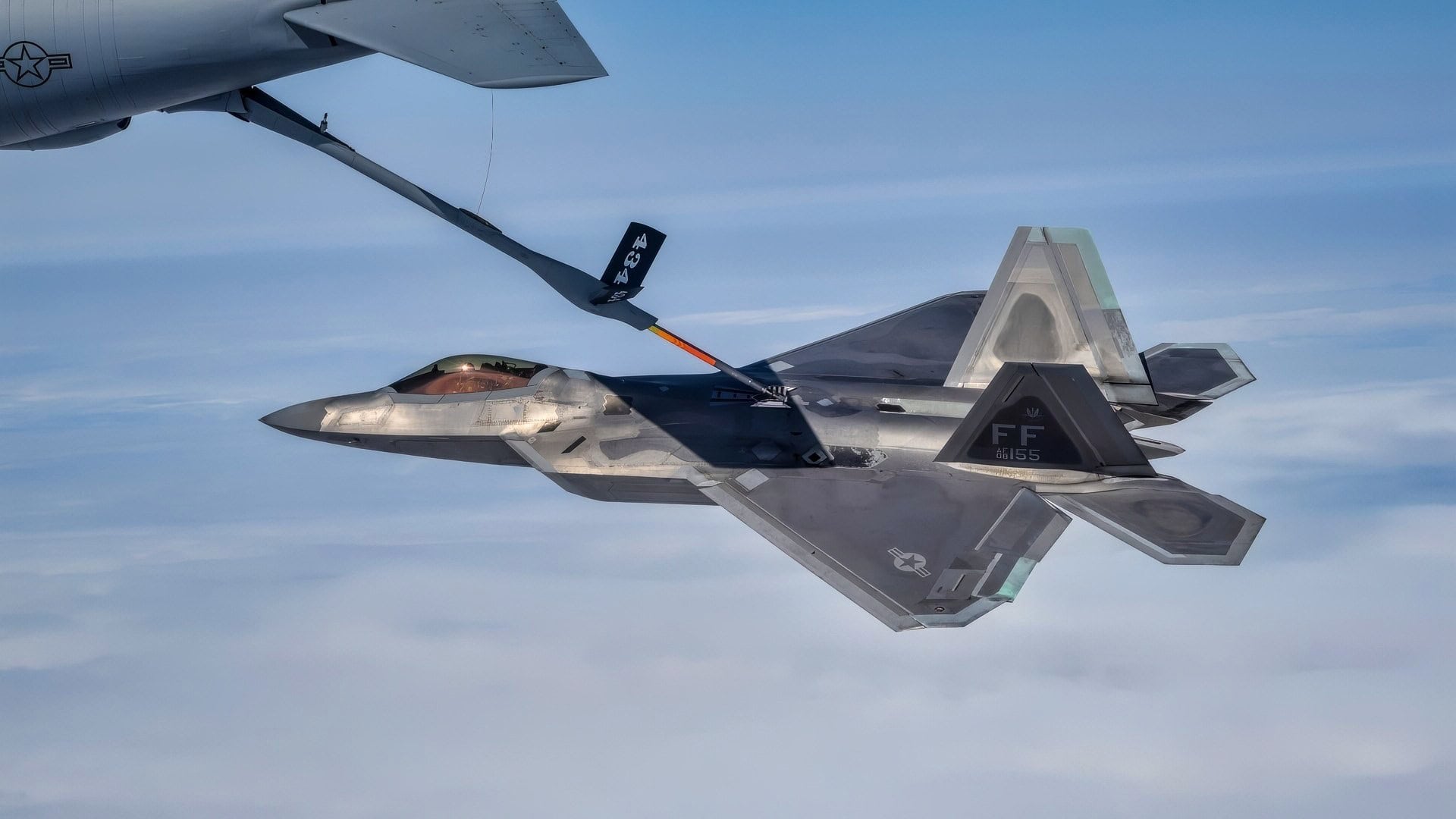
A U.S. Air Force F-22 Raptor and a KC-135 Stratotanker, assigned to the 434th Air Refueling Wing, Grissom Air Reserve Base, Ind., conduct aerial refueling over the continental United States, Aug. 21, 2018, during the Northern Lightning 18-2 exercise. Northern Lightning is one of seven Air National Guard joint accredited exercises held at a Combat Readiness Training Center and provides tailored, cost-effective and realistic combat training for participating units in a joint and multinational environment. (U.S. Air National Guard photo by Tech. Sgt. Mary E. Greenwood)
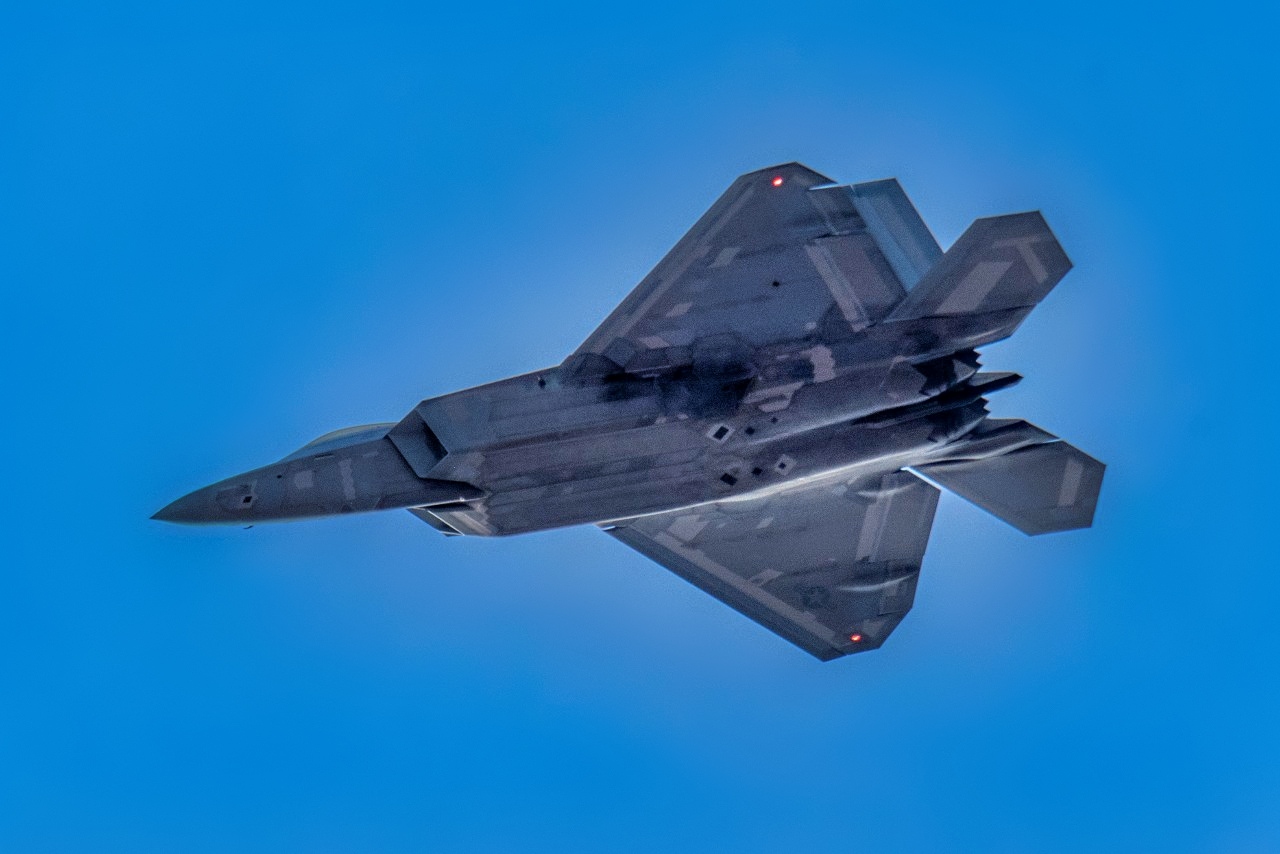
A U.S. Air Force F-22 Raptor assigned to the 3rd Wing conducts aerial practices at Joint Base Elmendorf-Richardson, Alaska, March 28. The F-22 is an American twin-engine, all-weather, supersonic stealth fighter aircraft and provides power projection across the Indo-Pacific region. (U.S. Air Force photo by Airman 1st Class Tala Hunt)
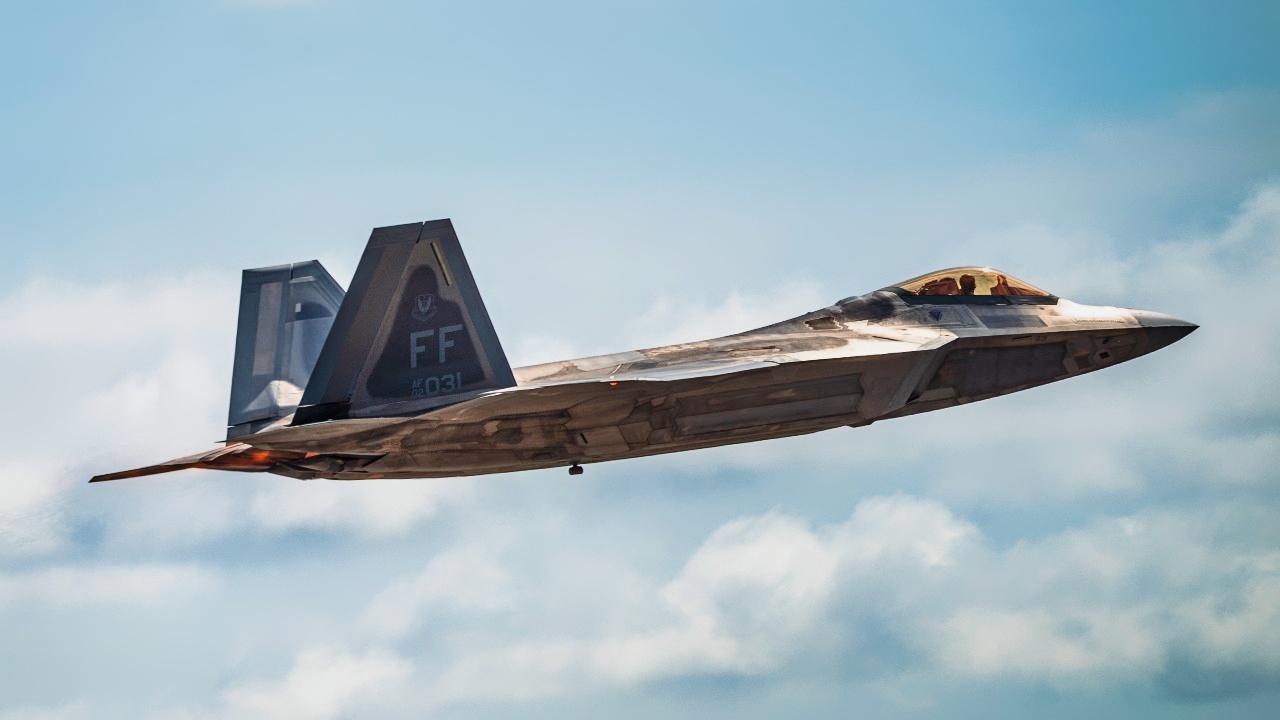
A U.S. Air Force F-22 Raptor assigned to the 71st Fighter Squadron, Joint Base Langley-Eustis, Virginia, takes off during Checkered Flag 25-2 at Tyndall Air Force Base, Florida, May 8, 2025. Air Combat Command’s Checkered Flag exercise simulates the full mobilization and deployment cycle, ensuring unit readiness for contingency operations. (U.S. Air Force photo by Airman 1st Class Zeeshan Naeem)
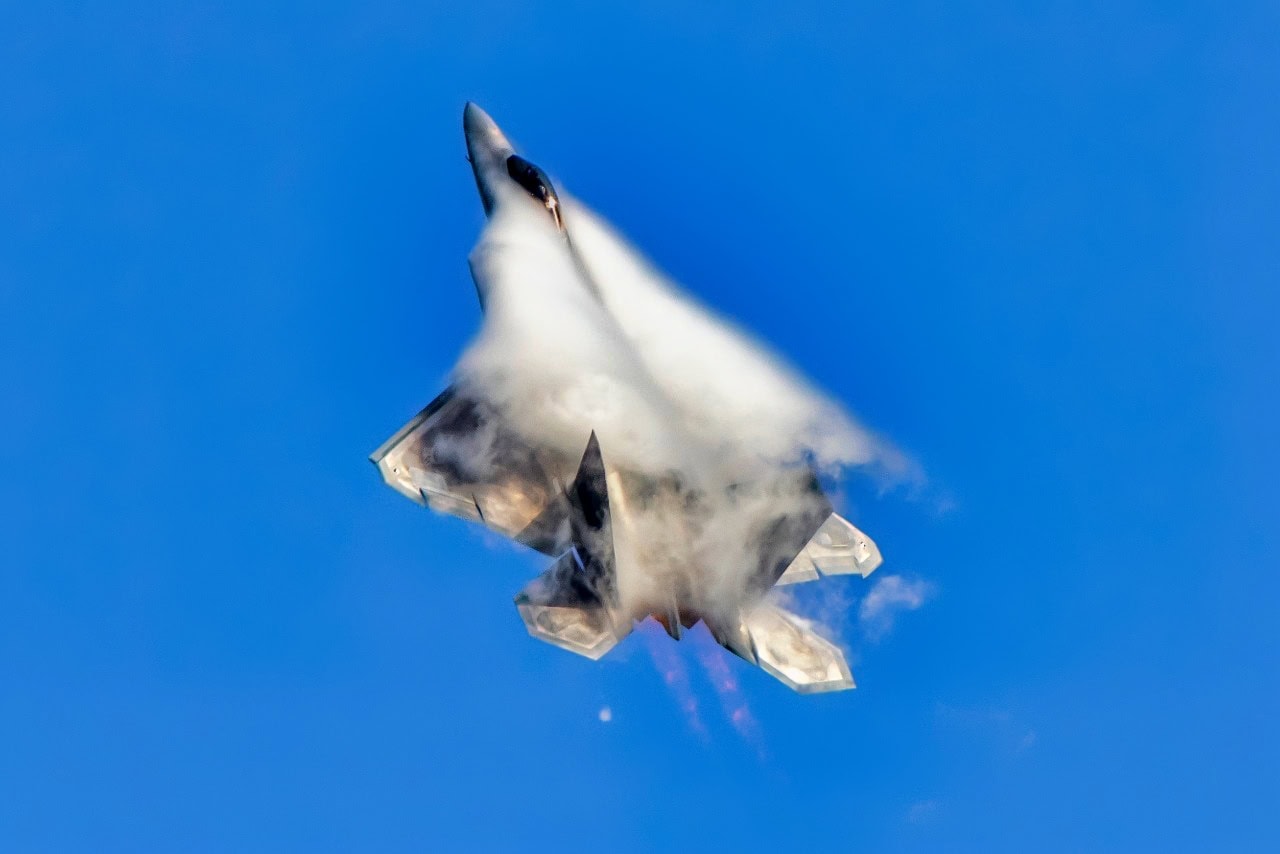
A U.S. Air Force F-22 Raptor performs a sharp aerial maneuver above the flight line during the 2024 Marine Corps Air Station Miramar Airshow in San Diego, Sept. 28, 2024. The F-22 Raptor Demonstration Team performs precision aerial maneuvers at airshows across the world to demonstrate the unique capabilities of the world’s premier 5th generation fighter aircraft. America’s Airshow 2024 is a unique and incredible opportunity to witness Marine and joint aviation capabilities, civilian performers, and the world-famous Blue Angels; to interact first-hand with Marines, other service members, and first responders; and to see first-hand the innovative spirit of the Marine Corps through emerging technologies and forward-thinking. (U.S. Marine Corps photo by Lance Cpl. Seferino Gamez)
One of the Raptor’s more significant modernization packages came later, in the late 2000s and mid-2010s. Increment 2 and Increment 3 modernizations expanded the Raptor’s targeting capability and integrated GPS-guided munitions, thanks in part to improved synthetic aperture radar mapping, which gave a leaver of detail to pilots that was not previously available. Importantly, this shifted the F-22 from a purely air-to-air platform into a stealthy fighter with strike capability, particularly useful for the opening stages of a high-end conflict.
The F-22 Super With Super Weapons
Eventually, the F-22 also integrated the AIM-9X, a more capable short-range missile, and other variants, including the AIM-120D, further pushed the F-22’s engagement ranges. And while the Raptor lacks some of the weapon flexibility of other multirole fighters such as the F-35, it is far more flexible than in its original state.
Thanks to the Raptor’s original role as a highly stealthy aircraft, its in-flight datalink was optimized to connect to other Raptors, but did not liaise as smoothly with other aircraft. The Raptor eventually gained the ability to receive Link 16 data from other aircraft, ships, or ground nodes, though its ability to transmit via Link 16 is restricted to preserve its stealth profile in most operational contexts.
Some of the most important changes to the Raptor fleet, however, relate to diagnostics and maintenance, particularly to the Raptor’s notoriously finicky stealth coatings, which crinkle and degrade and need periodic replacement.
About the Author: Caleb Larson
Caleb Larson is an American multiformat journalist based in Berlin, Germany. His work covers the intersection of conflict and society, focusing on American foreign policy and European security. He has reported from Germany, Russia, and the United States. Most recently, he covered the war in Ukraine, reporting extensively on the war’s shifting battle lines from Donbas and writing on the war’s civilian and humanitarian toll. Previously, he worked as a Defense Reporter for POLITICO Europe. You can follow his latest work on X.