
A $22 Billion Trump-Class Battleship? Inside the BBG(X) Debate
In December 2025, President Donald Trump unveiled plans for a new type of “battleship” which is informally dubbed the Trump-class battleship as party of his envisioned “Golden Fleet” initiative. Formally dubbed BBG(X), the announcement was made at Trump’s residence in Mar-a-Lago with the first ship of the class christened the USS Defiant.
Based on the renderings of the new battleship, it is likely that this project was underway before President Trump took office and was given higher priority due to Trump’s personal inclination toward the battleship concept (I have no evidence for this, except for my own knowledge of U.S. Navy development practices).
Immediately after its announcement, the Trump-class sparked a flurry of debates across the defense community about whether the new battleship is already dead upon arrival or whether it serves any actual purpose.
Background: The Trump-Class Battleship
At its core, the Trump-class concept proposes a very large, conventionally powered surface combatant with a displacement exceeding 35,000 tons and equipped with a dense mix of vertical launch cells and a battery of Conventional Prompt Strike (CPS) hypersonic missiles.
It will also field advanced sensors derived from the Flight III destroyers (notably the AN/SPY-6 radar), and growth margins for directed-energy weapons and possibly railguns as those technologies mature.
Early Navy materials reviewed by reporters described a ship roughly double the tonnage of the Zumwalt-class, carrying 128 Mk-41 VLS cells and 12 CPS tubes, and capable of more than 30 knots, positioning it as a flagship for Surface Action Groups with expanded aviation and command facilities.
The big problem is the cost. A preliminary range cited by analysts and reporters places the lead ship at roughly $18–22 billion, exceeding even the price of the Ford-class carriers, while follow-on hulls are projected to fall to the low teens per ship (in the best-case scenario).
Even proponents of the battleship concede that a first-in-class platform laden with new systems will incur a high cost, which has historically led to the deaths of many past naval projects.
Some naval leaders have claimed that this is an evolutionary step, suggesting that the Trump-class would adapt DDG(X) concepts to a much larger hull to achieve magazine depth and power generation that current destroyers can’t provide.
Arguments in Favor the BBG(X)
Many are quick to dismiss the Trump-class (mainly due to its association with President Trump), but there are some legitimate arguments in favor of a new “battleship.”
The first is a matter of strategic arithmetic: the U.S. faces a widening “magazine gap” against the PLAAN and its extensive anti-access networks, and that a few exceptionally capable platforms, each with a large loadout of interceptors and long-range strike weapons, could supply surge firepower when it is most needed.
In this context, BBG(X) would not resurrect the battleship of 1944, but field a missile-era capital ship with the sensors, command facilities, and electrical headroom to host hypersonic batteries, advanced electronic warfare suites, other future systems as they become practical at sea.
A second argument concerns fleet architecture: a large, heavily defended node at the center of a Surface Action Group could orchestrate distributed assets while serving as a magazine and command nexus. employing superior radar and combat systems to thin out incoming salvos. There are also economic arguments in favor of the newer ship.
A major focus of this administration is to revitalize the American shipbuilding industry. A project of this size could go a long way in reinvigorating domestic production, providing new jobs and economic opportunities. Is this enough to displace the tremendous cost of the BBG(X)? In all honesty, probably not.
Haven’t We Tried This Before?
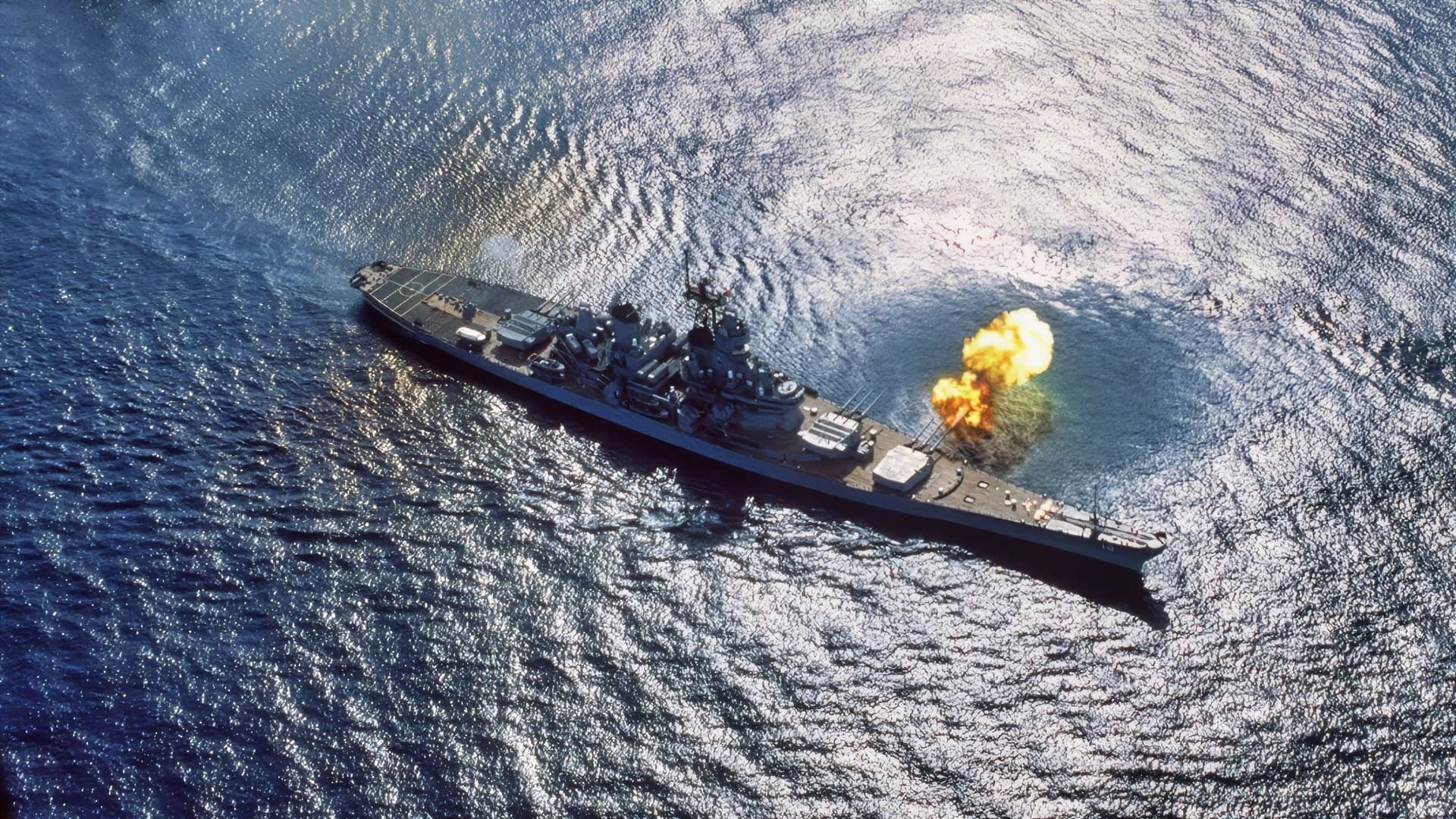
To anyone familiar with the history of the Iowa-class battleships, one might realize that a similar strategy was adopted back in 1980. Indeed, from 1982-1992, the U.S. Navy operated four Iowa-class battleships, which were deeply modernized to include the latest VLSs, air defenses, and onboard radar and electronic systems. While they weren’t as advanced as the proposed Trump-class, they fulfilled some of the same roles and offered a point of comparison to the new BBG(X). The Iowa class was reactivated to counter emerging Soviet naval threats, particularly the large Kirov-class battlecruisers.
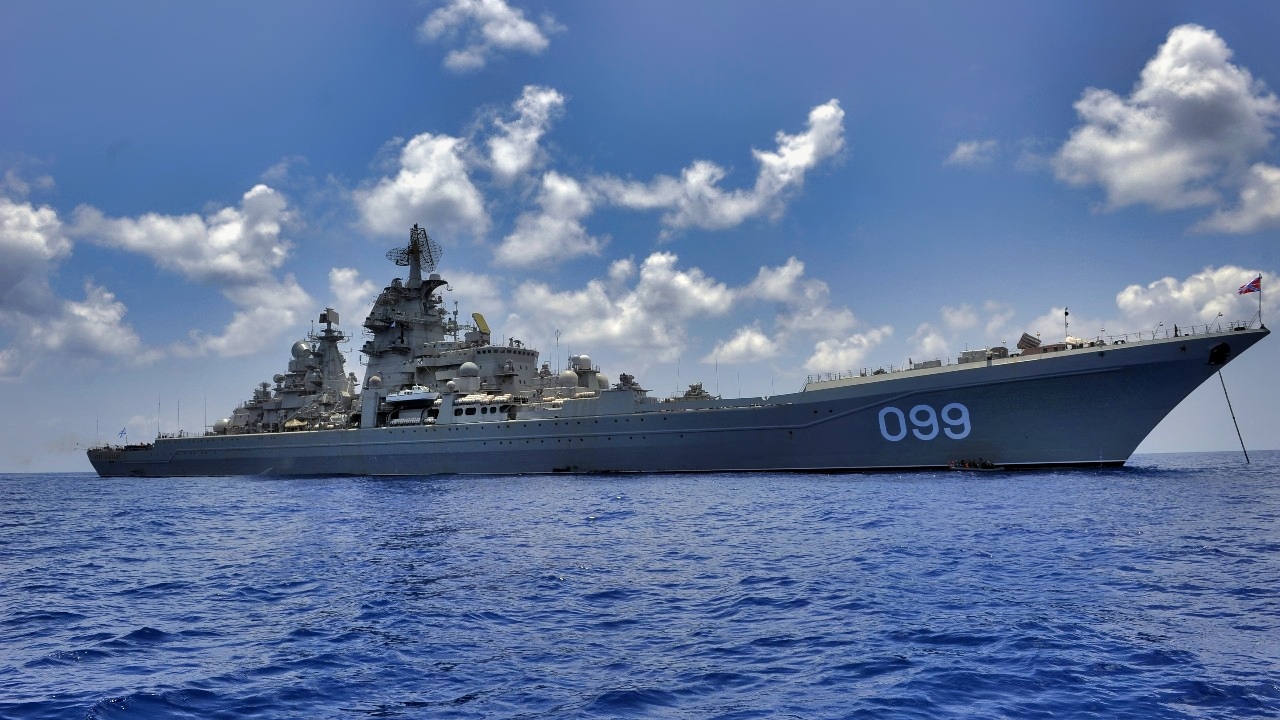
Kirov-Class Russian Navy. Image Credit: Creative Commons.
However, as everyone knows, the Iowa-class was decommissioned for the last time when the Cold War ended, which effectively ended the battleship concept for good. This was due in large part thanks to the dissolution of the Soviet Union, meaning that the Iowa-class no longer had a threat that they no longer needed to counter.
Another factor that sealed the battleship’s fate was the realization that, at least in their current configuration, battleships could no longer contend with the strategic realities of modern naval warfare.
That’s not to say there is no need for large naval capital ships, but in the age of seaborne unmanned systems and hypersonic anti-ship missiles, there is a strong case that the battleship concept isnot feasible today. This is not even the cost of construction and maintaining large steel leviathans, another factor that influenced the final decommissioning of the Iowa-class.

Battleship USS Iowa Logo 19FortyFive Image.
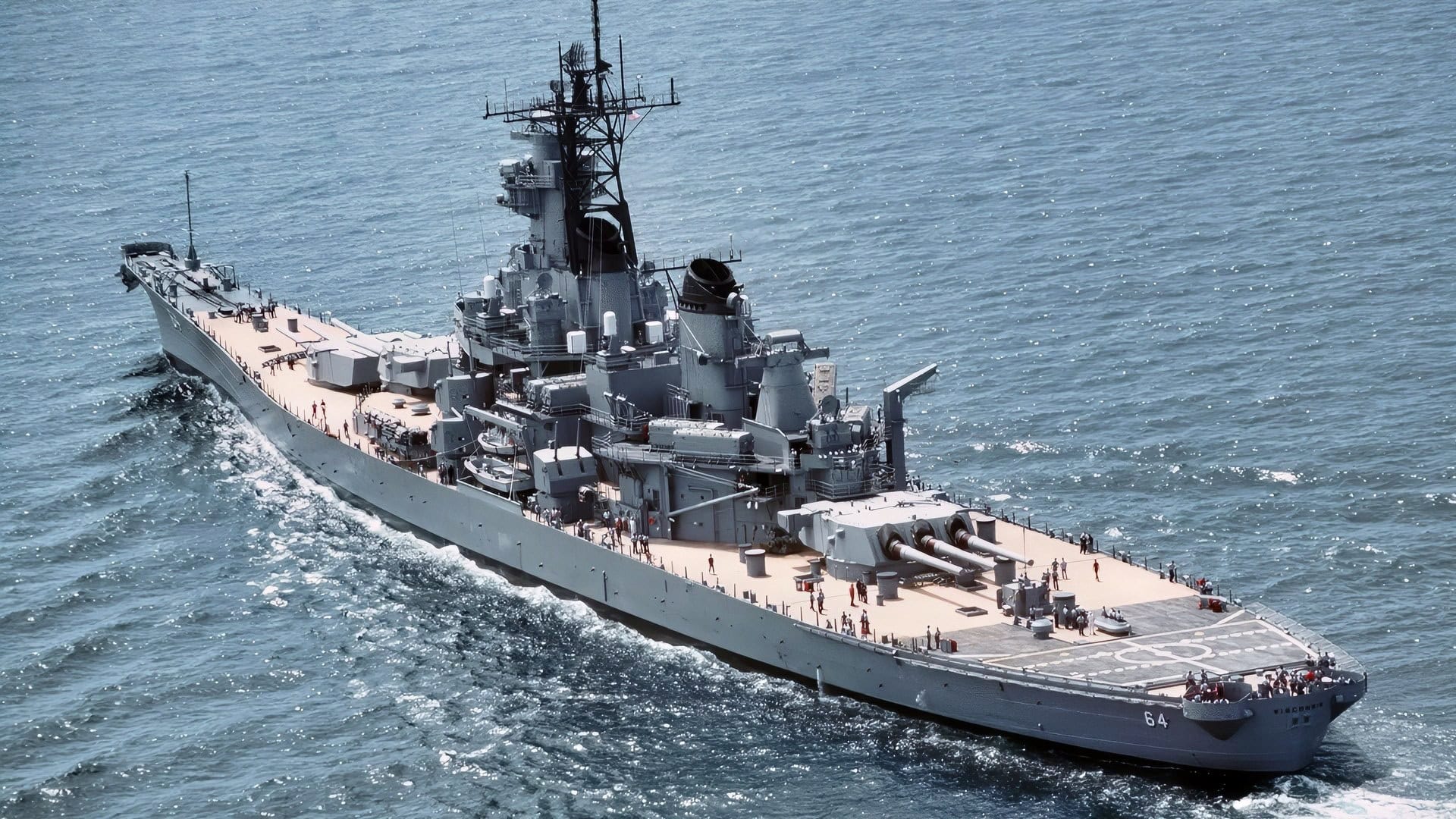
U.S. Navy Iowa-Class Battleship. Image Credit: Creative Commons.

Iowa-Class Battleship. 19FortyFive.com Image.
Overall, the Trump-class is an ambitious attempt to revitalize naval prestige and provide a new layer of deterrence against the emerging naval threat posed by China. However, a ship of this scale is unlikely to be approved.
There are simply too many risks involved, from the sheer economic cost of the project to the uncertain role of large battleships in modern naval warfare. While there are legitimate advantages to a ship of this size, the economic burden of the ship, along with its association with Trump, is likely to ensure that it never sets sail in the future.
About the Author: Isaac Seitz
Isaac Seitz, a Defense Columnist, graduated from Patrick Henry College’s Strategic Intelligence and National Security program. He has also studied Russian at Middlebury Language Schools and has worked as an intelligence Analyst in the private sector.