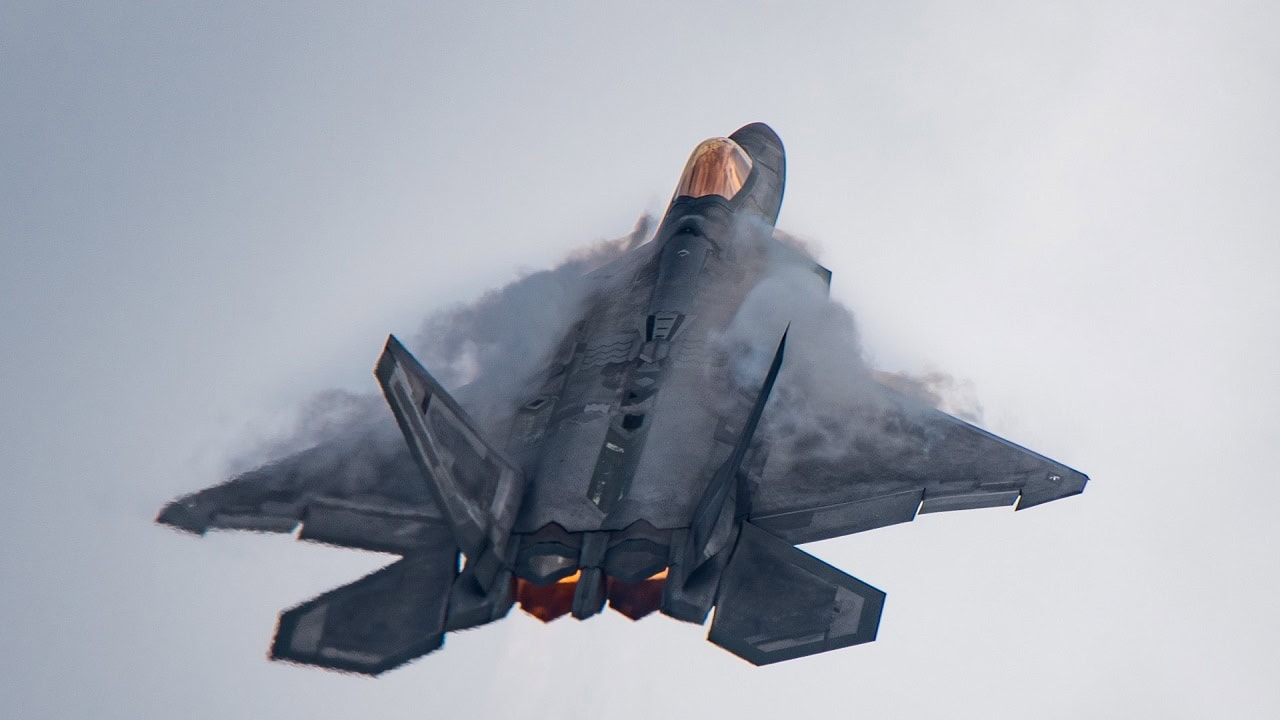
Summary and Key Points: Caleb Larson, a national security journalist and Ukraine conflict veteran, analyzes the evolution of the F-22 Raptor into the modernized “Super” variant.
-As the U.S. Air Force prepares for the Boeing F-47 (NGAD) to enter production in 2028, the Raptor fleet is receiving a $9 billion viability upgrade.
-Key 2026 enhancements include low-drag external fuel tanks, underwing infrared search and track (IRST) pods, and synthetic aperture radar mapping.
-This 19FortyFive report explores how these upgrades, alongside the AIM-260 JATM, ensure air superiority against China and Russia while extending the Raptor’s service life into the 2050s.
-Bonus: This article includes some unique original F-22 Raptor photos taken by 19FortyFive staffers.
Why the F-22 Raptor is Flying Until 2060 Despite the Arrival of the Sixth-Generation F-47

F-22 Raptor Model. Image Credit: 19FortyFive.com
When the F-22 entered service in the mid-2000s, it was envisioned as a highly agile, stealthy air superiority fighter.
It had been designed to penetrate highly contested Soviet airspace during the Cold War.
The collapse of the Soviet Union led to a far reduced Raptor fleet—the Air Force originally considered a 750-plane purchase. But while today’s Raptor fleet is less than 200 strong, it is still considered the world’s preeminent air superiority fighter—though it lacks some of the multi-role flexibility and networking capabilities of newer, post-Cold War fifth-generation aircraft, the F-35.
The Raptor has incorporated a number of upgrades since it first entered service.
The jet’s software is improved, providing a better interface with newer weaponry, and the fighter has better networking capabilities with aircraft and other assets.
Some of the first updates honed the jet’s APG-77 advanced electronically scanned array (AESA) radar and bolstered electronic warfare protection.
But one of the Raptor’s most far-reaching updates occurred from the late 2000s until the mid-2010s.
The Increment 2 and Increment 3 modernizations improved the F-22’s targeting and use of GPS-guided weaponry thanks to synthetic aperture radar mapping, which provided Raptor pilots with a level of detail they previously did not have.
These updates turned the F-22 from an air superiority fighter into a platform capable of striking other types of targets.
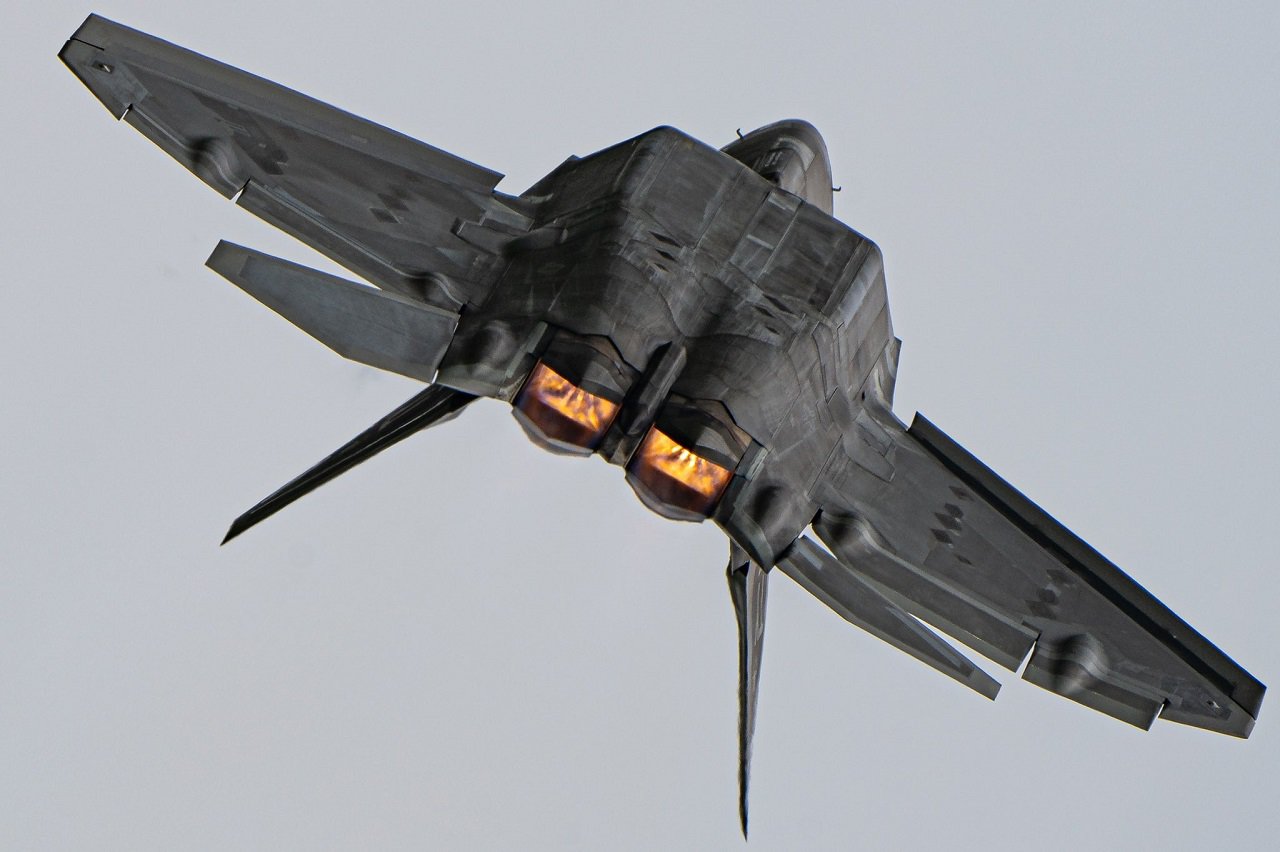
F-22 Raptor. Image Credit: Creative Commons.
The jet would also eventually accept the AIM-9X missile as well as other, newer weapons that would expand the Raptor’s engagement ranges. And while the Raptor lacks the multi-role flexibility of the newer F-35, it is certainly a significantly more flexible platform today than it was in its original iteration.
Some of the Raptors’ most significant updates are those that increase the jets’ longevity. Improvements in the Raptor’s maintenance and diagnostics aid the jet’s operational readiness. New stealth coatings replace originals that were infamously difficult to maintain and significantly reduced operational readiness.
The F-22 Flies Into the Future
Although the F-22 platform has already received many upgrades, there could be more in the future, according to comments made by U.S. President Donald Trump.
“We’re going to do an F-55 and – I think, if we get the right price, we have to get the right price – that’ll be two engines and a super upgrade on the F-35, and then we’re going to do the F-22,” Trump explained while at a meeting in Doha. “I think the most beautiful fighter jet in the world is the F-22 but we’re going to do an F-22 Super and it’ll be a very modern version of the F-22 fighter jet. We’re going to be going with it pretty quickly.”
While the F-55 moniker may have been a slip-up, Lockheed Martin is bullish on the prospects for future F-22 upgrades. “There’s no limitation on the airplane itself that drives it. That will be a decision in terms of force management and how soon any replacements or other technologies might come along, so we’re posturing beyond seven years,” OJ Sanchez, one of aerospace giant Lockheed Martin’s top personnel, told Defense One. “We’re continuing to think, ‘How do we keep the airplane relevant?’”
Sanchez did admit that the Raptor’s congressionally-mandated export ban, a result of the Obey Amendment, limits future options for the platform, but added it is not unusual for aircraft to fly past their originally projected service lives, thanks in part to continuous upgrades and modernization, as well as pressing operational challenges.
“It’s less about how long is it going to be in service and more about the unique capability that it brings to ensure air superiority, wherever it’s needed…so the Air Force has asked us to move forward with that modernization program, and then we’ll see how long the aircraft endures,” Sanchez explained.

F-22 Raptor Exhibit Explainer 19FortyFive Photo. Taken By Harry J. Kazianis in July 2025 at the National Museum of the Air Force.
In the past, Congress has stopped the U.S. Air Force from retiring the Raptor fleet, partly because there simply is no replacement for the air superiority fighter.
According to reports, the F-22 soon will integrate low-observable external fuel tanks that will be crucial to expanding the fighter’s range, as well as underwing infrared sensor pods.
Past the F-22 Raptor Into the Next Generation
The future of the F-22 Raptor depends in large part on its replacement, Boeing’s F-47. Although some F-47s are reportedly already being built, the aircraft will not enter service until the end of this decade, at the earliest.

F-22 Raptor At National Museum of the Air Force. Photo Taken by Harry J. Kazianis for 19FortyFive Back in July 2025.
Any delay to that timetable would force the Air Force to lean on the F-22 Raptor fleet until enough F-47s can be built.
It will be some time yet before the timeline becomes clear. For now, the F-22 remains one of the U.S. Air Force’s most important assets. But, time is ticking, and as we know from firsthand experience, as seeing the Raptor upclose, as shown above, the museums are waiting for those F-22 displays and the eager crowds.
About the Author: Caleb Larson
Caleb Larson is an American multiformat journalist based in Berlin, Germany. His work covers the intersection of conflict and society, focusing on American foreign policy and European security. He has reported from Germany, Russia, and the United States. Most recently, he covered the war in Ukraine, reporting extensively on the war’s shifting battle lines from Donbas and writing on the war’s civilian and humanitarian toll. Previously, he worked as a Defense Reporter for POLITICO Europe. You can follow his latest work on X.