
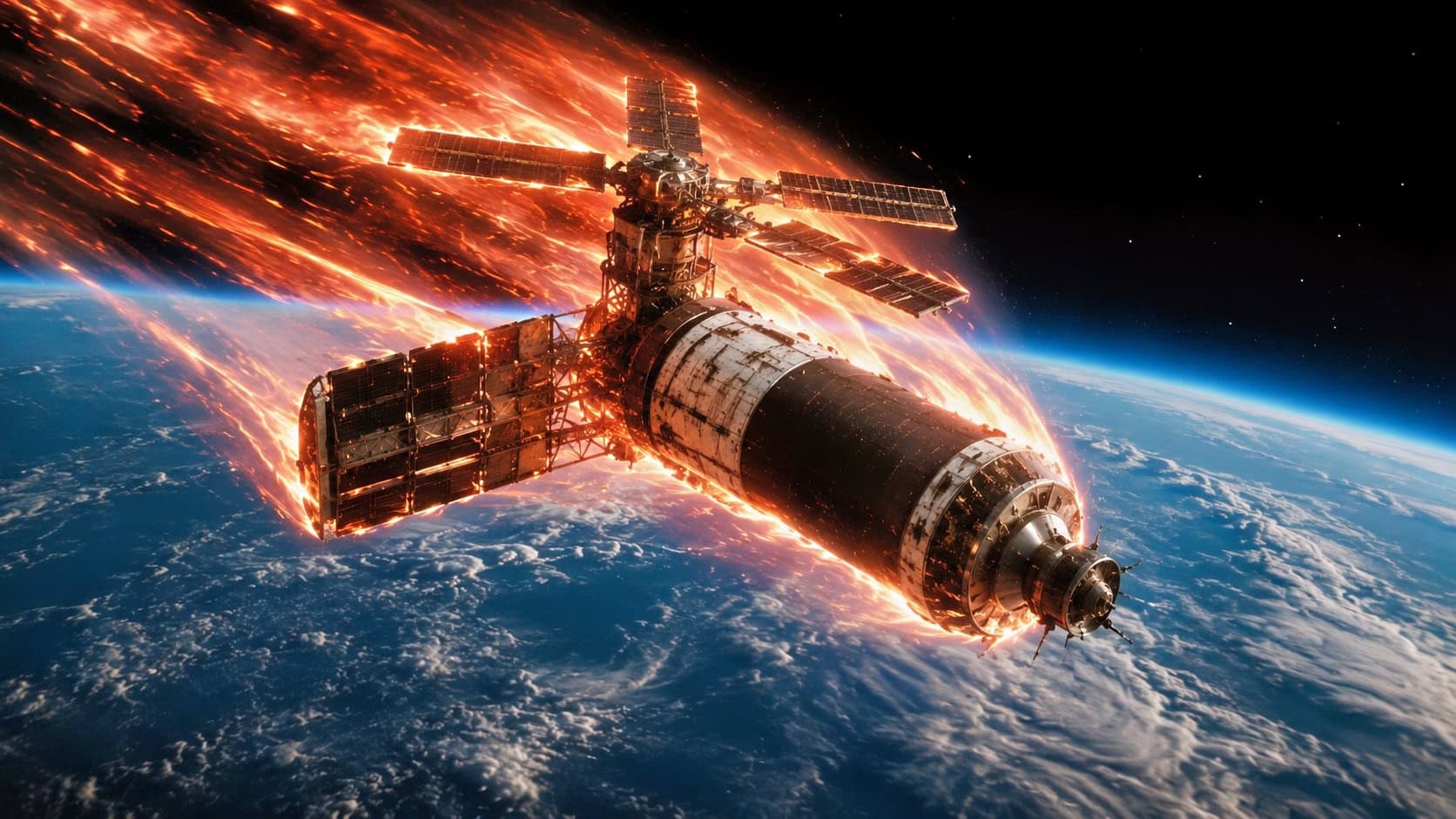
In the summer of 1979, the United States dropped a 77-ton space station out of the sky and could not say where it would land. Skylab, America’s first space station, launched in 1973 and abandoned in 1974, was supposed to stay in orbit until the new Space Shuttle could fly up and boost it to safety. The shuttle ran years late, the Sun grew unexpectedly active and thickened the upper atmosphere, and Skylab began falling faster than anyone had planned. NASA, the agency that had put men on the Moon a decade earlier, found it could no longer save its own station, and the question stopped being whether Skylab would fall and became where. For weeks, the entire world watched the sky. Newspapers sold mock Skylab insurance, there was near-panic in some countries, and bets were placed on where the hardware would come down. NASA aimed for the Indian Ocean. Skylab broke apart later than the models predicted, overshot, and rained debris across a long stretch of Western Australia. No one was hurt. And the small Shire of Esperance, surveying the wreckage scattered across its district, did the only reasonable thing. The United States of America was issued a $400 littering ticket.
America’s First Space Station
Skylab was the United States’ first space station, launched on a modified Saturn V rocket in May 1973 and built largely from hardware left over after the Apollo Moon program was cut short. It was a real outpost where three separate crews lived and worked from 1973 through 1974, conducting solar astronomy and studying how the human body held up during long stays in space. By the time the last crew came home in February 1974, Skylab had cost an estimated $2.2 billion, and the plan was to leave it parked in orbit, empty, until NASA could send astronauts back up to use it again. It was a large object for its day, with a reentry mass usually estimated at 77 tonnes (about 169,000 pounds).
The Rescue That Never Came
The plan to save Skylab depended on a spacecraft that did not yet exist. NASA intended to send astronauts up on one of the early Space Shuttle missions to attach a rocket stage to the station and either boost it into a higher, more stable orbit or guide it to a controlled deorbit over the Pacific. The trouble was timing. The shuttle’s development ran long, and the winged orbiter didn’t come online until 1981, by which point Skylab was already gone.
Worse, the Sun refused to cooperate. The solar cycle of the late 1970s intensified into the second most active in a century, heating and expanding Earth’s upper atmosphere and increasing the drag on Skylab, pulling its orbit down far faster than the engineers had projected. Early estimates had put the station safe into the 1980s. By 1977, the revised projections moved the reentry up to as early as mid-1979. The agency that had landed on the Moon could not keep its own station in the sky, and by late 1978, it had effectively conceded that Skylab was coming down on its own.
The Whole World Watched The Sky
NASA could map a possible debris footprint thousands of miles long, but it could not say where in that footprint the pieces would actually fall, because the timing of the breakup depended on too many variables. So for weeks in 1979, the world watched and, in many places, made a party of it.
American newspapers jokingly offered Skylab insurance that would pay out for death or injury from falling fragments, stores sold novelty hard hats, and people threw Skylab parties. The San Francisco Examiner went furthest, offering a $10,000 prize to the first person to deliver a piece of the station to its offices within 72 hours of the crash, a bet the paper felt safe making because the debris was not expected to come down anywhere near the continental United States.
There was real anxiety underneath the jokes, especially abroad, but in the place that ended up directly beneath the falling station, the mood tilted toward spectacle. Tiny Balladonia, a settlement on the Nullarbor Plain with a population of about 20, briefly became the center of the world’s attention, and once it was clear debris had reached the ground, treasure hunters swarmed the desert looking for pieces, to the point that one sheep-station manager had to ring the local paper and ask people to get off his land.
77 Tons Over The Outback
NASA was not entirely helpless as Skylab came down.
In its final orbits, controllers fired the booster rockets one last time to set the station tumbling in a way meant to push the breakup toward the southern Indian Ocean, away from people. It was a mostly uncontrolled reentry with a partial nudge on the aim, not a precise landing, and the nudge only half worked. Skylab entered a little earlier than predicted and broke apart at an altitude of about 10 miles, slightly lower than expected, which pushed the impact footprint farther east than planned.
The result was that while the heaviest pieces fell into the ocean, a long trail of debris carried on over land, scattering large chunks and dozens of smaller fragments across a sparsely populated swath of Western Australia, from the coastal town of Esperance across the Nullarbor Plain and on past Balladonia, accompanied by sonic booms heard across the Outback in the early hours of July 12 local time.
The remarkable thing is that it hurt no one. The pieces came down over a thinly settled region, causing no injuries or real damage. The reentry still triggered a diplomatic moment, with President Jimmy Carter sending a message to Australia expressing relief that no one had been harmed and offering any assistance the country might need. Australia’s response, or at least Esperance’s, turned out to be rather less solemn.
A $400 Ticket For Littering
When NASA representatives came to the area regarding the debris, the Shire of Esperance presented them with a bill. It was a comical $400 bill for littering, issued under the same local ordinance that would have applied to anyone else who scattered rubbish across the district, now applied to the world’s most advanced space agency. The detail that most retellings drop is the one that makes the whole thing make sense.
Everyone involved knew it was a joke. A small rural shire was not seriously trying to regulate the reentry of an American spacecraft, and the humor worked precisely because of the mismatch between a local council’s litter rule and a falling 77-ton space station. The NASA men took the ticket in good spirits, and the agency never paid it, which was understood as part of the gag rather than any kind of diplomatic incident.
The fine then sat unpaid for 30 years, kept alive less as a grievance than as a piece of local folklore that Esperance was happy to retell. The ending came in 2009. For the 30th anniversary of the crash, Scott Barley, a radio host for Highway Radio in California and Nevada, used his program to raise the $400 from his listeners and finally settle the bill. The cheque was handed over, the city of Barstow declared July 13, 2009, a “Shire of Esperance/Skylab Day,” and Barley was given a key to the city. The long-running joke had a tidy finish, half a world and three decades from where it started.
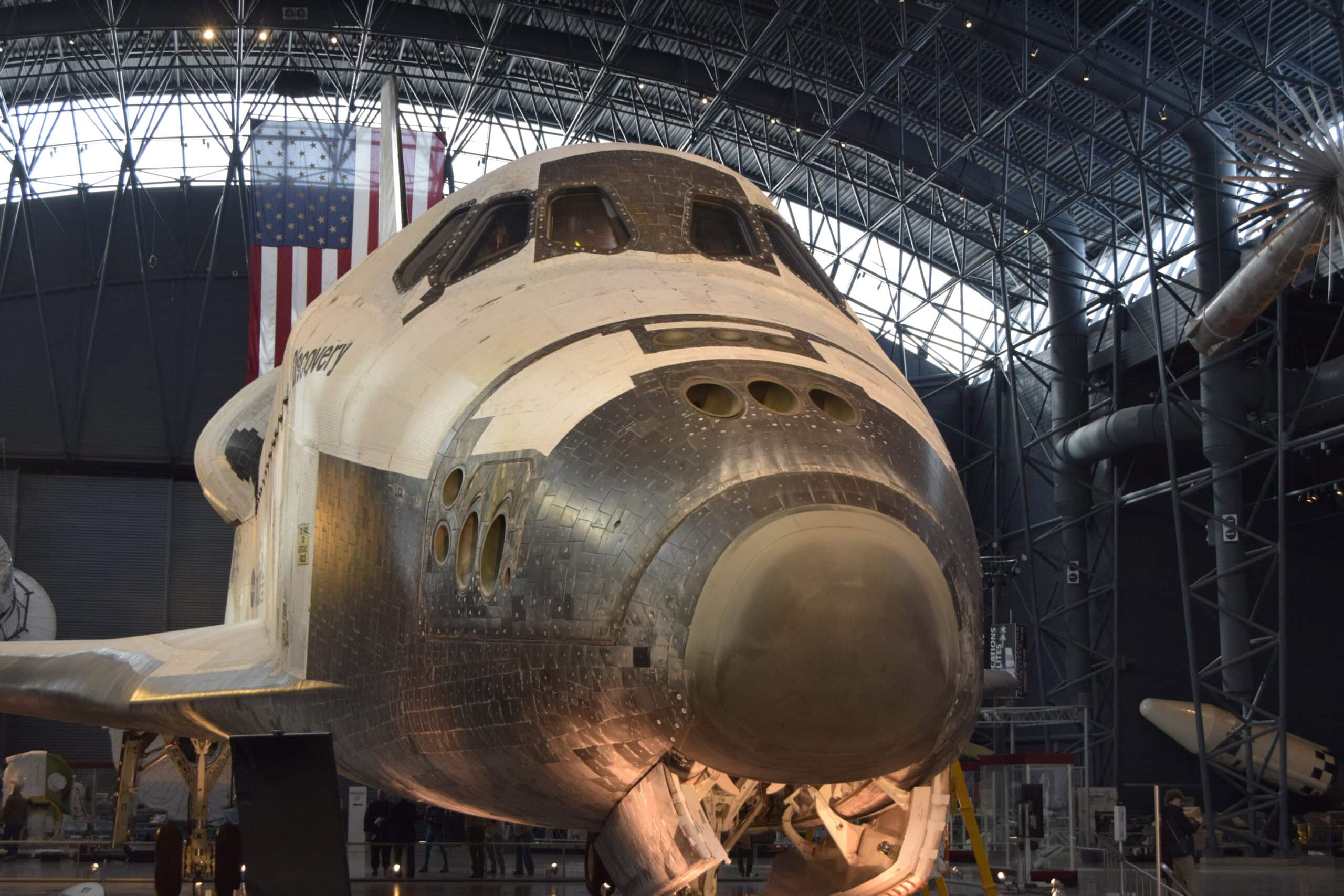
NASA Space Shuttle at the Smithsonian. Image Credit: 19FortyFive Original Photo from Visit in 2025.
The Teenager And The Bounty
The San Francisco Examiner’s $10,000 bounty turned out not to be as safe a bet as the paper assumed. News of the prize traveled all the way to Esperance, where a 17-year-old local named Stan Thornton woke in the early morning to the sound of Skylab breaking up overhead and fragments pelting his house. He grabbed a few charred pieces from his yard, made his way to San Francisco, and reached the Examiner’s office within the deadline to collect the $10,000. A teenager from a remote Australian town had beaten the world to the prize, with debris that had landed, more or less, in his own backyard.
Skylab Is Still In The Outback
More than 45 years later, much of what survived the fall is still in Australia.
The Esperance Municipal Museum keeps a large oxygen tank from the station along with its food freezer, the nitrogen spheres from the attitude-control thrusters, and a section of the hatch the astronauts once crawled through, with the oversized 2009 cheque hanging above the display and a billboard outside the building that reads, “In 1979, a spaceship crashed over Esperance. We fined them $400 for littering,” stamped “PAID IN FULL.” Down the road, Balladonia holds a few sheets of the orbiter’s metal, including one bearing the word “Skylab” and another marked “airlock, danger.” Other pieces ended up at the US Space and Rocket Center in Huntsville and at a museum in Sydney, and it is entirely possible that more fragments are still lying out in the remote Outback, never found. There is more of America’s first space station on display in two small Australian towns than in most museums in the United States.
The deeper problem Skylab dramatized never really went away. It was the heaviest spacecraft to reenter up to that time, and the difficulty of bringing a large object down without precise control over where the debris falls is the same one space agencies still manage today, with spent rocket stages and dead satellites. The modern answer is to aim controlled reentries at a remote, empty stretch of the South Pacific far from any land, a kind of spacecraft graveyard, precisely so that nothing repeats what happened over Western Australia in 1979. It belongs to the broader story of what goes up eventually coming back down somewhere, the same story as the long-orbiting Soviet hardware that has tumbled out of the sky in the decades since.
Skylab’s fall was the rare space accident that ended as comedy rather than tragedy. A superpower that had walked on the Moon ten years earlier dropped 77 tons of its own hardware onto another country, could not say where it would land, hurt no one, and was handed a parking-style ticket for the trouble by a town of a few thousand people on a lonely coastline.
The fine went unpaid for 30 years, the debris went on display, and a teenager with a fistful of charred metal flew to California and collected $10,000. The greatest embarrassment in the early history of space stations came down in the Australian desert and turned into one of the best stories in spaceflight.
About the Author: Harry J. Kazianis
Harry J. Kazianis (@Grecianformula) was the former Senior Director of National Security Affairs at the Center for the National Interest (CFTNI), a foreign policy think tank founded by Richard Nixon based in Washington, DC. Harry has over a decade of experience in think tanks and national security publishing. His ideas have been published in the NY Times, The Washington Post, The Wall Street Journal, CNN, and many other outlets worldwide. He has held positions at CSIS, the Heritage Foundation, the University of Nottingham, and several other institutions related to national security research and studies. He is the former Executive Editor of the National Interest and the Diplomat. He holds a Master’s degree focusing on international affairs from Harvard University.

