
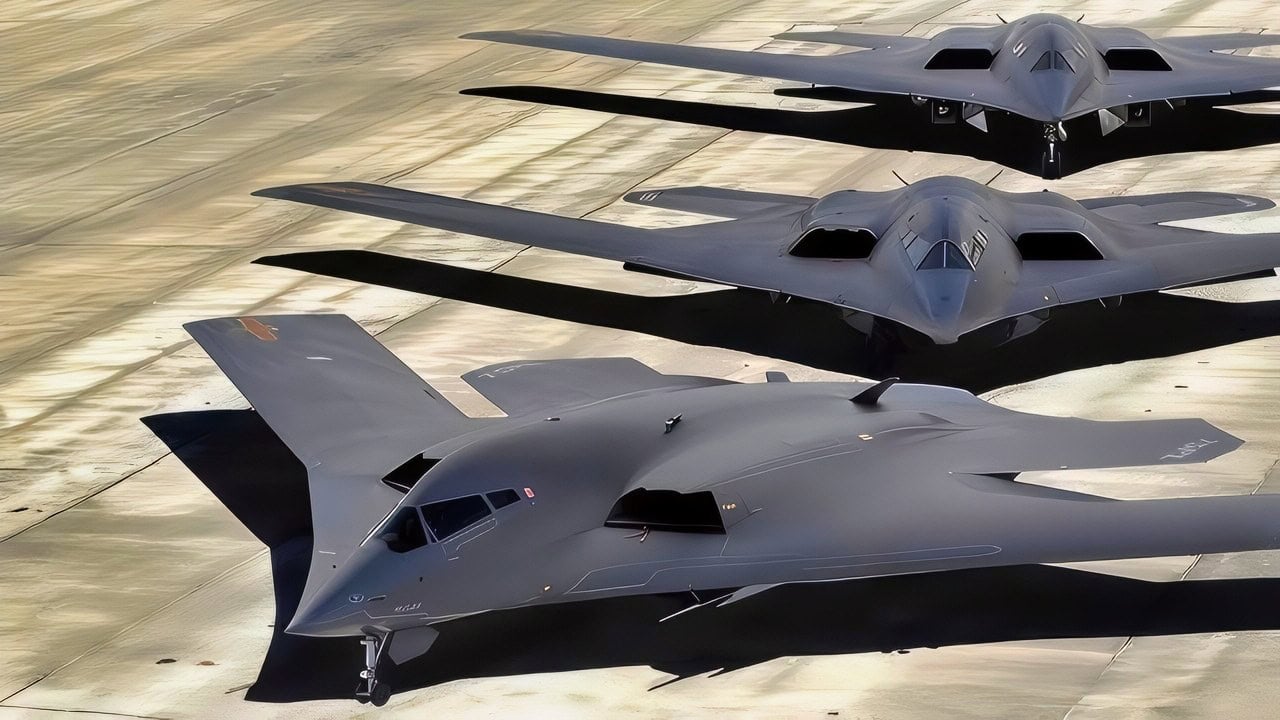
A decade after Xi’an Aircraft Corporation’s strategic bomber program first surfaced in public, the company still has no flying prototype to show for it. The H-20 was acknowledged in 2016, has missed a string of unveiling windows since, and has produced no confirmed test flight, no images of a finished airframe, and no sign of a production line. The reasons are industrial rather than financial. An intercontinental flying-wing bomber makes demands on engines, low-observable materials, large-composite manufacturing, and flight-control engineering that fall precisely on the parts of China’s aerospace-industrial base that remain the least developed.
Xi’an, AVIC, and a Program Without a Production Line
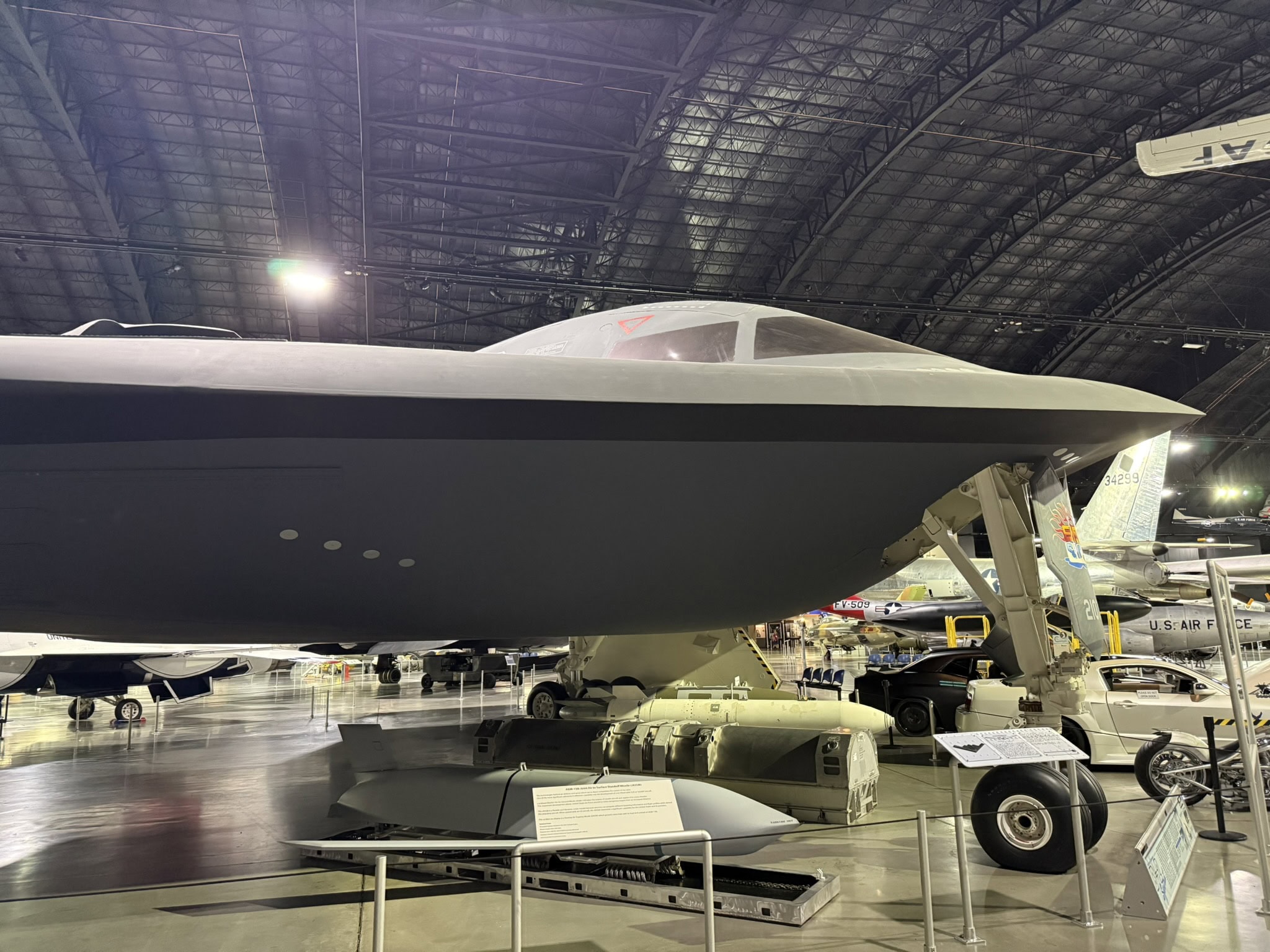
B-2 Spirit Photo Taken in July of 2025 by Harry J. Kazianis for 19FortyFive.com
The H-20 is a project of Xi’an Aircraft Corporation, the bomber-building arm of Aviation Industry Corporation of China (AVIC), the state aerospace conglomerate. Xi’an’s pedigree is in the H-6, a license-built descendant of the 1950s-era Soviet Tupolev Tu-16 that remains the only long-range bomber the company has ever series-produced. Moving from an upgraded 1950s airframe to a clean-sheet flying wing is a generational leap in manufacturing capability, not an incremental update to an existing line.
What is publicly known about the design comes mostly from outside China. The U.S. Department of Defense has described the H-20 as a subsonic flying wing with a range of at least 8,500 kilometers and a payload capacity of around 10 tonnes, and the Pentagon’s annual reports have projected an operational debut in the 2030s. Those reports have also grown notably quieter on the program. The Pentagon’s most recent annual assessment of Chinese military power, published in December 2025, made no mention of the H-20 at all, a silence The War Zone flagged in reporting on the state of China’s bomber ambitions.
The Engine Is the Central Bottleneck
The most intractable problem is propulsion. China does not have a purpose-built large, high-bypass, fuel-efficient turbofan suited to pushing a heavy flying wing across intercontinental distances, and developing one has proven harder than any single part of the airframe. The WS-15 that powers the Chengdu J-20 is the wrong class of engine entirely, an afterburning fighter powerplant built for speed and agility rather than range and efficiency.
The likely stopgap is a variant of the WS-20, a high-bypass turbofan developed for the Y-20 airlifter with a thrust in the range of 13,000 to 16,000 kgf, derived from the WS-10 “Taihang” core. Analysts have speculated that the WS-20 may not provide the thrust or the efficiency to carry a 10-tonne load over Pacific distances, though that engine pairing remains unconfirmed. The fallback, the Russian-derived D-30KP that powers the H-6K, is an older low-bypass design poorly suited to either fuel efficiency or a low-observable installation.
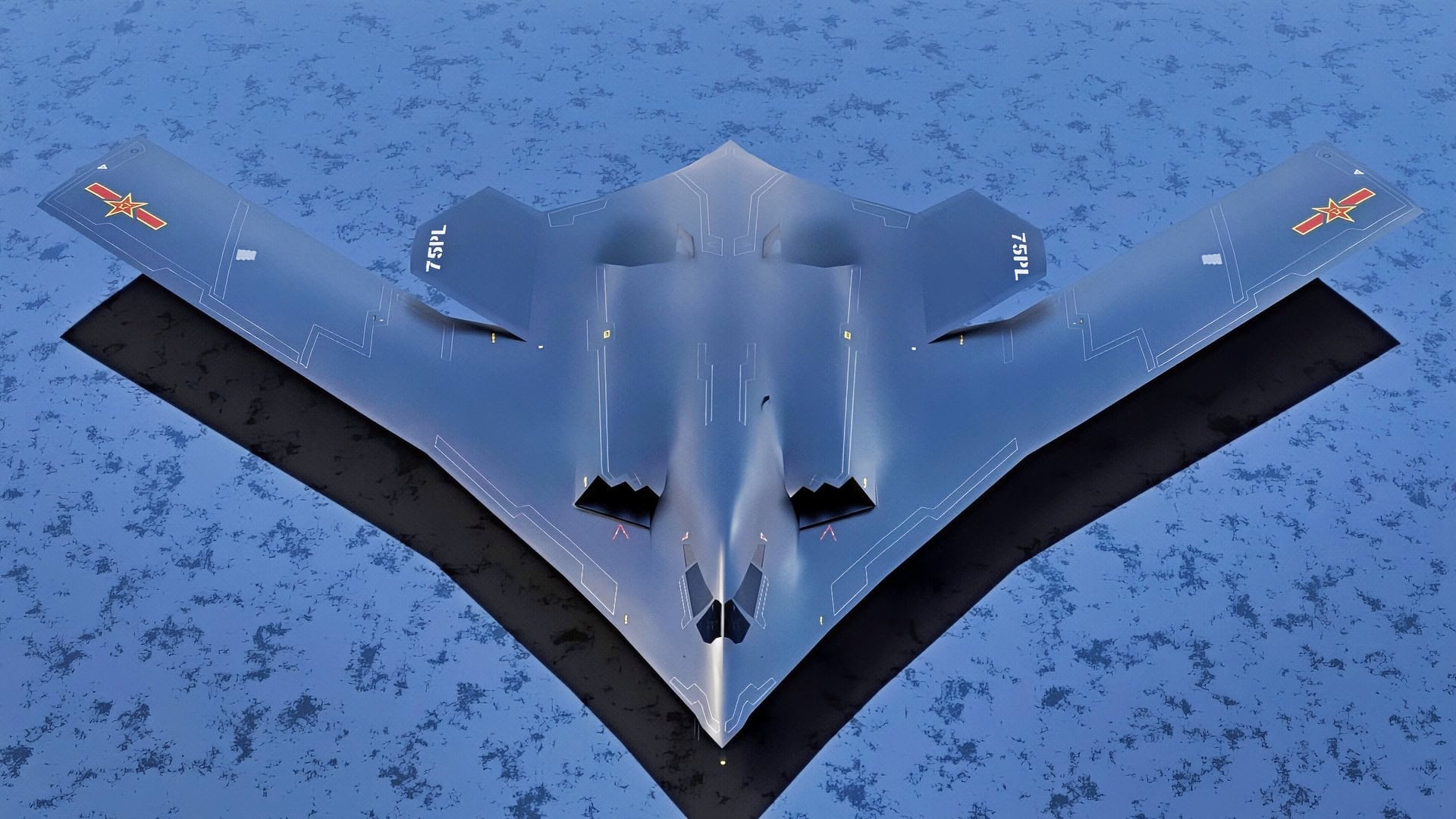
H-20 Bomber Mock Up X Screenshot 2026
Behind the specific engine choice sits a broader manufacturing problem that China has spent years working to close. Janes has assessed that the country’s central difficulty in fielding production-ready military aero-engines is reliability, which it ties to core technologies and to “high-grade materials, alloys, and components” such as bearings, compressors, and turbine blades, as well as design and manufacturing processes. Those are precisely the disciplines an efficient large turbofan depends on.
There is also a stealth penalty embedded in the shortfall: Chinese turbofans tend to run hotter and less efficiently than Western equivalents, which raises the rear-hemisphere infrared signature and works against the very low observability the airframe is designed to deliver, a point detailed in earlier analysis of the program. The scale of the engineering gap shows up on the civil side as well.
China’s domestic high-bypass turbofan for commercial airliners, the CJ-1000A, is not expected to be ready until around 2030, underscoring how far the country’s large-turbofan programs still have to run.
Radar-Absorbent Materials at Bomber Scale
The second bottleneck is materials science. Radar-absorbent materials and coatings are delicate and difficult to apply, and a low-observable airframe must present a surface that is essentially seamless, because gaps and discontinuities re-radiate radar energy and drive up the radar cross-section. That problem grows more severe with size.
Aviation Week has documented how the American B-2, the closest analogue to what Xi’an is attempting, required conductive tapes and caulks to bridge any gaps in its skin, a labor-intensive treatment that became one of the largest drivers of the bomber’s maintenance burden.
Producing broadband, all-aspect radar-absorbent structures across an airframe large enough to cross oceans is a first-order materials challenge that does not transfer cleanly from fighter-scale work.
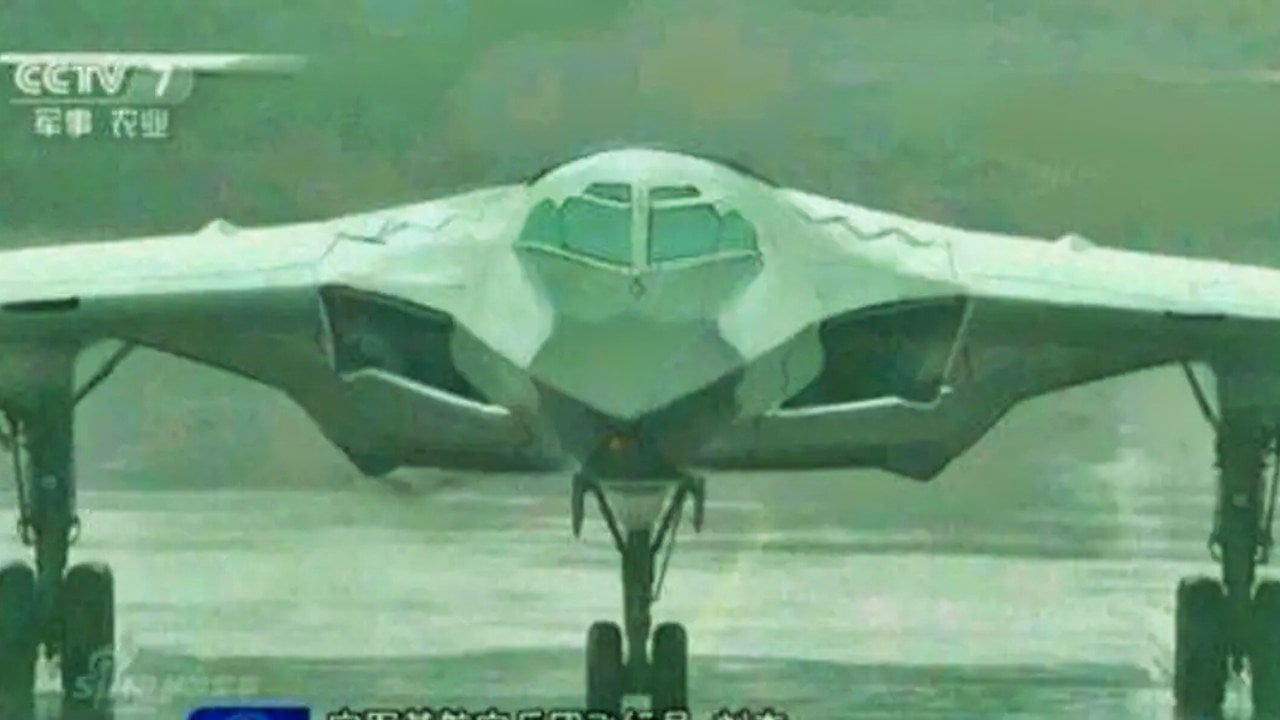
Image Credit of H-20 Bomber: Creative Commons.
The coatings and composite structures that achieve low observability on a small fighter must be re-engineered for a far larger surface area while holding the same tolerances, and stealth materials, alongside engine performance, are the two areas where China’s aviation sector has historically lagged the West most clearly. These are not problems that can be solved with additional funding or by copying an existing airframe’s external shape, because the hard part lies in the materials and the process, not the silhouette.
Precision Composites and Tooling That Does Not Yet Exist
Closely tied to the materials problem is the manufacturing one. A low-observable airframe must be built to a smooth, seam-free finish, and that requires custom production tooling, much of which does not yet exist and has to be designed and built before the first airframe can be assembled. Large composite structures are difficult to handle in the first place.
They are laid up from many individual layers, and small errors in shape compound quickly across a large part, which is unacceptable on an aircraft whose specific contours are what make it stealthy.
The tolerances involved are unforgiving. Stealth airframes are assembled to fit, measured in millimeters, because panel gaps or inconsistencies in the coating translate directly into a larger radar cross-section. Holding that precision across a bomber-sized composite airframe demands industrial infrastructure, climate-controlled assembly, automated material-application systems, and a trained workforce, which China is still building out. It is the difference between demonstrating a capability on a prototype and producing it repeatably on a line, and the line is where the H-20 has shown no public progress.
Tailless Flight Control
The flying-wing planform that delivers the stealth also creates the fourth problem. A tailless aircraft is aerodynamically unstable and difficult to control, and keeping one flying smoothly requires a fly-by-wire system that makes continuous micro-adjustments throughout the flight, supported by new flight-control computers and software developed for the airframe. Getting that integration right is aerodynamic and software engineering at the edge of the achievable.
China has flown tailless designs before, but at a different scale. Its flying-wing experience is concentrated in smaller unmanned aircraft such as the GJ-11 Sharp Sword combat drone, not in a large, manned, intercontinental platform capable of carrying a heavy payload for long endurance. The control laws and structural and aerodynamic refinements that work on a drone do not scale up automatically, and the leap from an unmanned testbed to a crewed strategic aircraft is substantial.
Competing for Materials, Labor, and Budget
The H-20 does not draw on China’s aerospace base in isolation. It competes for the same advanced materials, skilled engineers, and program funding as the J-20 and J-35 fighters, an expanding fleet of unmanned systems, and a large and growing missile-production effort, all of which are currently in active manufacturing. With finite supplies of specialized labor and high-grade materials, a bomber that has not reached the production line tends to lose the internal competition to programs already delivering hardware. The prolonged absence of any confirmed prototype or line has fueled speculation that China is steering resources toward fighters and unmanned aircraft, though that shift is an inference rather than a documented decision, and the contrast is evident in the pace of fighter programs advancing while the bomber remains out of sight.
None of this means Beijing has abandoned the requirement. Song Zhongping, a military analyst and former People’s Liberation Army instructor, argued in the South China Morning Post that “a dedicated strategic bomber is irreplaceable” even in an era of other long-range options, a view that reflects why China continues to fund the effort. American assessments, for their part, frame the gap as a matter of capability rather than intent. Gen. Stephen Davis, head of U.S. Air Force Global Strike Command, has described China as a “regional bomber force at best,” and a Defense Department intelligence official told Breaking Defense that the H-20’s system design is probably nowhere near as capable as U.S. low-observable platforms because Chinese engineers had run into significant engineering design challenges.
The present state of the program is the clearest evidence of where those challenges stand. Nearly ten years after it was revealed, the H-20 has no confirmed flight, no visible production line, and a service-entry estimate that has drifted into the 2030s, while Chengdu and Shenyang continue to turn out fighters in quantity. The constraints are concrete and industrial: the engines, the low-observable materials, the precision tooling, and the flight-control integration. Until Xi’an and AVIC close them, the H-20 remains a strategic bomber that the Pentagon’s most recent report on Chinese military power did not mention at all.
About the Author: Harry J. Kazianis
Harry J. Kazianis (@Grecianformula) was the former Senior Director of National Security Affairs at the Center for the National Interest (CFTNI), a foreign policy think tank founded by Richard Nixon based in Washington, DC. Harry has over a decade of experience in think tanks and national security publishing. His ideas have been published in the NY Times, The Washington Post, The Wall Street Journal, CNN, and many other outlets worldwide. He has held positions at CSIS, the Heritage Foundation, the University of Nottingham, and several other institutions related to national security research and studies. He is the former Executive Editor of the National Interest and the Diplomat. He holds a Master’s degree focusing on international affairs from Harvard University.

