
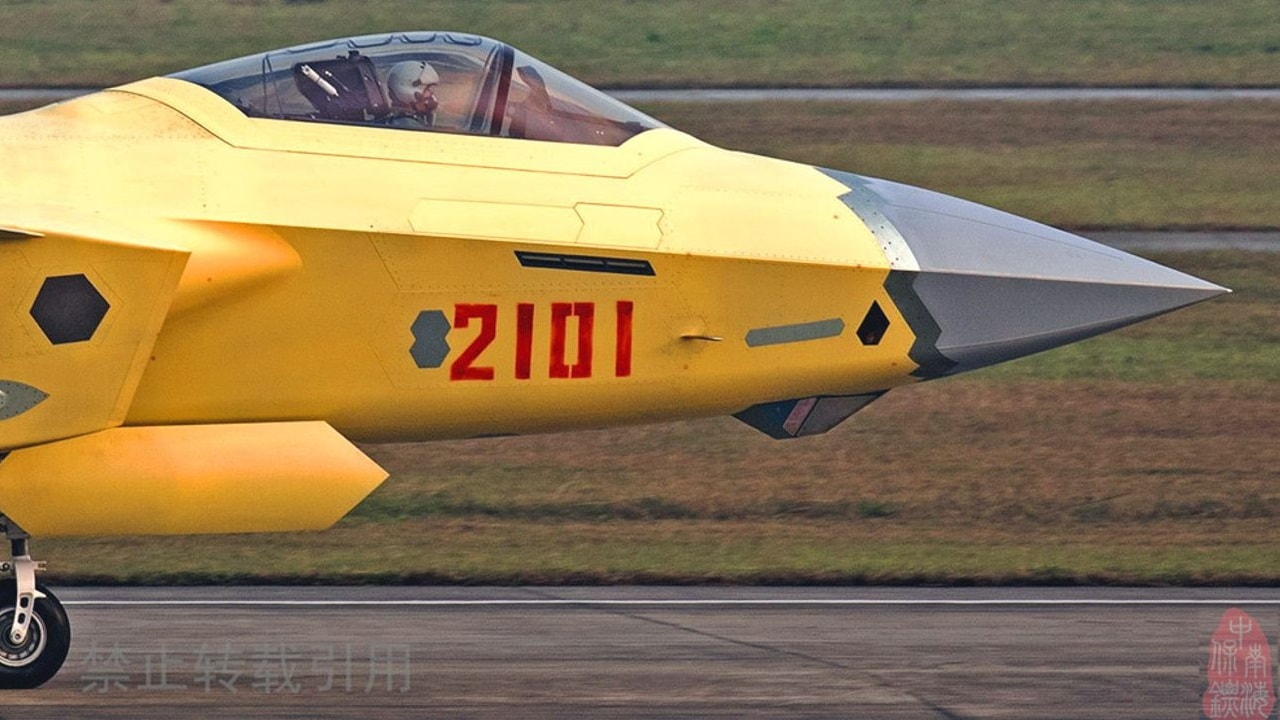
J-20 Mighty Dragon: The Industrial and Aerospace Questions – On January 24, Chengdu Aircraft Corporation released photographs of a J-20A stealth fighter in flight, finished in the yellow zinc-chromate primer the Chinese industry applies during production and acceptance testing, before the final stealth coatings go on. The detail that mattered sat at the back of the aircraft. The nozzle geometry matched the WS-15, the high-thrust turbofan China has been trying to perfect for this jet since the 1990s. Days later, footage circulated by state media showed at least three J-20As in the same pre-delivery primer taxiing together, according to a Xinhua post carried by the South China Morning Post.
What Does the WS-15 Engine Actually Change for the J-20?
A new engine on a fighter sounds like a maintenance item. On this fighter, it is the difference between the aircraft China designed and the aircraft China has actually been flying, because the J-20’s operational logic, its reach, its dash speed, and the energy it can hand a missile at launch all run through the engines. As of July 2, the jets undergoing pre-delivery testing in Chengdu are the first built from the start around the powerplant the design always assumed.
Aerospace Reality: A Mach 2 Airframe That Flew for a Decade on Interim Engines
Everything about the J-20’s shape argues for speed. The long blended fuselage, the canard-delta layout, and the diverterless supersonic inlets were chosen to enable a large aircraft to move fast and far while remaining hard to detect. The jet first flew in January 2011 and entered service in 2017 as the first operational stealth fighter built outside the United States.
The engines never kept up. Early production aircraft flew on imported Russian AL-31 variants, and from around 2021 the fleet transitioned to the domestic WS-10C, itself an interim solution. A 2021 analysis carrying the Royal United Services Institute’s assessment of the program was blunt about the consequences: the powerplants left the aircraft underpowered and unable to supercruise, and the J-20, the largest low-observability fighter in production anywhere, could not compete with the flight performance or agility of the F-22. For most of its service life, China’s premier stealth fighter has been a supersonic design flying on engines that could not fully exploit the flight envelope it was designed for.
Washington said much the same thing in its own documents. In its 2023 report on Chinese military power, the Pentagon listed supercruise not as something the J-20 had, but as something Beijing was working toward, writing that planned upgrades included “adding supercruise capability by installing higher-thrust indigenous WS-15 engines.” Supercruise, maintaining supersonic speed without the afterburner fuel burn that empties tanks in minutes, is the capability that separates a jet that can touch Mach 2 from one that can fight there.
The speed figures themselves have always required care. Beijing publishes no official top speed. The commonly cited estimate is around Mach 2, twice the speed of sound, and Chinese-reported figures for the newer two-seat J-20S run as high as Mach 2.55, a number best treated as Beijing’s claim rather than a measured fact. Whether the interim-engine jets could supercruise at all is itself contested: RUSI assessed in 2020 that they could not; the Pentagon, in 2023, described supercruise as a future addition, and claims of Mach 1.5 cruise speeds circulated anyway. The variance is the honest picture, and every part of it turns on the engine.
Industrial Shift: The WS-15 Moves From Test Article to Production Line
The WS-15 has been the program’s longest-running promise. China’s state engine maker announced the start of serial production in 2023, the same year a J-20 first flew with two of the engines installed. In 2024, The War Zone published the clearest imagery yet of a WS-15-equipped J-20A and noted the numbers that make the engine matter: prototypes reportedly producing at least 36,000 pounds of thrust with afterburner against a 40,000-pound goal, compared with roughly 35,000 pounds for each of the F-22’s F119s. That thrust, the outlet assessed, could put the J-20A into “the elite group of current fighters that can supercruise well above Mach 1,” with the gains showing up exactly where the jet’s missions need them, in dash speed and ceiling.
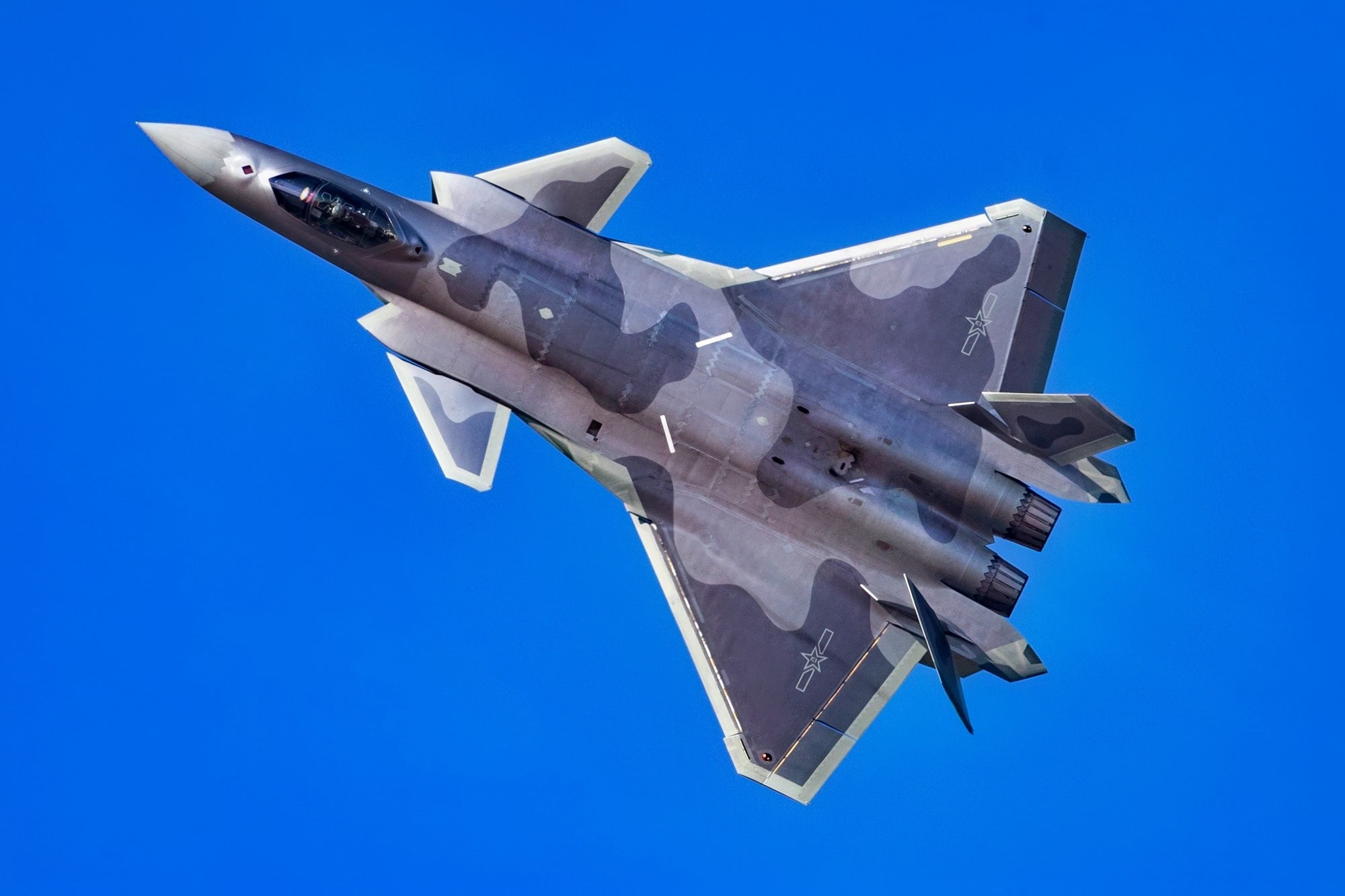
J-20 Fighter from China. Image Credit: Creative Commons.
What changed over the winter is the stage of the program those engines occupy. Footage circulating in late December 2025 pointed to newly completed production aircraft with the WS-15 installed, and the January releases from Chengdu, aircraft in acceptance primer rather than test markings, read as scaling rather than experimentation.
How quickly the WS-15 displaces the WS-10C across the production line has not been publicly confirmed, and the thrust figures are reported rather than verified. But the direction is no longer in dispute. The engine the airframe waited fifteen years for is going onto new jets as they are built.
PL-15 Missiles and Tanker Orbits: What the J-20’s Speed Is Actually For
The case for caring about any of this rests on a piece of physics that gets less attention than stealth coatings and radar cross-sections.
A missile fired from a fighter flying at supersonic speed and high altitude begins its flight with energy it did not have to generate itself; the launch aircraft’s speed and altitude become the missile’s head start. A fighter that cruises at supersonic speeds without afterburners arrives at the launch point with that energy and with fuel still in its tanks. Speed, in this arithmetic, works less as a getaway statistic than as a range extender for every weapon the aircraft carries.
China has built its air-to-air arsenal around that arithmetic. The Royal United Services Institute’s January assessment of Chinese air power, written by its air power research lead Justin Bronk, found that the PL-15, PL-16 and PL-17 missile family gives Chinese fighters not just longer reach than Western jets armed with the AIM-120 AMRAAM but “an advantage in time-to-target across any given range,” because the missiles fly faster at their peak. In a simultaneous exchange, the paper assessed that the Chinese shot would probably arrive first. The PL-16 adds folding fins sized so that a J-20 can carry six of them internally, thereby deepening the magazine without compromising the jet’s stealth. The missiles got a combat data point in May 2025, when a PL-15E fired during the India-Pakistan clash downed at least one Indian Rafale, with Pakistani officials claiming to Reuters that one shot connected from 200 kilometers, and RUSI’s caveat travels with the claim: the export missile is probably inferior to what frontline Chinese units carry.
Now put the fast jet and the fast missile against the map. RUSI’s conclusion is that China fields capabilities capable of threatening American aerial refueling tankers, carrier groups, and forward bases at distances of 1,000 kilometers or more. American airpower in the Western Pacific runs on a small number of large, slow, unstealthy aircraft, the KC-135 and KC-46 tankers, and the radar and command planes that let fighters find their targets and their fuel. A stealthy interceptor that cruises at supersonic speeds exists to compress the time those aircraft have to react and to stretch the distance at which they can be reached. Push the tankers back, and every American fighter they feed loses combat time and reach over the places where a fight would happen. The Pentagon’s December 2025 report to Congress warned that the growing inventory of J-20 variants is built to contest American and allied air operations in a conflict, and in January, Beijing itself widened the job description, using the program’s fifteenth anniversary to reveal that the two-seat J-20S adds maritime strike to the family’s missions.
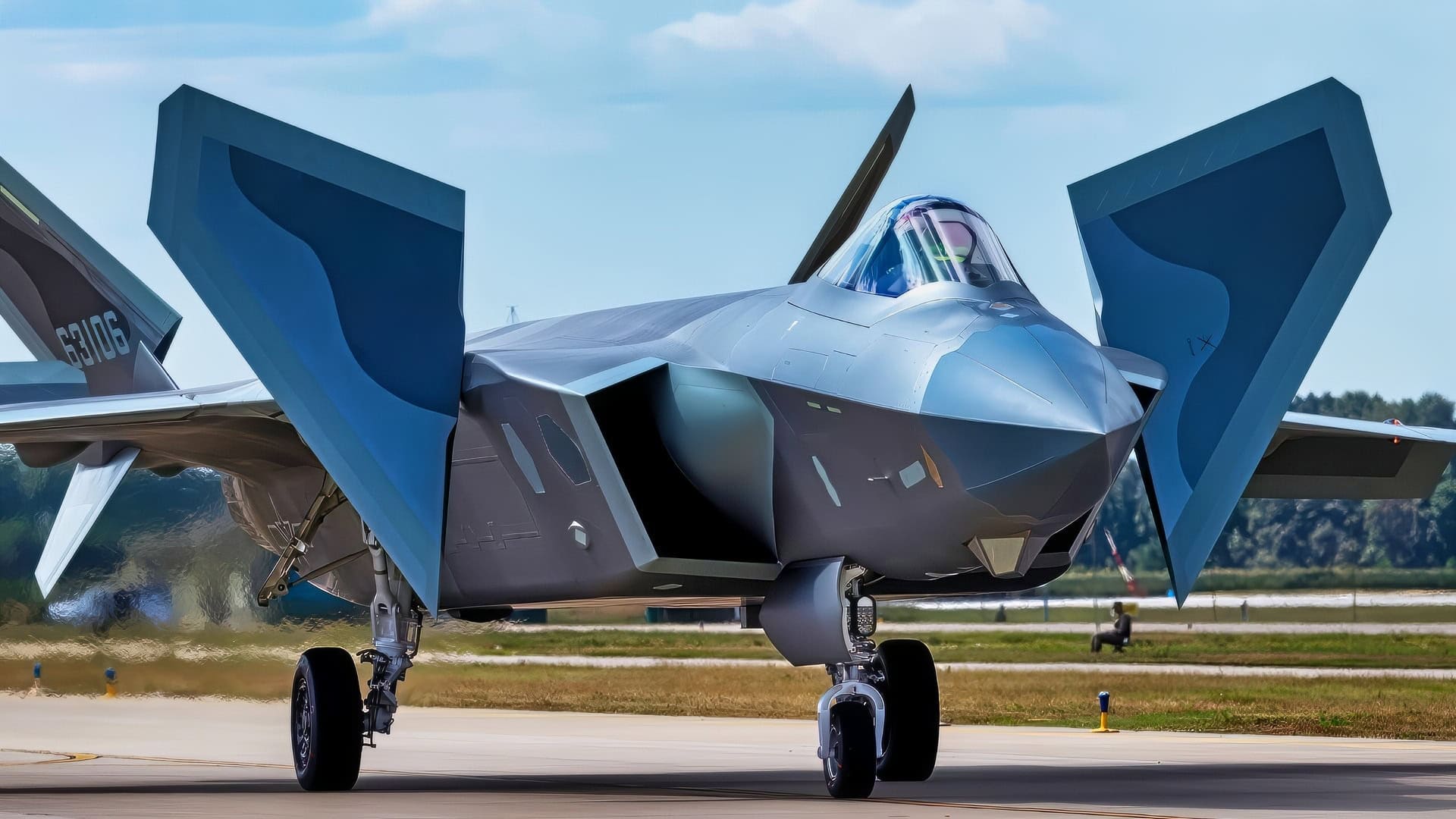
J-20 Fighter 2025 Photo. Image Credit: Creative Commons.
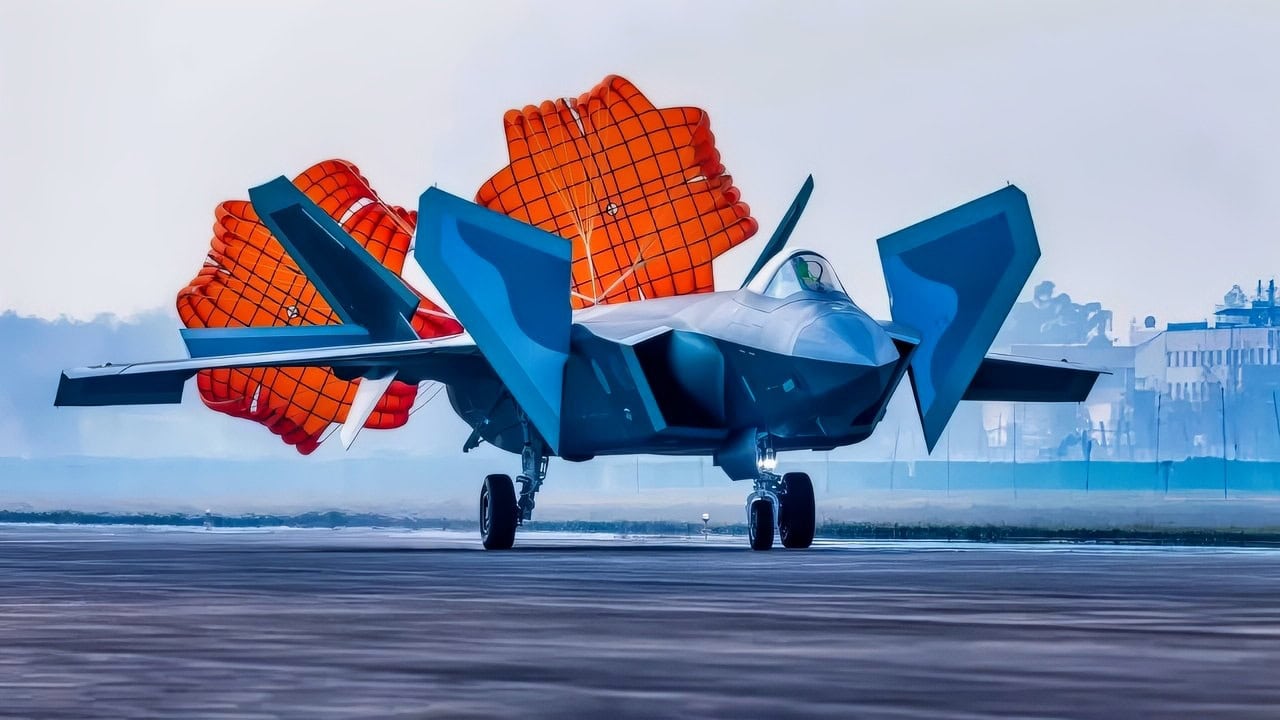
J-20S Fighter from China. Image Credit: Creative Commons.
Scale does its own work here. Chinese production is estimated at roughly 120 J-20s per year, compared with an F-22 fleet that ended at 187 aircraft when the line closed in 2012. A single year of Chengdu’s output builds roughly two-thirds of the entire Raptor fleet. RUSI’s count put about 300 J-20s in service by mid-2025, up from around 50 in 2020, with the trend pointing toward roughly 1,000 by 2030. Numbers like that turn a performance upgrade into a theater problem: not one fast interceptor probing the tanker line, but squadrons of them.
The Air-Superiority Question: Where the Speed Case Meets Its Limits
The strongest objection deserves its full weight. Modern air combat is decided overwhelmingly by detection and tracking, by who sees whom first and shoots from ambush, and speed does not outrun a missile once a jet is tracked. By that logic, which many analysts hold, the J-20’s stealth shaping and sensor fusion matter far more than its Mach number, and a fixation on raw speed reads like Cold War nostalgia.
Each part of that is real, and the core of it is probably right as far as any single engagement goes: sensors and stealth, more than knots, decide who dies in a beyond-visual-range exchange. It is also a description of one engagement, and the tanker problem spans geography, fuel fractions, and reaction time across millions of square miles, which is exactly where cruise speed compounds.
The framing of the jet itself is also contested, and honestly so. Aviation Week noted the split years ago: the Western press casts the jet as a stealthy interceptor built to hunt tankers and command aircraft, while every Chinese description of the aircraft makes it an air-superiority fighter meant to defeat other fighters; a PLAAF brigade commander said its purpose was to “sweep away all fourth-generation fighters.” If Beijing’s own framing is accurate, the tanker-hunter thesis overstates the jet’s specialization.
The 2020 RUSI critique has not been repealed either: this is a big, heavy aircraft that has never matched the F-22’s agility, its supercruise performance has never been publicly demonstrated, its thrust figures are reported rather than measured, its pilots have no combat record, and the readiness of a fast-growing fleet is opaque. The engine changes the jet’s potential. Nothing yet in the public record proves the potential has been reached.
For now, the newest J-20 Mighty Dragons sit in yellow primer at Chengdu, waiting for their stealth coatings, and the measures that matter next are concrete: how fast a fully powered J-20A actually cruises, how much reach that speed hands a PL-15 at the moment of launch, and how far back the tankers and radar aircraft have to stand in response. Even China’s sixth-generation prototypes, by RUSI’s read, are optimized for the same currency of altitude and speed. The airframe waited for its engine for fifteen years. The engine’s first full production year is already half over.
About the Author: Harry J. Kazianis
Harry J. Kazianis (@Grecianformula) was the former Senior Director of National Security Affairs at the Center for the National Interest (CFTNI), a foreign policy think tank founded by Richard Nixon based in Washington, DC. Harry has over a decade of experience in think tanks and national security publishing. His ideas have been published in the NY Times, The Washington Post, The Wall Street Journal, CNN, and many other outlets worldwide. He has held positions at CSIS, the Heritage Foundation, the University of Nottingham, and several other institutions related to national security research and studies. He is the former Executive Editor of the National Interest and the Diplomat. He holds a Master’s degree focusing on international affairs from Harvard University.

