
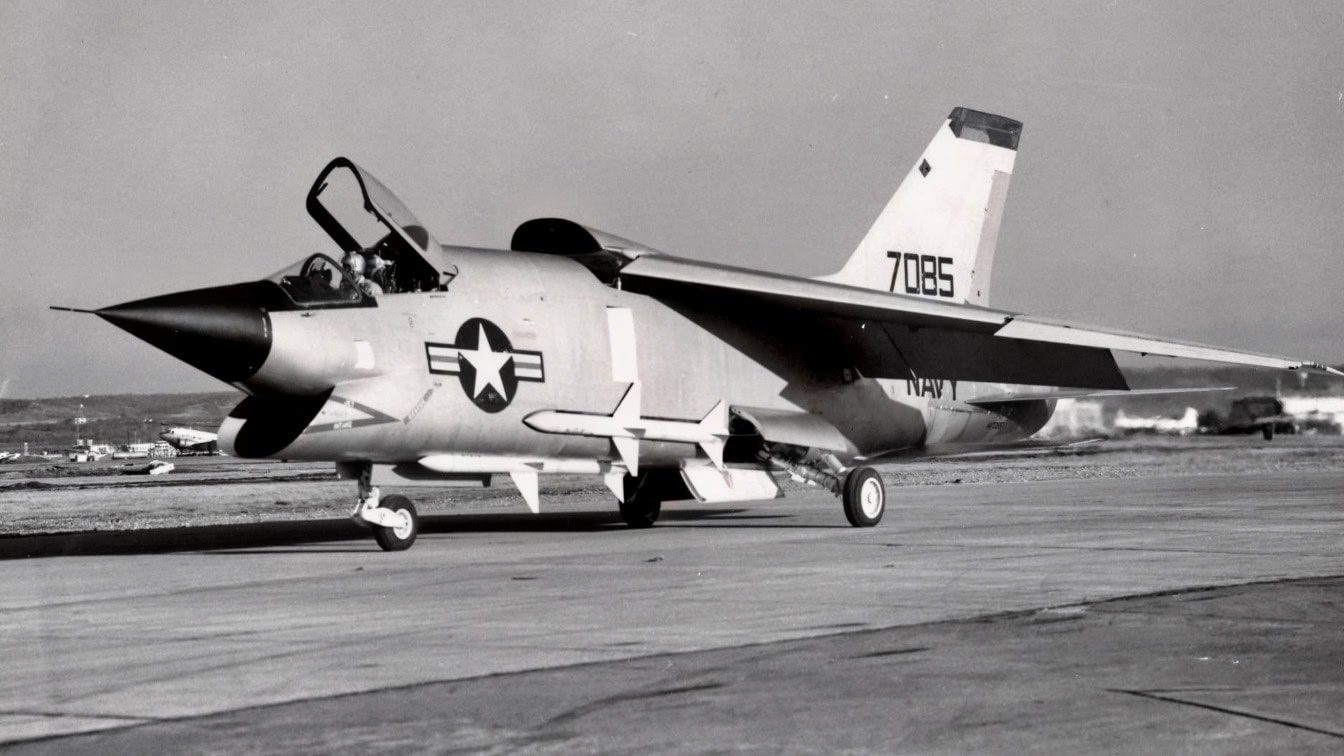
Summary and Key Points: In the summer of 1959, the brand-new National Aeronautics and Space Administration took possession of a rejected Navy fighter and used it to make some of the first airborne measurements of how a sonic boom affects people below — a question NASA is still pursuing today. The airplane had lost a competition months earlier to the aircraft that became the F-4 Phantom, and the men who flew it went on to Apollo, the Space Shuttle, and six years in a Hanoi prison cell. This is the story of the best fighter the United States never built, and of everything its loss set in motion. This is the story of the Vought Crusader III
Meet Vought’s Crusader III
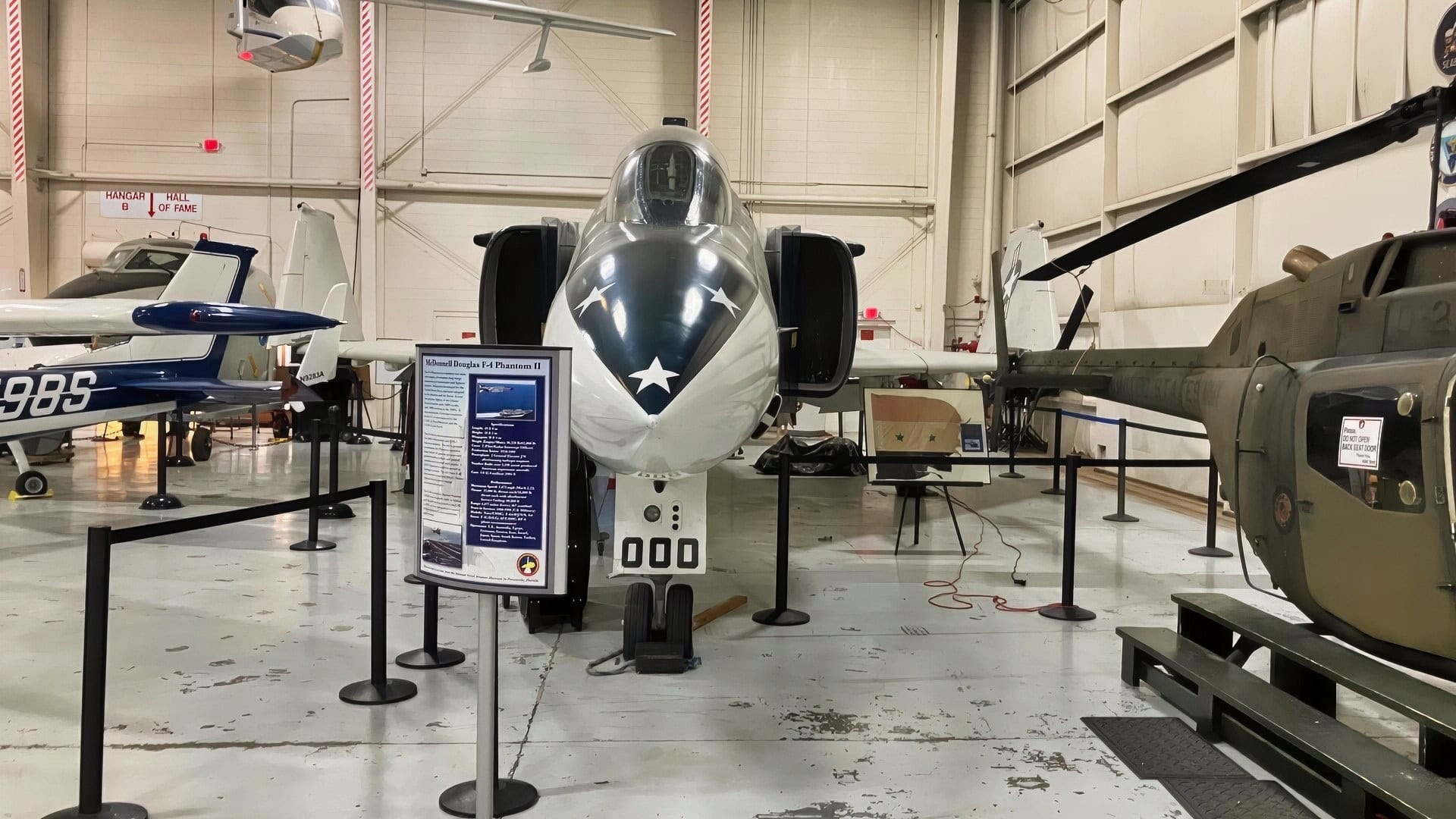
F-4 Phantom Fighter Aviation Museum of Kentucky. Taken by 19FortyFive on March 1, 2026.
In December 1958, the US Navy chose the F-4 Phantom over a Vought fighter that was faster, lighter, cheaper, and, according to the men who flew both, the better airplane. The rejection looks like a blunder, and the legend insists NASA pilots spent 1959 proving it by jumping Navy Phantoms in mock dogfights until the complaints came down. The record tells a more complicated story: the Navy’s reasoning was sound, the famous dogfights may never have happened, and more than 5,000 Phantoms vindicated the choice. Not one Crusader III survives.
On December 17, 1958, the Navy announced it would buy the two-engine, two-seat McDonnell F4H-1 Phantom II as its next fleet-defense fighter, ending the hopes of Chance Vought’s XF8U-3 Crusader III. The next day, the Navy canceled Vought’s Regulus II cruise missile in favor of the submarine-launched Polaris. In 48 hours, the company in Grand Prairie, Texas, lost its two biggest programs, and nearly 4,000 people lost their jobs. The airplane at the center of that week had already flown faster than anything else in the Navy’s inventory, and the argument over whether the Navy got the decision right has now outlived every single airframe, all of which went to the scrapper.
From F-8 Crusader to V-401: A New Airplane Wearing an Old Name
The Navy opened the competition in 1955, asking for a Mach 2-class fleet-defense interceptor, and Vought answered with what its engineers called the V-401. The designation F8U-3 and the Crusader name suggested an upgrade of the F-8 already headed to the fleet. The airplane underneath was almost entirely new, sharing the variable-incidence wing that tilted up for carrier landings and little else. In place of the F-8’s J57, the Pratt & Whitney J75-P-5A delivered 29,500 pounds of thrust in afterburner, roughly 10,000 pounds more than the engine it replaced.
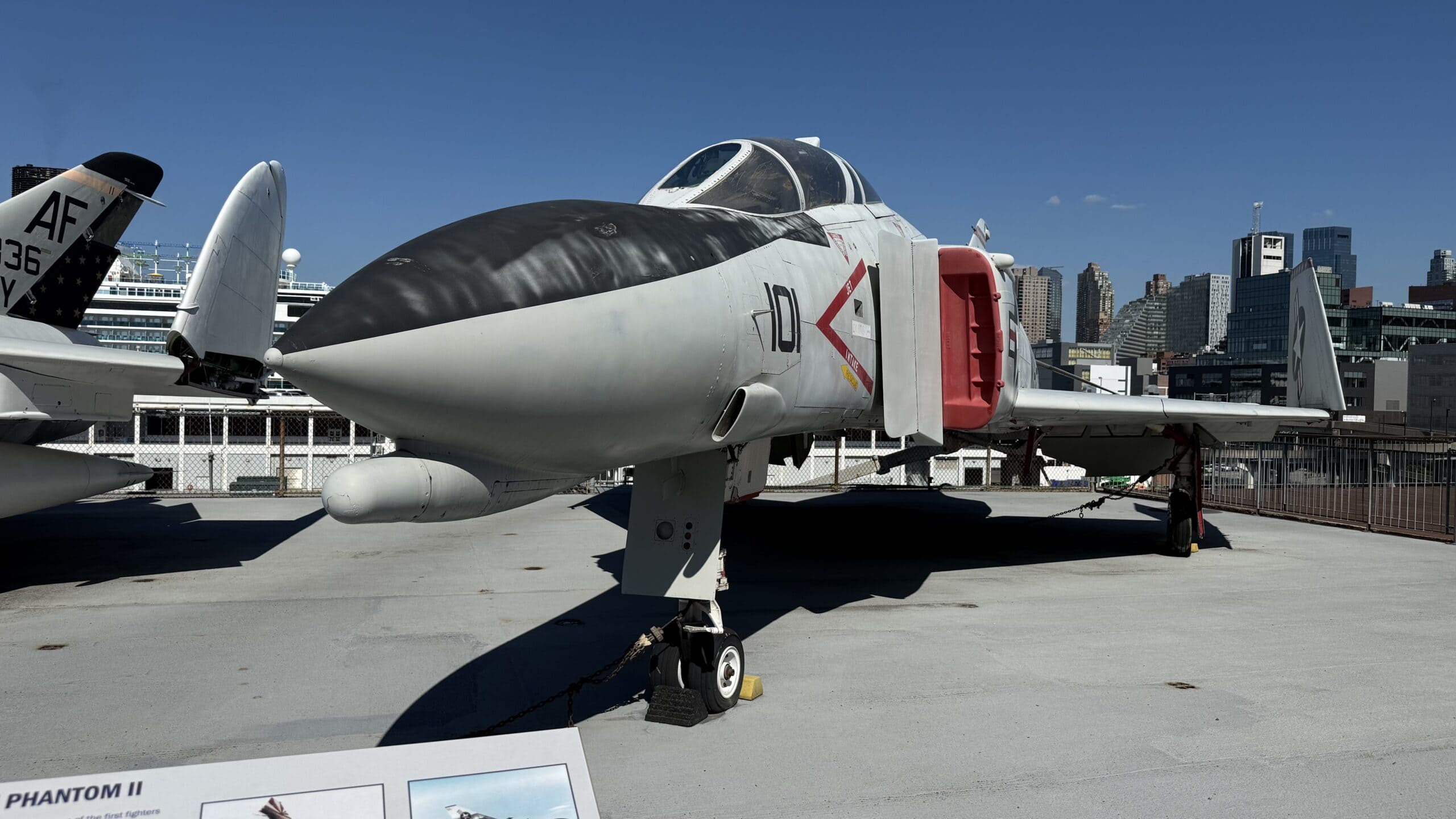
F-4 Phantom. 19FortyFive.com Photo.
A swept-forward Ferri scoop under the nose fed the engine at high Mach, and two large ventral fins, needed for stability past Mach 2, rotated flat so the jet could land. Vought even reserved space for an 8,000-pound-thrust Rocketdyne rocket booster in a proposed F8U-3F version, though no rocket ever flew. The fire-control ambition was equally aggressive for 1958: a system built around the AN/AWG-7 computer and APG-74 radar, designed to track six targets and engage two of them at once, feeding three Sparrow missiles carried semi-recessed under the fuselage. As flown, the Crusader III carried no gun at all. It was a pure creature of the missile age.
June 2, 1958: John Konrad Takes It Up Less Than a Week After the Phantom
The prototype rolled out at Grand Prairie on April 20, 1958, was flown to Edwards Air Force Base by C-124 transport, and made its first flight on June 2 with Vought chief test pilot John Konrad at the controls, the same man who had first flown the original Crusader. A jammed throttle cut the maiden flight short. It hardly mattered. The Crusader III was airborne less than a week after its rival, McDonnell’s F4H-1, and on August 14, on its 38th flight, it exceeded Mach 2 in level flight before the Phantom did.
How fast it ultimately went became part of the problem with telling this story honestly. Books and articles have claimed Mach 2.6, and Vought projected Mach 2.9 for a rocket-boosted version. The definitive program history, Tommy Thomason’s monograph for Ginter Books, puts the documented maximum at Mach 2.39, reached once, with normal operations no higher than Mach 2.32. The limiter was almost comically mundane: the Plexiglas windscreen could not take the heat of sustained flight much beyond Mach 2.35, and Vought was designing a new windscreen for the production jet when the program died. Even at its documented numbers, the airplane demonstrated a zoom ceiling above 76,000 feet, and it was still accelerating when its pilots throttled back.
The Flyoff at Edwards: Bob Elder, Dick Gordon, and a Lieutenant Named Bill Lawrence
The Navy evaluation team that flew both jets head-to-head reads like a roll call of naval aviation royalty today. Capt. Bob Elder led it and took the Navy’s first flight in the Phantom. Cmdr. Larry Flint flew the Navy’s first hop in the Crusader III. The Phantom’s project pilot was Lieutenant Junior Grade Dick Gordon, who would later fly to the Moon on Apollo 12. The Crusader III’s project pilot was Lt. William Lawrence, and by his own account in his Naval Institute oral history, the team’s early sorties settled the speed question fast: Elder took the Phantom to Mach 1.5, Lawrence took the Crusader III to Mach 2.1, and a 28-year-old lieutenant from Nashville became the first naval aviator to fly twice the speed of sound in a Navy airplane.
The flyoff confirmed the Vought’s edge as a flying machine. Konrad said the Crusader III could “fly circles around the Phantom II,” and Barrett Tillman’s MiG Master records its combat thrust-to-weight ratio at nearly one-to-one against the early Phantom’s 0.87. Vought’s own comparisons, pressed relentlessly by vice president and designer Russell Clark, had the F8U-3 5,000 pounds lighter, 100 knots faster, and 20 percent smaller on a crowded carrier deck. The honest ledger carries the other column too: the jet had a lingering compressor-stall tendency at high Mach, its weight crept past the 37,500-pound target, it carried three Sparrows against a four-missile goal, and without afterburner, its takeoff run roughly tripled.
Why the Navy Picked the Phantom: Two Engines, Two Seats, and the Sparrow Problem
None of the performance numbers decided the competition, because the competition was never really about them.
The Sparrow missile of 1958 was semi-active: the launching aircraft had to hold its radar on the target continuously from launch to impact. A single pilot flying a night intercept at twice the speed of sound while steering a radar cursor was a recipe for task saturation, and Vought’s answer, a second grip on the control stick to run the radar, asked one man to do two jobs. The Phantom carried a radar intercept officer whose entire job was the scope.
Add two engines for over-water survivability and a payload that lets the Phantom bomb targets as well as intercept them, and the Navy’s choice stops looking sentimental and starts looking like systems engineering. The Crusader III was a magnificent interceptor and nothing else; proposed day-fighter, British, and Air Force variants never left paper. On December 17, 1958, the Navy took the Phantom, and the Regulus II cancellation the next day turned a defeat into a catastrophe for Vought.
The following decade ruled on the decision. Redesignated F-4B in 1962, the Phantom became the first of more than 5,000 to fly for the Navy, the Marines, and the Air Force, and fought over Vietnam, where the missile-only faith of 1958 collapsed and guns were bolted back onto an airframe with room to take them. Navy engineer George Spangenberg still called the Crusader III “the best fighter never produced,” and, as a matter of pure aerodynamics, he may have been right. The Navy had chosen the airplane that could survive its own era’s mistakes, and the Phantom absorbed every correction the 1960s threw at it.
NASA’s Sonic Boom Lab and the Dogfight Legend Nobody Can Verify
The three flying Crusader IIIs went to the brand-new NASA in 1959, two to Langley in Virginia and one to Ames in California.
The legend, carried in Tillman’s book and repeated as fact ever since, holds that NASA pilots in the surplus Vought jets gleefully bounced Navy Phantoms undergoing evaluation out of Patuxent River, beating the airplane that had beaten theirs, until formal Navy complaints ended the sport. It is the perfect revenge story, which is precisely why it deserves scrutiny. The late aviation historian Robert F. Dorr challenged it directly, noting the lore’s origin is unclear, that the NASA Crusaders made very few flights, and that they were never based where the handful of existing Phantoms flew. The West Coast jet apparently never even flew in NASA colors.
What the record does document is quieter and more consequential. NASA Langley’s own program records show the F8U-3 among the earliest airborne measurements of sonic boom strength, conducted off Wallops Island, Virginia, in the summer of 1959. The fighter the Navy turned down spent its short second life generating data about what supersonic flight does to the people underneath it, a question NASA has been chasing ever since. The science of sonic booms is documented; the dogfight story survives on its desire to be true.
Bill Lawrence’s Phantom, the Hanoi Hilton, and a Destroyer Still Underway
The airplane’s people carried the story further than the airplane did. Lawrence made the final cut for the Mercury astronaut program and was dropped only when screening found a heart condition; his daughter Wendy became an astronaut instead, flying four Space Shuttle missions.
On June 28, 1967, commanding a fighter squadron over North Vietnam, Lawrence was shot down and captured, and he spent nearly six years in the Hanoi Hilton, where he composed what became Tennessee’s official state poem from memory in solitary confinement. The jet he was flying when he went down was an F-4 Phantom, the airplane that had beaten his Crusader III nine years earlier.
The airframes themselves went to Norfolk for disposal; one reportedly ended up as a firefighting trainer, and every Crusader III was eventually cut up. There is no museum example anywhere on earth.
About the Author: Harry J. Kazianis
Harry J. Kazianis (@Grecianformula) was the former Senior Director of National Security Affairs at the Center for the National Interest (CFTNI), a foreign policy think tank founded by Richard Nixon based in Washington, DC. Harry has over a decade of experience in think tanks and national security publishing. His ideas have been published in the NY Times, The Washington Post, The Wall Street Journal, CNN, and many other outlets worldwide. He has held positions at CSIS, the Heritage Foundation, the University of Nottingham, and several other institutions related to national security research and studies. He is the former Executive Editor of the National Interest and the Diplomat. He holds a Master’s degree focusing on international affairs from Harvard University.

