
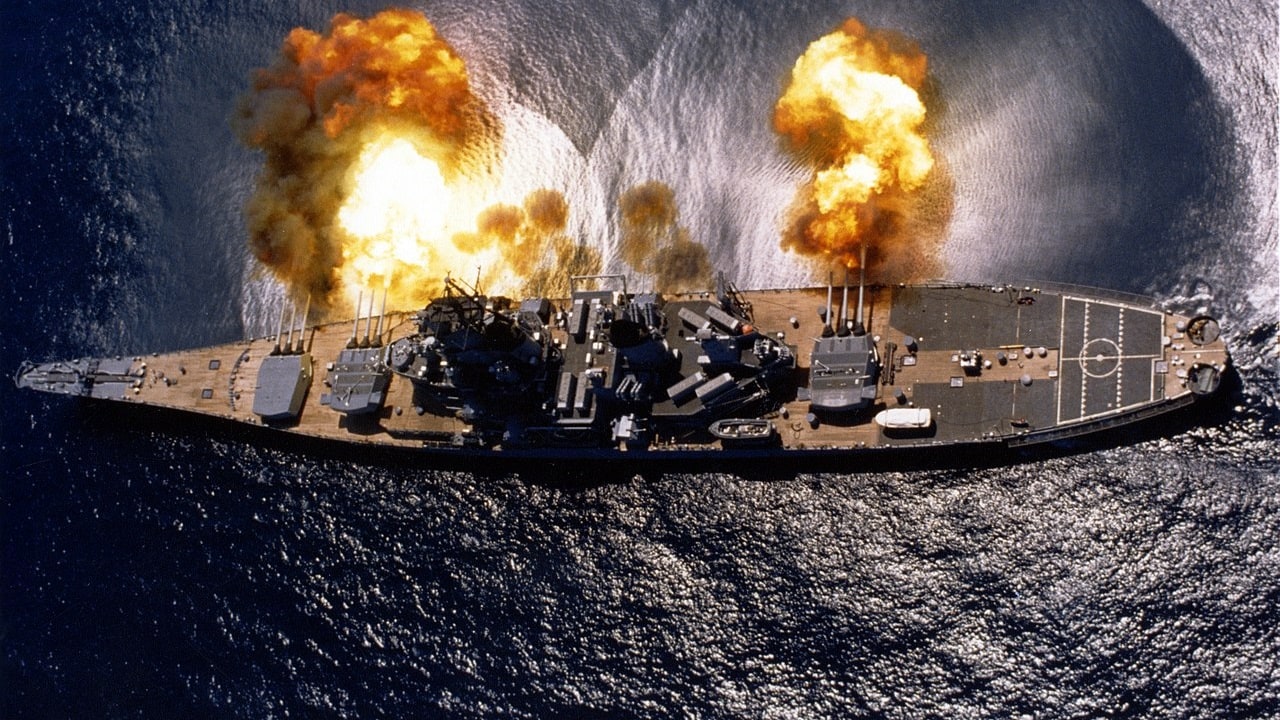
The Trump-Class Battleship’s Biggest Problem Isn’t Politics—It’s The Railgun
The prospective Trump-class battleship is already highly controversial. And, petty politics notwithstanding, there are legitimate reasons to wonder about the proposed battlewagons’ feasibility.
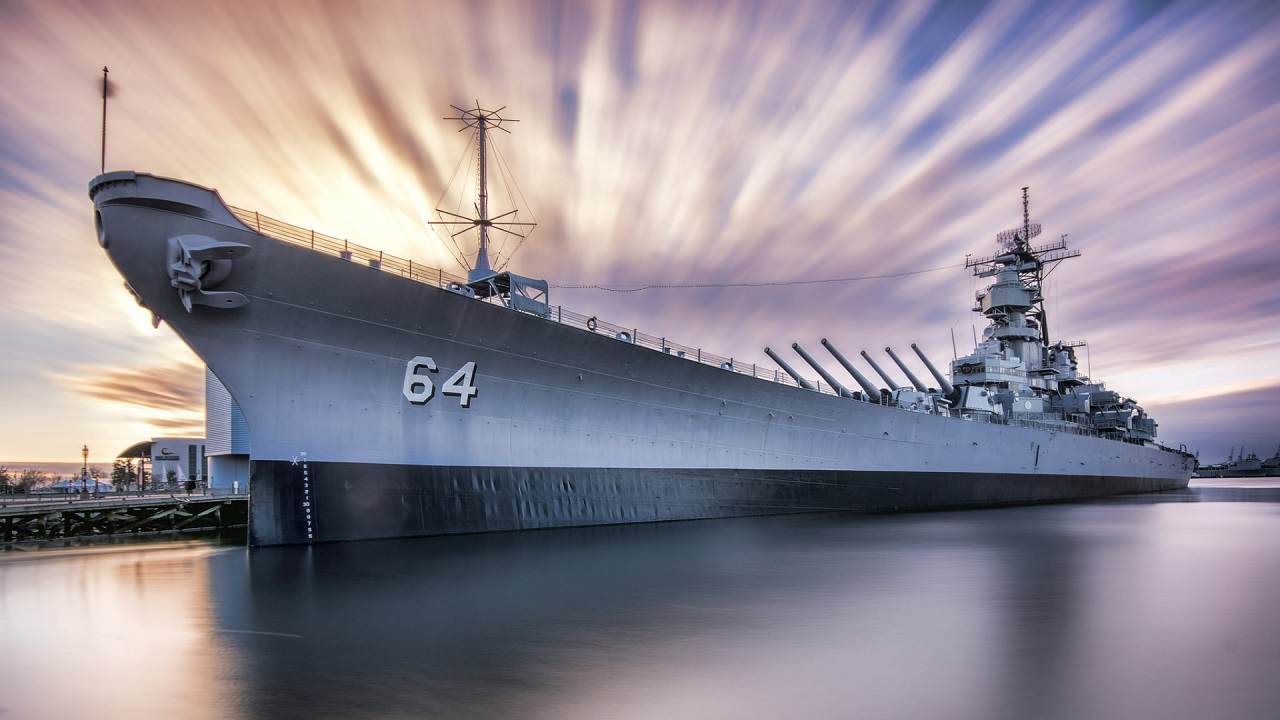
Iowa-Class Battleship. Image Credit: Creative Commons.
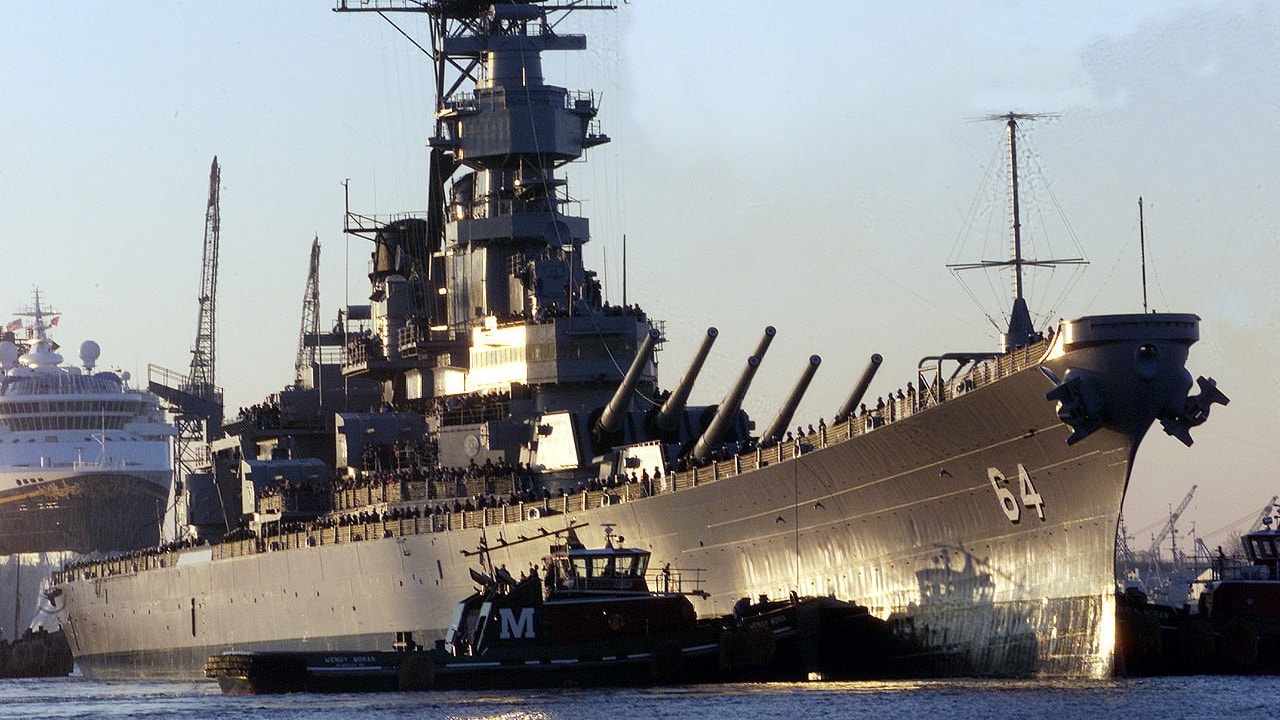
A tug boat nudges the bow of the battleship USS Wisconsin (BB 64) as the ship is pushed from the Norfolk Naval Shipyard to the Nauticus Museum in Norfolk, Va., on Dec. 7, 2000. The Wisconsin will be the centerpiece of a four-part exhibit on the battleship’s role in Naval history.
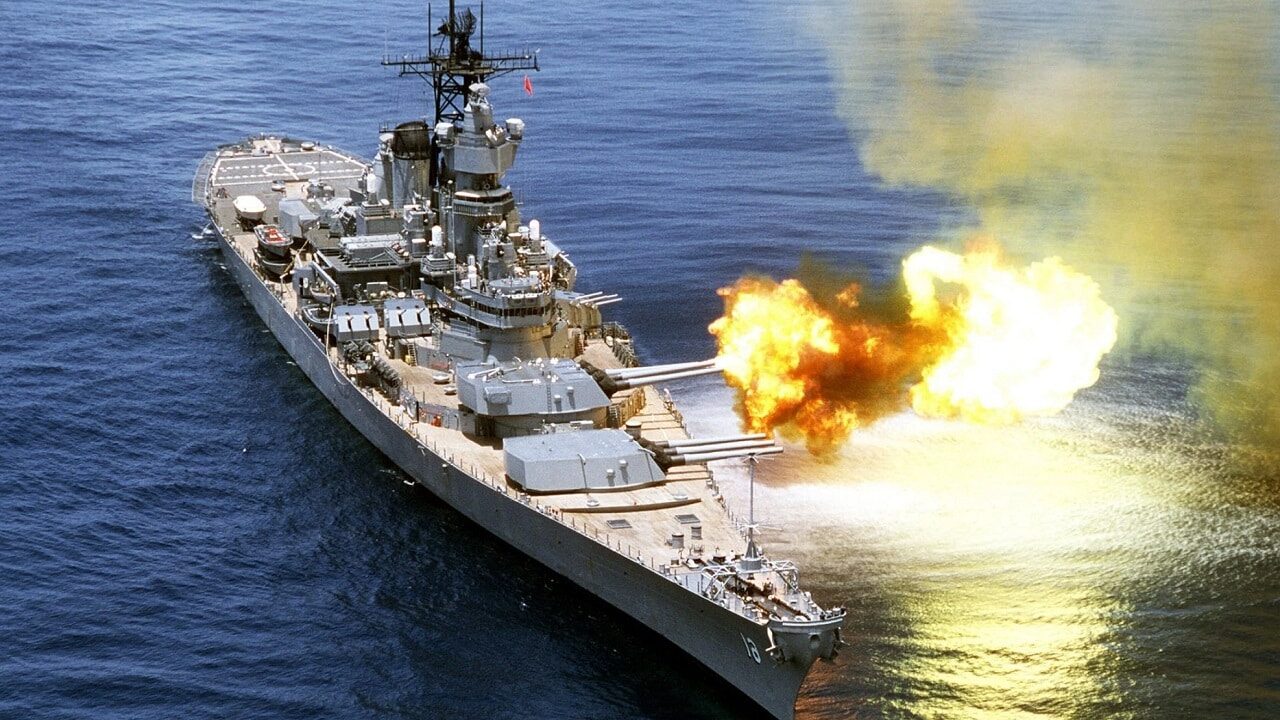
Iowa-Class USS Wisconsin Battleship. Image Credit: Creative Commons.
For one thing, the United States has not built and commissioned brand-new battleships since 1944, with the Iowa-class battleships USS Missouri (BB-63) and USS Wisconsin (BB-64) being the last two of the bunch. Another major problem is that the U.S. shipbuilding industry is a mere shadow of its former self.
And even once those problems are addressed, there remains a particularly vexing devil in the details: the railgun.
The Railgun Sounds Great in Theory…
The Iowa-class battleships’ main armament was their nine 16-inch/50 caliber Mark 7 guns (two triple turrets fore, one turret aft).
Assuming the Trump battleships do get built, they won’t have that many guns, nor guns of that bore size. What they will instead wield—in addition to a Surface-Launched Cruise Missile-Nuclear (SLCM-N) system and a pair of 300kW lasers—will be a 32-megajoule electromagnetic railgun that hurls tungsten projectiles at a hypersonic velocity of Mach 6. The sheer kinetic energy generated by these projectiles, along with their accuracy, would presumably more than make up for their lack of bore size and quantity relative to their WWII predecessors. (Although the mechanical analog fire-control computers on the Iowas were remarkably advanced and accurate for their time.)
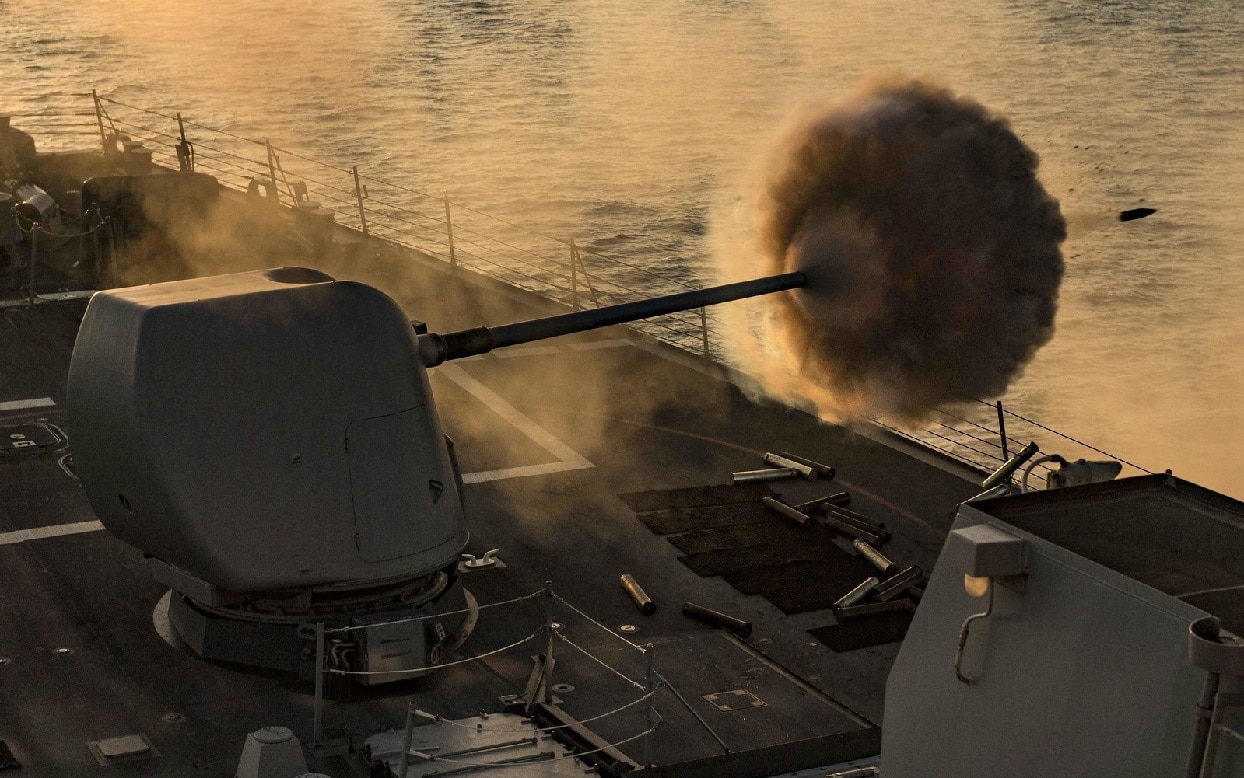
MEDITERRANEAN SEA (Sept. 24, 2018) The Arleigh Burke-class guided-missile destroyer USS Carney (DDG 64) fires its 5-inch gun during a live-fire exercise, Sept. 24, 2018. Carney, forward-deployed to Rota, Spain, is on its fifth patrol in the U.S. 6th Fleet area of operations in support of regional allies and partners as well as U.S. national security interests in Europe and Africa.
…But In Practice…
The problem is that the U.S. Navy, for all of its impressive technological achievements, has never successfully built a viable railgun. Earlier this decade, the Navy considered bringing back the railgun. Indeed, there was a Newsweek video published on MSN titled “US Navy Demonstrates Electromagnetic Railgun,” accompanied by a caption reading “Using an electrical pulse, the railgun can fire projectiles over 100 miles away;” the muzzle flash and smoke plume from the discharge of the round made for quite an awe-inspiring visual spectacle.
Alas, according to James Keller of Task & Purpose, the Navy’s railgun program was officially declared dead in July 2021 “in light of ‘fiscal constraints, combat system integration challenges and the prospective technology maturation of other weapon concepts,’ according to a statement provided to Military.com.”
Fifteen years and $500 million on research and testing went down the drain.
Another technical challenge of railgun technology is that these weapons require a very large power supply—to the tune of a million or so amperes of current.
So then, is there any hope of reviving the railgun for the benefit of U.S. seapower?
For a potential positive answer to that question, we turn to one of America’s allies in the Quad.
The Japanese Model: A Potential Solution?
Japan has had some modicum of success in building railguns. Specifically, a railgun was test-fired from a Japanese warship in October 2023.
Fast-forward to mid-April 2025, and the Japan Maritime Self-Defense Force (JMSDF) released an image of its state-of-the-art railgun, which was undergoing testing aboard the test ship JS Asuka.
JMSDF testing overcame key hurdles such as rail erosion after repeated firing (120+ rounds). This was evidently made possible by switching from copper as the initial barrel material to a blend of unspecified metals and other materials. Prior to this breakthrough, it was considered a given that railguns had to be serviced after nearly every shot, rendering them less practical than conventional projectiles.
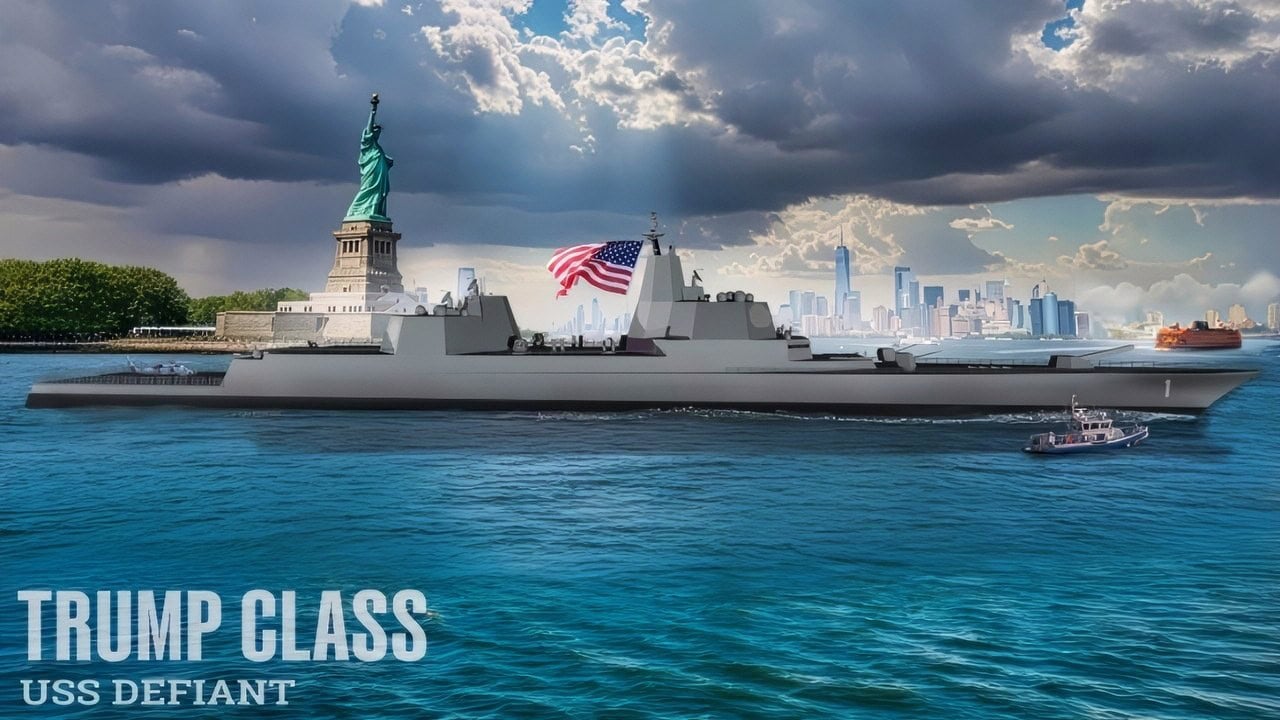
Trump-Class Battleship. Image Credit: Creative Commons/White House.
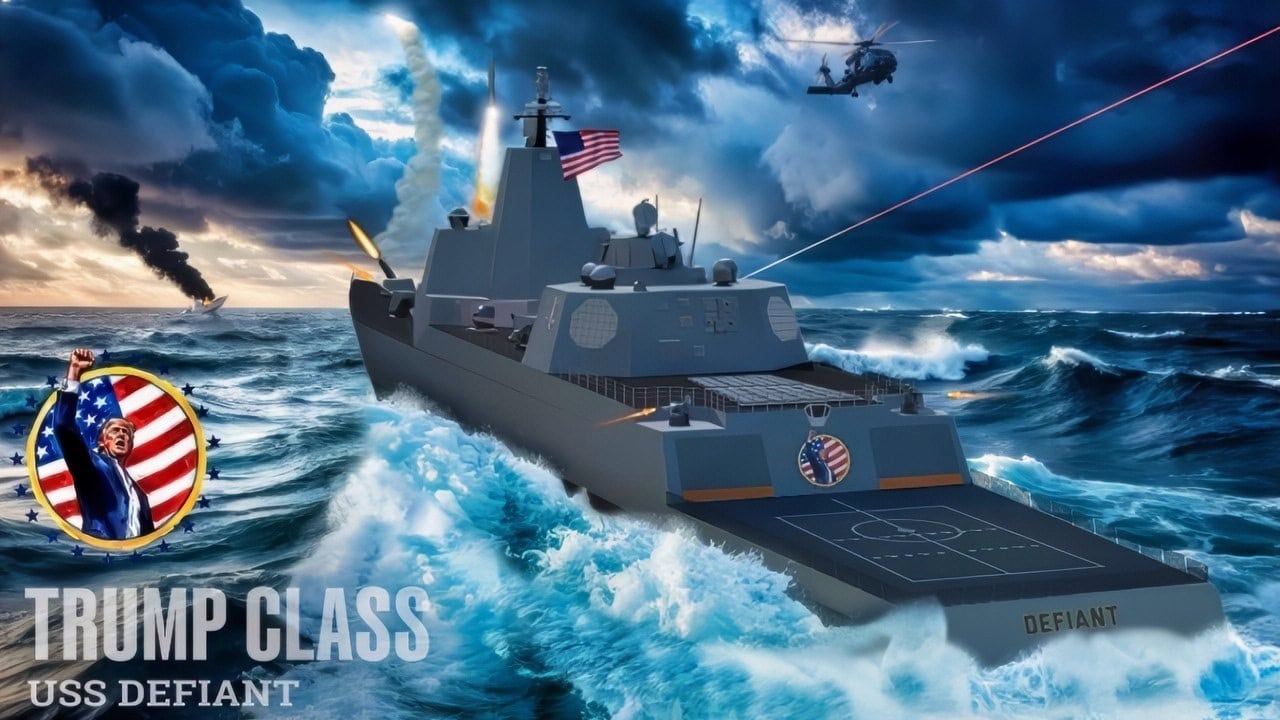
Trump-Class Battleship. Image Credit: Creative Commons/White House Photo.
Perhaps even more impressively, this extended barrel life was achieved with relatively modest funding—the equivalent of about $6.5 million, a pittance compared with what the U.S. Navy spent on its failed railgun testing.
Japan’s railgun development is being conducted by the Ground Systems Research Center, a division of the Acquisition, Technology & Logistics Agency, which began full-scale project research in 2016 and carried on through 2022.
Perhaps the Navy’s R&D planners would be well-advised to consider brainstorming with their Japanese counterparts and pool resources to develop railguns as a joint venture going forward.
About the Author: Christian D. Orr, Defense Expert
Christian D. Orr is a Senior Defense Editor. He is a former Air Force Security Forces officer, Federal law enforcement officer, and private military contractor (with assignments worked in Iraq, the United Arab Emirates, Kosovo, Japan, Germany, and the Pentagon). Chris holds a B.A. in International Relations from the University of Southern California (USC) and an M.A. in Intelligence Studies (concentration in Terrorism Studies) from American Military University (AMU). He is also the author of the newly published book “Five Decades of a Fabulous Firearm: Celebrating the 50th Anniversary of the Beretta 92 Pistol Series.”