
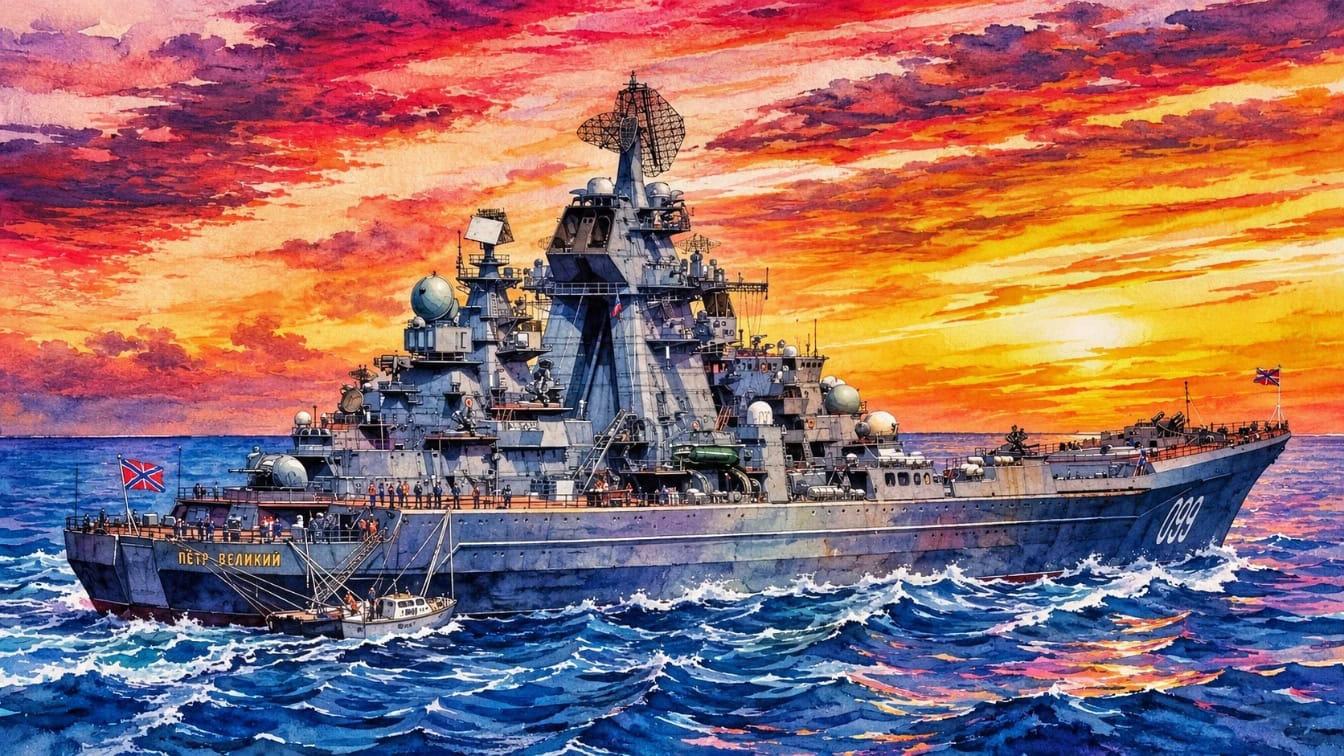
Russia’s Kirov-class battlecruisers — the largest surface combatants any navy has built since the World War II battleships, and the last nuclear-powered surface warships of their kind anywhere on Earth — are vanishing. Of the four the Soviet Union completed, two are being cut up for scrap, one is reportedly headed for retirement, and only one, the Admiral Nakhimov, is emerging from a rebuild so long and so costly it became one of the most expensive warship overhauls in history. The battlecruiser, as a warship type, was born before World War I and was all but extinct by 1945; these Soviet giants were its one improbable final revival. Now that revival is ending, and when these ships go, a century-old category of capital ship goes with them.
The Kirov class is at once a uniquely Russian story of ambition outrunning resources and the last chapter of a warship type no navy will build again.
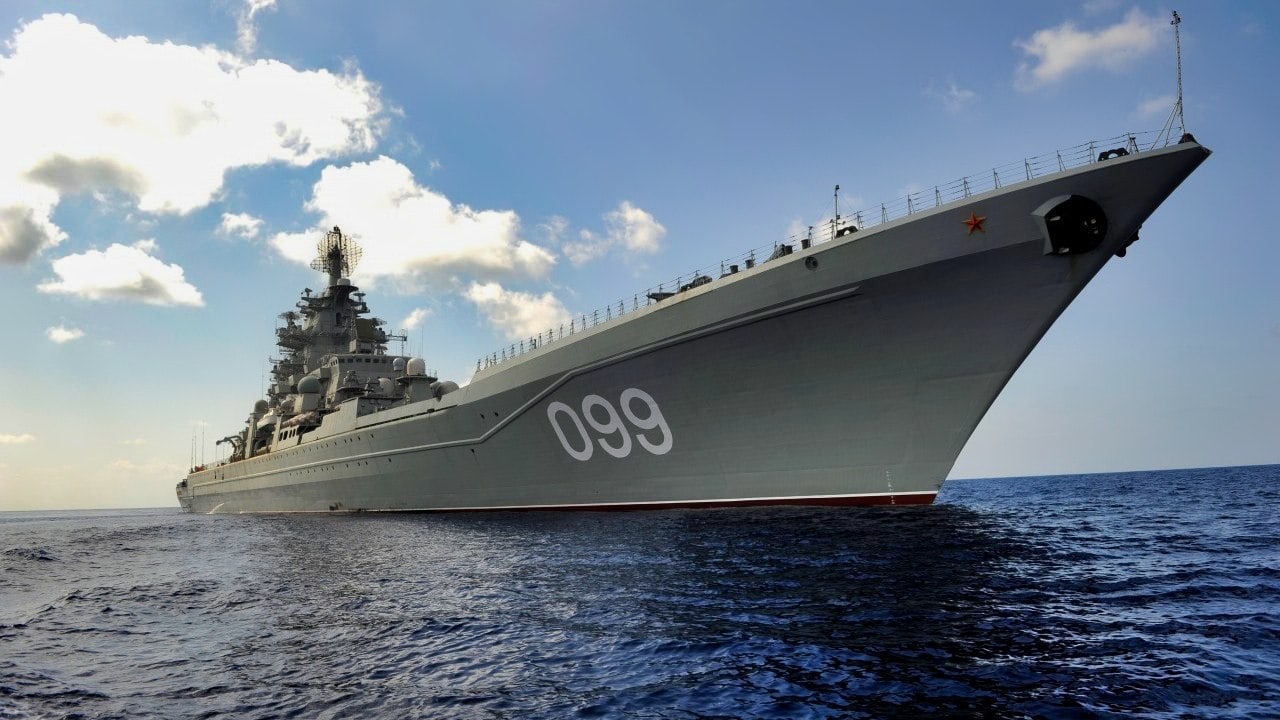
Kirov-Class Battlecruiser Russian Navy
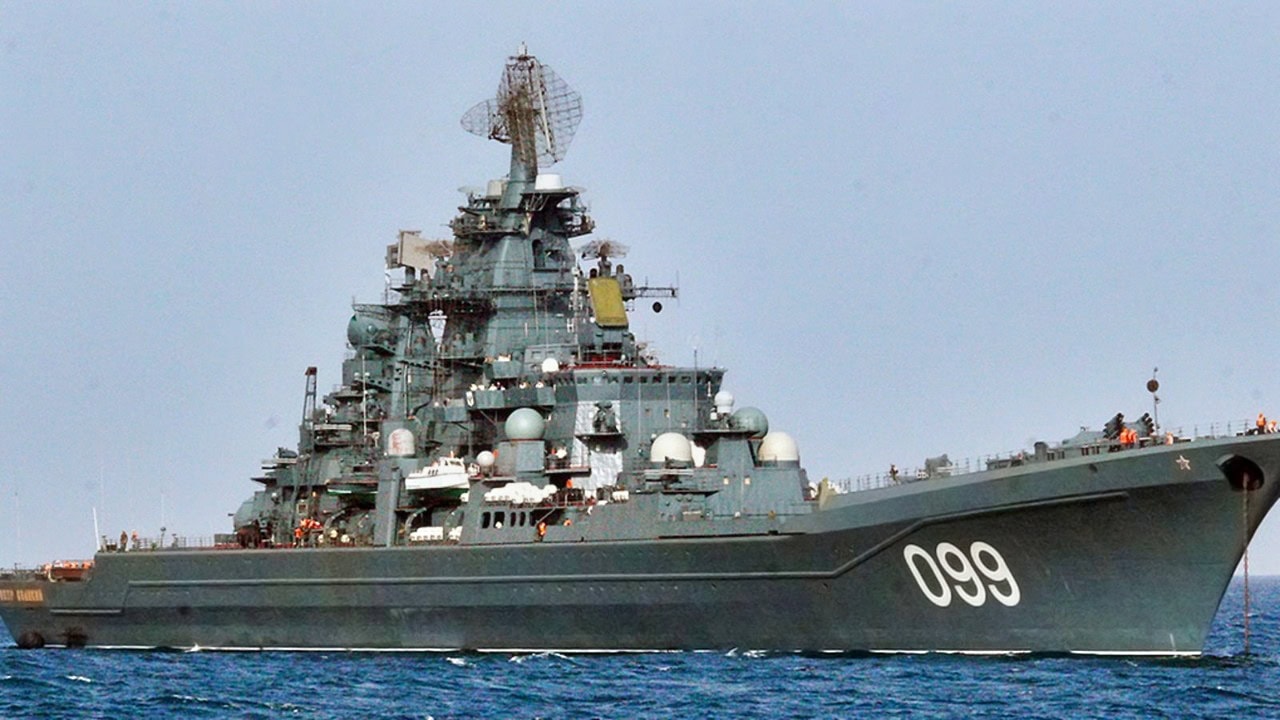
Kirov-Class Battlecruiser Russian Navy. Image Credit: Creative Commons.
What A Battlecruiser Is, And Why The Soviets Revived It
The battlecruiser was an early-twentieth-century idea: a “fast capital ship” carrying battleship-caliber guns and cruiser speed, with the armor sacrificed to buy that speed. The type emerged around 1908 with Britain’s Invincible, and its central weakness was exposed catastrophically at the Battle of Jutland in 1916, where thin protection let several British battlecruisers blow up under German fire.
The tradeoff lost its remaining logic when fast battleships arrived in the late 1930s, offering speed and armor together, and when air power and then guided missiles shifted naval combat away from gun duels entirely. After World War II, no nation built another battlecruiser, and the category effectively disappeared.
The Soviet Union revived it, after a fashion, at the end of the Cold War. Officially, the Kremlin classified its new Project 1144 Orlan ships as heavy nuclear-powered missile cruisers, and the “battlecruiser” label is a Western analytical convention rather than a literal description — these were missile ships, not gun-armed vessels in the Jutland sense. But Western analysts reached for the term because the ships were so much larger and more heavily armed than any cruiser that no ordinary category fit. At roughly 24,300 tons standard and 28,000 tons full load, and 252 meters long, the Kirovs were bigger than many World War I capital ships and the largest surface combatants any navy had put to sea since the last battleships
. Their appearance prompted the United States to recommission its Iowa-class battleships in the 1980s as a direct answer. They were also nuclear-powered, using a combined nuclear and steam system — two reactors backed by oil-fired boilers — driving turbines for around 120,000 horsepower, which made them, along with the U.S. nuclear cruisers America retired in the 1990s on cost grounds, among the only nuclear surface combatants outside the carrier fleets ever built.
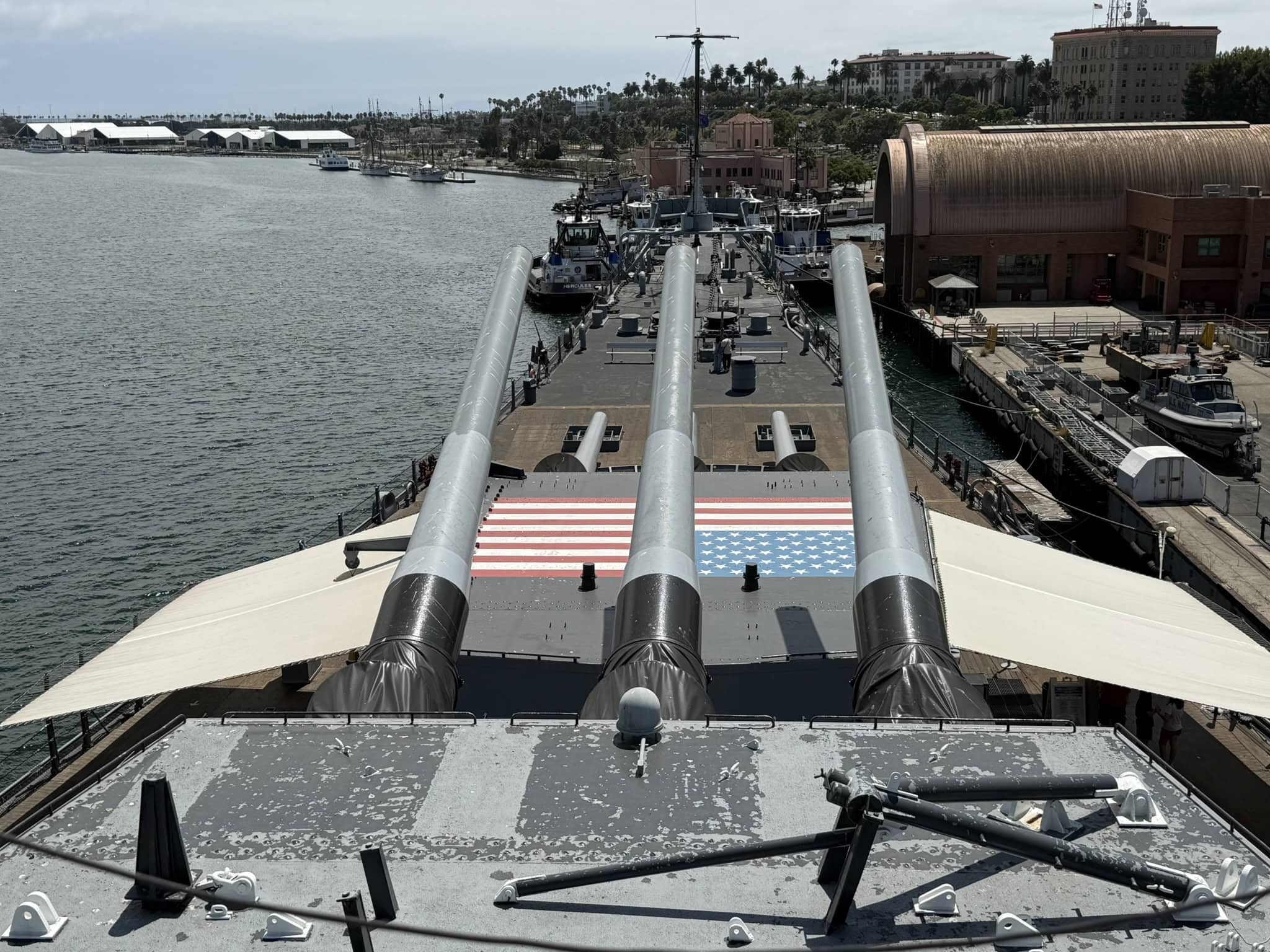
USS Iowa Battleship visit by Harry J. Kazianis for 19FortyFive.com. Taken back in August 15, 2025.
What The Kirov-Class Was Built To Do: Hunting American Aircraft Carriers
The Kirovs were designed for one overriding mission: to hunt and kill American aircraft carrier strike groups. Their offensive power centered on 20 P-700 Granit anti-ship missiles, the heavy supersonic weapons NATO called the SS-N-19 Shipwreck, mounted in angled tubes below the forward deck.
These were enormous compared with Western anti-ship missiles like the Harpoon or Exocet — the same weapon carried by the Oscar-class submarines — with a maximum range of around 260 nautical miles and a 750-kilogram warhead, designed to be fired in a coordinated salvo that would receive targeting data from satellites or other assets and overwhelm a carrier group’s defenses through sheer mass and speed.
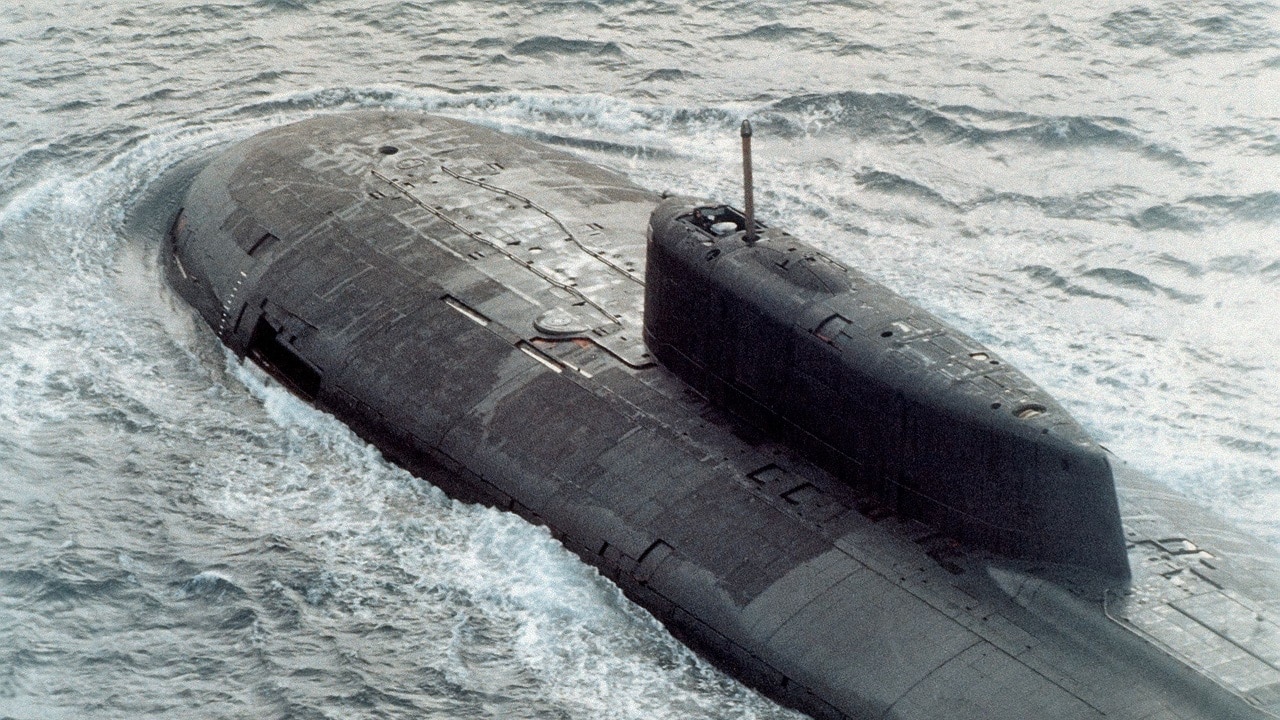
Oscar-class Submarine from Russia.
Around that carrier-killing battery, the ships layered one of the densest air-defense suites afloat, built on the S-300F — the naval version of the S-300 surface-to-air system — with later ships and the modernized Pyotr Velikiy carrying the improved S-300FM that gave the Russian Navy its only ballistic-missile-defense-capable surface ship.
Short-range Kinzhal and Kashtan point-defense systems, anti-submarine rockets, torpedoes, and a main gun rounded out a floating arsenal meant to fight as a self-contained fortress at the center of a Soviet surface action group. It was a concept built for a specific Cold War problem — breaking up American carrier operations in a global war — and that problem, and the navy built to pose it, largely dissolved when the Soviet Union did.
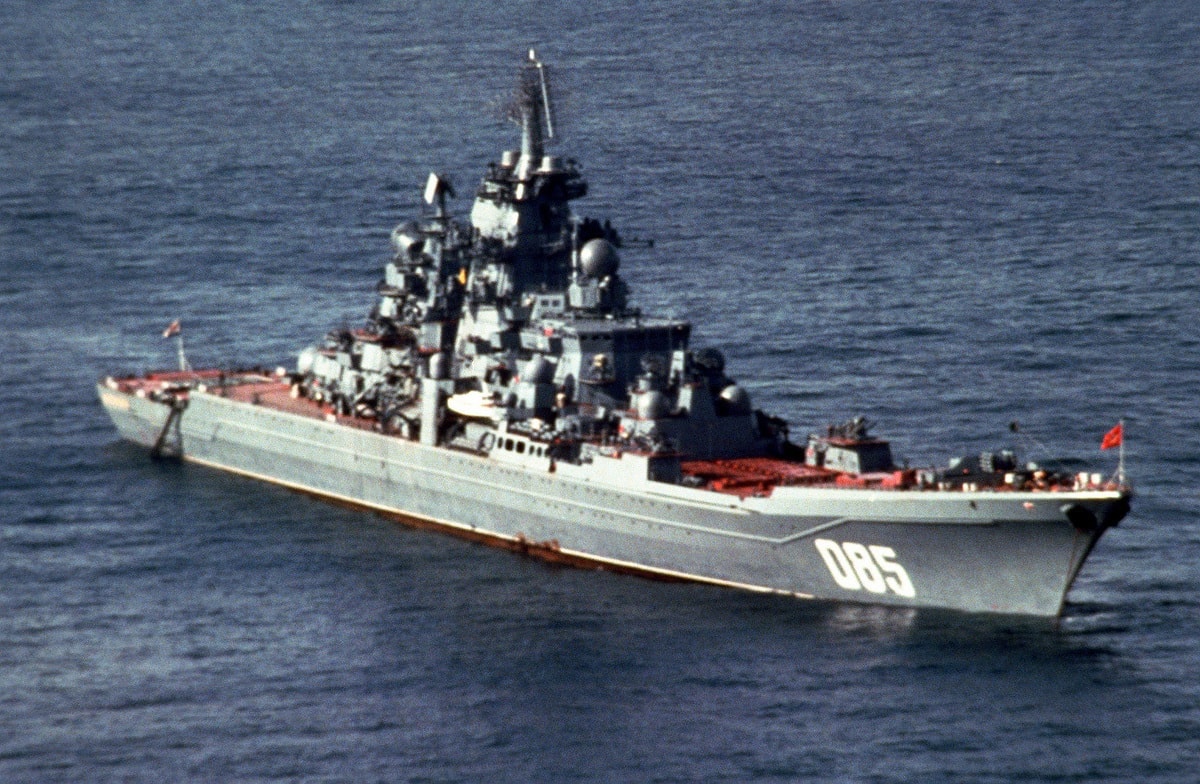
A starboard bow view of the Soviet Kirov class nuclear-powered guided missile cruiser KALININ.
The Four Ships, One By One
The complete fate of the class tells the story better than any single ship. Four Kirovs were completed — a fifth was canceled in 1990 before the Soviet collapse — and no two are ending the same way.
The lead ship, commissioned in 1980 as Kirov and renamed Admiral Ushakov in 1992, barely made it out of the Soviet era. It suffered a reactor accident in 1990 during a deployment in the Mediterranean, and with the funds gone and the country dissolving, the damage was never repaired. The ship was laid up for decades, its reactor cores judged too degraded and dangerous to defuel cheaply, and Russia decided in 2019 to scrap it. It is being dismantled, the lead ship of the class ending as scrap without ever returning to service.
The second ship, commissioned in 1984 as Frunze and renamed Admiral Lazarev, was assigned to the Pacific Fleet, became inactive by 1994, and was decommissioned in 1998. After years laid up, the Russian Armed Forces and the state nuclear corporation Rosatom signed a contract in February 2021 to dismantle and scrap the ship, and it sailed to the 30th Shipyard in April 2021, with dismantlement scheduled to be completed by late 2025. Like the lead ship, it is being cut up rather than saved.
The third ship is the one Russia chose to rebuild. Commissioned in 1988 as Kalinin and renamed Admiral Nakhimov, it last operated under its own power in 1997 and arrived at the Sevmash shipyard in 1999, where it has been ever since. A full modernization, Project 1144.2M, was approved years earlier but only began in earnest around 2013 and 2014, and it has run extraordinarily long.
The ship’s two reactors were restarted — one in December 2024, the second in February 2025 — and on June 1, 2026, the Russian government announced the battlecruiser had entered the final phase of sea trials after departing Sevmash, with delivery to the navy expected this year. That timeline should be read with caution, because it has slipped repeatedly — from 2018 to 2021 to 2022 to 2024 — and nearly 27 years will have passed between the ship’s arrival at the yard and its return to service, longer than it spent in frontline service as a Soviet warship.
The cost is equally hard to pin down: a 2013 contract reportedly worth around 50 billion rubles, roughly $667 million, ballooned to estimates approaching 200 billion rubles, about $2.7 billion, with some Western assessments putting the total as high as $5 billion. The rebuild stripped out the old Granit tubes and replaced them with about 80 universal vertical-launch cells for modern Kalibr, Oniks, and Zircon missiles, with a navalized S-400 replacing the S-300F for air defense — a strike battery that, combined with the air-defense launchers, is sometimes cited at up to 174 cells.
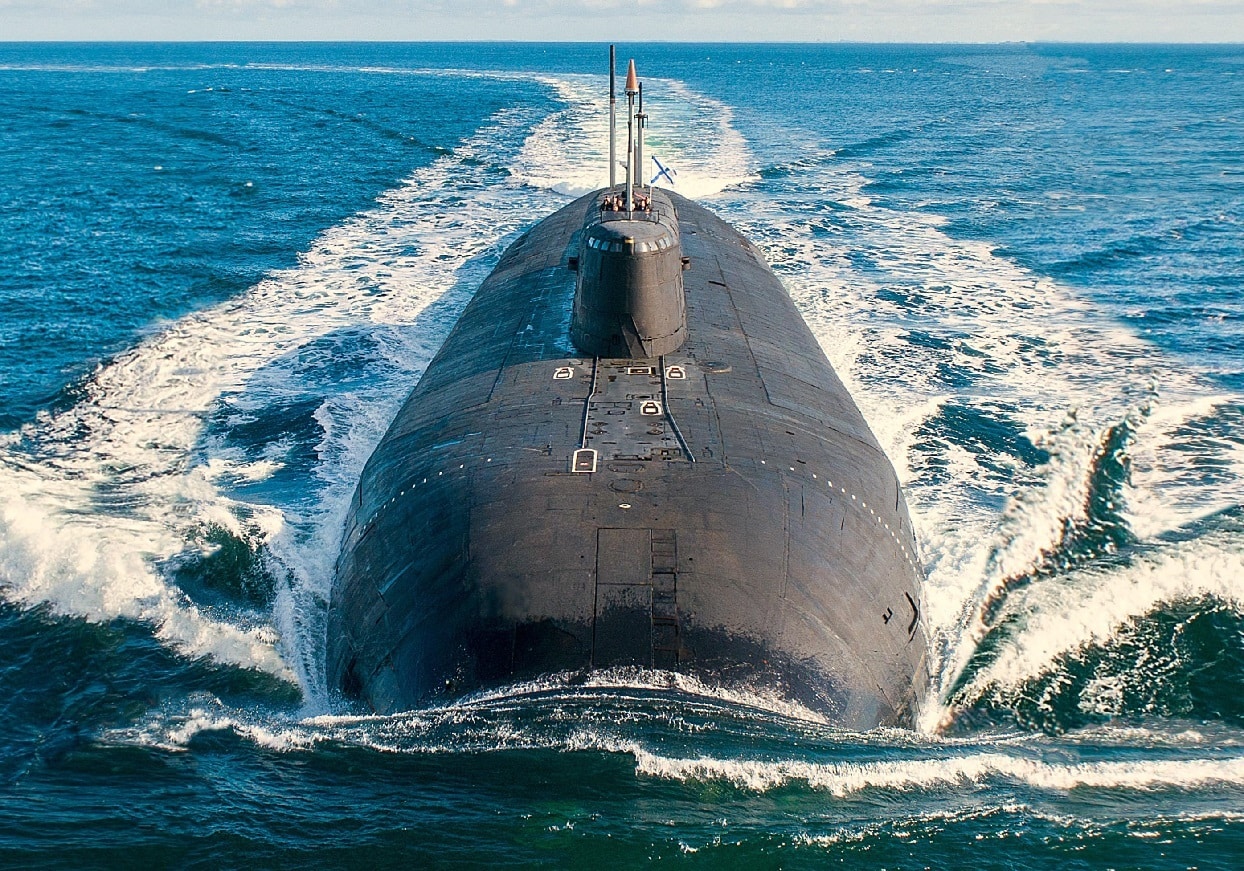
Image of an Russian Oscar-class Submarine. Image Credit: Creative Commons.
The Zircon hypersonic missile is part of the planned fit, though Russia has so far claimed operational Zircon deployment only on its Gorshkov-class frigates, and its performance figures are Moscow’s claims rather than independently confirmed. Nakhimov is slated to become the new flagship of the Russian Navy.
The fourth ship is the workhorse now facing the axe. Laid down in 1986 and commissioned in 1998 as Pyotr Velikiy, it became the flagship of the Northern Fleet and did the real work of the class: in 2000 it was the first ship to detect the sinking submarine Kursk and served as command vessel during the recovery, and it later escorted the carrier Admiral Kuznetsov to Syria in 2016 and 2017, ran counter-piracy patrols in the Gulf of Aden, and conducted Arctic deployments.
It received only a modest refit, and rather than give it the same ruinous rebuild as its sister, Russia appears set to retire it instead — a Russian Navy source told state media in mid-2023 that a principal decision to decommission Pyotr Velikiy had been made, to take effect once Nakhimov returns. The ship has been laid up at Severodvinsk since 2022 and has not been deployed since. As with so many Russian naval plans, the retirement is reported as an intent rather than an executed fact, but the direction is clear.
The Bet On One Ship: Why Russia Could Only Save Nakhimov
The reason Russia is rebuilding exactly one of these ships, scrapping two, and retiring the third comes down to money and capacity. The country cannot spread its finite, sanctioned, wartime shipbuilding resources across submarines, frigates, corvettes, and two nuclear battlecruisers at once.
Sevmash, the yard handling the work, has struggled with personnel shortages, and the consensus within the Russian naval establishment was that keeping one Kirov in service was a stretch, and keeping two would be unaffordable. Maintaining even a single nuclear battlecruiser is expensive, which is precisely why Pyotr Velikiy has sat idle rather than steaming.
The critique came from inside the system. Admiral Sergei Avakyants, the former commander of Russia’s Pacific Fleet, argued in an August 2025 interview that repairing Pyotr Velikiy would waste state resources better spent on several new ocean-going warships, and that the very concept of the heavy nuclear cruiser represented an unjustified balance between cost and effectiveness.
His point cuts to the heart of the problem: a single huge hull concentrates an enormous share of the fleet’s firepower and value in one place, where modern doctrine favors spreading capability across many smaller ships. Five modern frigates can carry the same roughly 80 strike cells as the rebuilt Nakhimov while giving the navy five separate hulls, five radars, and five operating areas — and the loss of any one of them would hurt far less than the loss of the one irreplaceable cruiser. That Russia is keeping the Kirov concept alive at all is itself a measure of its shipbuilding limits: no cruiser-sized surface combatant has been laid down in post-Soviet Russia, and no successor to the Project 1144 design exists or is under construction.
The Obsolescence Question: A Giant Target In The Moskva Era
The hardest question hanging over the whole effort is whether a single enormous surface ship makes any sense in 2026. The cautionary example is recent and close to home: the cruiser Moskva, flagship of Russia’s Black Sea Fleet, was sunk in April 2022 — Ukraine says by two Neptune anti-ship missiles, while Russia attributed the loss to a fire that detonated ammunition.
Either way, a large, prestigious Russian warship went to the bottom, and the war in the Black Sea has since shown how vulnerable surface ships are to missiles and cheap drones launched in saturation. A rebuilt Nakhimov is not meaningfully better armored than Moskva was, and analysts have noted that the billions spent adding new missiles to the ship might have done more good spent on fire suppression and damage control. Some have described the program as having the hallmarks of a vanity project, more about the appearance of strength than practical combat value.
That gives the Kirov revival a real possibility of irony: Nakhimov may emerge from its quarter-century rebuild already obsolete, a Cold War carrier-hunter optimized for a threat environment that no longer exists, returning to a navy that would likely never risk it in contested waters like the Black Sea.
Its reactors are aging, its design predates the drone era, and its sheer size and limited speed make it a conspicuous target. The most probable use for the ship is as an Arctic missile platform defending the Northern Fleet’s ballistic-missile submarine bastions, kept close to home where its huge missile load has value, and its vulnerability is less exposed — a far narrower role than the global carrier-killing mission it was built for.
The Verdict: The Last Battlecruisers On Earth
The Kirov class is the end of a line in two senses. It is the end of a specific Soviet ambition — the dream of a blue-water navy that could contest the United States across the oceans — now reduced to a single rebuilt ship that will likely stay near its own coast.
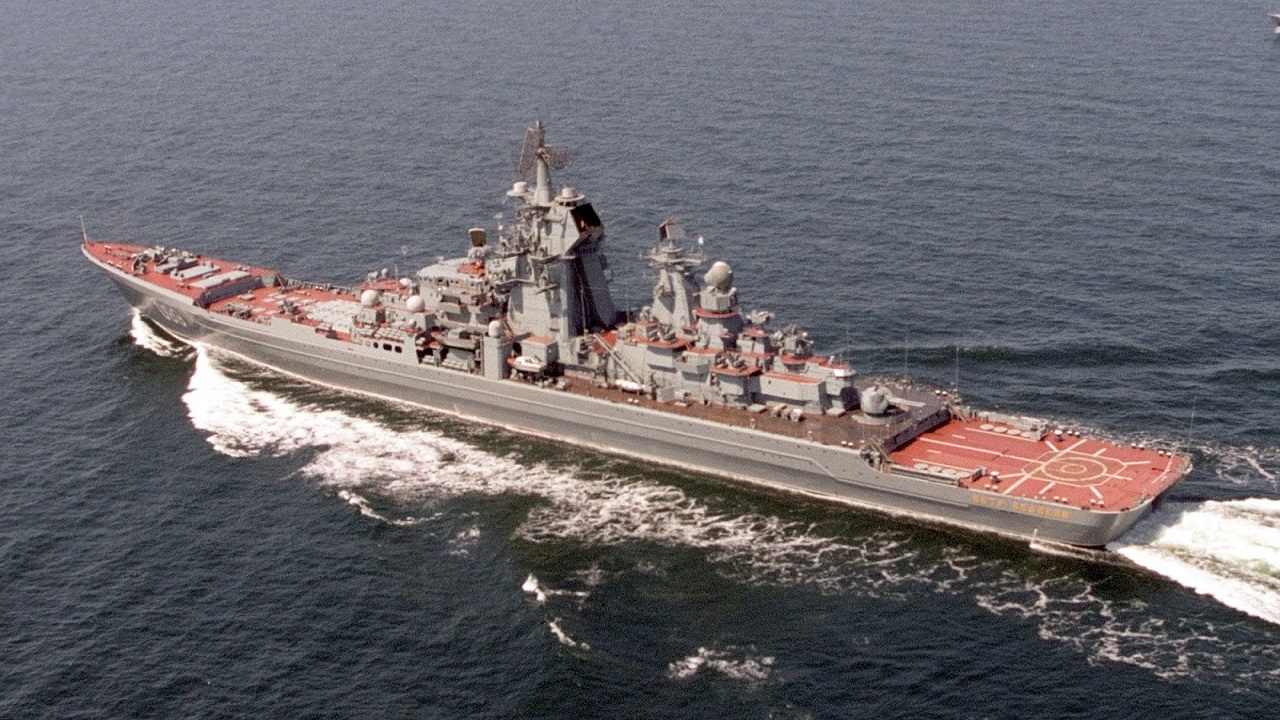
Kirov-Class battlecruiser. Image Credit: Creative Commons.
And it is the end of the battlecruiser itself, a warship type that was supposed to have died at Jutland and again after 1945, given one last revival in these nuclear giants and now expiring with them. When the two ships being scrapped are gone, when Pyotr Velikiy is retired, and when Nakhimov eventually reaches the end of its extended life, there will be no battlecruisers left anywhere, and no navy is building more.
What makes the story distinctly Russian is the mismatch between the ambition and the means. Moscow built the largest surface warships of the postwar era, then could not afford to keep them, could not safely dismantle them quickly, and could not build anything to replace them — so it poured billions and a quarter-century into resurrecting a single Cold War hull to serve as a flagship almost by default, as its only aircraft carrier rusts toward its own end and its planned new large combatants stay on the drawing board.
The Admiral Nakhimov will return to the fleet as the most heavily armed surface combatant in the world and, quite possibly, as a relic the moment it does. It is the last battlecruiser, holding the flag for a navy that can no longer build another, and when it finally goes, the type that began with the Invincible in 1908 will go with it.
About the Author: Harry J. Kazianis
Harry J. Kazianis (@Grecianformula) was the former Senior Director of National Security Affairs at the Center for the National Interest (CFTNI), a foreign policy think tank founded by Richard Nixon based in Washington, DC. Harry has over a decade of experience in think tanks and national security publishing. His ideas have been published in the NY Times, The Washington Post, The Wall Street Journal, CNN, and many other outlets worldwide. He has held positions at CSIS, the Heritage Foundation, the University of Nottingham, and several other institutions related to national security research and studies. He is the former Executive Editor of the National Interest and the Diplomat. He holds a Master’s degree focusing on international affairs from Harvard University.