
Summary and Key Points: This analysis by Brent M. Eastwood, PhD, a former U.S. Army Infantry officer, contrasts the current deployment of the USS Gerald R. Ford with the historical endurance of the USS New Jersey (BB-62).
-While the Ford’s crew grapples with mechanical issues and the fatigue of a 246-day mission, the Iowa-class battleship New Jersey once maintained combat readiness for 14 months during World War II.
-As the Ford strike group utilizes the Aegis Weapon System to prepare for a potential “Kinetic Missile Fight” in the Mediterranean, the legacy of WWII shore bombardments and carrier escorts serves as a vital psychological anchor for modern naval force posture.
14-Month Combat Mission: Why the Iowa-Class Battleship USS New Jersey is the Ultimate Model for the USS Gerald R. Ford Aircraft Carrier
Sailors on the USS Gerald R. Ford may be getting frustrated during their current deployment, which has sent the world’s largest and most advanced aircraft carrier back to the Mediterranean Sea from the Caribbean for a potential combat cruise to counteract Iran.
This is the second time the Gerald R. Ford has been in the Central Command area of operations. The Ford just completed duty in the Western Hemisphere, where it did an excellent job fighting transnational crime and conducting counter-narcotics missions, even participating in the operation that captured narco-terrorist president Nicolas Maduro.
Toilets on the Fritz
However, sailors onboard are involved in a “stink.” Around 650 toilets on the $13.3 billion carrier are clogged. Some shipmates are spending their valuable time vigorously cleaning and mopping heads that would normally be spotless during deployments.
This Has Been One Long Deployment, and It’s Not Over Yet
The Ford has been out to sea for more than 246 days. This is over eight months of duty. It left its homeport in Norfolk, Virginia, on June 24, 2025. Typical U.S. carrier deployments last around six months, but they can sometimes extend to eight or nine.
The supercarrier is part of a strike group that could attack Tehran to finally put an end to uranium enrichment for nuclear weapons, curtail its ballistic missile program, and halt Iranian support of terror groups like Hamas, Hezbollah, and the Houthis.
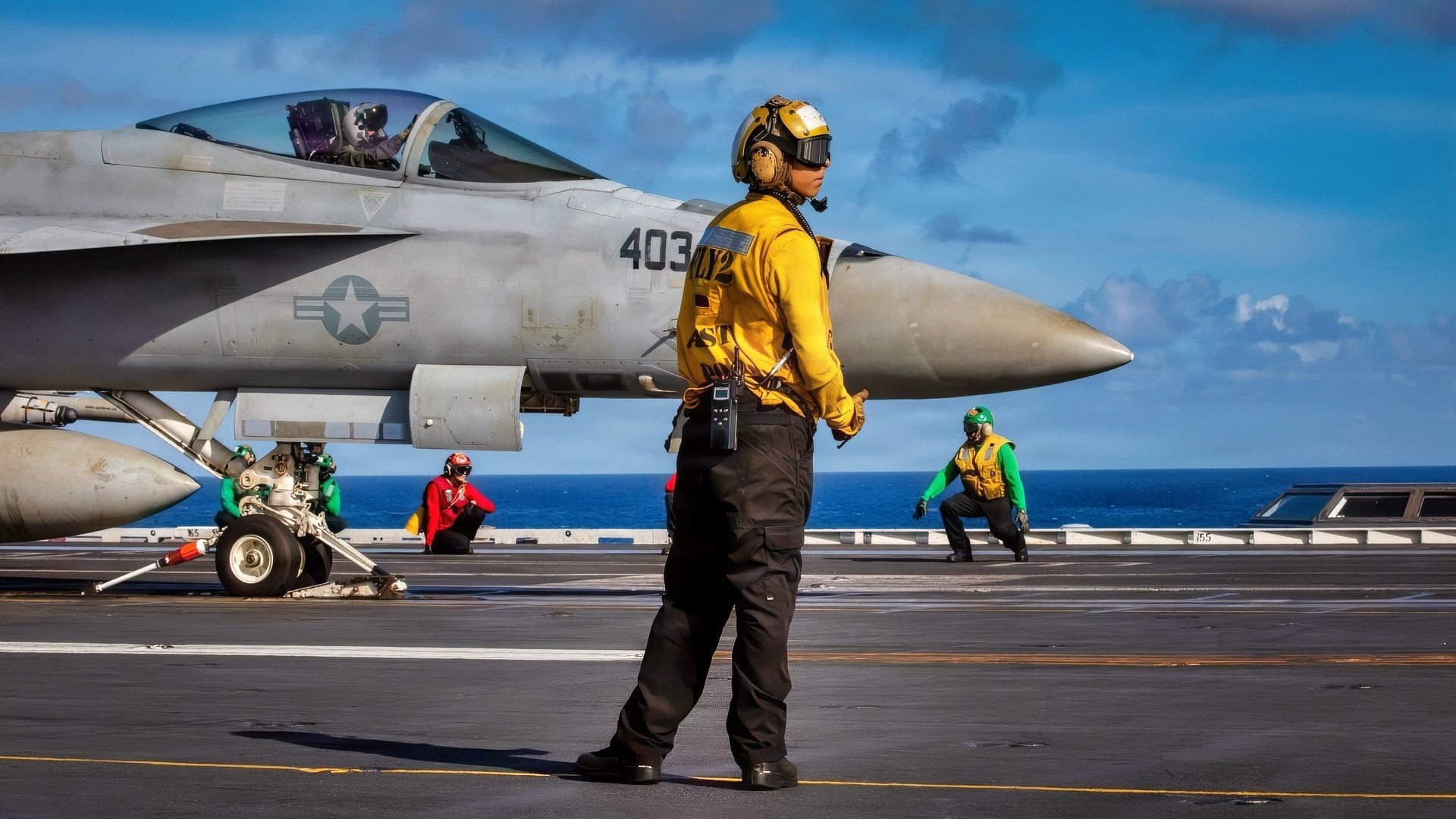
A U.S. Sailor signals to an F/A-18E Super Hornet aircraft, attached to Strike Fighter Squadron 87, during flight deck operations on the flight deck of the world’s largest aircraft carrier, Ford-class aircraft carrier USS Gerald R. Ford (CVN 78), while underway in the Caribbean Sea, Jan. 3, 2026. U.S. military forces are deployed to the Caribbean in support of the U.S. Southern Command mission, Department of War-directed operations, and the president’s priorities to disrupt illicit drug trafficking and protect the homeland. (U.S. Navy photo)
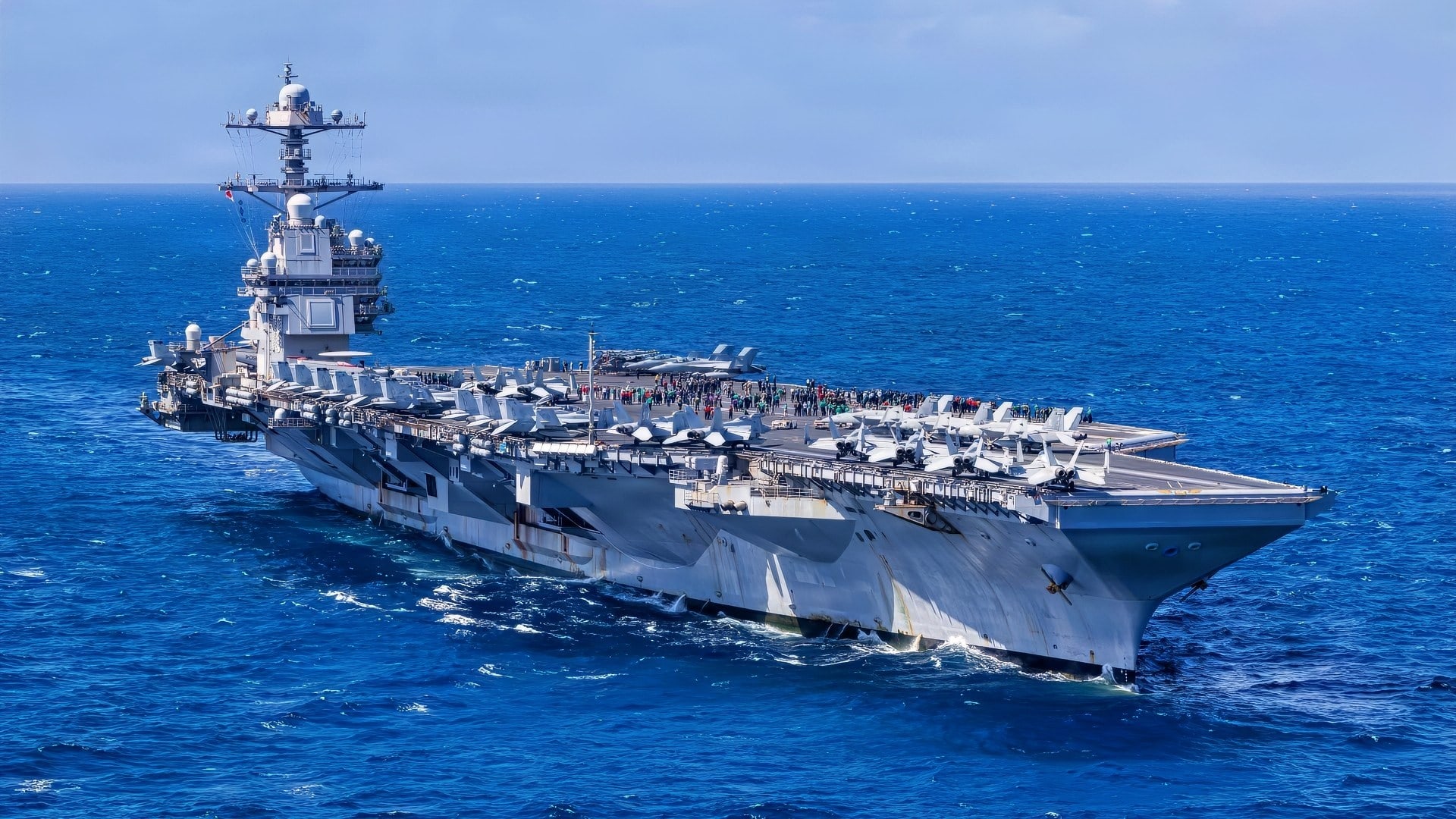
The world’s largest aircraft carrier, Ford-class aircraft carrier USS Gerald R. Ford (CVN 78), transits the Caribbean Sea during Carrier Air Wing 8’s aerial change of command ceremony, Jan. 19, 2026. U.S. military forces are deployed to the Caribbean in support of the U.S. Southern Command mission, Department of War-directed operations, and the president’s priorities to disrupt illicit drug trafficking and protect the homeland. (U.S. Navy photo)
Will War Happen With Iran?
The Ford is currently on the island of Crete in the Mediterranean Sea. It will spend a few more days replenishing at the U.S. naval base at Souda Bay after transiting the Strait of Gibraltar. There is no time for sailors to take extended liberty, though.
They must take the opportunity to rest and prepare for what could be round-the-clock combat operations against Iran if President Donald Trump orders it. The White House and Trump’s diplomatic corps are trying to work out some agreement in which the Iranians would finally see the light and limit their malign activities that have destabilized the region for decades.
The CNO Is Not A Big Fan of Extended Deployments
The Navy’s Chief of Naval Operations, Admiral Daryl Caudle, admitted in January that the Gerald R. Ford may be overextended.
“I think the Ford, from its capability perspective, would be an invaluable option for any military thing the president wants to do,” Caudle explained. “But if it requires an extension, it’s going to get some pushback from the CNO. And I will see if there is something else I can do,” the admiral said to reporters at a naval conference. “It is the extensions that bother,” he added.
This Is Part of Being a Sailor, Though
Sailors on the Ford could be fatigued, missing their families, and sacrificing shared life events like weddings, births, and funerals. But this is what they signed up for. The Navy is used to combat deployments, and carriers are especially busy with flight deck operations that keep their aircraft humming night and day and in all types of weather.
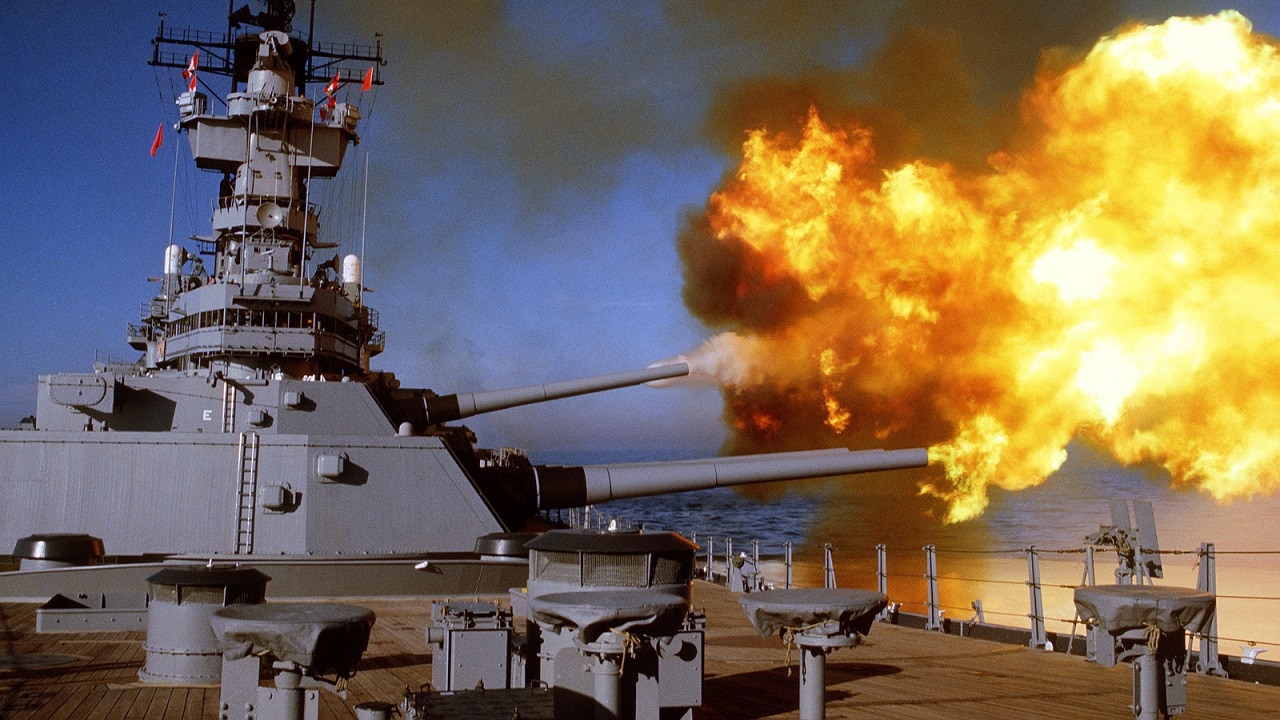
The Nos. 1 and 2 Mark 7 16-inch/50-caliber guns are fired to starboard during a main battery firing exercise aboard the battleship USS NEW JERSEY (BB-62).
Like all personnel on floating air bases, these sailors are the best at what they do. Whether they are a cook, radar operator, flight deck sailor, or aviator, these people are flat-out experts and lead the world in operational excellence.
Get Ready for a Potential’ Kinetic Missile Fight’
But combat with the Ford could turn into what I call the “Kinetic Missile Fight.” Iran has a huge inventory of ballistic missiles, and they are close to buying ship-killing projectiles from China as we speak. There is cause for concern that a carrier could be hit with a missile or a loitering drone.
But the carrier strike group has the Aegis Weapon System and the SM-Standard Missile family of interceptors, which can defend effectively against incoming bogeys.
Learning from World War II and Iowa-Class Battleships
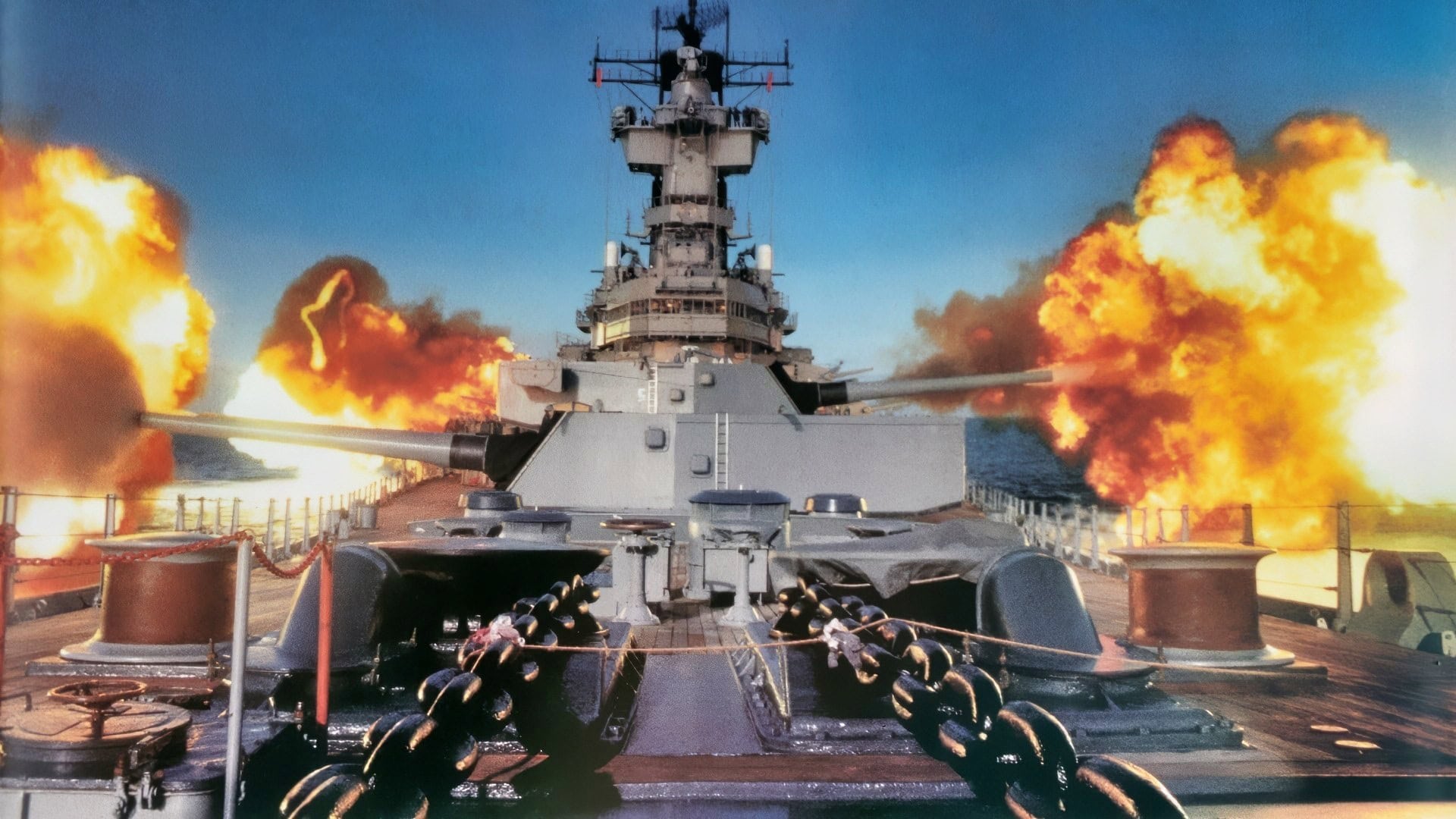
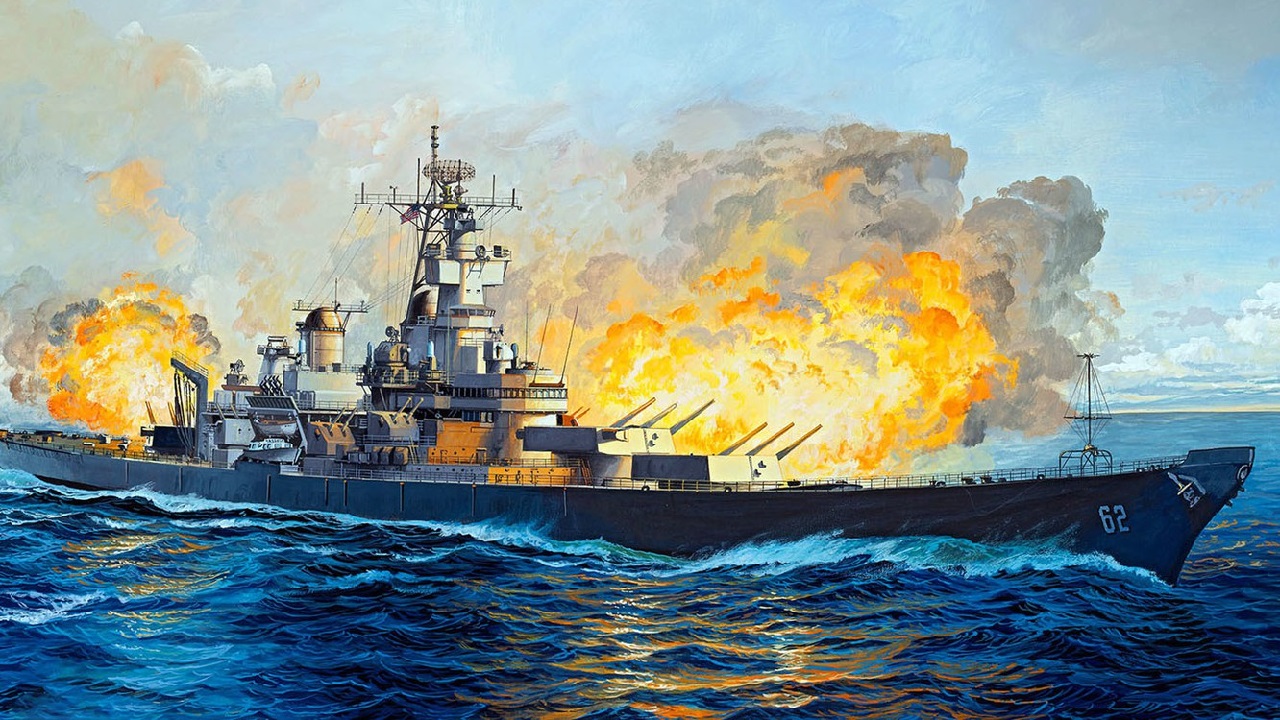
Copy negative of the US Navy (USN) Iowa Class (as built) Battleship USS NEW JERSEY (BB 62) firing a 21-gun broadside. Exact date shot unknown. Image Credit: Creative Commons.
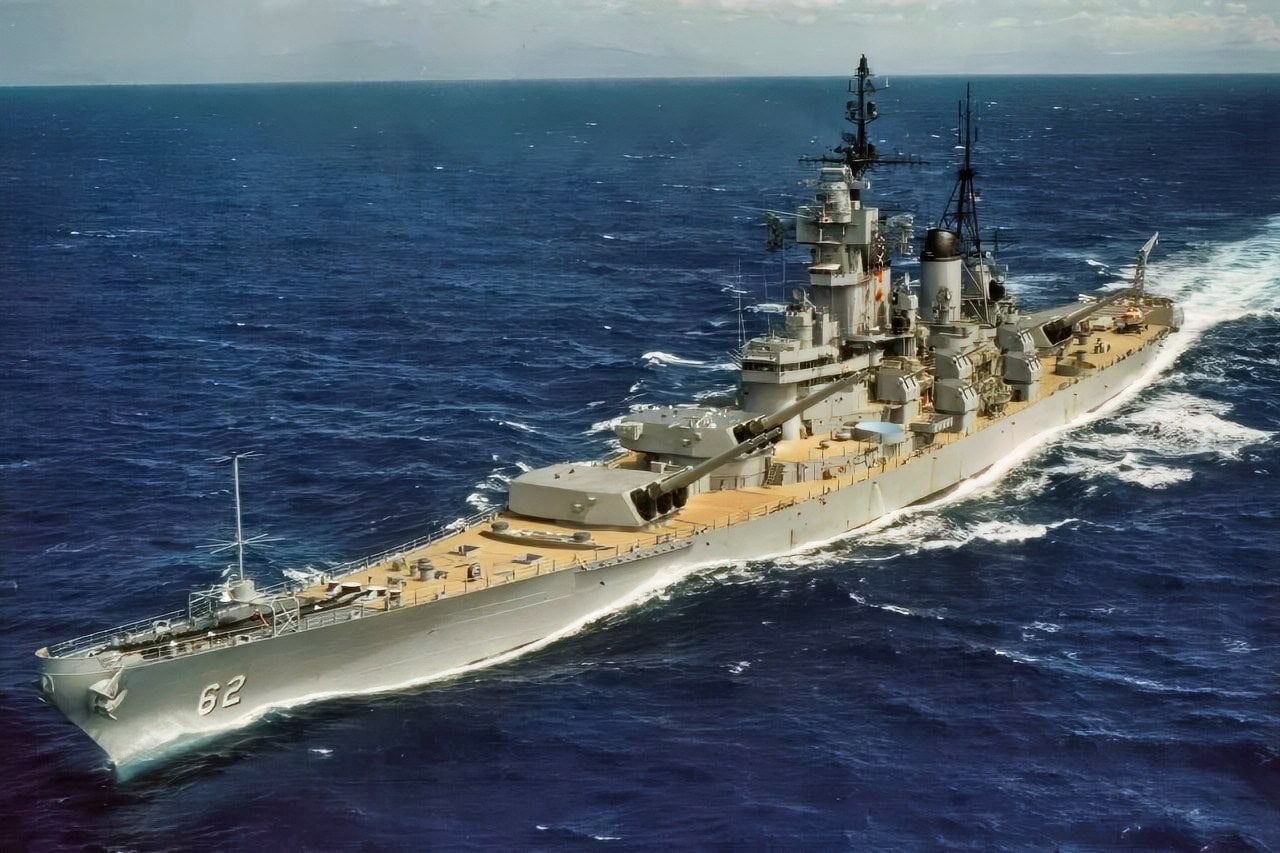
USS New Jersey Battleship. Image Credit: Creative Commons.
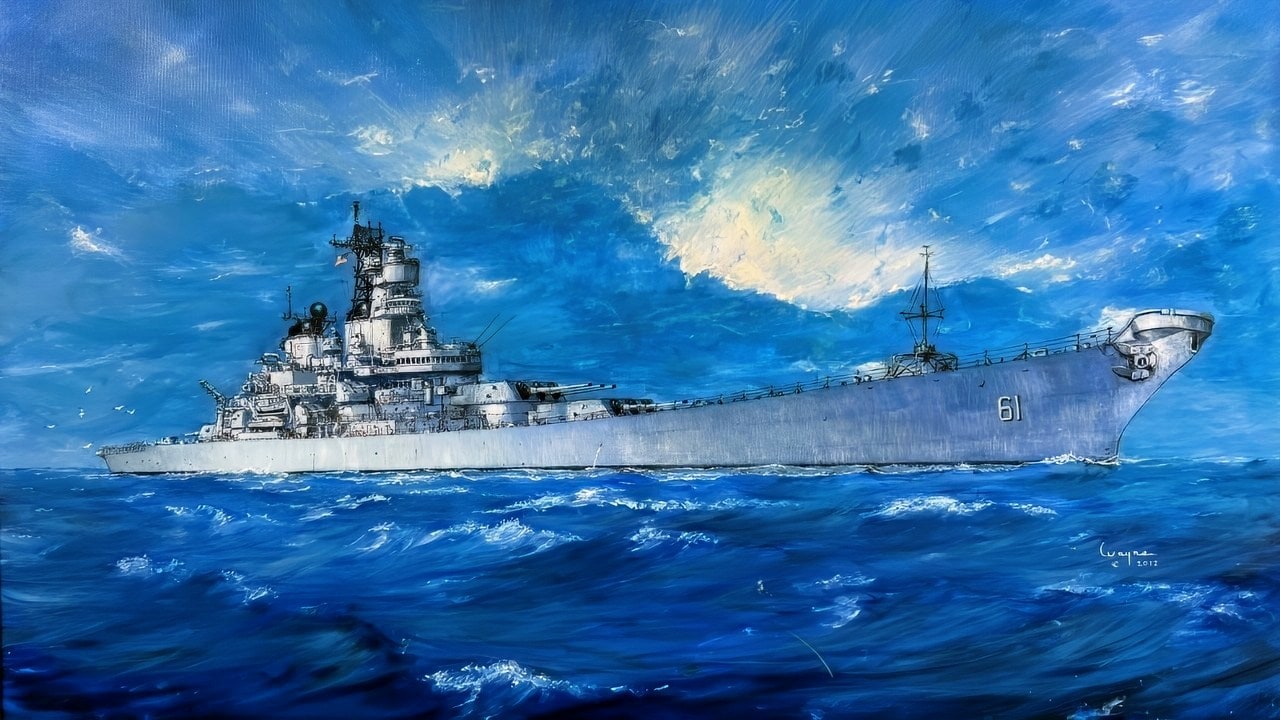
Image taken by Harry J. Kazianis aboard the USS Iowa on August 15, 2025. Image is of a painting of the USS Iowa of the Iowa-Class. USS New Jersey is also a Iowa-Class battleship.
The sailors on the Gerald R. Ford could use a refresher on World War II, since they were out to sea for more than a year. Not to disparage the toughness and resolve of today’s shipmates, but the personnel during the 1940s could sustain combat operations for much longer than six months.
Battleship New Jersey Once Fought for 14 Months Straight
One particularly busy ship was the USS New Jersey (BB-62). The Iowa-class battleship was the most decorated battlewagon in naval history with 19 battle stars. During World War II, it was once deployed for 14 months. This was one of the longest continuous combat missions during the war.
These sailors were probably dragging at the end of that deployment. You have to hand it to these men who battled combat fatigue and missed their families, too. The New Jersey bombed shore targets to the Stone Age and escorted carriers too during the island-hopping campaign in the Pacific. New Jersey took part in the Marshall Islands campaign and the Battle of Leyte Gulf.
Quick Specs on the New Jersey
New Jersey’s 16-inch/50-caliber guns blasted away, and they fired 2,700-pound shells. The battleship was nearly 900 feet long and displaced 45,000 tons. It entered service in 1943. The vessel could hit a top speed of over 30 knots. Around 2,000 sailors made their home on the New Jersey for sustained combat that looked like it was never going to end until the Japanese surrender after the Americans dropped two atomic bombs.
The propulsion system comprised eight Babcock & Wilcox boilers and four shafts, delivering 212,000 horsepower. Its range was 15,000 nautical miles. The Iowa-class battleships were the only dreadnoughts that could keep up with U.S. Navy fleet aircraft carriers, and they made a formidable addition to the large carrier strike groups.
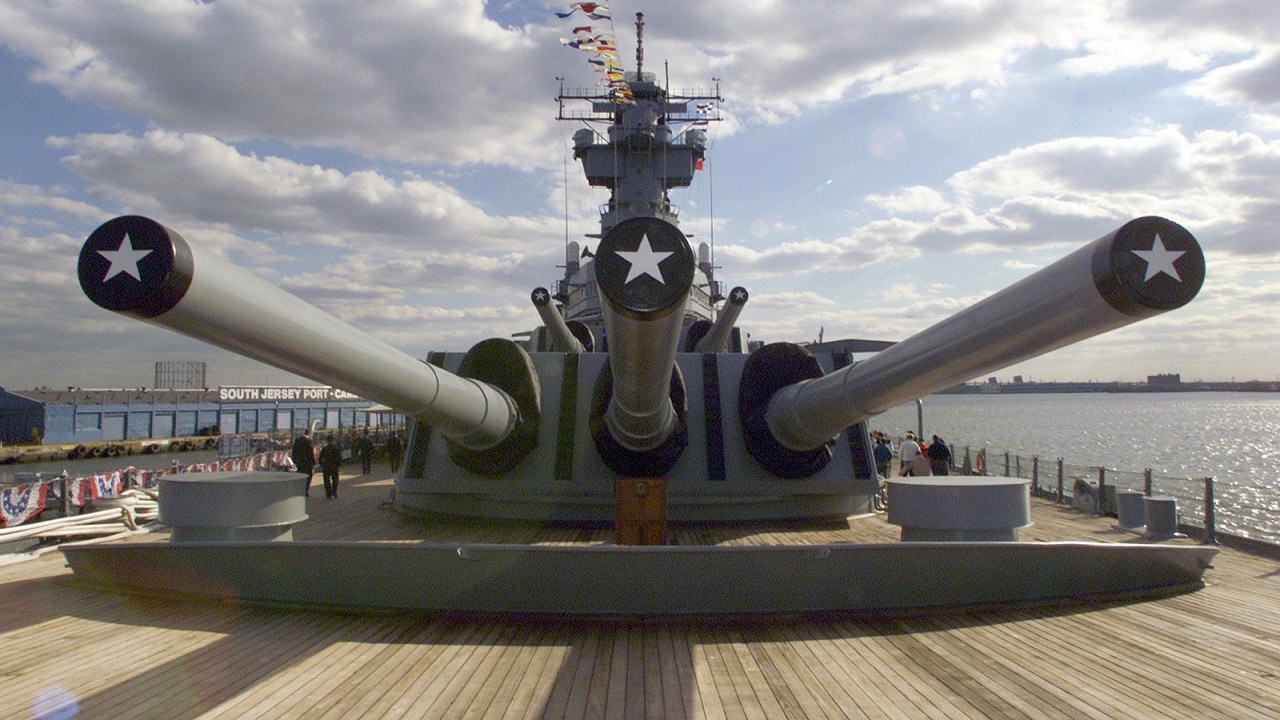
A head on view of the forward 16″ gun turrets on the USS NEW JERSEY (BB 62).
USS New Jersey Sailor Shares His Story
Sailors were always active on board, and battle stations could be particularly stressful, especially during shore bombardment, when enemy aircraft were a concern during amphibious attacks.
The Battleship New Jersey Museum and Memorial interviewed sailor Charles Owen in 2019.
“We went on to the Marshall Group. We bombarded the beaches so that the Marines and soldiers could land there. We could get on the deck and watch the big guns go off, bombarding the islands. We were also manning the 40-millimeter at the time. If any of the Japanese planes came in, we’d be ready. We could see when one of the guns hit the beach. We wondered where the big guns would hit, and this went on for hours. They fired all nine of the 16-inchers,” Owen said.
“We sailed on to Saipan, Tinian, and Guam. We were bombarding those three islands for 30 days — day and night. That was a tough battle there. We shot down some planes there and after that went to New Guinea. Soldiers and Marines were landing and we bombarded the beaches there. We always had to watch out for the Japanese planes when I was on the 40s. Our job was to protect the carriers too. We could also fight it out with the Japanese airplanes trying to hit the carriers,” Owen said. This went on for what seemed like forever during the war. Over and over, New Jersey repeated these missions.
Long Days and Long Nights
That gives you a taste of what sailors were up against in the Pacific on the New Jersey. It didn’t seem like they got much of a break during the deployments. They probably rotated personnel on the guns so shipmates could snatch a few winks or get a bite to eat. I’m sure those still living have tinnitus to this day.
Oral Histories Can Fire Up 21st Century Sailors
Sailors on the Ford should check out some of these World War Two oral histories from sailors serving on ships for such long periods. They could garner some inspiration from those deployments. The Ford may be going through some tough times, but the Americans are ready for continuous action if needed.
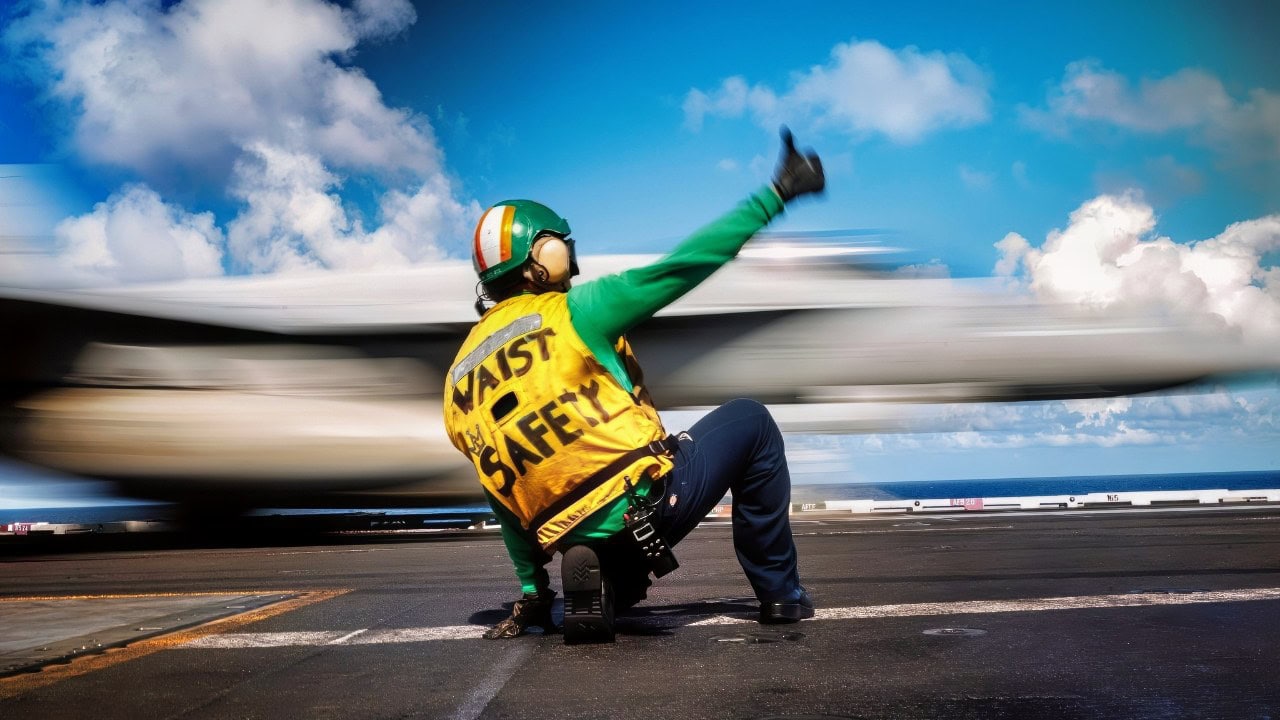
USS Gerald R. Ford Aircraft Carrier or Supercarrier
The toilets will hopefully be fixed, and war could still be averted with the Iranians. But personnel on the Ford must be ready for another 2 to 3 months at sea in the Middle East.
Until then, they can view more interviews with World War Two sailors who maintained a continuous rate of fire for weeks on end. The USS New Jersey was a combat stalwart, and the Gerald R. Ford could make its own history due to the expertise of the modern-day sailors on board. Hold steady and support those flight deck operations if needed against Iran, shipmates. Your country depends on you.
About the Author: Dr. Brent M. Eastwood
Author of now over 3,000 articles on defense issues, Brent M. Eastwood, PhD is the author of Don’t Turn Your Back On the World: a Conservative Foreign Policy and Humans, Machines, and Data: Future Trends in Warfare plus two other books. Brent was the founder and CEO of a tech firm that predicted world events using artificial intelligence. He served as a legislative fellow for US Senator Tim Scott and advised the senator on defense and foreign policy issues. He has taught at American University, George Washington University, and George Mason University. Brent is a former US Army Infantry officer. He can be followed on X @BMEastwood.