
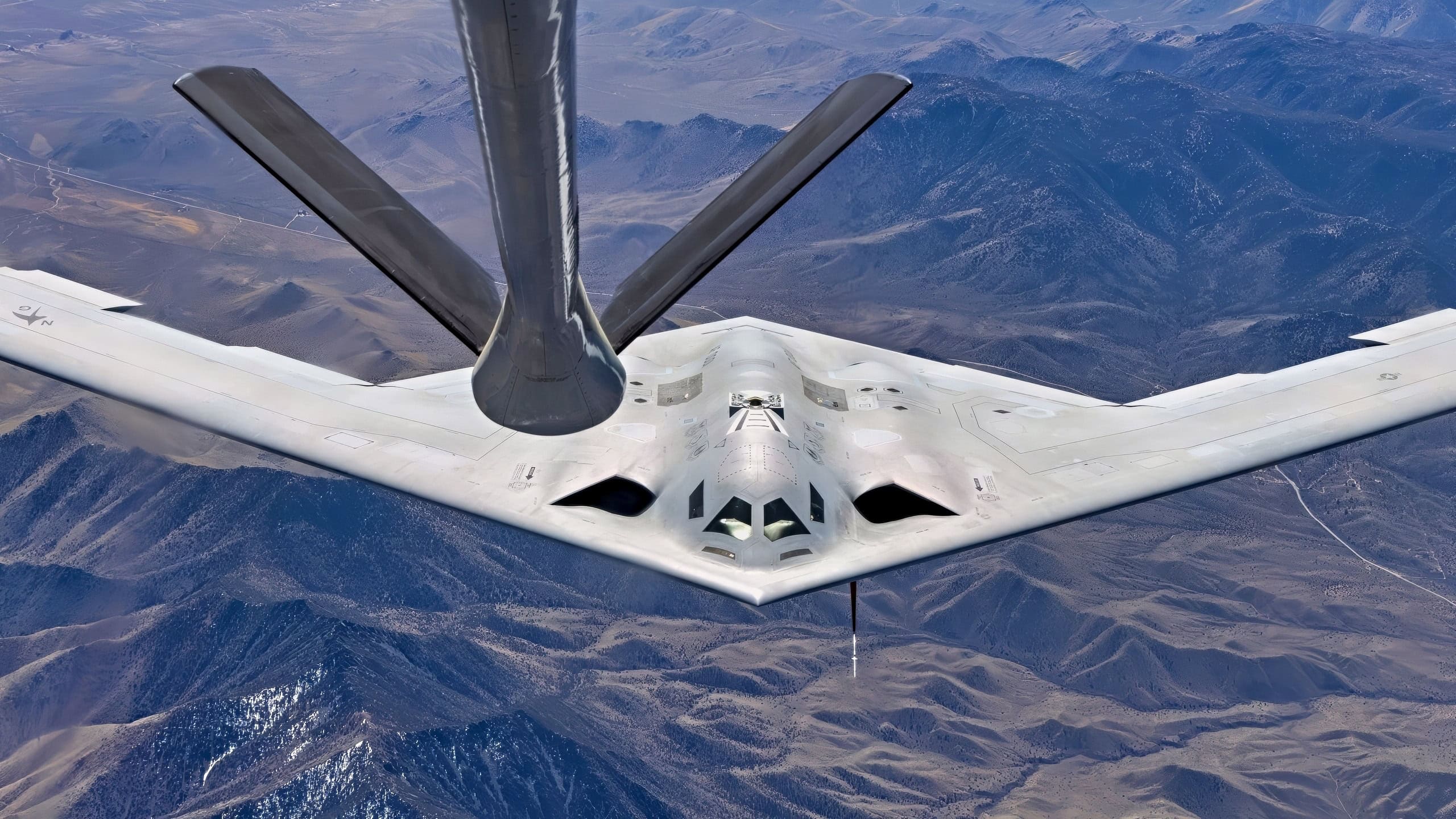
Summary and Key Points: Northrop Grumman, the U.S. Air Force, and Congress are now arguing over a single number: how many B-21 Raiders America will actually build. The bomber is running ahead of schedule and under budget; its contractor is absorbing more than $2 billion in losses to build it faster than the Pentagon has ordered, and every commander who testifies wants more of them than the program of record buys. After a decade of development, the engineering question is essentially settled. What remains is an industrial budget fight over production numbers — and that is the fight this program is now facing.
B-21 Raider: Aerospace Miracle
On June 11, the Air Force announced something bomber programs almost never advertise this early: an operational test pilot had flown the B-21 Raider, seated beside a graduate of the Air Force Test Pilot School, years before the aircraft reaches a combat wing.
The point, said Lt. Col. Matthew Gray, who directs the Raider Combined Test Force, is to start judging the jet now — to “evaluate the bomber’s true combat utility, not just its flying characteristics.” Programs such as this one choose their announcements carefully. Choosing this one indicates that the schedule question is closing and the quantity question is opening.
America’s next bomber enters July 2026 in exactly that condition: performing better than its own plan, built by a contractor losing money on every early airframe, wanted in numbers its program of record does not buy, while the bombers it replaces spend the summer flying combat missions nobody scheduled for them.
Aerospace Origins: A Secret Program, a Cost Shootout, and the Doolittle Raiders’ Name
The B-21 began in 2011 as the Long Range Strike Bomber program, a classified effort to field a penetrating bomber that could deliver conventional and nuclear weapons deep inside defended airspace.
The Air Force issued its request for proposals in July 2014 and awarded the contract to Northrop Grumman in October 2015, beating a joint Boeing-Lockheed Martin bid; when the losers protested, the Government Accountability Office sustained the Air Force’s choice, and the decision record showed cost had been the deciding factor. Management went to the Air Force Rapid Capabilities Office rather than the normal acquisition bureaucracy, a choice the program’s defenders now cite constantly.
The designation marked it as the 21st century’s first bomber, and in September 2016, the service named it Raider in honor of the Doolittle Raiders, with retired Lt. Col. Richard Cole, the last living member of the 1942 raid, serving as a witness at the ceremony.
The design that emerged from Palmdale’s Plant 42 on December 2, 2022, in the first public rollout of a new American bomber in three decades, is a flying wing, visibly smaller than the B-2 it echoes, built around next-generation low-observable shaping, an open-systems architecture meant to take upgrades for decades, and what Northrop has claimed as the mantle of a sixth-generation aircraft.
The Air Force’s own fact sheet calls it “a dual-capable penetrating strike stealth bomber” and hands it, alongside the re-engined B-52, the entire future of the bomber force.
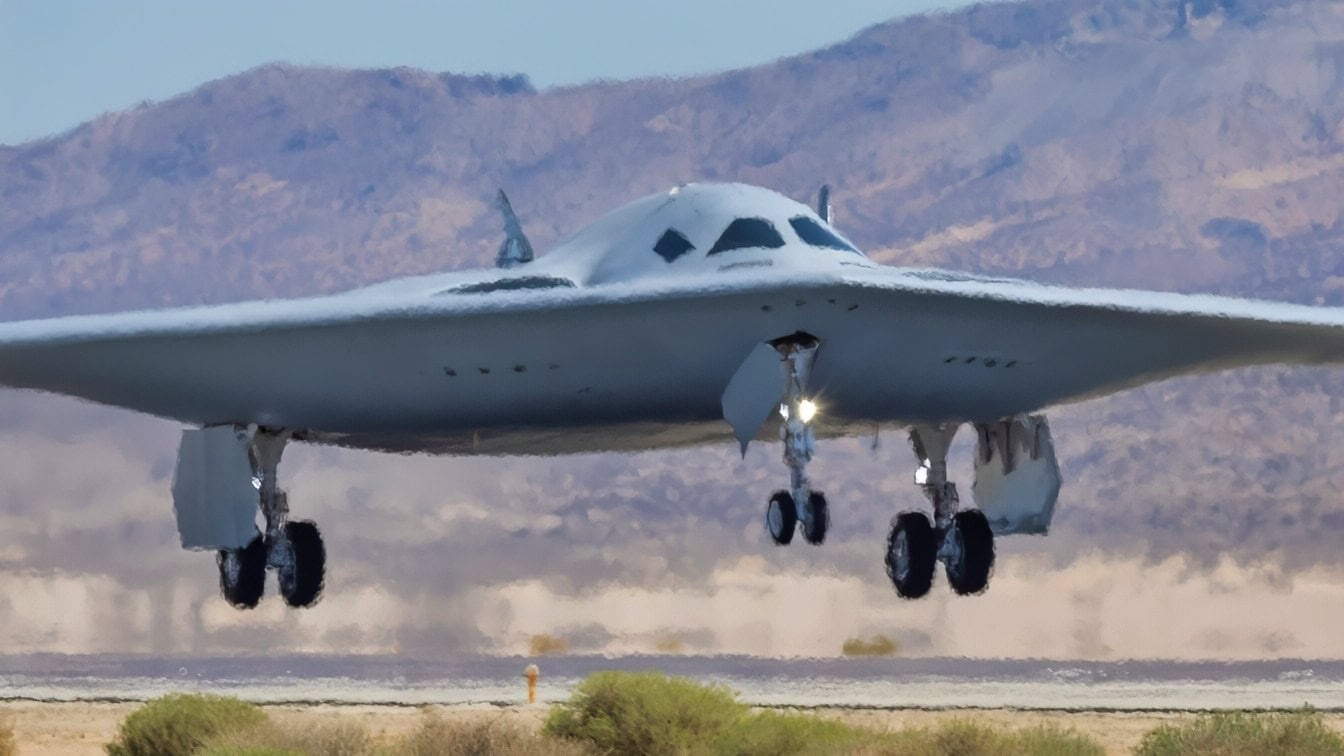
A B-21 Raider test aircraft lands at Edwards Air Force Base, Calif., during ongoing developmental flight testing, Sept. 11, 2025. The B-21 will be the backbone of the bomber fleet; it will incrementally replace the B-1 Lancer and B-2 Spirit bombers. (U.S Air Force photo by Todd Schannuth)
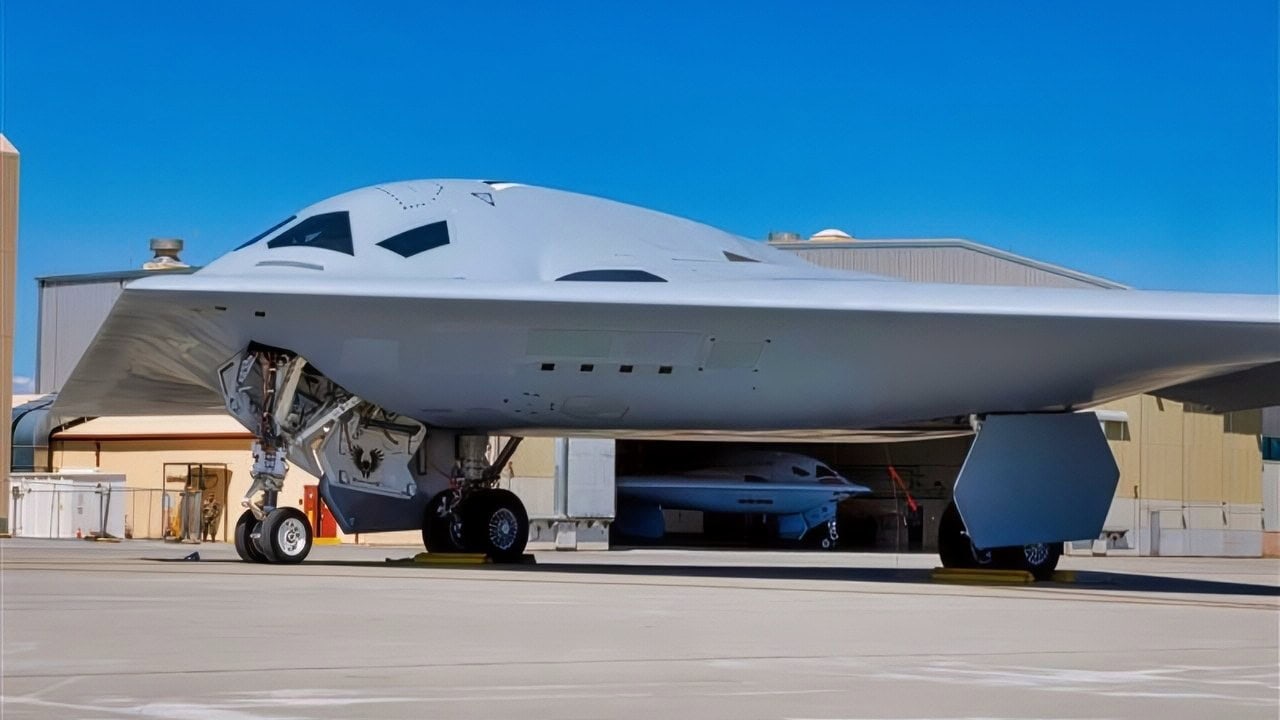
A second B-21 Raider, the world’s sixth-generation stealth bomber, test aircraft arrives at Edwards Air Force Base, Calif., Sept. 11, 2025. The addition of the second test aircraft expands mission systems and weapons integration testing, advancing the program toward operational readiness. (Courtesy photo)
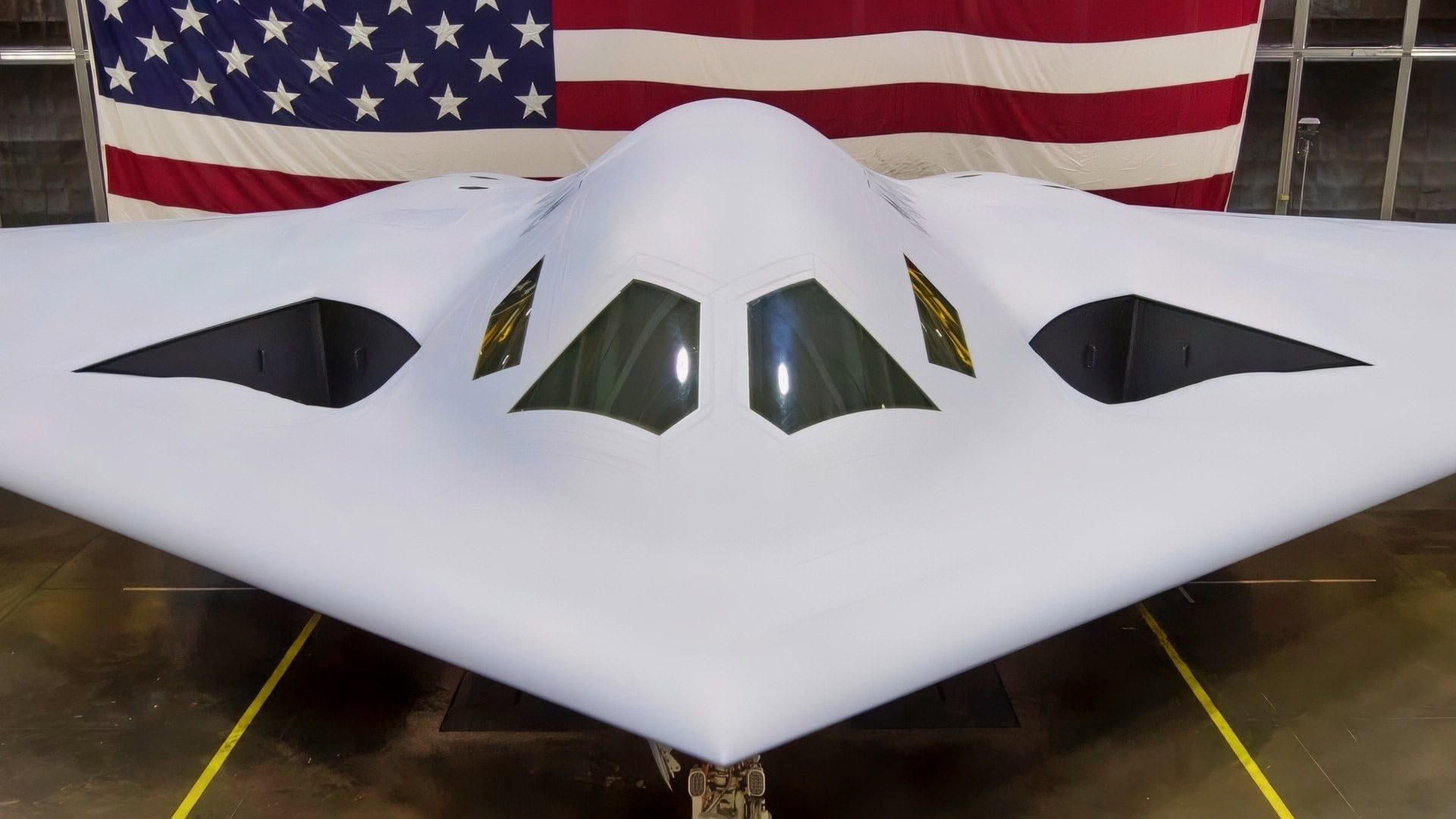
The B-21 Raider was unveiled to the public at a ceremony Dec. 2, 2022 in Palmdale, Calif. The B-21 will provide survivable, long-range, penetrating strike capabilities to deter aggression and strategic attacks against the United States, allies, and partners. (U.S. Air Force photo)
The weapons plan runs from the AGM-158 JASSM-ER cruise missile on the conventional side to the B61-12 gravity bomb and the AGM-181 Long Range Standoff missile on the nuclear side, keeping the aircraft one of the three modernization pillars of the American deterrent alongside the Sentinel missile and the Columbia-class submarine. The first flight came on November 10, 2023. Unlike most programs at that stage, the jet that flew was built on the operational production line, with operational tooling, to the operational configuration, a decision that looked expensive at the time and looks shrewd now.
Industrial Reality: Two Jets Over the Mojave and a Test Campaign Beating Its Own Clock
The flight-test program crossed from cautious to fast over the past ten months. A second B-21 arrived at Edwards Air Force Base on September 11, according to Air Force Secretary Troy Meink, letting the Combined Test Force run parallel work on mission systems and weapons integration instead of queuing everything behind one airframe. On March 10, the first Raider flew a five-and-a-half-hour aerial refueling mission behind a KC-135, acknowledged by the Air Force on April 14, and by early June, aviation photographers at Edwards were catching test aircraft 0001, known to its test force as Cerberus, flying tanker-supported sorties and showing off control-surface details no one had documented before.
A critical test campaign planned for 180 days closed out in 73, an announcement made in May, with the compression attributed to sorties that validated multiple test points at once rather than to corner-cutting. The June 11 operational-pilot flight capped the run, with Gen. Dale White, the Department of War’s direct-reporting portfolio manager for the B-21, the F-47 fighter, Sentinel, and the Collaborative Combat Aircraft drones, pressing the test force for urgency without recklessness.
The production side moved in parallel. On February 23, Northrop Grumman announced that it and the Air Force are accelerating B-21 production, backed by more than $5 billion that the company has invested in digital engineering and manufacturing infrastructure. The company’s stated schedule now has the first aircraft reaching Ellsworth Air Force Base in 2027.
The money behind the acceleration came from the reconciliation package passed last summer, which carried $4.5 billion to raise annual production capacity by 25 percent, a story 19FortyFive covered in detail in March, second-production-line history lessons included. Several more aircraft are in assembly at Palmdale behind the two flying at Edwards. Outside estimates place the classified production rate at around seven aircraft a year.
Business & Industrial Ledger: The Program That Works and the Contractor That Pays for It
Washington’s best-behaved major weapons program is also the one on which its builder loses money. Northrop signed fixed-price terms on the early production lots back in 2015, which means cost growth above a threshold comes out of the company, and it has: a $1.56 billion pretax charge disclosed in January 2024, blamed on inflation and workforce disruption, followed by another $477 million in the first quarter of 2025, tied to rising materials costs and to a manufacturing-process change the company chose to absorb.
Chief executive Kathy Warden’s explanation of that choice is the most revealing sentence in the program’s finances: the change “positions us to ramp to the quantities needed in full rate production,” and beyond the program of record if the government wants. Add the charges together, and the contractor building the Pentagon’s most disciplined program has taken just over $2 billion in losses, partly by design, to build bombers faster than anyone has yet ordered.
The government’s side of the ledger has held. The Air Force’s stated average procurement cost of roughly $692 million per aircraft, in early-2020s dollars against a $550 million target set in 2010 dollars, has survived reviews that wreck other programs, and the service pegs the whole effort, covering development, 100 aircraft, and 30 years of operations, at about $203 billion.
The ghost at every hearing is the B-2: planned at 132 aircraft, cut to 21 when the Cold War ended, each one costing about $2 billion once the tiny fleet absorbed the program’s overhead. Every argument about B-21 quantity is, underneath, an argument about never doing that again.
Air War Proof: Nineteen B-2s, Two Iran Campaigns, and the Case the Raider Didn’t Have to Make
The strongest argument for the B-21 was that it was flown, rather than written, twice by the airplane that the Raider replaces.
In June 2025, seven B-2s flew from Missouri to strike Iran’s hardened nuclear facilities with 30,000-pound Massive Ordnance Penetrators, in what the Pentagon described as the largest B-2 operational strike in its history. Nine months later, they went back. Operation Epic Fury opened on February 28 of this year, hitting more than 1,000 targets inside the first day, by U.S. Central Command’s account, and on the night of March 1, the B-2s flew from Whiteman Air Force Base to Iran and back, missions running 30 to 40 hours, to put 2,000-pound-class weapons on hardened ballistic-missile facilities. CENTCOM confirmed the missions, the Jerusalem Post reported, noting the same fleet’s role the previous June against sites such as Natanz, which was dug in beneath a mountain.
All three American bomber types flew in the campaign, with B-1Bs and B-52s staging forward in Britain, but the missions requiring penetration of defended airspace with heavy weapons were flown by a single aircraft type. The War Zone’s assessment was blunt: the B-2 has done what no other asset can, and, in a detail that says everything about the handoff underway, coating technologies developed for the B-21 program are already being applied to the B-2 mid-war to keep it flying.
Now run the arithmetic that keeps planners up at night. The B-2 fleet numbers nineteen, out of 21 ever built, after two were lost in accidents. Two major air campaigns in nine months have leaned on those nineteen airframes for every mission of their kind, while the bills arrive separately: the White House signaled in April, per Washington Post reporting carried in Arms Control Today’s budget analysis, that Iran war costs could require $80 to $100 billion beyond the regular budget, and a late-June supplemental request reported by Air & Space Forces Magazine sought $17.3 billion for operational costs and $21 billion for munitions.
And Iran is the smaller problem. In the Pacific, FlightGlobal notes, the unclassified Taiwan war games keep reaching the same finding: victory runs through long-range anti-ship strikes, and the aircraft that deliver them are bombers, operating across distances where fighters depend on tanker orbits that Chinese missiles are built to threaten.
A penetrating bomber launched from American soil is the one strike asset that geometry cannot easily take away, and the United States operates the Western world’s only dedicated bomber fleet. Asked at an April 21 Senate hearing whether 100 Raiders is enough, the commander of Indo-Pacific Command, Adm. Samuel Paparo, said he would favor 200 and “couldn’t be a stronger advocate.”
The Numbers Fight: 100 on Paper, 145 in Testimony, 200 in the War Games
Paparo’s answer was the loudest entry in a line of testimony that had been building for over a year. Gen. Anthony Cotton endorsed a fleet of 145 as head of Strategic Command in March 2025. His successor, Adm. Richard Correll, reaffirmed the 145 figure before House lawmakers on March 17 of this year and confirmed that investments have been made to raise the production rate and “potentially open a second production line,” a decision still pending. Defense Secretary Pete Hegseth told senators this spring that the requirement runs well past 100.
The Mitchell Institute’s February policy report argues for 200. Against all of it stands the program of record, a minimum of 100 aircraft, and the quiet arithmetic of a total bomber force Global Strike Command has sized at roughly 225, which, with about 76 re-engined B-52Js expected to survive, points toward 150 Raiders before anyone argues for a prolonged Pacific fight.
19FortyFive walked through that math last month; the short version is that every serious estimate now exceeds the number the Pentagon is contracted to buy.
The Counterpoints: Standoff Missiles, Drone Swarms, and the Budget That Has to Pay for Everything
The case against buying more deserves its full weight. The strongest version says penetration itself is becoming optional: B-52s lobbing JASSM-ERs, future hypersonic weapons, and the Long Range Standoff missile can hold targets at risk from outside defended airspace, at a fraction of the cost per shot, without betting a $692 million airframe and its crew.
A second version says the money buys more deterrence elsewhere, in thousands of collaborative combat drones, deeper munitions stocks, and the missile-defense interceptors the Iran war is burning through. A third is simple budget physics: the same modernization account is carrying Sentinel’s overruns and Columbia’s bills inside a defense request that has swollen toward $1.45 trillion, and something eventually gives. And the fixed-price scars are real; a contractor $2 billion underwater is not an industrial base with infinite slack.
Each objection is serious, and the standoff argument is the strongest of them. It is also the argument that the last two years have kept testing. Standoff weapons flew against Iran in volume, and the missions that settled matters, at the buried nuclear sites and the hardened missile plants, still required a penetrating airplane directly over the target, carrying a weapon no missile matches.
The counterargument’s last line of defense is that no adversary bomber forces the issue, and here the mirror is instructive: China’s H-20, the B-21’s only would-be peer, has produced no confirmed flight as of 2026, with Beijing’s own timeline slipped to the 2030s, the head of Global Strike Command calling China “a regional bomber force at best,” and the Pentagon’s December China report not mentioning the aircraft at all, a freeze 19FortyFive examined in February. The hardest problem in military aviation is one Beijing cannot yet solve, and America is solving ahead of schedule. That asymmetry is an argument for finishing the job rather than trimming it.
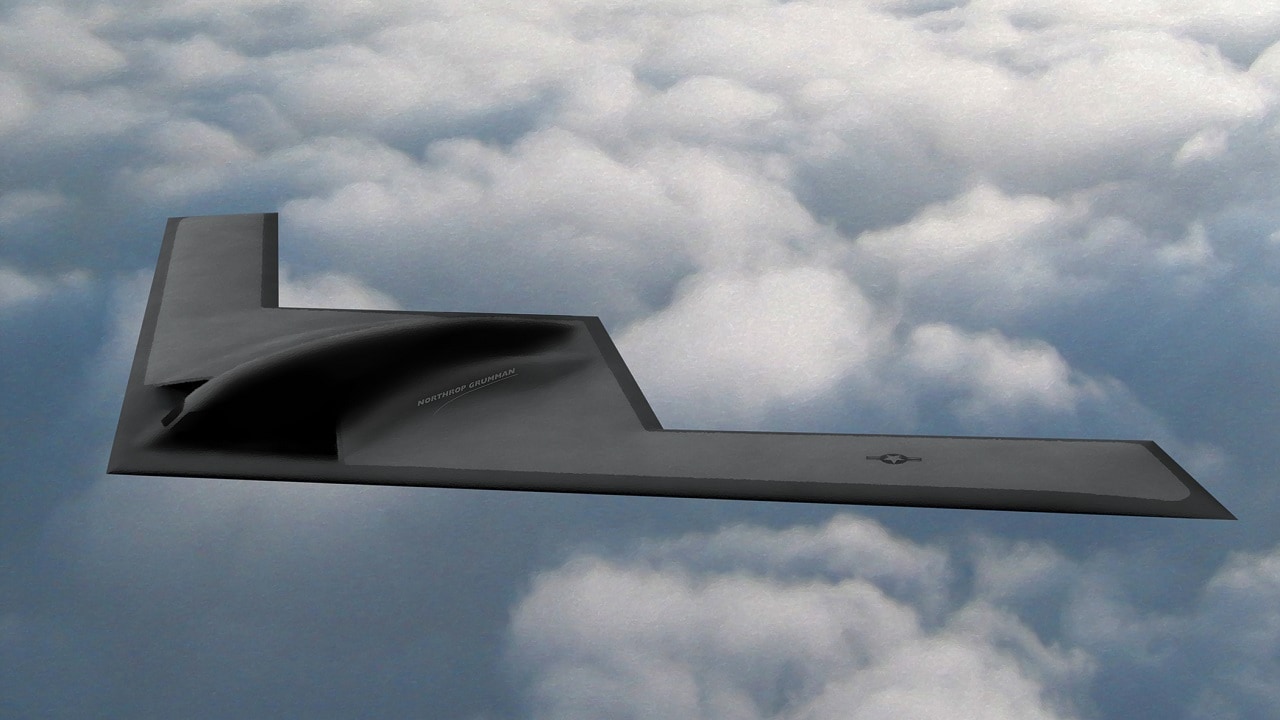
B-21 Raider bomber. Image Credit: Creative Commons.
As of today, the program’s public face is two gray flying wings over the Mojave, several more airframes taking shape at Palmdale, and a beddown clock running at Ellsworth with the first arrival on track for next year.
The nineteen bombers the B-21 Raider replaces are spending this summer flying combat missions their planners never scheduled, against a bill Congress is being asked to cover in supplementals.
Eighty-four years after sixteen bombers reached a target no one thought reachable, the airplane named for their crews is nearly here. How many of them America builds is the last question the program has not answered.
About the Author: Harry J. Kazianis
Harry J. Kazianis (@Grecianformula) was the former Senior Director of National Security Affairs at the Center for the National Interest (CFTNI), a foreign policy think tank founded by Richard Nixon based in Washington, DC. Harry has over a decade of experience in think tanks and national security publishing. His ideas have been published in the NY Times, The Washington Post, The Wall Street Journal, CNN, and many other outlets worldwide. He has held positions at CSIS, the Heritage Foundation, the University of Nottingham, and several other institutions related to national security research and studies. He is the former Executive Editor of the National Interest and the Diplomat. He holds a Master’s degree focusing on international affairs from Harvard University.

