
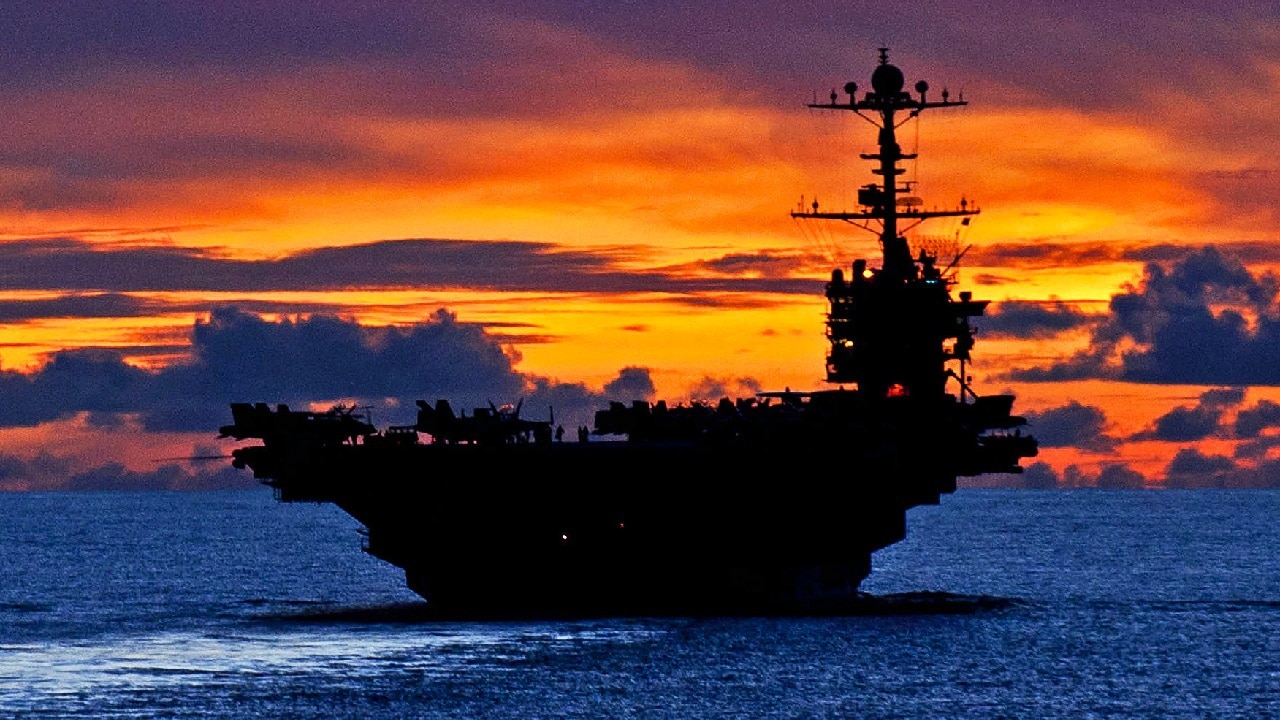
Summary and Key Points: China is building dozens of a single type of submarine that has repeatedly defeated American aircraft carriers in war games — cheap, quiet diesel-electric boats that cost a fraction of the $13 billion warships they threaten. The U.S. Navy has known about the vulnerability for two decades, ever since it leased a small Swedish submarine that repeatedly slipped past a carrier’s defenses. What has changed since is the Office of Naval Intelligence’s projection of where the Chinese fleet is heading, and how little the Navy has done to close the gap.
A $6 Billion U.S. Carrier Was ‘Sunk’ by an $80 Million Swedish Submarine in 2005. China Learned the Lesson
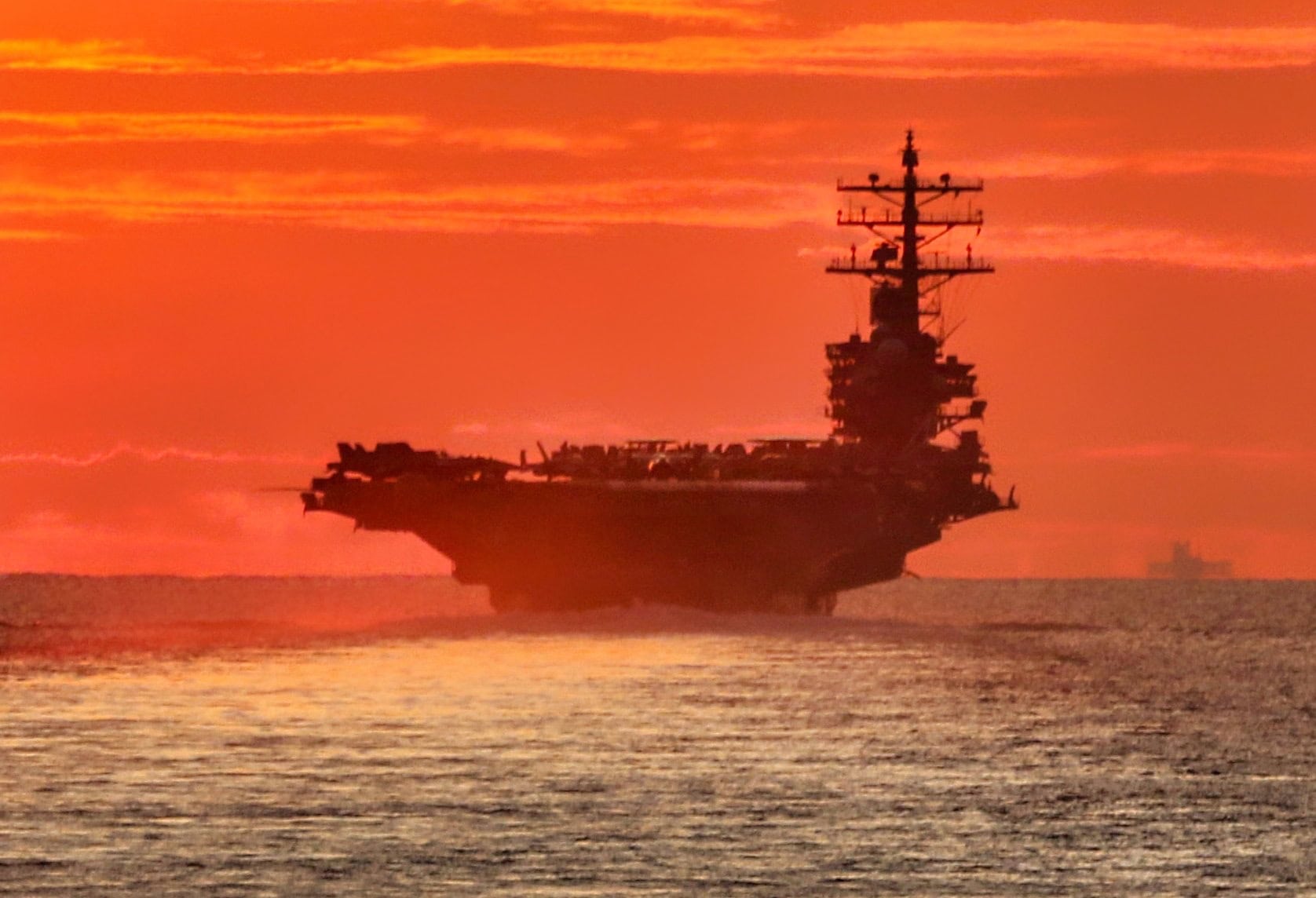
(June 18, 2021) As seen from the Ticonderoga-class guided-missile cruiser USS Shiloh (CG 67), the Navy’s only forward-deployed aircraft carrier USS Ronald Reagan (CVN 76) transits the Strait of Malacca with the Arleigh Burke-class guided missile destroyer USS Halsey (DDG 97). The ships are part of Task Force 70/Carrier Strike Group 5, conducting underway operations in support of a free and open Indo-Pacific. (U.S. Navy Photo by Mass Communication Specialist 1st Class Rawad Madanat)
The U.S. Navy has known since at least 2005 that a quiet diesel-electric submarine can slip past a carrier’s defenses and score a simulated kill, because a leased Swedish boat did it repeatedly to the USS Ronald Reagan and its entire strike group. Two decades later, the vulnerability is not fixed, the Navy still lacks robust deep-water anti-submarine capability by its own intelligence directorate’s account, and the country building most of these submarines is China. The problem is no longer a war-game curiosity. It is a procurement question worth tens of billions of dollars.
The U.S. Navy spends roughly $13 billion to build a single Gerald R. Ford-class aircraft carrier, and it is buying at least ten of them.
The Office of Naval Intelligence projects that China’s submarine force will reach 65 boats in 2025 and 80 by 2035, and nearly half of Beijing’s conventional submarines already carry the one technology that turned a cheap diesel boat into a carrier-killer in the Navy’s own exercises.
Those two facts sit at the center of the most expensive unresolved argument in American naval planning, and the argument started with a small Swedish submarine that the Navy itself invited to San Diego.
Sweden’s Gotland Embarrassed the U.S. Navy in 2005, and the Navy Paid to Keep It
In 2004, the United States asked Sweden to lease it a submarine. The two governments reached an agreement the following spring, and the Swedish Navy sent HSwMS Gotland, a 1,600-ton diesel-electric boat, along with its crew, to operate out of San Diego for what became two years of anti-submarine training. The Navy wanted the Gotland because it posed a threat that American sonar could not reliably detect, and the exercises that followed confirmed that fear in the most direct way possible.
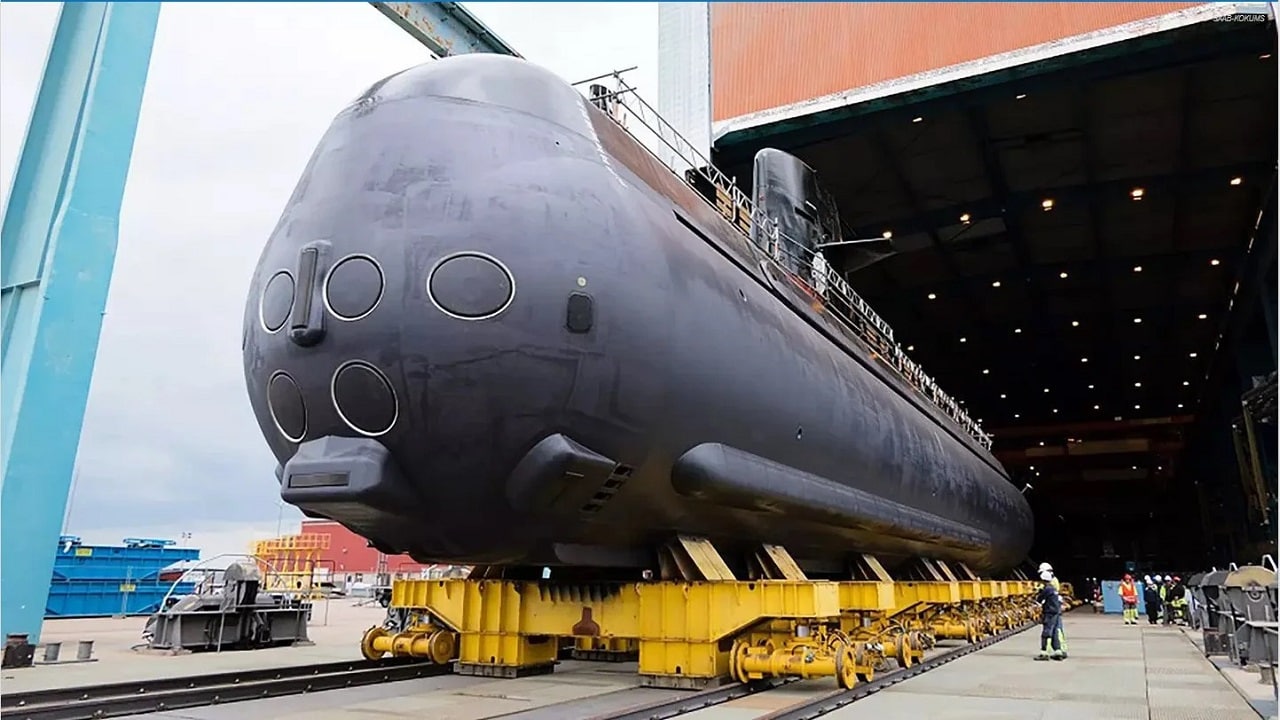
Gotland-Class. Image Credit: Creative Commons.
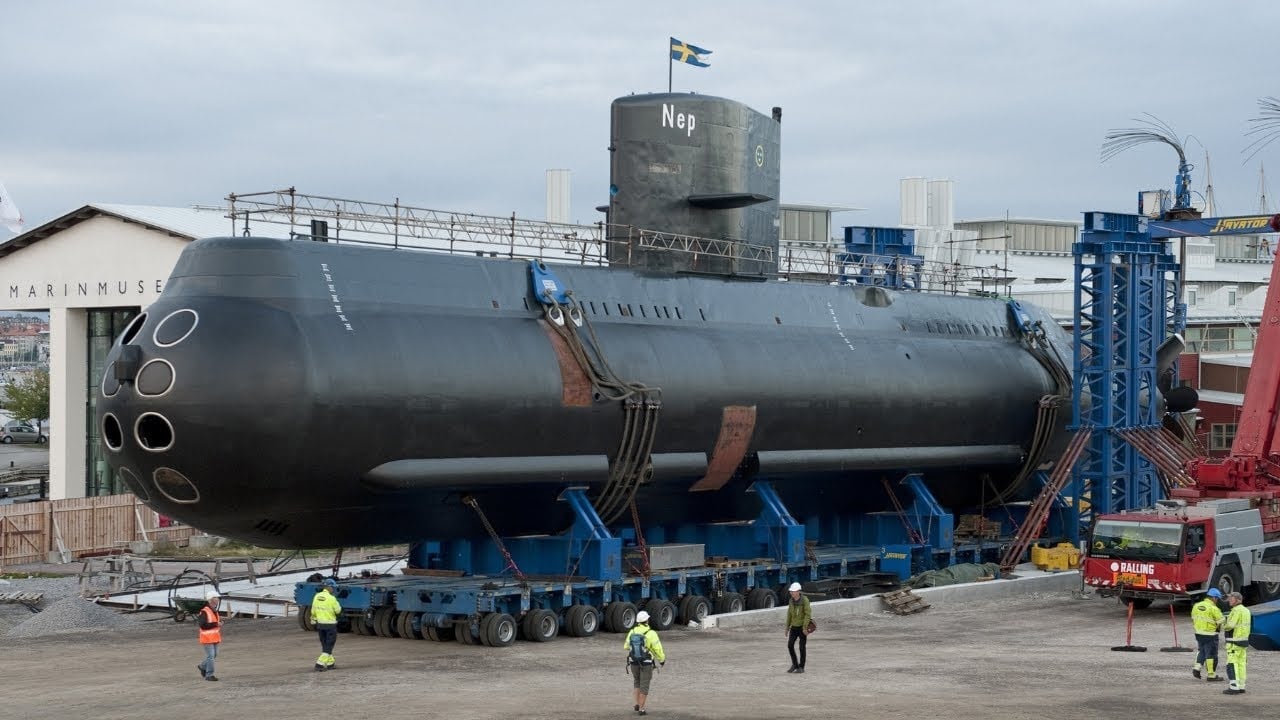
Gotland-class submarine. Image Credit: Creative Commons.
During war games off the California coast, the Gotland penetrated the layered defenses screening the USS Ronald Reagan, a $6.2 billion Nimitz-class supercarrier, and reached a firing position for simulated torpedo attacks.
It did this against a full carrier strike group built to prevent exactly that, with destroyers, helicopters, and nuclear attack submarines all assigned to find it, and by the accounts that circulated afterward, it scored its “kills” more than once without being detected.
No torpedo was real, and no ship was damaged, but in the accounting of a naval exercise, a simulated hit on a carrier means the carrier would have been disabled or lost.
The Navy’s response was telling: rather than dismiss the result, it extended the Gotland lease for a second year and studied the boat until 2007. The service had paid to learn how badly its most valuable ships could be threatened by one of the cheapest platforms in undersea warfare.
Why Air-Independent Propulsion Beats a Nuclear Carrier’s Defenses
The Gotland’s advantage came from a propulsion system, not a weapon. Diesel-electric submarines historically carried a fatal limitation: their engines need air, so the boat had to run near the surface or raise a snorkel to recharge its batteries, and a snorkeling submarine is loud and easy to detect.
A conventional boat could stay fully submerged and silent for only a few days before it was forced up. That limitation is what made nuclear power worth its enormous expense, because a nuclear submarine never has to surface to breathe.
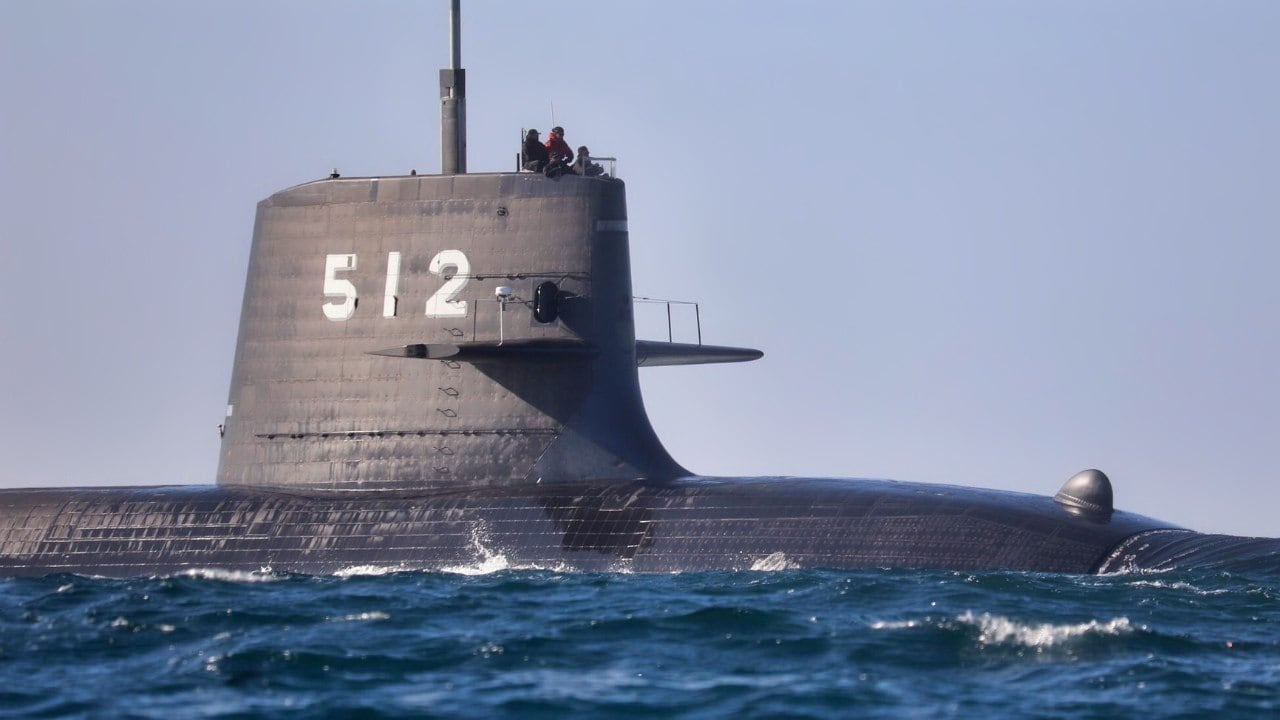
Soryu-Class Japan Submarines. Image Credit: Creative Commons.
Air-independent propulsion erased the distinction for the missions that matter most.
The Gotland class was the first in the world to field a Stirling-engine AIP system, which lets the boat generate power from stored liquid oxygen while remaining submerged and quiet for weeks rather than days. Analysts who have studied the technology note that AIP systems convert chemical energy into electric power at far higher efficiency than a diesel engine running on air, and the practical result is that the risk of detection now exists mainly during transit, not while the submarine waits in position.
For a boat lying quietly across a carrier’s expected path, that is the whole game. The Gotland did not outrun or outfight the Reagan’s strike group. It simply waited where sonar could not find it, and the strike group drove into the ambush.
The 2005 Result Was a Pattern, Not a Fluke
The temptation is to treat the Gotland as a single embarrassing afternoon, and the record does not support that reading. Cheap submarines defeating expensive carriers in exercises is a recurring outcome that predates the Swedish boat and continues after it.

PACIFIC OCEAN (Dec. 17, 2025) – Los Angeles-class fast-attack submarine USS Annapolis (SSN 760) steams forward off the coast of Guam during a photo exercise, Dec. 17, 2025. Assigned to Commander, Submarine Squadron 15 at Polaris Point, Naval Base Guam, Annapolis is one of five fast-attack submarines forward-deployed in the Pacific. Renowned for their unparalleled speed, endurance, stealth, and mobility, fast-attack submarines serve as the backbone of the Navy’s submarine force, ensuring readiness and agility in safeguarding maritime interests around the world. (U.S. Navy photo by Lt. James Caliva)

(June 30, 2011) The Virginia-class attack submarine USS California (SSN 781) underway during sea trials. (U.S. Navy photo by Chris Oxley/Released).
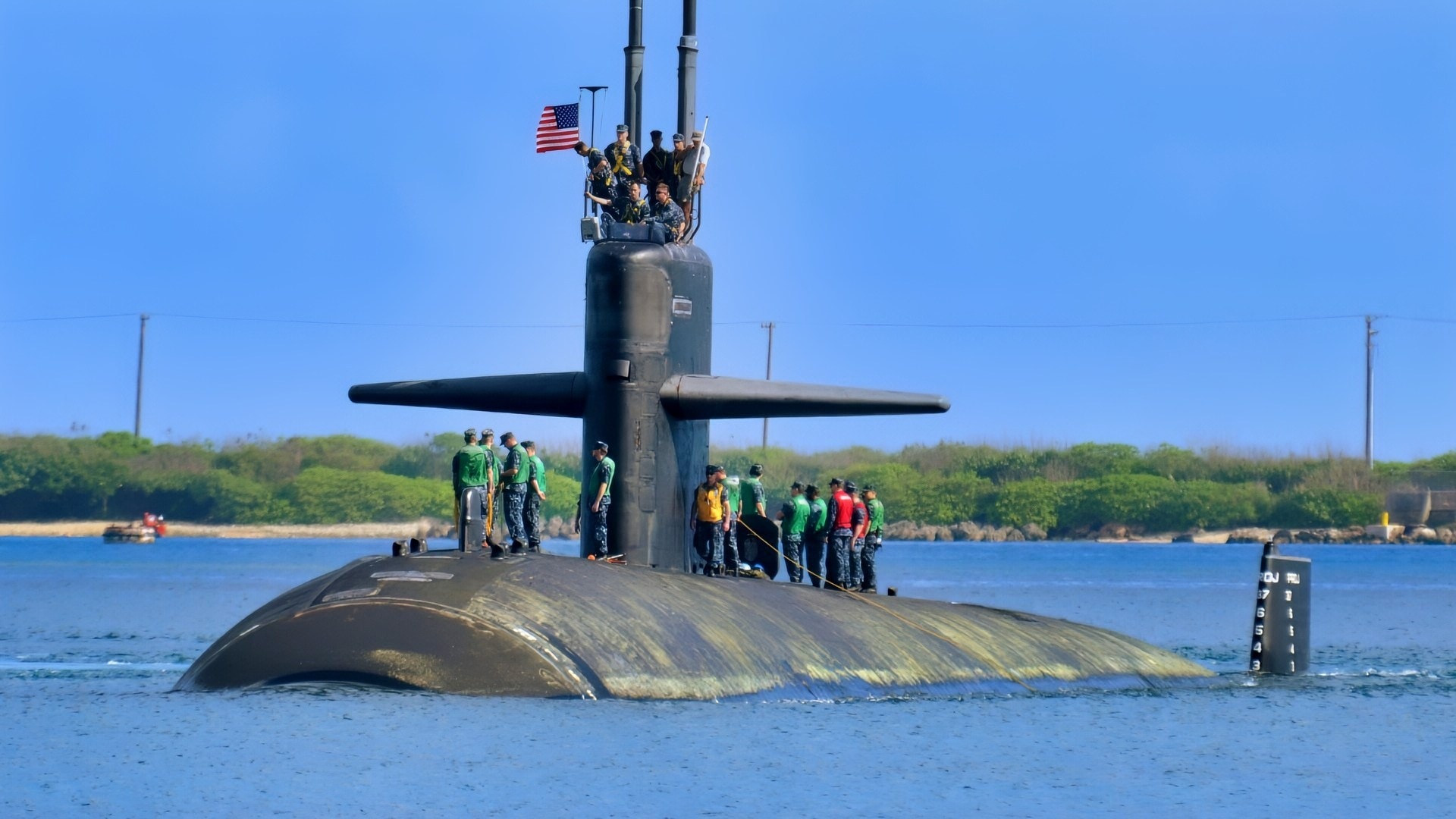
130507-N-LS794-045
POLARIS POINT, Guam (May 7, 2013) The Los Angeles-class attack submarine USS Albuquerque (SSN 706) arrives in Apra Harbor, Guam, to conduct maintenance and liberty. Albuquerque is conducting operations in the U.S. 7th Fleet area of responsibility. (U.S. Navy photo by Mass Communication Specialist 1st Class Jeffrey Jay Price/Released)
Accounts of Cold War and post-Cold War war games describe roughly eight instances between the early 1970s and 2005 in which conventional submarines reached firing position against U.S. carriers, including Canadian boats in the 1980s and, in the years around the Gotland’s visit, Australian Collins-class submarines that reportedly penetrated American carrier screens during combined exercises.
Each case carried the same lesson the Gotland delivered in concentrated form: a well-handled submarine in the right position is extremely difficult to stop, and the defending force does not always know it has failed until the exercise is scored.
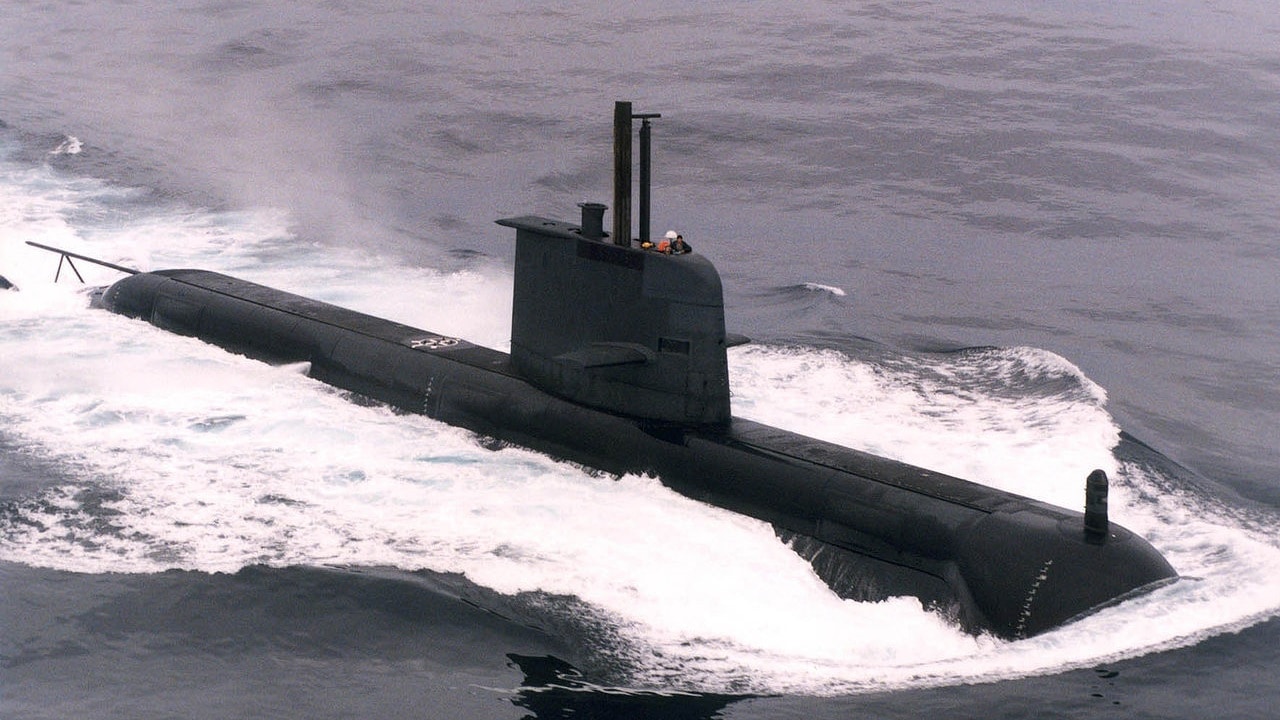
Collins-Class Submarine from Australia.
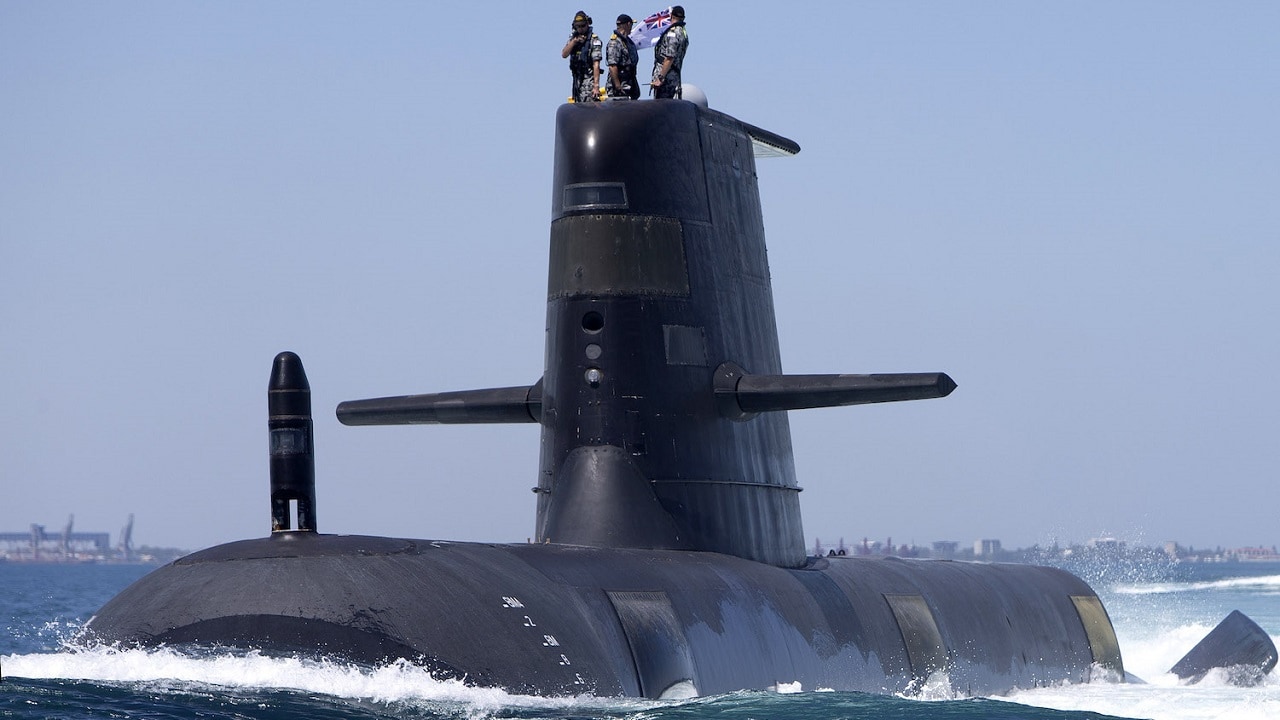
Collins-Class Submarine from Australia’s Navy.
That history matters now because the conditions that produced it have not changed in the defender’s favor. Anti-submarine warfare is among the hardest problems in naval operations, and the U.S. Navy allowed its edge to atrophy after the Cold War, when the deep-water submarine threat receded, and the fleet reoriented toward power projection against opponents with no comparable undersea force.
The Gotland exercises were a warning that the holiday was over. The question two decades later is whether the Navy used the intervening years to fix the problem or merely to document it.
China Is Building the Submarines the Gotland Proved Could Win
The reason the 2005 result now reads as a strategic problem rather than a training footnote is the direction of Chinese shipbuilding. The Office of Naval Intelligence and the Congressional Research Service assess the People’s Liberation Army Navy submarine force at roughly 65 boats in 2025, growing toward 80 by 2035, and the conventional portion of that fleet is where the Gotland’s lesson lands. China operates around 46 diesel-electric attack submarines, and roughly half of them carry AIP, built on the same Stirling-engine principle Sweden pioneered.
The specific boat is the Yuan class, the Type 039A and its later variants, China’s first domestically built AIP submarine, produced at Wuhan and fielded in numbers approaching two dozen, with more under construction. The Yuan is not a museum piece riding on a decades-old design.
It carries anechoic tiles and noise-isolation measures intended to make it hard to track, and it is armed with the submarine-launched YJ-18 anti-ship cruise missile, which means it does not even need to close to torpedo range to threaten a surface group.
China has also invested in the ability to cue those boats, developing undersea sensors and surveillance capabilities that could position a waiting submarine along a carrier’s likely track, which is precisely the scenario in which a quiet AIP boat is most lethal.
A diesel submarine is most dangerous when someone else has already told it where the target will be, and Beijing is building the surveillance layer to do exactly that.
The U.S. Navy’s Own Intelligence Chief Says the Undersea Gap Is Real
None of this is a case that American officials are trying to hide. Testifying before the U.S.-China Economic and Security Review Commission in March 2026, the commander of the Office of Naval Intelligence, Rear Adm. Michael Brookes, warned that Chinese undersea forces may credibly challenge U.S. regional maritime dominance by 2040, and outside analysis reaches the same conclusion from the other direction.
The Congressional Research Service, drawing on Defense Department assessments, notes that China’s own navy still lacks a dependable deep-water anti-submarine capability, and a Royal United Services Institute study concludes that China’s submarine fleet is steadily narrowing the qualitative distance and wearing down the U.S. Navy’s longstanding undersea edge.
The uncomfortable symmetry is that the American ASW weakness the Gotland exposed is the mirror image of the buildup now underway across the Pacific. The Navy is spending on the answer, funding survivability upgrades, unmanned undersea systems, and expanded submarine production, and its FY2026 and FY2027 shipbuilding budgets pour billions into the surface and subsurface force.
Yet the core arithmetic that made the 2005 exercise so unsettling has only grown starker. A Ford-class carrier now costs about $13 billion for the lead ship and more than $14 billion for the newest hulls under construction, and it can be threatened by a submarine that costs a small fraction of that figure, built by a rival that is producing them in quantity. The Navy has known the shape of this problem for two decades. What it has not yet demonstrated is a reliable way to keep a $13 billion ship safe from an $80 million one, and the number of those cheaper boats in the water is climbing every year.
About the Author: Harry J. Kazianis
Harry J. Kazianis (@Grecianformula) was the former Senior Director of National Security Affairs at the Center for the National Interest (CFTNI), a foreign policy think tank founded by Richard Nixon based in Washington, DC. Harry has over a decade of experience in think tanks and national security publishing. His ideas have been published in the NY Times, The Washington Post, The Wall Street Journal, CNN, and many other outlets worldwide. He has held positions at CSIS, the Heritage Foundation, the University of Nottingham, and several other institutions related to national security research and studies. He is the former Executive Editor of the National Interest and the Diplomat. He holds a Master’s degree focusing on international affairs from Harvard University.

