Many former naval aviators still pine for the days when the United States Navy operated the iconic F-14 Tomcat. What many people don’t remember is that the F-14 was not the only plane the Navy considered for its new carrier-based bird.
Indeed, at the same time the F-14 was coming around, the Air Force had been operating the F-15 Eagle with great success.

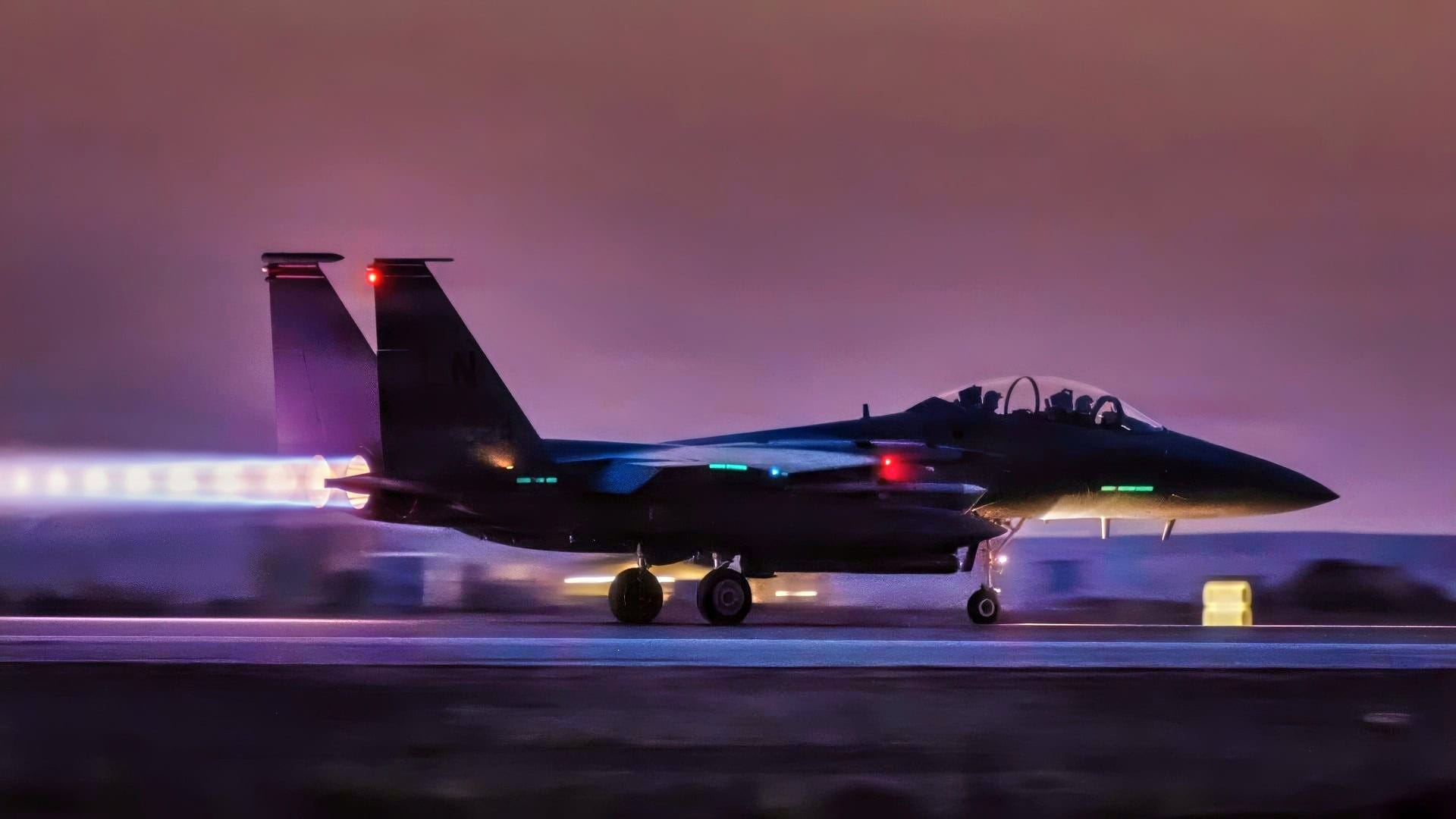
A U.S. Air Force F-15E Strike Eagle performs a flare check over the U.S. Central Command area of responsibility, March 9, 2025. The F-15E is deployed within the CENTCOM AOR to help defend U.S. interests, promote regional security, and deter aggression in the region. (U.S. Air Force photo by Senior Airman Zachary Willis)
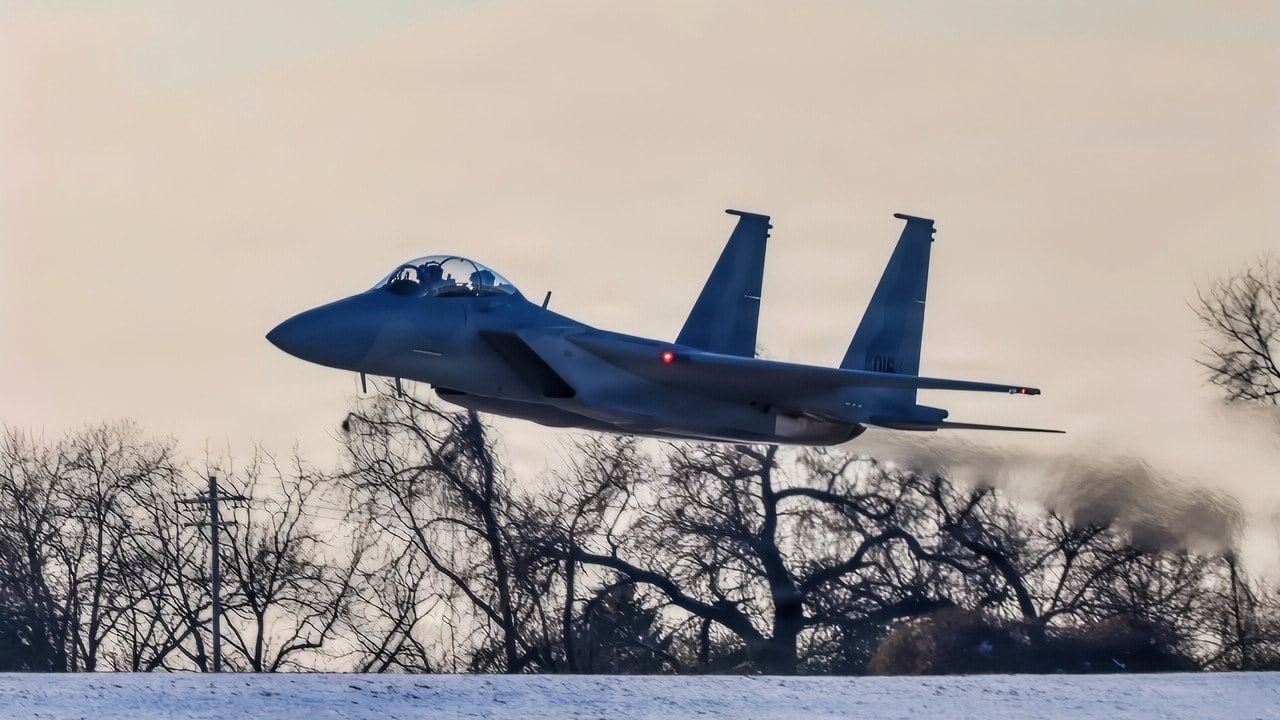
An F-15EX departs for Portland Air National Guard Base. The U.S. Air Force, in partnership with Boeing and the Defense Contract Management Agency, has resumed F-15EX Eagle II deliveries to the Portland Air National Guard Base, overcoming recent production delays. (Courtesy photo)
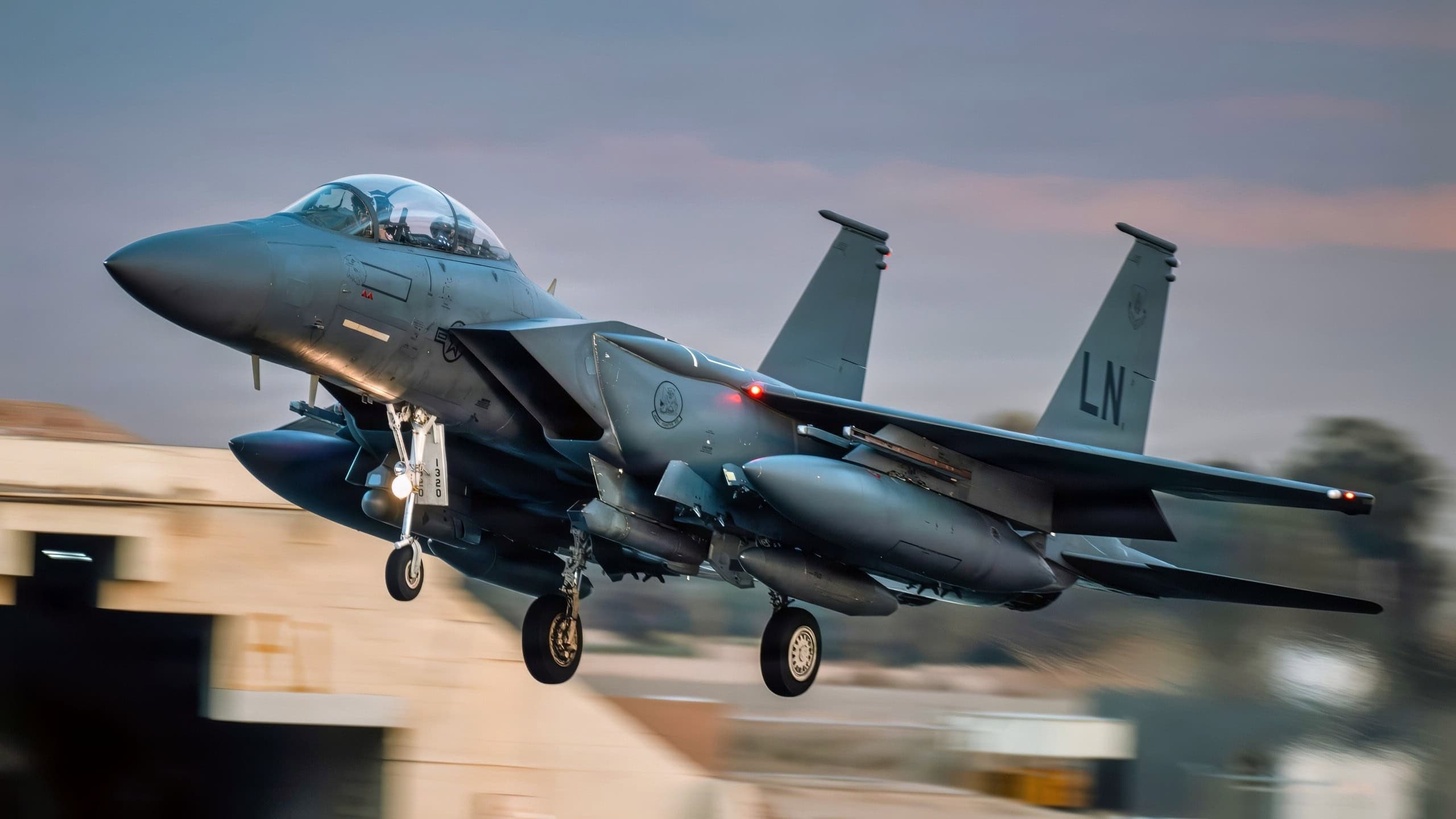
A U.S. Air Force F-15E Strike Eagle aircraft prepares to land at a base in the Middle East, Jan. 18, 2026. The U.S. maintains a highly agile fighting force, leveraging the most advanced capabilities to support the long-term security and stability of the region. (U.S. Air Force photo by Senior Airman Jonah Bliss)
Many wondered if a navalized variant of the popular, hugely successful fourth-generation warplane would meet the Navy’s carrier-based needs.
The F-15N “Sea Eagle” is one of those interesting “what- ifs” in military aviation, like the F-22 “Sea Raptor,” or the fabled “Aurora” spy plane that never came to fruition.
In fact, the Sea Eagle was faster than the Tomcat. It was more maneuverable, too. And the F-15N was simpler mechanically. All this meant that the F-15N Sea Eagle would have been cheaper to maintain than the Grumman F-14. Rather than designing an entirely new naval fighter, McDonnell Douglas proposed modifying its Air Force fighter, the F-15, for carrier operations.
Changes to the F-15N
The Sea Eagle would have required several major modifications to its airframe to succeed as a carrier-based fighter. For carrier landings, the Navy required the proposed Sea Eagle to have strengthened landing gear and an arresting hook (to catch, or “trap,” the cables that pull a landing plane back, preventing it from sliding off the short carrier flight deck).
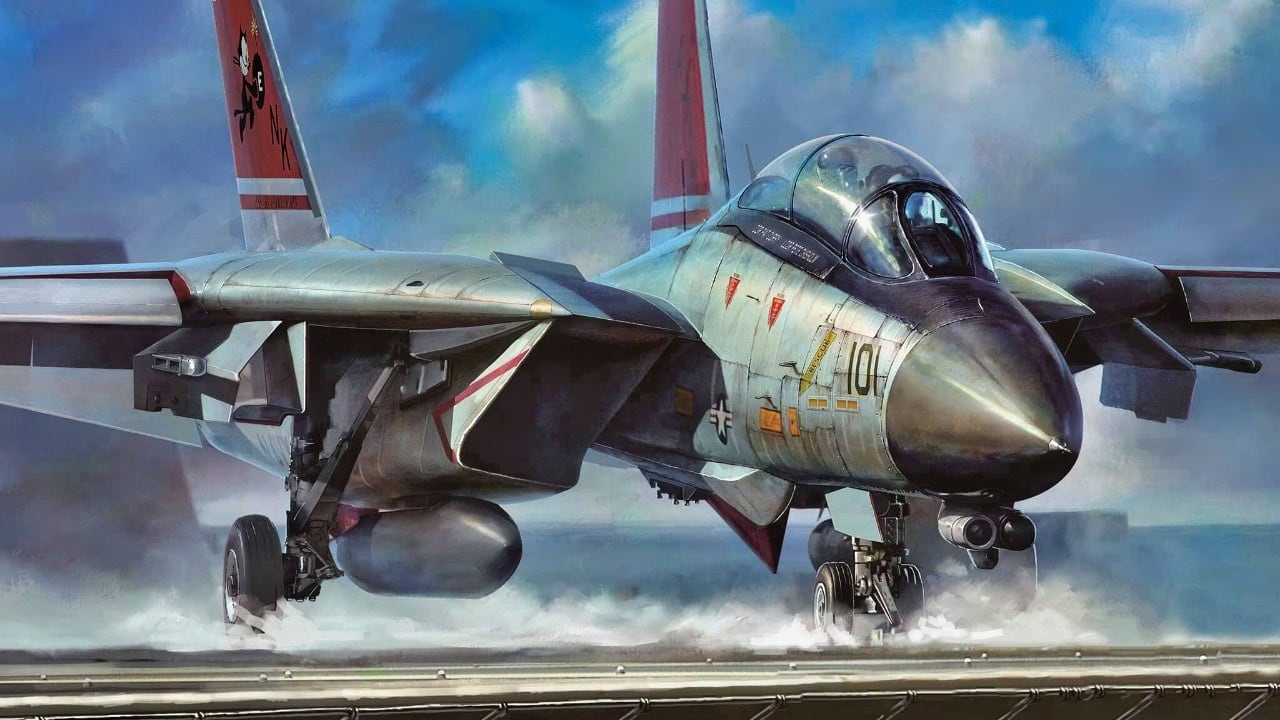
F-14 Tomcat Fighters. Image Credit: Creative Commons.
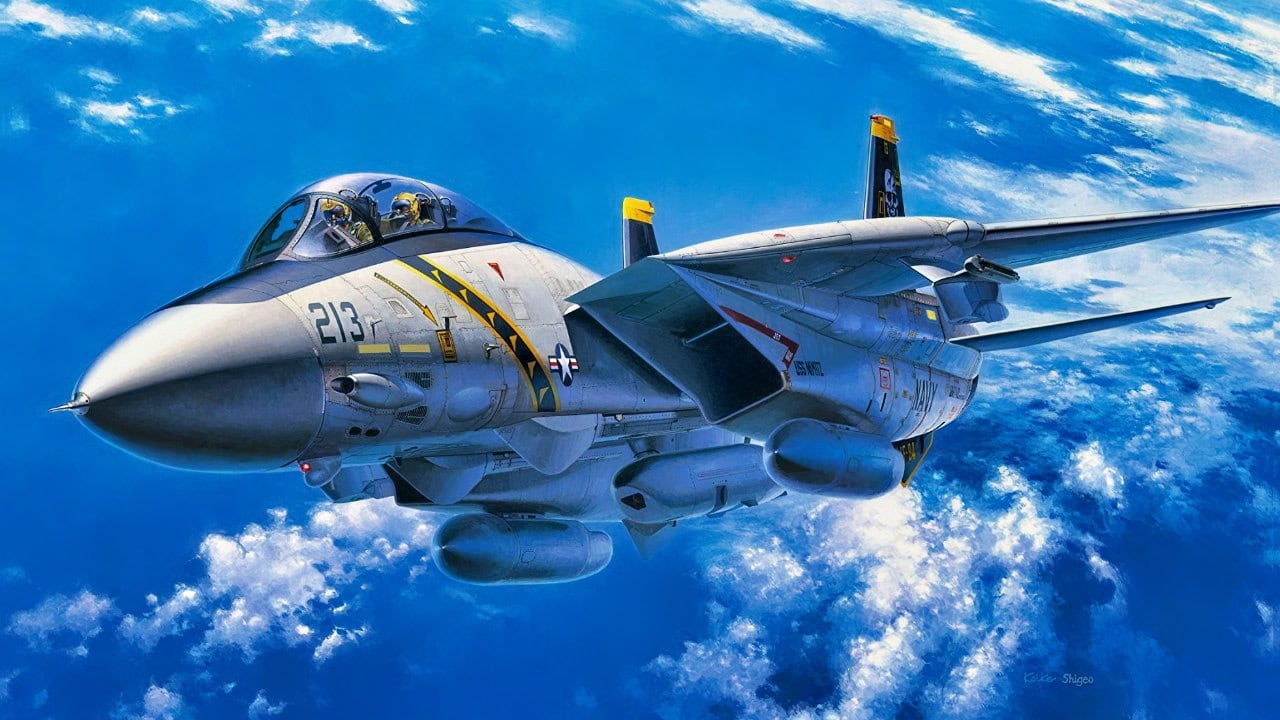
F-14 Tomcat
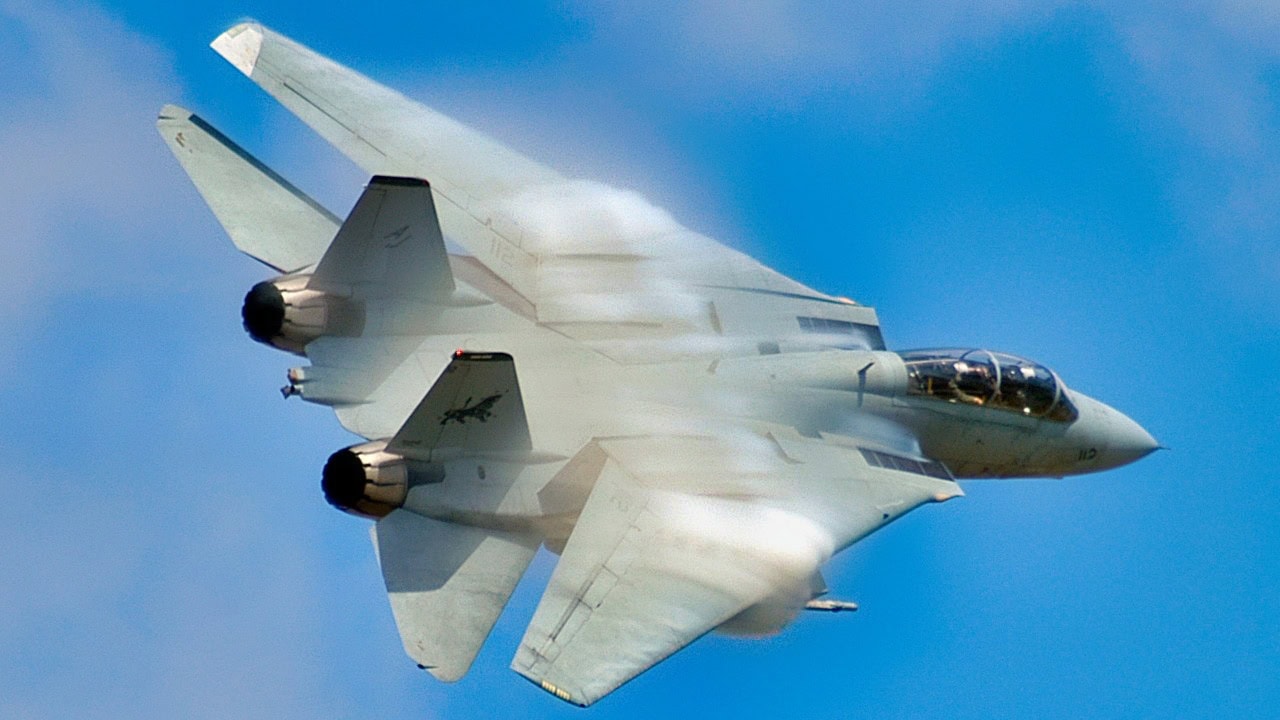
Naval Air Station Oceana, Va. (Sept. 25, 2004) – An F-14D Tomcat assigned to the “Black Lions” of Fighter Squadron Two One Three (VF-213), conducts a high-speed pass at the conclusion of the tactical air power demonstration at the 2004 “In Pursuit of Liberty,” Naval Air Station Oceana Air Show. The demonstration showcased multiple F-14 Tomcats and F/A-18 Hornets displaying various maneuvers and simulated bomb and staffing passes in front of the crowd. The air show, held Sept. 24-26, showcased civilian and military aircraft from the Nation’s armed forces, which provided many flight demonstrations and static displays. U.S. Navy photo by Photographer’s Mate 2nd Class Daniel J. McLain (RELEASED).
Because of the hard landings on the carrier, defense contractors like McDonnell Douglas reinforced the fuselage.
Since the F-15N would be operating at sea, and the ocean is composed of salt, the F-15N would have needed corrosion protection against those elements–fundamentally different from the kind of coatings that the Air Force required for its F-15s.
Plus, the F-15N had to fit in the relatively cramped hangars below the carrier’s flight deck, so its wings had to fold.
The engineering requirements for the plane, therefore, increased further because the proposed F-15N’s wings required robust wing structures and modified catapult-launch fittings.
Structurally, McDonnell Douglas assessed that the F-15 already had an exceptional thrust-to-weight ratio and robust landing characteristics, making navalization less daunting than many had thought.
The Fatal Problem: Phoenix
But the one complicating factor in the development of the F-15N–indeed, the issue that killed the project–was the AIM-54 Phoenix missile.
During the Cold War, the Navy wasn’t simply buying another dogfighter. Because of the Soviet threat to the US Navy carrier battle groups, the fleet required a fleet-defense interceptor.
This requirement was the mission that ultimately made the F-14 Tomcat so beloved: it conducted fleet-defense interceptor missions like no other plane.
Indeed, some naval aviation experts insinuate that the F-18E/F Super Hornet, while an excellent plane, never truly replaced the F-14 in that specific capability.
If the Navy went with the F-15N Sea Eagle, they’d have needed to beat
the Soviet Tu-22M Backfire, Tu-95 Bear bombers, Tu-16 Badgers, long-range cruise missile raids, and saturation attacks against the carriers themselves. The Phoenix missile could engage targets over 100 miles away. That was an impressive capability at that time.
The problem was that the F-15 could not carry this weapon. And that weapon was essentially the system the Navy relied on to defend its carriers. Only the Tomcat carried the Phoenix.
That plane had a Hughes AWG-9 radar and a two-man crew to manage the enormous radar picture (remember the original Top Gun, where you had Maverick flying with Goose in the same cockpit).
McDonnell Douglas Tried to Fix It
McDonnell Douglas was not blind to that weakness. They proposed modifying the APG-63 radar and integrating the Phoenix missile capability into the F-15N.
McDonnell Douglas engineers worked alongside Hughes Aircraft to integrate the radar with the Phoenix missile, creating the F-15N-PHX concept.
The Navy was interested and spent much time studying the concept.
Sadly, the determination was that adding the Phoenix capability to the F-15N meant adding around 10,000 more pounds to the plane. Once that occurred, many of the proposed advantages of the Sea Eagles evaporated.
The F-14 then became more tenable for the Navy’s unique requirements.
Why the F-14 Won
The Navy needed what amounted to, in the words of my colleagues at National Security Journal, a “fleet-defense missile truck.” The AWG-9 radar could simultaneously track dozens of aircraft.
Phoenix could attack an astonishing six Soviet bombers simultaneously.
That combination had no equal. It petrified the Soviets, and McDonnell Douglas could not match it with their possible F-15N Sea Eagle. So, the Tomcat was truly unmatched because the Navy’s primary mission at that time was protecting its expensive carriers against Soviet bomber raids–even if it meant diminishing the importance of dogfighting performance for carrier-based planes.
The Fly-Off That Never Happened
Senator Thomas Eagleton (D-MS) proposed an actual fly-off between the F-14 Tomcat and the F-15N Sea Eagle to determine which aircraft was the better fit for the Navy.
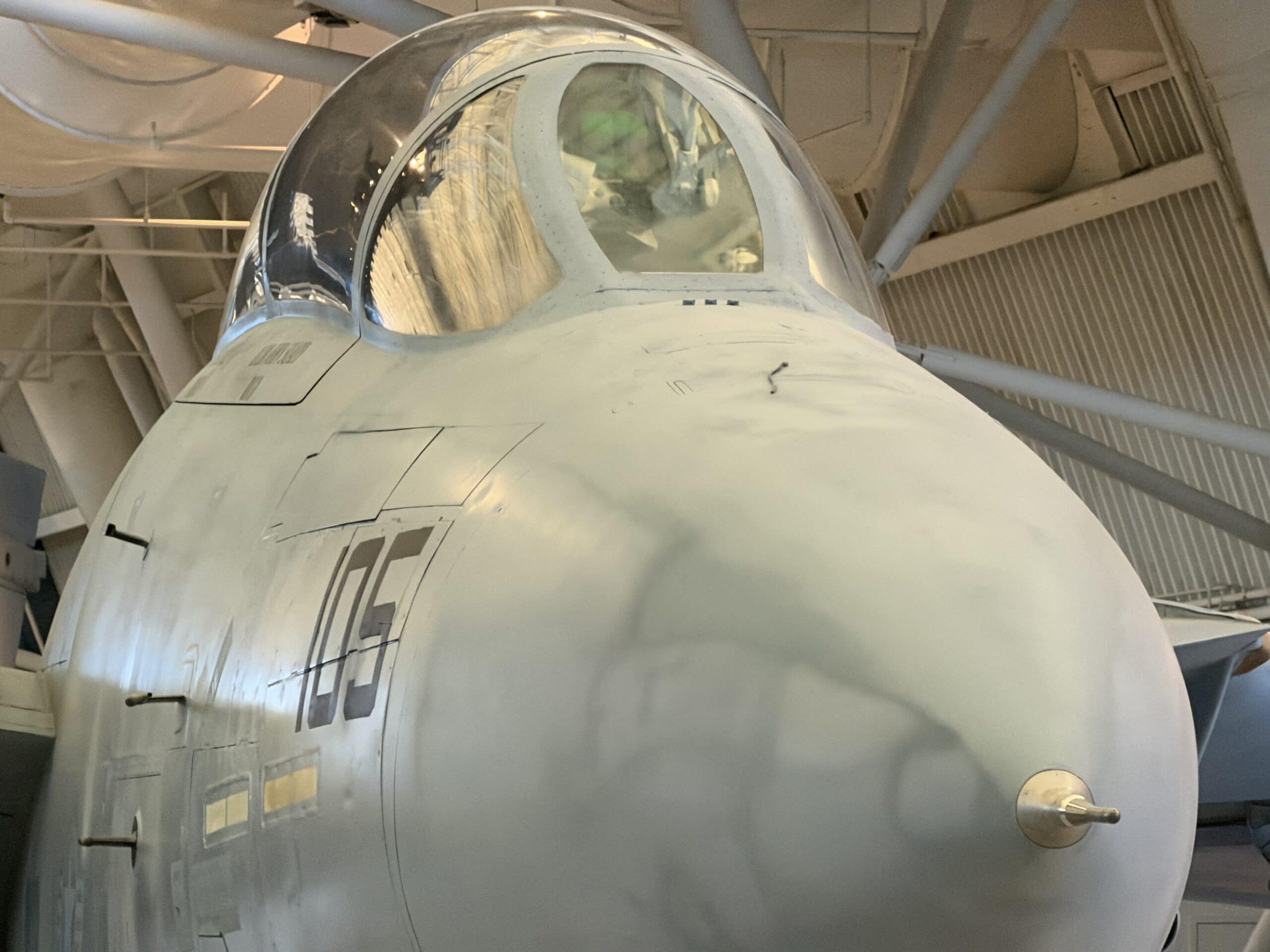
F-14D image taken by Christian D. Orr at the Smithsonian. 19FortyFive.com Image.
But the fly-off never occurred. The Navy decided early in the process that the lack of integration between the F-15N and the Phoenix missile essentially negated any other benefits.
But what a sight that would have been.
Even if the Navy still went with the Tomcat, as they likely would have, having the imagery and footage of the two planes squaring off would have been exciting.
Looking Back
Ultimately, my colleagues at 19FortyFive and National Security Journal concluded in their own write-ups on this fascinating “what if” in US military aerospace that the F-15 aged better than anyone expected.
Clearly, the F-15 has undergone multiple successful iterations and has enjoyed a long record of immense combat success for the US Air Force.
But, for the primary mission that the Navy required–fleet defense and air interception–the F-15N, as great a plane as it was (and it certainly was), could not hold a candle to the F-14 Tomcat.
Everything about the Tomcat was tailored specifically for the Navy’s needs. And it did its job with near perfection.
It wasn’t popular just because Tom Cruise made it the centerpiece of his legendary Top Gun film. It was legendary because, despite its flaws, the F-14 was the best in class at fleet defense.
Frankly, the Navy should never have retired the F-14 Tomcat in 2006. Many naval aviators opposed that decision.
Indeed, there’s an argument that the Navy should have taken seriously the calls to build the F-14 Tomcat II as a replacement for the Tomcat, rather than the F/A-18E/F.
It’s Not One-or-the-Other
The Navy made the correct decision for the early 1970s because defending carriers against Soviet bomber regiments required the F-14’s unique AWG-9/Phoenix combination.
The F-15’s extraordinary growth potential proved greater than anyone at the time anticipated. Had the Sea Eagle entered service and evolved alongside the Air Force’s Eagle, the Navy might have ended up with a remarkably capable long-range strike and air-superiority fighter by the 1990s (and beyond).
But what made the F-15 so great for the Air Force could never have worked for the Navy, as this essay has already demonstrated.
And this cuts back to a wider debate still ongoing in military circles: is standardization of warplanes even worthwhile, given how fundamentally different the requirements of the Air Force and the Navy are?
The likely answer is “no.” But don’t tell that to the eggheads at the Pentagon, who are religiously committed to this concept of making a one-size-fits-all warplane.
The Navy was smart to go with the F-14 over the very cool, ultimately–but needless–F-15N. In fact, the Navy’s biggest mistake was not choosing the F-14 over the Sea Eagle. It was the termination of the F-14 Tomcat program in 2006.
About the Author: Brandon J. Weichert
Brandon J. Weichert is the Senior National Security Editor at 19FortyFive.com. He also manages The Weichert Brief on Substack. Weichert also hosts “National Security Talk” on Rumble. He is the author of four bestselling national security books, the most recent of which is A Disaster of Our Own Making: How the West Lost Ukraine (Encounter Books). Follow him via Twitter/X @WeTheBrandon.