
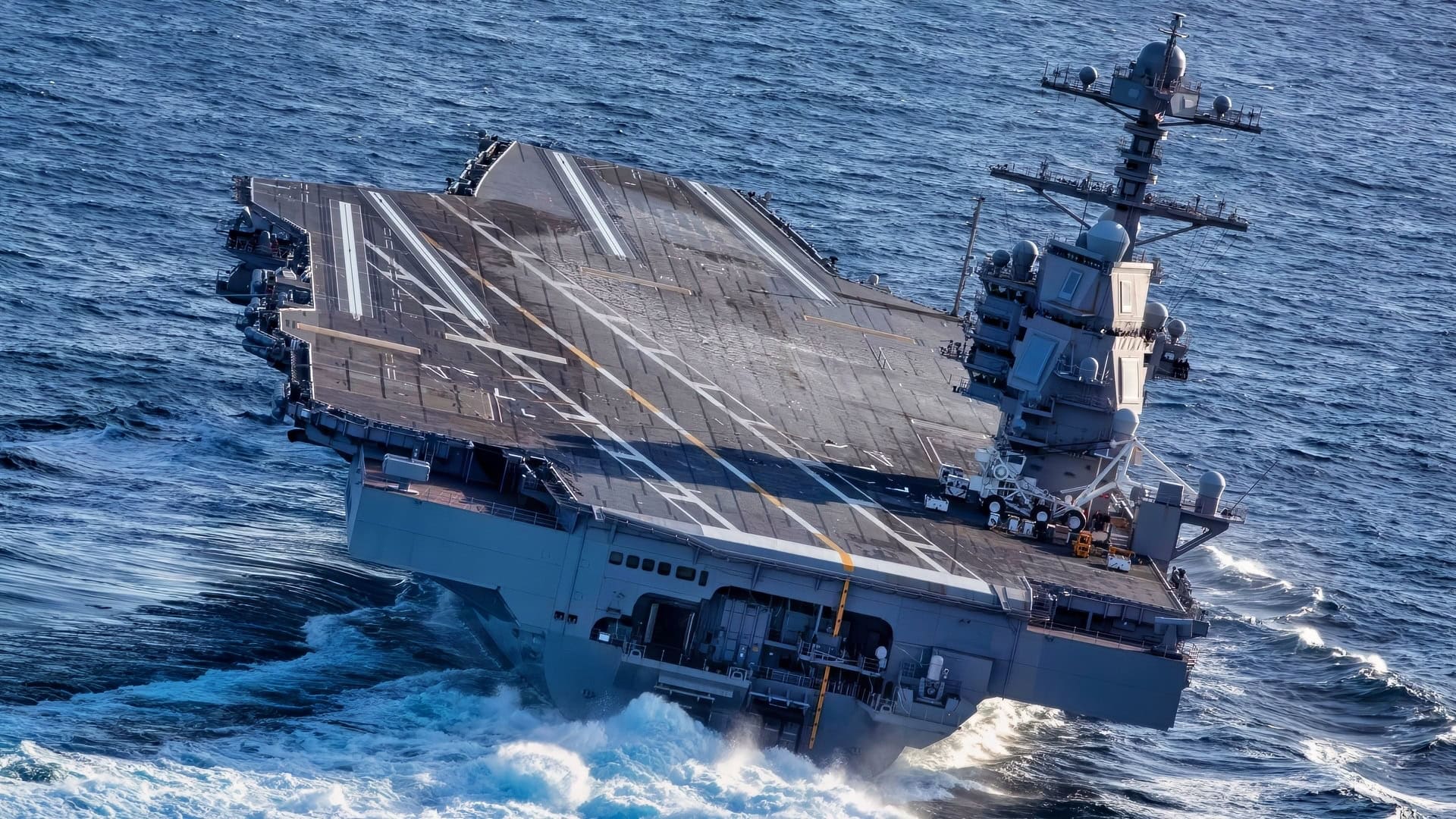
USS Abraham Lincoln is preparing to be relieved in the Middle East after more than 260 days deployed and more than 200 consecutive days without a port call. The controversy around Lincoln centers on crew welfare, supplies, and the psychological cost of an open-ended mission. USS Gerald R. Ford returned on May 16, 2026, after 326 days, the longest operational deployment by an American aircraft carrier since the Vietnam War.
Ford’s ordeal was different. Lincoln’s sailors have endured the harsher, uninterrupted stretch at sea. Ford faced the broader operational burden. The Navy sent its newest carrier through four fleet areas, across the Atlantic four times, and into missions ranging from NATO deterrence above the Arctic Circle to combat operations involving Venezuela and Iran. The ship sailed 57,713 nautical miles, completed 23 replenishments at sea, and supported 12,200 aircraft launches.
Ford also returned with physical damage, although no verified Iranian weapon struck the carrier. Its worst casualty came from inside the ship. A March 12 fire in its main laundry spaces injured three sailors, sent roughly 200 more for treatment after smoke exposure, affected seven berthing compartments, and displaced hundreds of crew members. The propulsion plant, reactors, and flight deck escaped damage.
Ford entered Norfolk Naval Shipyard on July 7 for a Planned Incremental Availability, with fire restoration running alongside scheduled maintenance and modernization. The Navy has not published a completion date.
Carrier availability of this type normally lasts six to eight months, but recent East Coast carrier maintenance periods have lasted roughly one year or longer. Early 2027 is the optimistic case.
A return later in 2027 aligns more closely with recent shipyard performance.
USS Gerald R. Ford’s Deployment Changed Mission Four Times
Ford left Norfolk on June 24, 2025, for a deployment in Europe. Carrier Strike Group 12 worked across the Atlantic and Mediterranean, participated in NATO’s Neptune Strike activities, and operated with allied ships and aircraft.
From August 23 through September 8, the carrier led a multinational force in the High North, operating above the Arctic Circle with Norway, Germany, and France.
The first mission demanded deterrence, alliance integration, and cold-weather operations near Russia’s Northern Fleet.
Ford’s air wing sent Super Hornets to Norway’s Ørland Air Base, while escorting destroyers operated in the Barents Sea.
Port visits in Europe gave the crew breaks that Lincoln, during its present uninterrupted run, did not have.
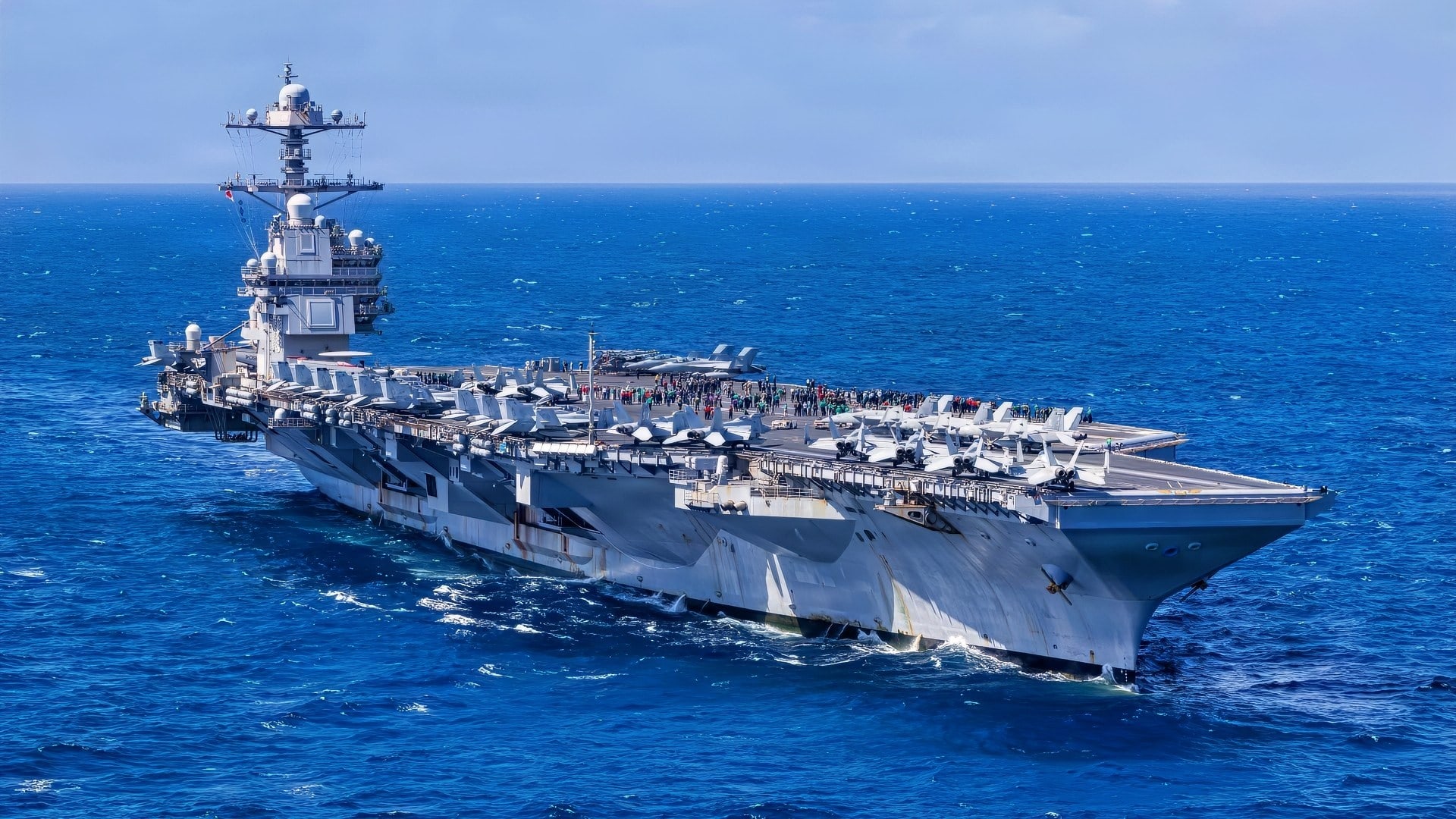
The world’s largest aircraft carrier, Ford-class aircraft carrier USS Gerald R. Ford (CVN 78), transits the Caribbean Sea during Carrier Air Wing 8’s aerial change of command ceremony, Jan. 19, 2026. U.S. military forces are deployed to the Caribbean in support of the U.S. Southern Command mission, Department of War-directed operations, and the president’s priorities to disrupt illicit drug trafficking and protect the homeland. (U.S. Navy photo)
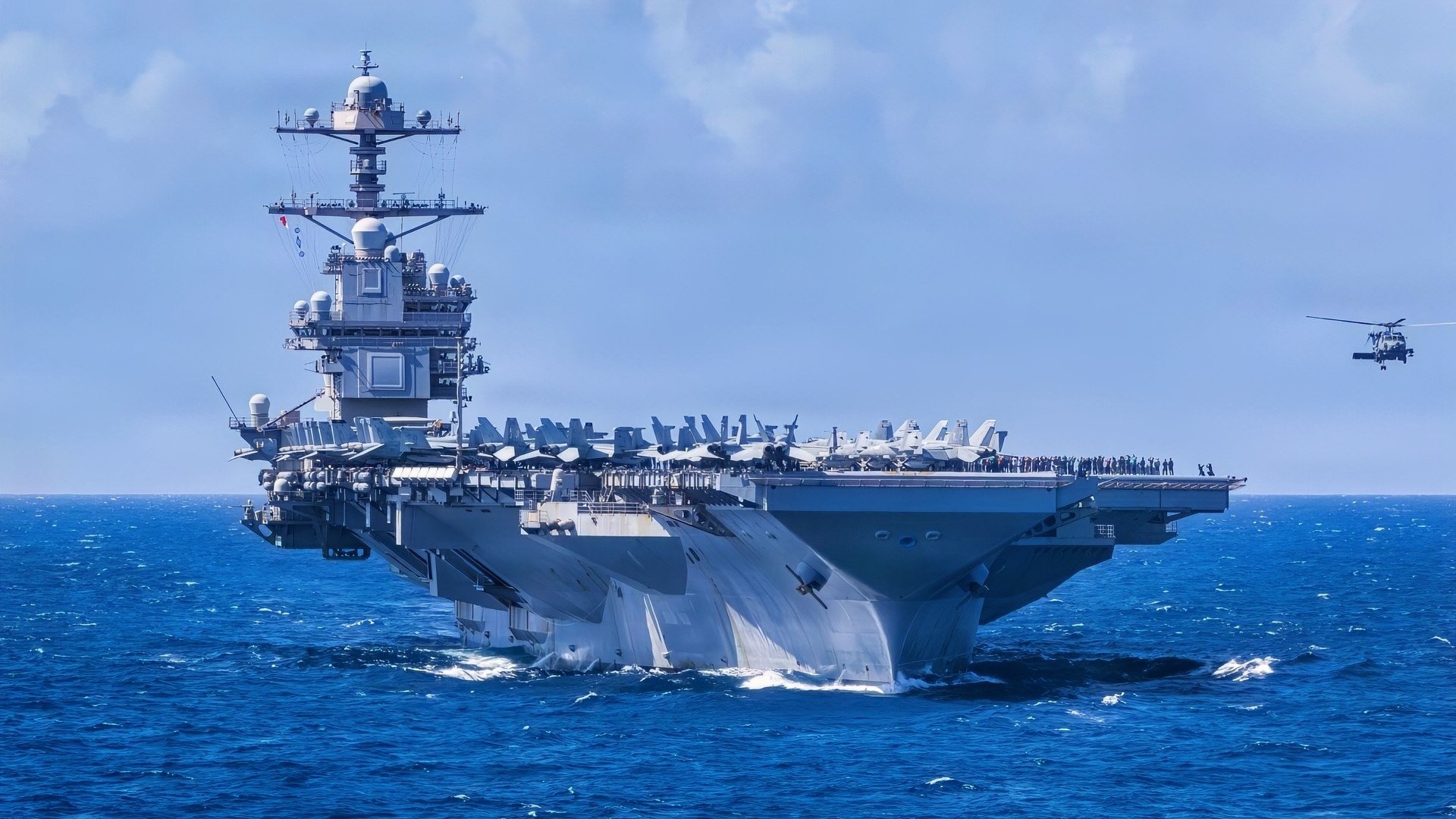
U.S. Navy Carrier Air Wing 8 aircraft fly in formation over the world’s largest aircraft carrier, Ford-class aircraft carrier USS Gerald R. Ford (CVN 78), during Carrier Air Wing 8’s aerial change of command ceremony while underway in the Caribbean Sea, Jan. 19, 2026. U.S. military forces are deployed to the Caribbean in support of the U.S. Southern Command mission, Department of War-directed operations, and the president’s priorities to disrupt illicit drug trafficking and protect the homeland. (U.S. Navy photo)
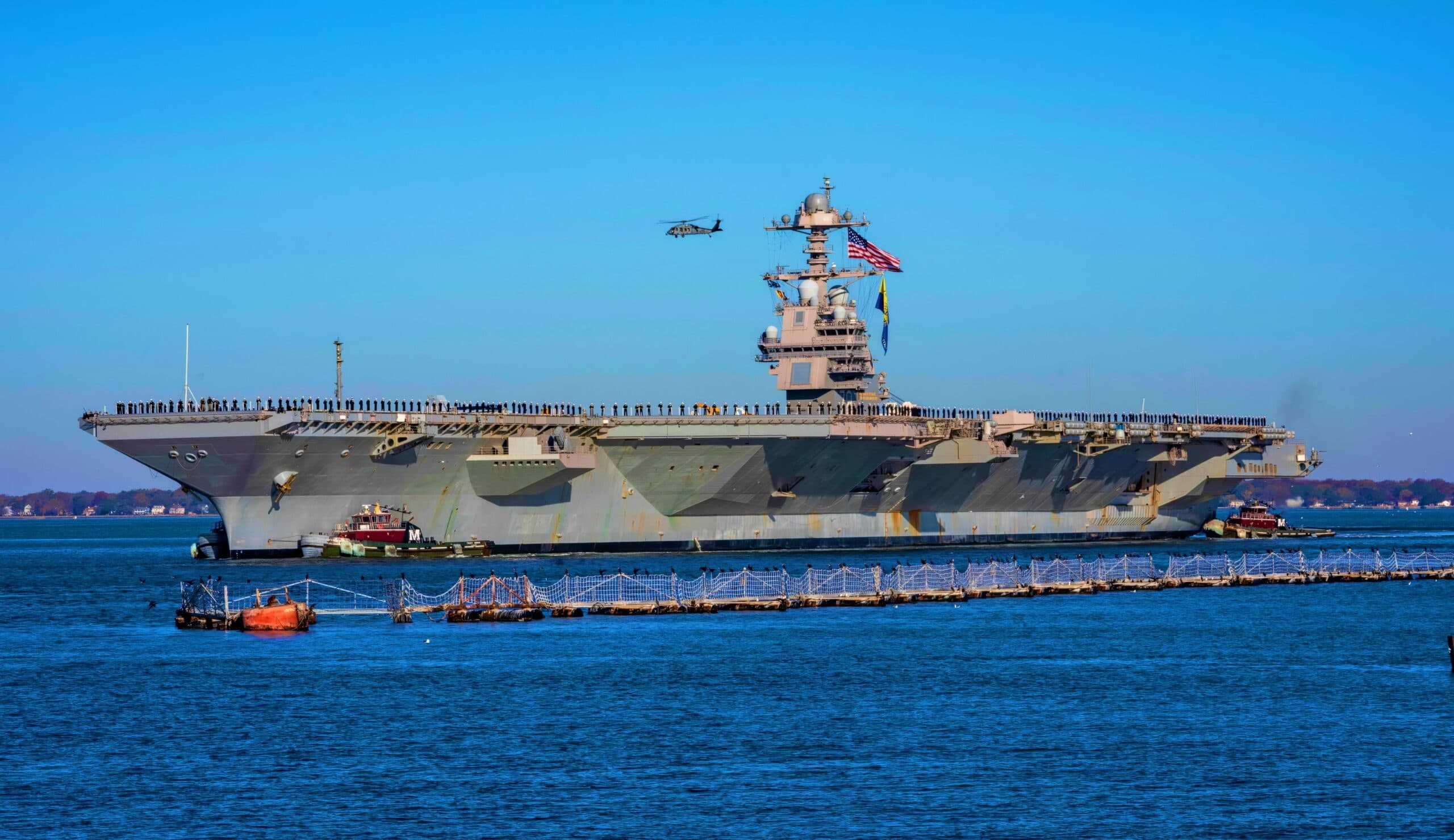
NORFOLK (Nov. 26, 2022) The USS Gerald R. Ford (CVN 78) returns to Naval Station Norfolk after completing their inaugural deployment to the Atlantic Ocean with the Gerald R. Ford Carrier Strike Group (GRFCSG), Nov. 26. The GRFCSG, returned to Naval Station Norfolk following a scheduled deployment with Allies and partners in an effort to build strategic relationships and contribute to a stable and conflict-free Atlantic region, while also showcasing the U.S. Navy’s most advanced class of aircraft carrier. (U.S. Navy Photo/Video by Mass Communication Specialist First Class Nathan T. Beard)
Washington then turned the carrier west. Ford entered the Caribbean on November 16 under Joint Task Force Southern Spear, supporting maritime interdiction and operations against drug-trafficking networks. The assignment escalated in January. Navy leaders said Ford’s strike group played a central role in Operation Absolute Resolve, the American operation that captured Venezuelan leader Nicolás Maduro and his wife from a fortified compound in Caracas. Public accounts do not provide a carrier-specific weapons total.
Ford crossed the Atlantic again as the crisis with Iran moved toward war. Carrier Air Wing 8 began supporting Operation Epic Fury from the eastern Mediterranean on February 28. The carrier transited the Suez Canal on March 5 and entered the Red Sea. By then, the ship had been deployed for more than eight months.
A Laundry Fire Did What Iranian Weapons Did Not
The fire began on March 12 while Ford operated in the northern Red Sea. The Navy identified the main laundry spaces as the point of origin and stated that the casualty was not combat-related.
No final public investigation has established the cause. Claims involving an Iranian strike or sabotage have appeared without supporting evidence.
The first official announcement did not convey the full extent of the disruption. Later reporting found that damage-control work continued for hours, with overhaul and checks for hidden fire lasting more than a day. More than 100 racks were lost. Other accounts placed the displaced population in the hundreds because smoke and heat made surrounding living spaces unusable.
The Navy sent 1,000 mattresses taken from the future USS John F. Kennedy and collected nearly 2,000 sweatsuits and other items of clothing for Ford’s crew.
The fire affected seven berthing compartments and the laundry capacity. Three sailors suffered direct injuries, including one who required medical evacuation. Roughly 200 sailors were treated for smoke exposure and returned to duty.
The incident reinforced why fire remains an aircraft carrier’s most immediate internal threat. Thousands of sailors live beside fuel, electrical equipment, aircraft, munitions, and industrial machinery inside one hull.
Ford continued flight operations, then sailed to Souda Bay, Crete, for emergency work. Norfolk Naval Shipyard sent 43 engineers and specialists. Ship personnel and local contractors rehabilitated the seven affected berthing compartments before Ford moved to Split, Croatia, for additional work and crew liberty. The carrier later returned to operational tasking.
The ship also dealt with recurring clogs in its vacuum sewage system. Reports described long lines and out-of-service toilets across a network serving roughly 650 fixtures. Fleet Forces Command responded that the system had processed more than six million flushes, teams cleared blockages promptly, and the problem did not impair combat readiness. The dispute matters because the Ford class was designed around reduced crew demands and improved maintainability.
Ford’s Repair Bill Is Measured in Time, Not a Published Dollar Figure
The Navy has released no fire-repair cost and has not separated the casualty work from the larger availability. Scheduled tasks include inspections, machinery maintenance, modernization, and restoration after 326 days of deployment.
Treating every day in the shipyard as fire repair would exaggerate the damage.
The schedule still carries risk. Ford is the first ship of its class serviced at Norfolk Naval Shipyard. A Planned Incremental Availability normally runs six to eight months. USS George H.W. Bush’s latest availability took about a year. USS Dwight D. Eisenhower’s lasted roughly 15 months. Ford’s previous six-month availability finished on schedule, but that work occurred at Newport News Shipbuilding before the carrier endured this deployment.
Some commentary has projected an 18-month absence. No Navy schedule supports a firm 18-month figure. Fire restoration, sewage work and the planned overhaul occur concurrently rather than as three separate six-month blocks. The defensible estimate is early 2027 if the yard meets the normal schedule, or the middle to latter part of 2027 if Ford follows recent carrier performance.
The wider concern, examined in earlier analysis of the maintenance bill behind Ford’s record cruise, is how much additional work appears after inspections open up machinery and damaged spaces.
Ford’s Harder Mission Does Not Make Lincoln’s Deployment Easier
Ford’s deployment was longer and more varied. It included NATO operations, Arctic flying, a Caribbean campaign, the capture operation in Venezuela and combat against Iran.
The carrier earned a Presidential Unit Citation, crossed the Atlantic four times, and came home with fire-damaged living spaces. In mission changes, geographic movement, and physical damage, Ford carried the heavier load.
Lincoln’s current burden is different. As of August 17, the carrier had spent more than 260 days deployed and more than 200 without entering port. Families and lawmakers raised concerns over mental health, food, mail, water, and plumbing.
The Navy disputed the bleakest reports, while USS George Washington moved west to relieve the ship. A recent comparison of Lincoln’s deployment with other long naval cruises shows why total deployment length and uninterrupted days at sea measure different forms of strain.
The two carriers expose the same fleet problem. Washington redirected each ship after departure, extended its mission, and delayed the maintenance or rest expected under the original schedule.
Ford’s arrival in the yard removes the Navy’s newest carrier from the rotation while Lincoln prepares to return and George Washington leaves the Pacific for the Middle East.
That pressure sits behind the shrinking number of carriers immediately available for new crises.
On August 17, 2026, USS Gerald R. Ford remained at Norfolk Naval Shipyard, 41 days into its first public-shipyard availability.
The Navy had released no completion date, no dollar estimate for the March fire, and no final public finding on what started it.
Most likely, the aircraft carrier will be out of action for at least a year, meaning no deployments to Iran or anywhere else for the foreseeable future.
About the Author: Harry J. Kazianis
Harry J. Kazianis (@Grecianformula) was the former Senior Director of National Security Affairs at the Center for the National Interest (CFTNI), a foreign policy think tank founded by Richard Nixon based in Washington, DC. Harry has over a decade of experience in think tanks and national security publishing. His ideas have been published in the NY Times, The Washington Post, The Wall Street Journal, CNN, and many other outlets worldwide. He has held positions at CSIS, the Heritage Foundation, the University of Nottingham, and several other institutions related to national security research and studies. He is the former Executive Editor of the National Interest and the Diplomat. He holds a Master’s degree focusing on international affairs from Harvard University.

