
US President Donald Trump is stuck in a strange, on-again-off-again war with Iran. He cannot win decisively without going big: he must invade Iran if he wishes to force a decisive defeat on it. But that is obviously risky.
The US public opposes the war and opposes an invasion even more.

U.S. Navy F/A-18 Super Hornets, assigned to the Harry S. Truman Carrier Strike Group’s Strike Fighter Squadron (VFA) 136, fly a mission over the U.S. Central Command area of responsibility, March 2, 2025. The HSTCSG is responsible for patrolling approximately 2.5 million square miles of ocean and includes the Arabian Gulf, Gulf of Oman, Red Sea, parts of the Indian Ocean and three critical choke points at the Strait of Hormuz, Suez Canal and Strait of Bab al-Mandeb. (U.S. Air Force photo by Staff Sgt. Jackson Manske)
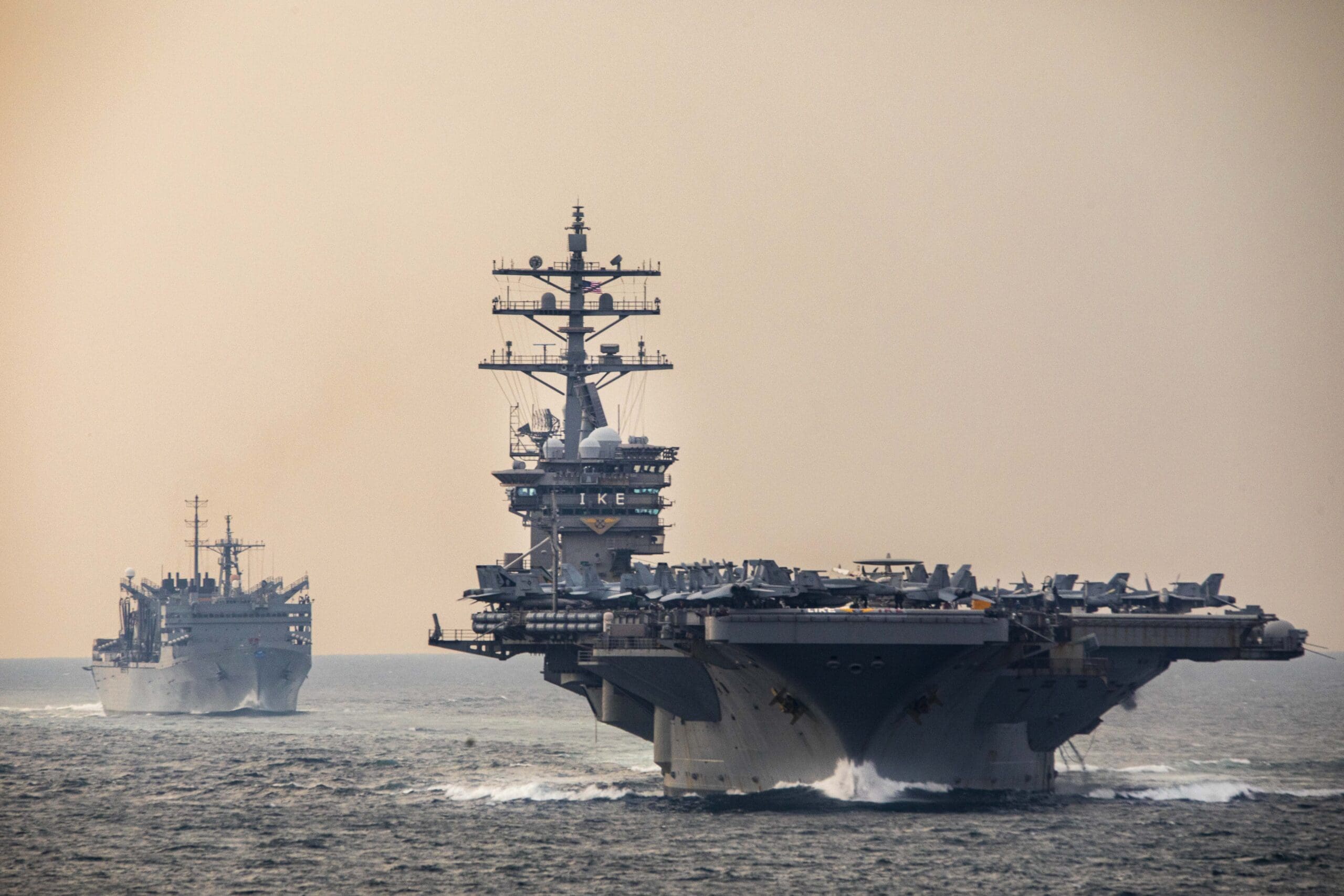
Components of the Dwight D. Eisenhower Strike Group (IKECSG) and the fast combat support ship USNS Supply (T-AOE 6) transit the Strait of Hormuz, Dec 14, 2023. As part of the Dwight D. Eisenhower Carrier Strike Group (IKECSG), the Philippine Sea is deployed to the U.S. 5th Fleet area of operations to help ensure maritime security and stability in the Middle East region. (U.S. Navy photo by Mass Communication Specialist 2nd Class Keith Nowak)
A ground war could easily morph into a repeat of the disastrous US occupation of Iraq two decades ago.
Trump’s other military option – bombing – has spent itself and failed. Bombing alone does not win wars, a lesson the US has learned repeatedly since World War II. It can support a ground campaign, but it is a limited tool alone to coerce regimes, especially ideological ones like Iran (or Vietnam or the Axis powers in the past).
Trump’s final option – other than withdrawal – is sanctions. Trump now appears to be leaning toward a slow bludgeoning of Iran.
Choking off Iran’s oil sales and blocking its trade with other countries would, ideally, generate enough popular discontent to push the regime elite to negotiate.
Unfortunately, this is unlikely to work on a short- or even medium-term timeline.
Iran’s Partners Will Help It
The most obvious parallel for any effort to isolate and sanction Iran into submission is North Korea. Sanctions on North Korea are punishing and quite thorough. Metal imports of almost any kind, for example, are forbidden.
They probably retard the development of the North’s nuclear weapons and missiles.
They also restrict the inputs needed for the economy. Sanctions will likely do the same in Iran.
But the full effect of demanding sanctions is almost never felt, because partners of the target state help it cheat. Or sanctions-running becomes so lucrative that a huge black market springs up to evade them.
Sanctions against Saddam Hussein’s Iraq were undermined by the latter in the 1990s. Sanctions against North Korea have also been undermined by the latter.
China and now Russia – newly aligned with North Korea in the context of the Ukraine War – have always shielded North Korea from the full weight of the sanctions.
They watered down the sanctions at the UN when they were passed.
They dragged their feet on reporting and surveillance. And they looked the other way as North Korea used their banks and operators to smuggle.
Iran can almost certainly expect China and Russia to do the same for the same reason. Both want Iran to survive and distract the US in the Middle East, just as both want North Korea to survive and distract the US in East Asia. As such, China and Russia will almost certainly help Iran violate sanctions, blunting their effectiveness.
Regime Elites Can Insulate Themselves
Despite Russian and Chinese help, the sanctions will have some bite, as they do in North Korea.
But North Korea has also shown how a sanctioned regime can push through the punishment – by forcing the costs of sanctions onto the politically powerless population.
North Korea is notorious for this.
The regime elite live in a reasonably modern city (Pyongyang) and enjoy contemporary luxuries, including automobiles, alcohol, nice food, and so on. And there are rumors of black markets too, such as for narcotics and prostitution.
All of these goodies are smuggled in illegally, using dollars earned by impoverished North Korean overseas laborers or North Korean soldiers fighting in Ukraine.
Iran will almost certainly do the same. The Islamic Revolutionary Guard Corps – the fanatical Shiite militia/clerical movement which runs Iran – will scarcely suffer.
They too will skim off the resources necessary from the subject population to reward themselves and pay off the smugglers.
The population will suffer; the elite will not – just as Hussein’s cronies did not suffer in the 1990s as the Iraqi population did.
Trump is desperately looking for a tool to beat Iran into submission. Sanctions are probably not it.
They take a long time to work, and even then, a committed dictatorship will suffer through them or evade them. They can restrain a rogue state somewhat – North Korea without sanctions would be even worse than with them – but they cannot bring it to heel. Trump is still stuck.
MORE – Iran: Could They Sink Aircraft Carriers?
Author: Dr. Robert Kelly, Pusan National University
Dr. Robert E. Kelly is a professor of international relations in the Department of Political Science and Diplomacy at Pusan National University in South Korea. His research interests focus on Security in Northeast Asia, U.S. foreign policy, and international financial institutions. He has written for outlets including Foreign Affairs, the European Journal of International Relations, and The Economist, and has appeared on television news services such as the BBC and CCTV. His personal website/blog is here; his Twitter page is here.