
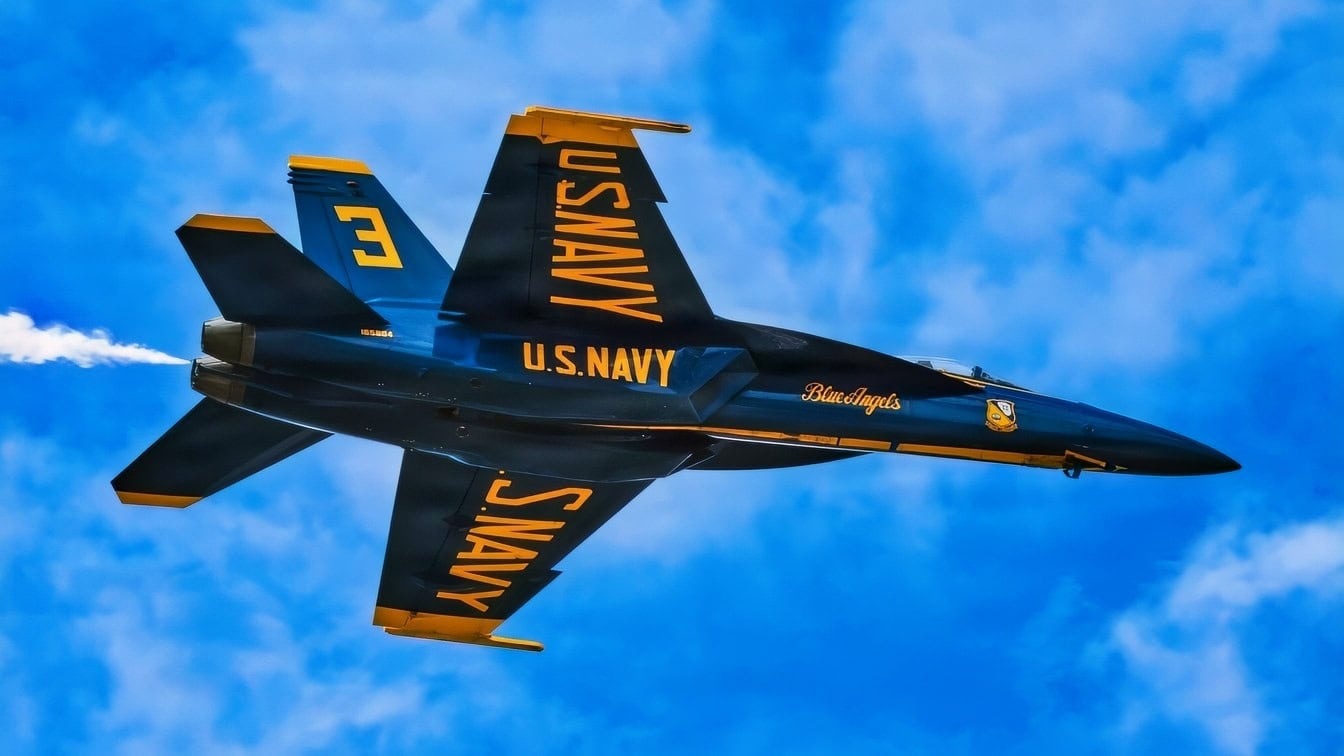
Though it has neither the sheer cultural iconic status of the 4th Generation F-14 Tomcat, the speed and mind-blowing 104: kill ratio of the Gen4 F-15 Eagle, the stealth of the 5th Generation F-22 Raptor, nor the futurism of the 6th Generation F-47 NGAD (Next Generation Air Dominance) fighter, Boeing’s F/A-18E/F Super Hornet 4.5 Generation fighter has nonetheless definitely made an impact, both literally and figuratively, in fictional cinematic battles and real-world conflicts alike.
We now examine 5 facts about the Super Hornet, or as her U.S. Navy crews unofficially and affectionately nickname her, the “Rhino.”
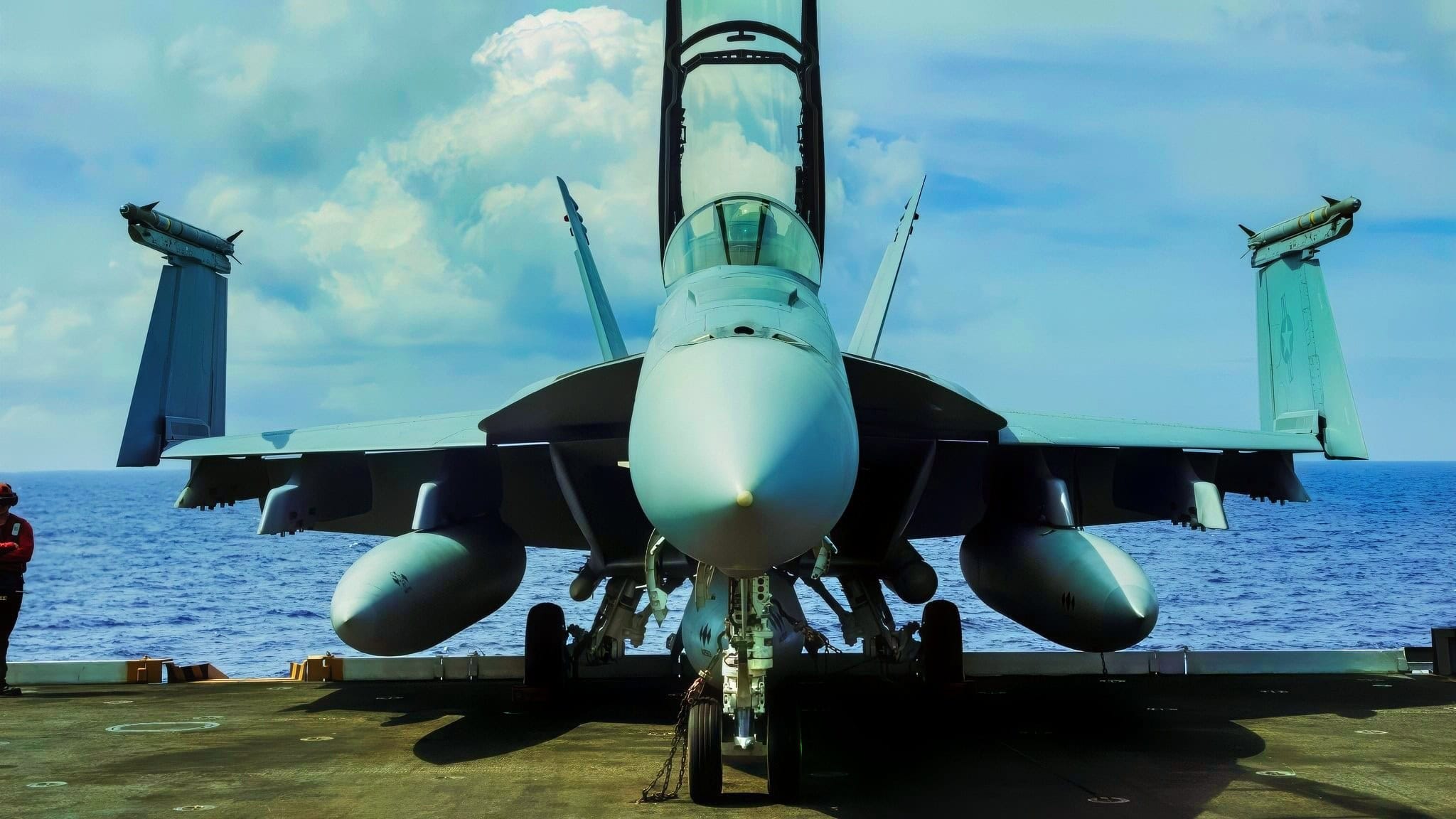
Capt. Tim Waits, commanding officer of Nimitz-class aircraft carrier USS George Washington (CVN 73), climbs into an F/A-18F Super Hornet, attached to Strike Fighter Squadron (VFA) 102, while underway in the South China Sea, Nov. 24, 2025. George Washington is the U.S. Navy’s premier forward-deployed aircraft carrier, a long-standing symbol of the United States’ commitment to maintaining a free and open Indo-Pacific region, while operating alongside allies and partners across the U.S. Navy’s largest numbered fleet. (U.S. Navy photo by Mass Communication Specialist 2nd Class Geoffrey L. Ottinger)
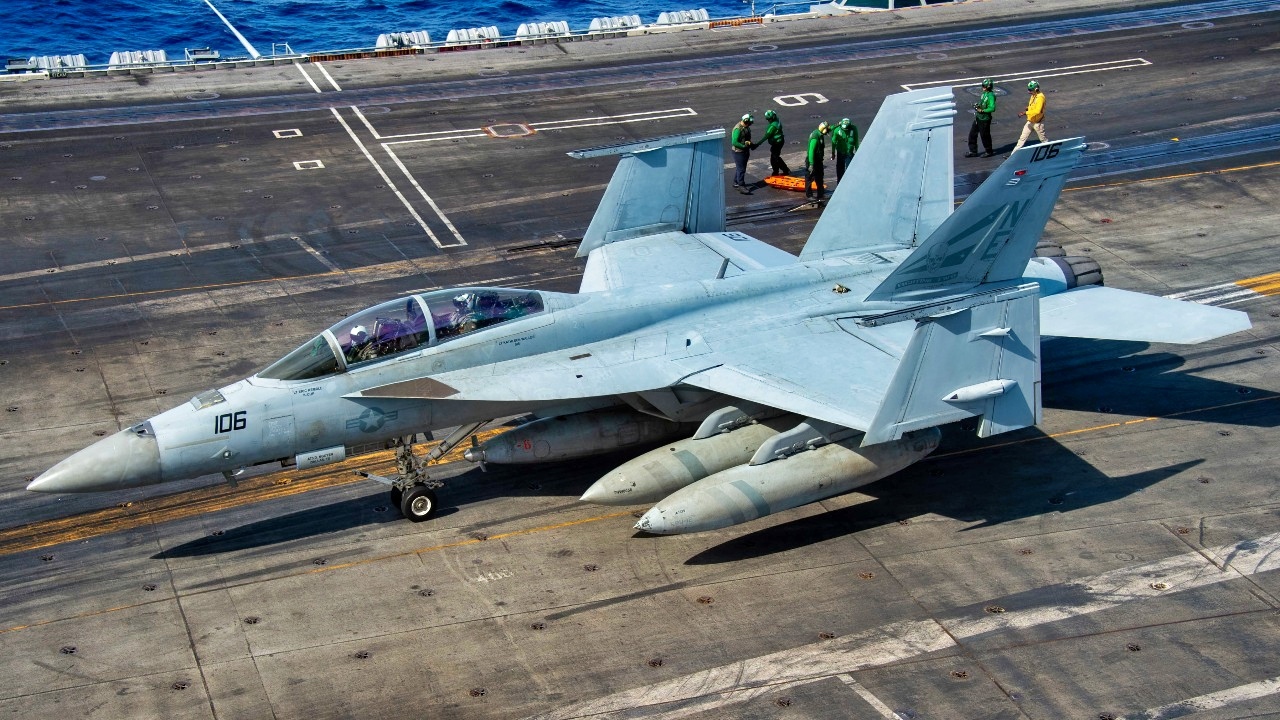
(Dec. 30, 2021) An F/A-18F Super Hornet, assigned to the “Bounty Hunters” of Strike Fighter Squadron (VFA) 2, taxis on the flight deck of Nimitz-class aircraft carrier USS Carl Vinson (CVN 70), Dec. 30, 2021. Carl Vinson Carrier Strike Group is on a scheduled deployment in the U.S. 7th Fleet area of operations to enhance interoperability through alliances and partnerships while serving as a ready-response force in support of a free and open Indo-Pacific region. (U.S. Navy photo by Mass Communication Specialist 3rd Class Jeff D. Kempton)
Super Hornet Fact #1: The Price Tag
This was a major reason—though certainly not the only reason—why the “Rhino” not only replaced the original Tomcat but was also chosen over the would-be “Super Tomcat” variant. As Monsieur Sebastien Roblin wrote back in October 2016:
“The Hornet airframe was not quite as optimized for air-to-air combat, but still delivered excellent performance, was based on fly-by-wire technology, and cost less money and time to fly and maintain.”
Thus, the Super Hornet made its operational debut in 1999. Today, its unit cost is about $70 million USD. Contrast that with, say, the $2 ***trillion*** price tag of the Lockheed Martin F-35 Lightning II!
Super Hornet Fact #2: Number Built
An estimated 632 Super Hornet specimens have been built to date. As a sign of the times and proof of the saying that “All good things must come to an end,” production shutdown is slated for 2027, once the Navy’s final order for 17 airframes is completed.
Super Hornet Not So Fun Fact #3: How Many Losses?
No “Rhino” has ever been shot down by enemy fire. That said, one of the warbirds—specifically a twin-seat F/A-18F—*was* lost to friendly fire, downed by a Standard Missile-2 (SM-2) launched from the Ticonderoga-class guided missile cruiser USS Gettysburg (CG-64) during operations against the Houthi terrorist group in Yemen.
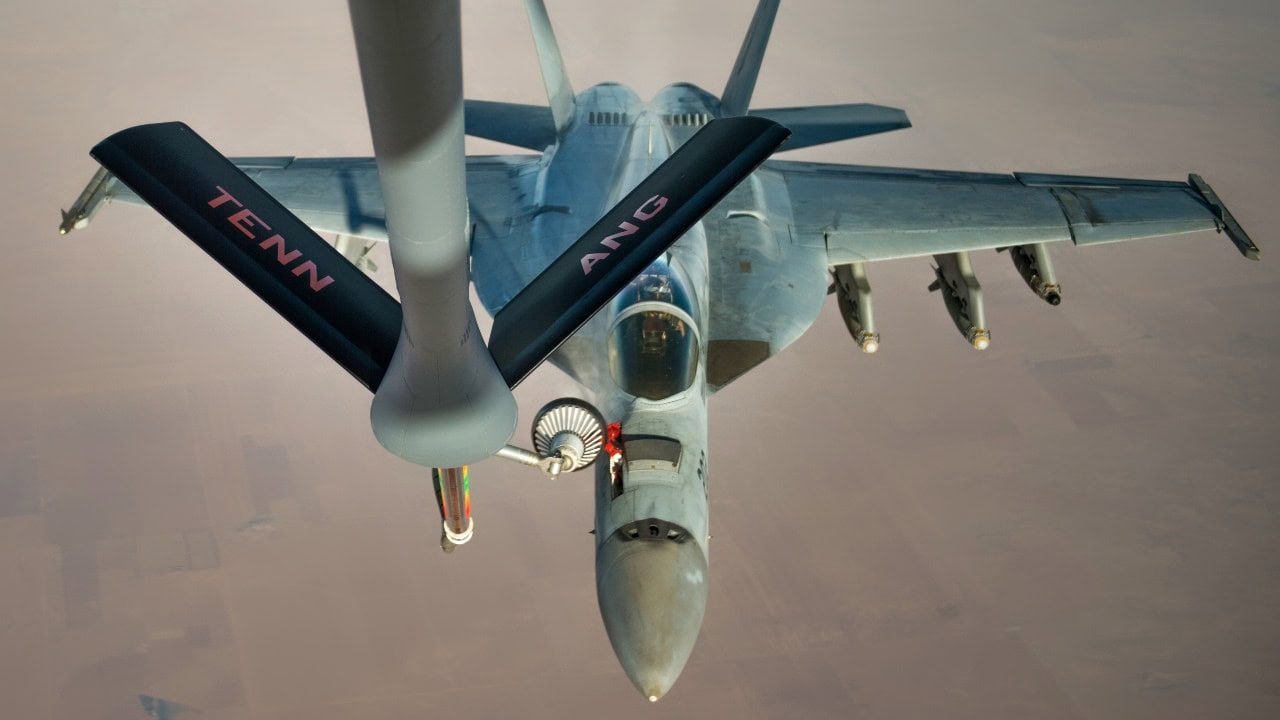
A U.S. Navy F/A-18 Super Hornet receives fuel from a KC-135 Stratotanker over Iraq in support of Operation Inherent Resolve Oct 17, 2016. The KC-135 provides the core aerial refueling capability for the U.S. Air Force and has excelled in this role for more than 50 years. (U.S. Air Force photo by Staff Sgt. Douglas Ellis/Released)
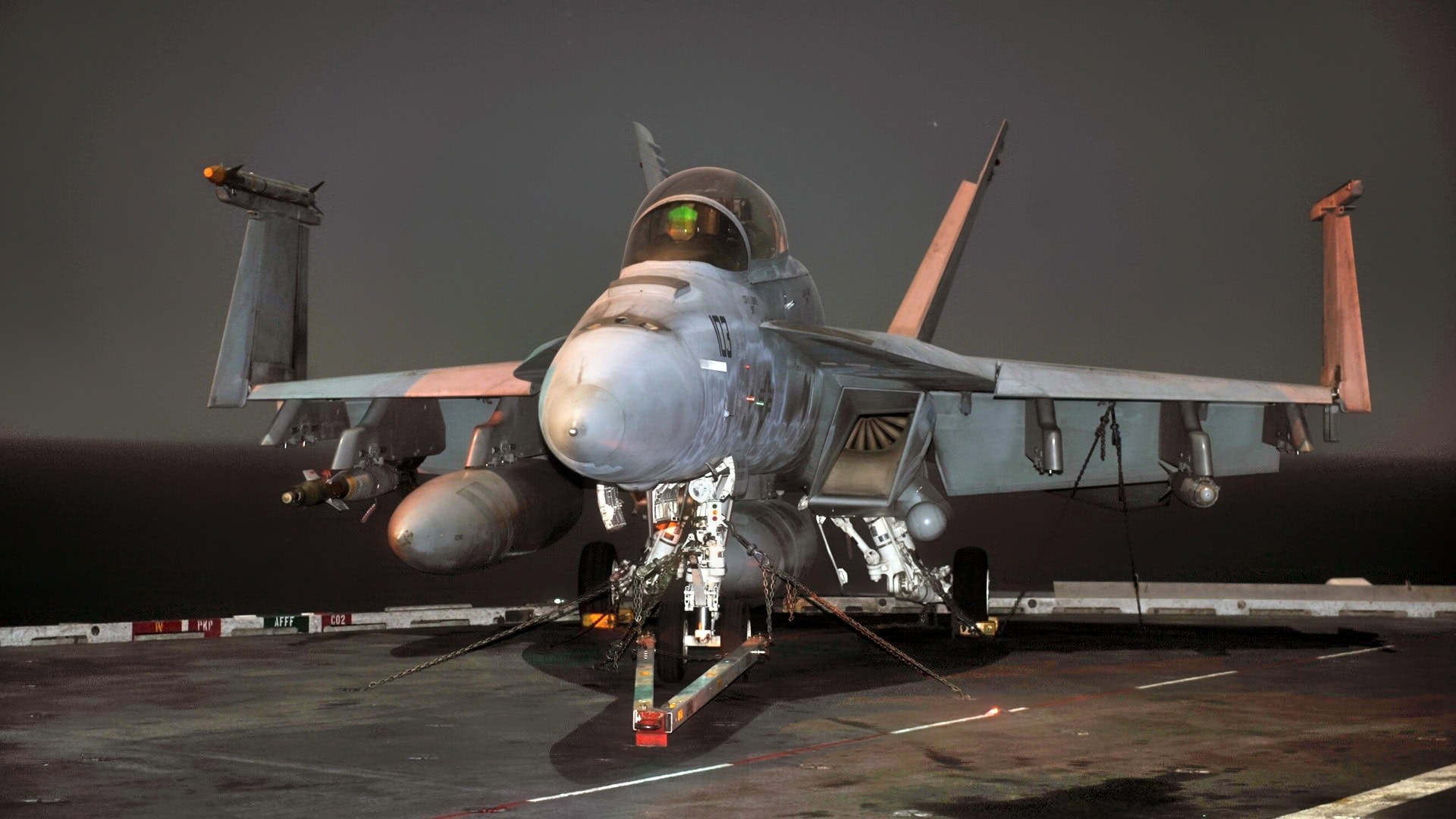
FA-18 Super Hornet. Image Credit: Creative Commons.
Fortunately, the two crew members ejected safely.
And speaking of those anti-Houthi operations, enemy fire *did* indirectly cause one Super Hornet loss, when, on 28 April 2025, a single-seat F/A-18E fell off an elevator of the USS Harry Truman (CVN-75) after the Nimitz-class carrier turned sharply to evade Houthi fire; thankfully, no deaths occurred.
Barely a week later, the Truman would lose another one of the precious warbirds when an F model ran afoul of a failure with the carrier’s arresting gear. Once again, no fatalities.
That said, there have been at least five other accidents involving the F/A-18E/F, and tragically, three of them were fatal: an F/A-18F crash on 6 April 2011 that killed both crew members, and F/A-18E crashes on 31 July 2019 and 3 June 2022 that killed the solo pilots.
Super Hornet Fun Fact #4: Overall Readiness
Aircraft readiness rates have been a major cause of concern throughout the U.S. Armed Forces.
However, the F/A-18E/F has been a proverbial ray of sunshine amid all those dark clouds of abysmal readiness rates, as an April 2026 report shows the Navy jet with an 80 percent readiness rate.
Super Hornet Fact #5: Weapons and Airspeed
Okay, that actually makes 6 Fun Facts, but eh, why nitpick?
In the original 1986 “Top Gun” film, Maverick famously said, “I feel the need…the need for speed!” The F-14 certainly fulfilled that need, with a max airspeed of Mach 2.34, or 1,795 mph. By contrast, the F/A-18E/F tops out at just over three-quarters of that figure, with a max airspeed of Mach 1.8, or 1,381 mph.
What’s more, it’s a mere 56 percent of the *theoretical* Mach 3.2 max airspeed—in practice, actually limited to Mach 2.83—attainable by the Soviet-designed MiG-25 “Foxbat.” Still, I don’t recall Maverick complaining about his Rhino being too slow in the Top Gun sequel, and it still beats the Mach 1.6 figure of the F-35.
As for armament, this is where the Rhino truly shines and shows its versatility as a “jack of all trades” for air-to-air and air-to-ground missions alike.
Yes, a so-called “Bombcat” version of the Tomcat was eventually fielded, but it still wasn’t optimized as a true multirole fighter-bomber like its successor. The F/A-18E/F’s arsenal consists of:
-1× 20 mm (0.787 in) General Dynamics M61A2 Vulcan cannon with 412 rounds of ammo; –11 hardpoints with a payload capacity of 17,750 lb. of bombs and/or missiles
Delving further, that bomb and missile ordnance suite can include:
-The AIM-9 Sidewinder infrared (IR) air-to-air missile
-The AIM-120 AMRAAM (Advanced Medium Range Air-to-Air Missile; affectionately nicknamed the “Slammer”)
–AGM-65E/F Maverick air-to-ground missile; yes, there’s that word again
–AGM-88 HARM ((High-speed Anti-Radiation Missile)
–JDAMs (Joint Direct Attack Munitions)
About the Author: Christian D. Orr
Christian D. Orr is a Senior Defense Editor. He is a former Air Force Security Forces officer, Federal law enforcement officer, and private military contractor (with assignments worked in Iraq, the United Arab Emirates, Kosovo, Japan, Germany, and the Pentagon). Chris holds a B.A. in International Relations from the University of Southern California (USC) and an M.A. in Intelligence Studies (with a concentration in Terrorism Studies) from American Military University (AMU). He is also the author of the book “Five Decades of a Fabulous Firearm: Celebrating the 50th Anniversary of the Beretta 92 Pistol Series,” the second edition of which was recently published.