

Key Points and Summary – The Navy is weighing whether the USS Gerald R. Ford aircraft carrier strike group can take on another major demand signal—potential operations near Iran—after an already long deployment and high operational tempo.
-The Chief of Naval Operations is portrayed as wary of extending Ford further due to maintenance timelines, contract schedules, and crew fatigue that can erode morale and performance.
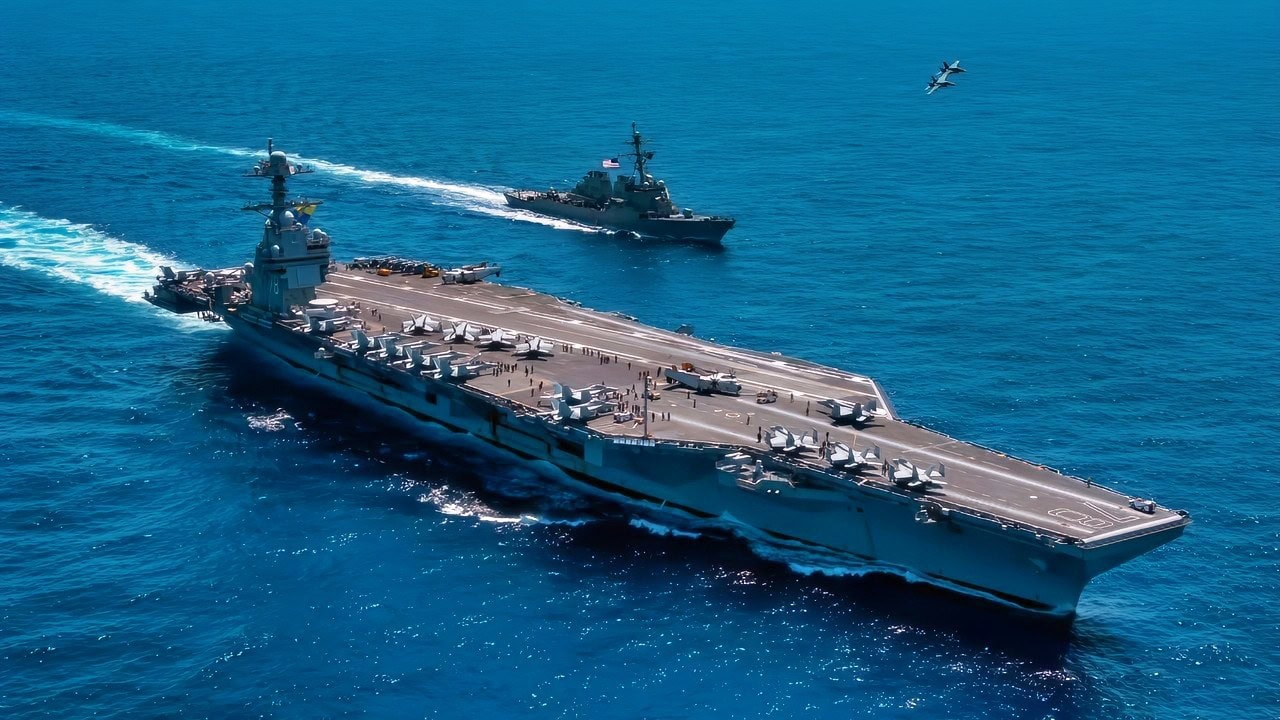
An F/A-18F Super Hornet, attached to the “Blacklions” of Strike Fighter Squadron (VFA) 213 and a F/A-18E Super Hornet, attached to the “Golden Warriors” of Strike Fighter Squadron (VFA) 87 fly over the world’s largest aircraft carrier, USS Gerald R. Ford (CVN 78), the Arleigh Burke-class guided-missile destroyer USS Mahan (DDG 72), April 11, 2025. The Gerald R. Ford Carrier Strike Group is underway in the Atlantic Ocean completing integrated naval warfighting training. Composite Training Unit Exercise. Image Credit: Creative Commons.
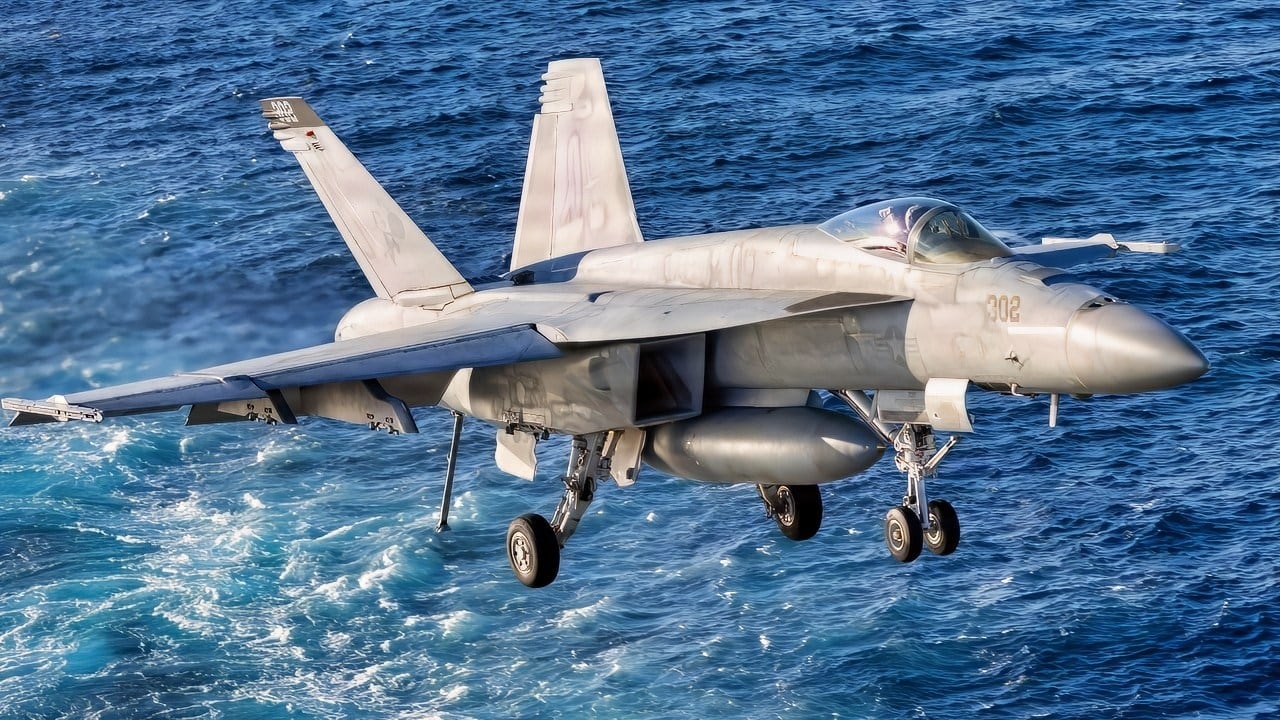
An F/A-18E Super Hornet aircraft approaches the flight deck of the world’s largest aircraft carrier, Ford-class aircraft carrier USS Gerald R. Ford (CVN 78), Nov. 17, 2025. U.S. military forces are deployed to the Caribbean in support of the U.S. Southern Command mission, Department of War-directed operations, and the president’s priorities to disrupt illicit drug trafficking and protect the homeland. (U.S. Navy photo)

Aircraft Carrier USS Gerald R. Ford Diagram. Image Credit: Creative Commons.
-With limited U.S. surface presence in the region, the USS Abraham Lincoln emerges as the most realistic alternative, even though repositioning takes time. And, at the moment, it seems the aircraft carrier will head to the Middle East.
-The dilemma highlights a broader strain: too few available aircraft carriers for overlapping crises.
The Real Enemy: The U.S. Navy’s Great Aircraft Carrier Shortage and Overuse?
Sometimes, U.S. Navy carrier strike groups get over-extended.
Flight deck operations can go 24-7. The crew gets tired and homesick.
Pilots are pushed to their limit, and the ships can have maintenance needs.
All of these factors have the Chief of Naval Operations (CNO) concerned that the USS Gerald R. Ford carrier strike group may need to come home this spring.
The Ford-class flotilla has been sailing since June of last year and is now in the Caribbean.
The ships were instrumental during Operation Absolute Resolve when Delta Force operators snatched Venezuelan narco-terrorist Nicolas Maduro.
Iran Is Exploding and Needs a Carrier Presence in the Area
But now the Navy needs a strike group in the Middle East to counter a powder keg situation in Iran.
The country is extremely unstable due to massive and deadly protests throughout its cities. President Donald Trump wants to send one carrier strike group to Central Command, but CNO Admiral Daryl Caudle is not sure that the Gerald R. Ford should be the carrier deployed to the Middle East.
“I think the Ford, from its capability perspective, would be an invaluable option for any military thing the president wants to do,” Caudle said to reporters at a recent conference noted by the War Zone. “But if it requires an extension, it’s going to get some push back from the CNO. And I will see if there is something else I can do.”
Abraham Lincoln Is In East Asia
As it stands now, the only other option for another strike group besides the Ford is the USS Abraham Lincoln, which is in the South China Sea. That carrier would have to transit back through the Strait of Malacca and the Indian Ocean to reach the vicinity of Iran.
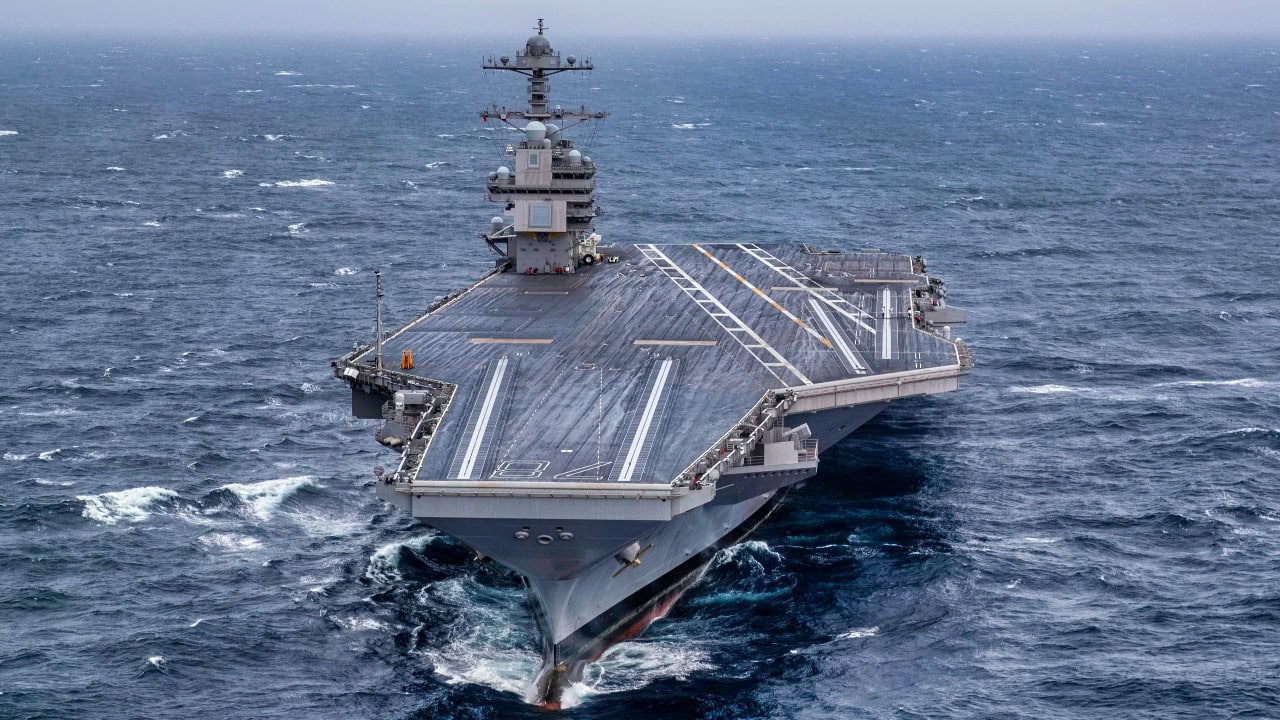
ATLANTIC OCEAN (Oct. 27, 2019) USS Gerald R. Ford (CVN 78) steams in the Atlantic Ocean for the first time since July 2018. Ford is conducting sea trials following its 15 month post-shakedown availability. (U.S. Navy photo by Mass Communication Specialist 3rd Class Connor Loessin)
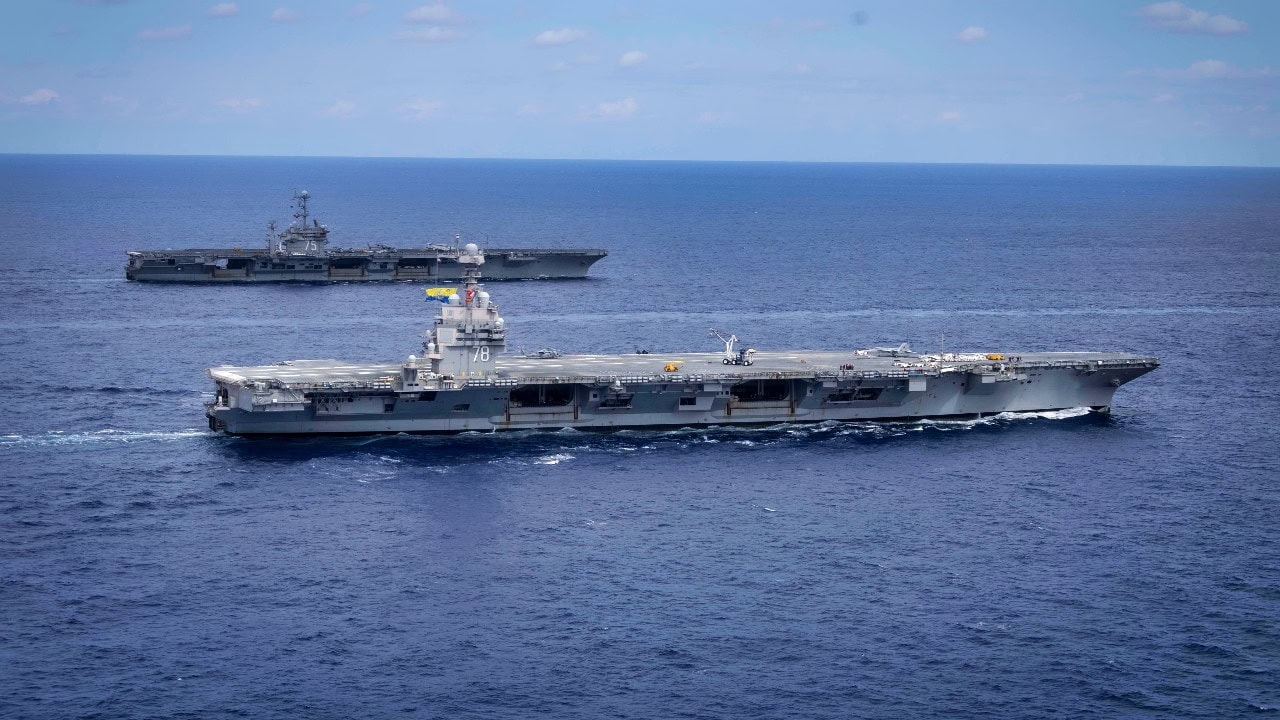
ATLANTIC OCEAN. (Aug. 24, 2024) The Nimitz-class aircraft carriers USS Harry S. Truman (CVN 75), back, and the world’s largest aircraft carrier, USS Gerald R. Ford (CVN 78), sail in formation in the Atlantic Ocean, Aug. 24, 2024. USS Gerald R. Ford is the flagship of the Gerald R. Ford Carrier Strike Group. The aircraft carrier is underway in the Atlantic Ocean to further develop core unit capabilities and skills such as fuels certification and ammunition on-load during its basic phase of the optimized fleet response plan. (U.S. Navy photo by Mass Communication Specialist 2nd Class Maxwell Orlosky).
And, as of now, reports are breakng it is indeed headed to the Middle East.
No other carriers are in Central Command at the moment, and Trump may order air strikes against Iranian targets at any moment. He was reportedly close to pulling the trigger on the night of January 14, but called a military operation off at the last moment.
Not Many Ships in Central Command
There are now just six U.S. ships in the Middle East – three Arleigh Burke-class destroyers and three Littoral Combat Ships.
This is insufficient, and the Lincoln probably needs to steam to the region as quickly as possible.
That could take weeks before it would arrive to start a combat attack.
How About Raining Down Tomahawk Missiles From Submarines?
However, there are likely attack submarines operating in Central Command that could fire a large number of Tomahawk cruise missiles at Iran if the president commands it. Trump is looking for a decisive win against the Iranian regime, one that would topple Supreme Leader Ali Khamenei.
Ford Has a High Operational Tempo
The Gerald R. Ford has been busy. It was in the Mediterranean this summer during Israel’s 12-day war against Iran and for Operation Midnight Hammer strikes against Iranian nuclear infrastructure.
It then made its way back to the Western Hemisphere, where it maintained a high operational tempo in action against Venezuela. But the Ford is nearing its capacity before it needs to return to port for maintenance and crew rest. The strike group has played a large role during Operation Southern Spear – the mission to punish boats that are hauling narcotics in the Caribbean.
“The fact that the Ford is currently operating in the Southern Command’s area of operations is fine with me,” Caudle said. “It is the extensions that bother.”
He is referring to the Ford strike group being sent to attack Iran, which would probably take months to deploy.
Long Deployments Affect Sailors’ Quality of Life
Caudle explained that long deployments can sometimes affect morale as sailors miss key life events with their families, such as births, weddings, and funerals. The CNO is a “sailor first” leader, and he understands how extended missions can negatively affect how personnel do their jobs.
The Ford also has maintenance contracts with firms that assume the Ford will be available for work at a certain time, and an extended deployment would jeopardize those agreements.
It’s a Tough Conundrum
This is a difficult situation for the Navy. If I were advising the CNO, I would recommend that he make his opinions known to the Secretary of Defense and the White House, but he may have to swallow some orders if the president is serious about sending the Ford to the Middle East.
I would be careful if I were the CNO and not make it look like the admiral is making too many excuses. Secretary of Defense Pete Hegseth and Trump are not that forgiving.
On the other hand, Caudle makes good points, and the chain of command may listen and choose either Lincoln or another carrier to take the mission in Central Command. Trump and Hegseth could be sympathetic to the plight of the Ford. And, as noted, it does seem the USS Abraham Lincoln is headed to the Middle East.
Don’t Seem Like a Complainer
Either way, Caudle needs to offer a solution and not bellyache too much. There needs to be a carrier to operate against Iran if needed. This also reveals a problem that the Navy doesn’t have enough operating flat-tops at this time. The ships seem to be port-dwellers, and that’s not an optimum situation for the maritime branch.
That means the CNO must address a larger problem, suck up the orders from the White House and Pentagon, and get his ships to the Middle East quickly, even if deployments need to be extended. Caudle said he likes to explain that the Navy can be “anywhere in two weeks.”
He just wants to make it known that sailors and aviators can have difficulty during long deployments, but the admiral may understand that, due to all the hot spots around the world, the personnel on the Ford and Lincoln will have to work harder and smarter during the coming months.
About the Author: Brent M. Eastwood
Author of now over 3,000 articles on defense issues, Brent M. Eastwood, PhD is the author of Don’t Turn Your Back On the World: a Conservative Foreign Policy and Humans, Machines, and Data: Future Trends in Warfare plus two other books. Brent was the founder and CEO of a tech firm that predicted world events using artificial intelligence. He served as a legislative fellow for US Senator Tim Scott and advised the senator on defense and foreign policy issues. He has taught at American University, George Washington University, and George Mason University. Brent is a former US Army Infantry officer. He can be followed on X @BMEastwood.