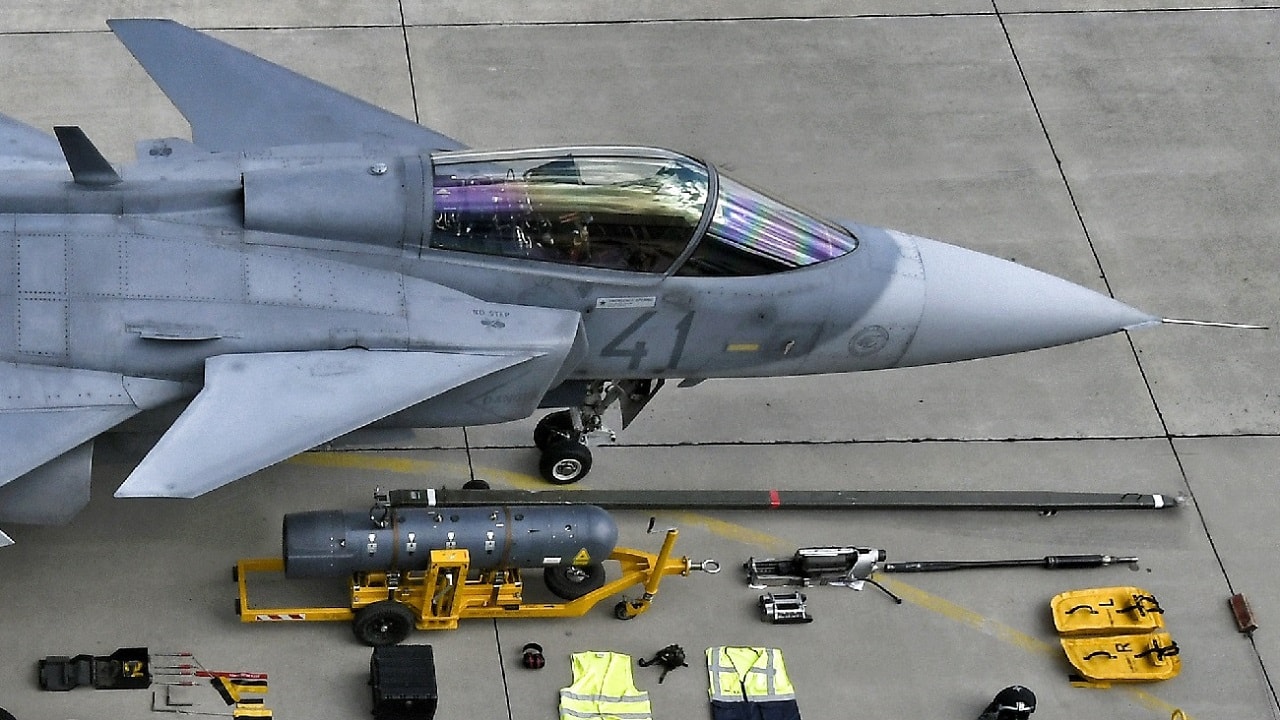
The Saab JAS 39 Gripen is a single-seat, single-engine, multirole fighter jet designed and manufactured by the Swedish company Saab AB. The newest variants of the family, the Gripen E/F, are among the most advanced 4.5-Generation fighters, according to some experts.
They are marketed as cost-effective alternatives to the F-35 or other expensive European aircraft. The JAS 39 has received international acclaim for its versatility, ease of maintenance, and high-performance capabilities.
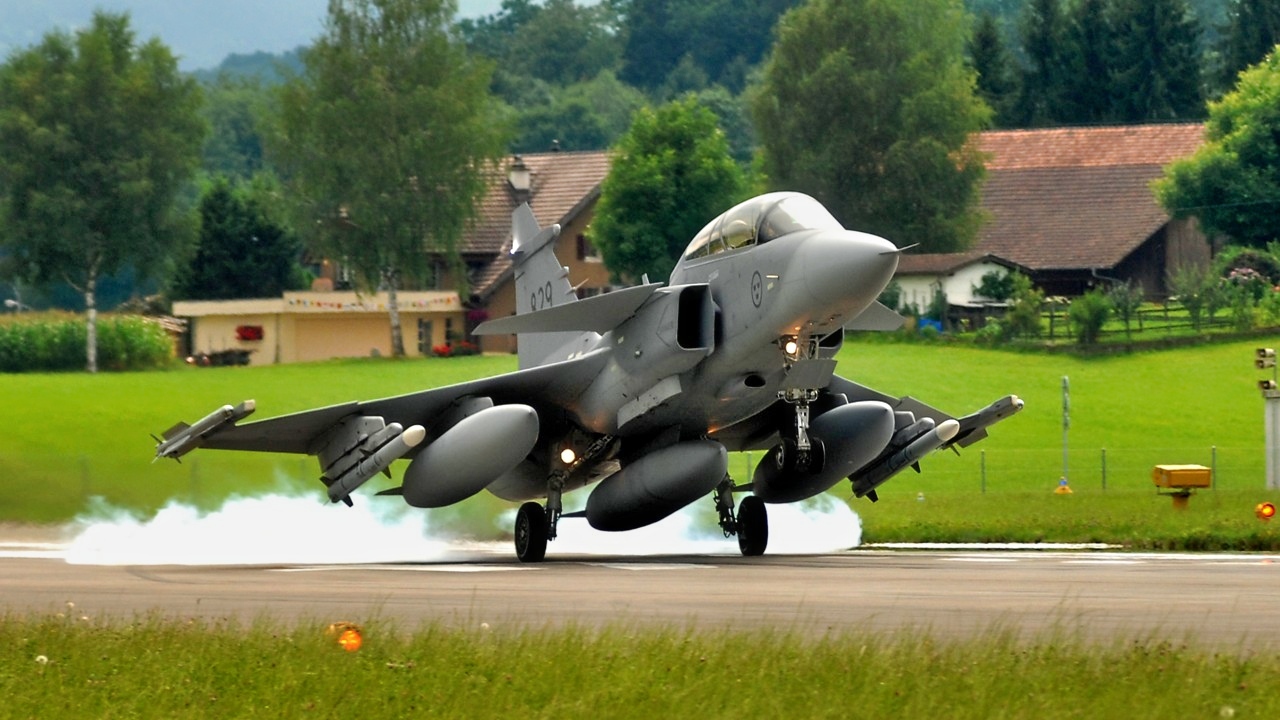
JAS 39 Gripen Fighter. Image Credit: Creative Commons.
Development of the JAS 39
The origins of the JAS 39 date back to the late 1970s, when Sweden sought replacements for its aging Saab 35 Draken and Saab 37 Viggen aircraft. In 1979, the Swedish government launched studies for a single platform capable of performing fighter, attack, and reconnaissance duties, known collectively in Swedish as JAS, which became the basis for the program’s designation.
The new aircraft had to improve on the Viggen’s range and payload, yet be smaller, cheaper to operate, and capable of dispersed operations that were central to Sweden’s Cold War defense strategy. Swedish planners needed an aircraft capable of taking off and landing on extremely short, austere road bases as part of the Bas 90 system. These makeshift runways measured just 800 meters long and 17 meters wide, a requirement that significantly shaped both size and aerodynamic design.
In 1981, Saab formed the IG JAS consortium with Volvo Aero, Ericsson/GEC-Marconi, and FFV Aerotech to develop and build the new aircraft.
The first prototype flew on 9 December 1988, and although the early development phase was marked by two flight-test crashes, the issues were traced to flight-control software and resolved through revisions. Sweden received its first production Gripen in 1993, and by 9 June 1996, the aircraft officially entered service with the Swedish Air Force.
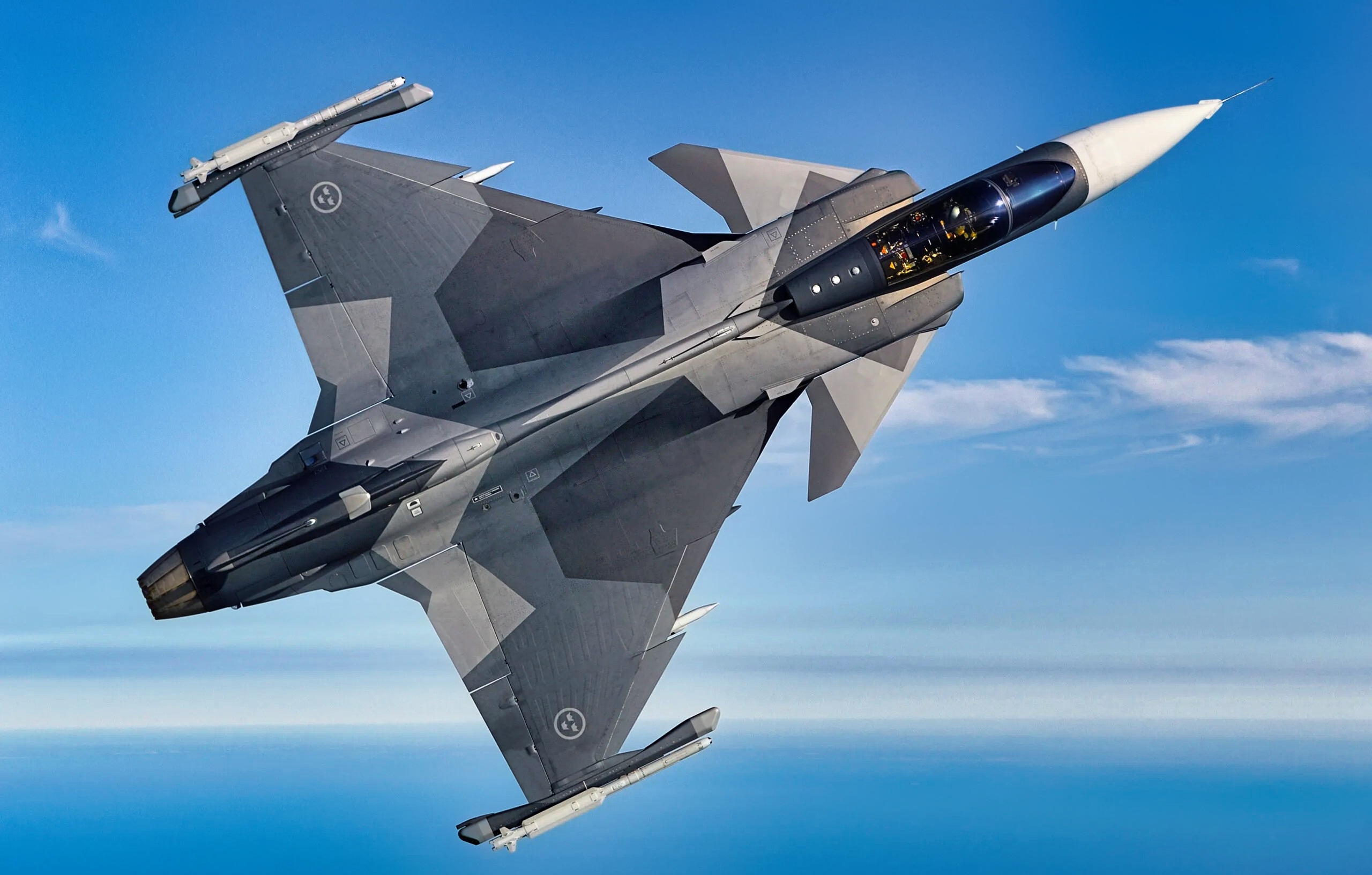
JAS 39 Gripen E Fighter. Image Credit: Saab.
Design Characteristics
The aircraft employs a delta-wing and canard configuration, which, combined with a relaxed stability design and fly-by-wire controls, gives it excellent maneuverability and short-field handling. These characteristics were essential for operating on rural roadways or on dispersed bases (which, to be fair, is a capability not as unique as Saab’s marketing team insists it is), where compact size and quick turnaround were vital.
The JAS 39 was engineered so that small teams, often including young conscripts, could refuel and rearm it quickly in field conditions.
This logistical simplicity, combined with low fuel consumption and maintenance requirements, helped make the JAS 39 a more affordable option than other European aircraft.
Early versions of the JAS 39 were powered by the Volvo RM12 engine, a derivative of the GE F404, enabling the aircraft to reach Mach 2.
Later variants, especially the Gripen E, adopted the more capable General Electric F414G, which improved thrust, increased payload capacity, and extended the aircraft’s range. The Gripen E also features a larger fuselage and greater internal fuel storage, addressing the endurance concerns of earlier versions.
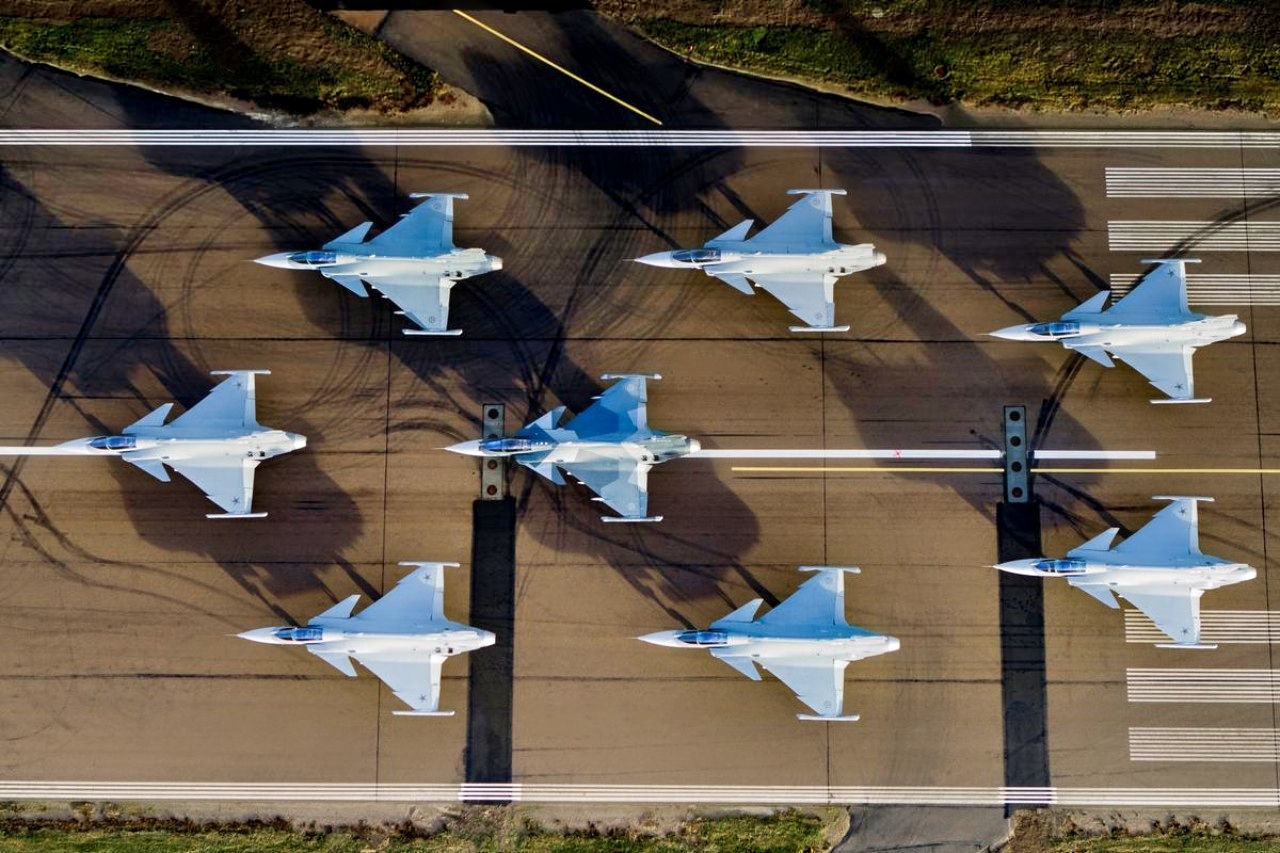
JAS 39 Gripen E. Image Credit: Creative Commons.
Specs and Capabilities of JAS 39
The C/D models introduced the PS-05/A pulse-Doppler radar and a modern glass cockpit, enhancing situational awareness and compatibility with NATO standards. The most advanced variant, the Gripen E, incorporates the Raven ES-05 AESA radar, which significantly improves long-range detection, tracking stability, and resistance to electronic jamming.
Complementing the radar is the Skyward-G infrared search-and-track system, which provides passive detection of targets, including low-observable aircraft, without revealing the Gripen E’s position.
The aircraft’s Arexis electronic warfare suite further strengthens its defensive and offensive EW capabilities, giving it a strong presence in environments dominated by electronic threats.
The JAS 39 family supports a broad range of weapons suited for both air-to-air and air-to-ground missions. Air-to-air options include the Meteor BVR missile, the IRIS-T, the AIM-9 Sidewinder, and other systems depending on operator requirements.
For ground attack, the JAS 39 can deploy AGM-65 Mavericks, precision-guided munitions, and targeting pods, making it as effective in strike roles as in air defense. Despite its compact dimensions, the aircraft can carry over 5,000 kilograms of ordnance, distributed across multiple hardpoints.
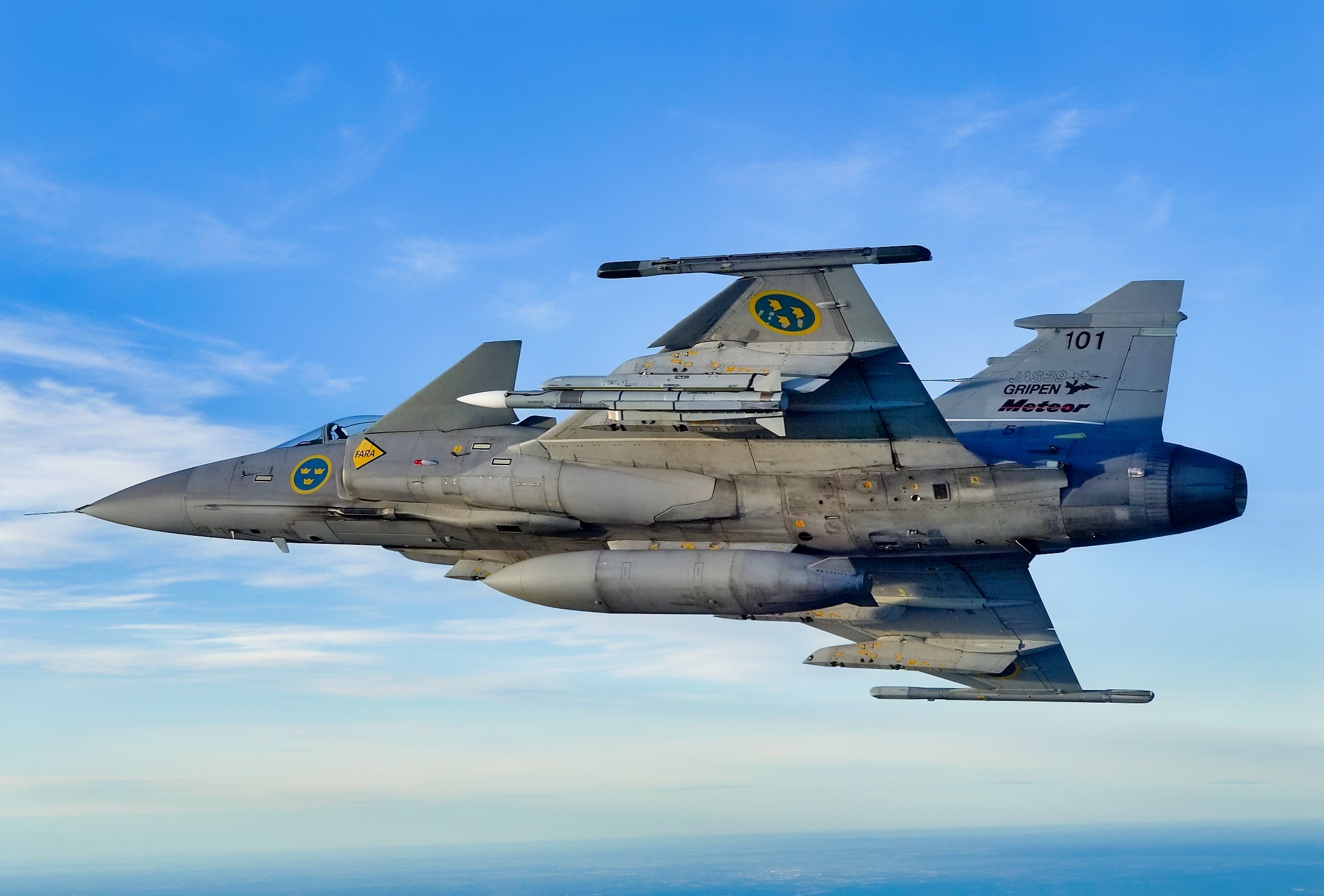
JAS 39 Gripen. Image Credit: Creative Commons.
The Gripen Through the Years
Across its production life, the JAS 39 has evolved through distinct variants. The A/B models were introductory versions developed primarily for Sweden, serving as the foundation for subsequent improvements.
The C/D variants, introduced in the early 2000s, added air-to-air refueling capability, enhanced avionics, and full NATO interoperability, allowing Sweden and export customers to integrate the aircraft into multinational operations.
The most significant leap forward came with the Gripen E/F, also referred to earlier as Gripen NG or Super JAS, which began deliveries to Sweden and Brazil in 2019.
Brazil assembles many of its Gripen E/F fighters domestically under a licensed-production arrangement, demonstrating the platform’s adaptability to industrial partnership models. Saab has also proposed specialized derivatives, including a Gripen Maritime for carrier operations and an optionally unmanned version.
The JAS 39 program reached new heights in 2025, when the Gripen E flew with an embedded artificial intelligence agent, Centaur.
This AI system conducted beyond-visual-range engagement tasks, managed electronic warfare functions, and even maneuvered against a manned Gripen D during test flights.
It marked the first time a frontline fighter had integrated AI so deeply into real operational scenarios and demonstrated the platform’s potential for future man-machine teaming.
This development has opened a new chapter in air combat evolution and has positioned the Gripen E as a compelling competitor in an era increasingly defined by automation and network-centric warfare.
MORE – The 5 Letter Word That Makes the Ford-Class Aircraft Carrier Worth Every Penny
About the Author: Isaac Seitz
Isaac Seitz, a Defense Columnist, graduated from Patrick Henry College’s Strategic Intelligence and National Security program. He has also studied Russian at Middlebury Language Schools and has worked as an intelligence Analyst in the private sector.