
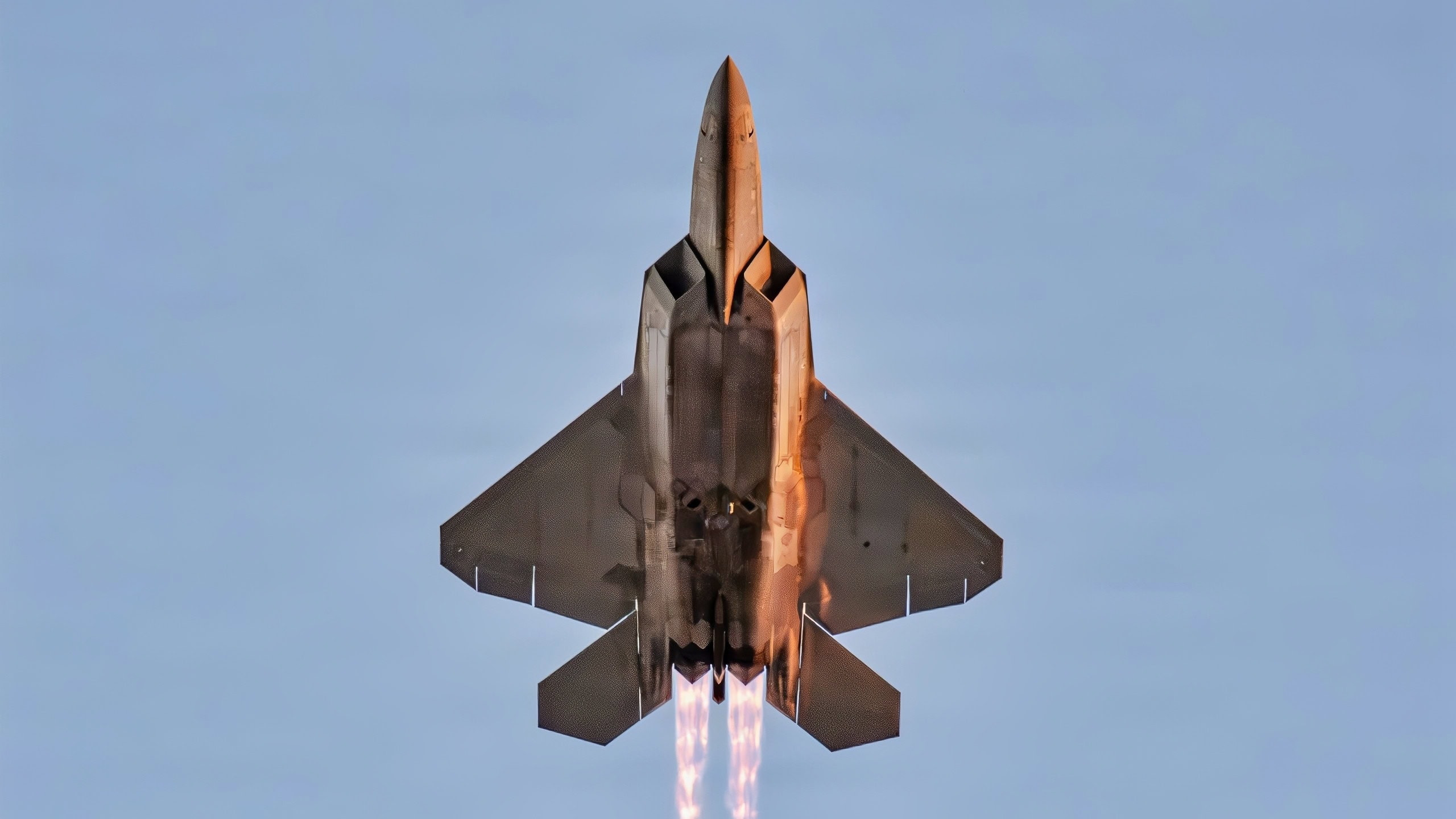
Summary and Key Points: Pratt & Whitney just announced that one of its engines has crossed a line no rival engine maker has reached: one million flight hours on the F119, the powerplant it built for the U.S. Air Force two decades ago and that China and Russia have spent the years since trying to equal. The milestone is a quiet measure of something Washington’s competitors have found hard to copy — not the stealth fighter everyone photographs, but the engine buried inside it, and the manufacturing base that keeps it running.
Aerospace History Made:

F-22 Raptor Exhibit Explainer 19FortyFive Photo. Taken By Harry J. Kazianis in July 2025 at the National Museum of the Air Force.

F-22 Raptor Model. Image Credit: 19FortyFive.com
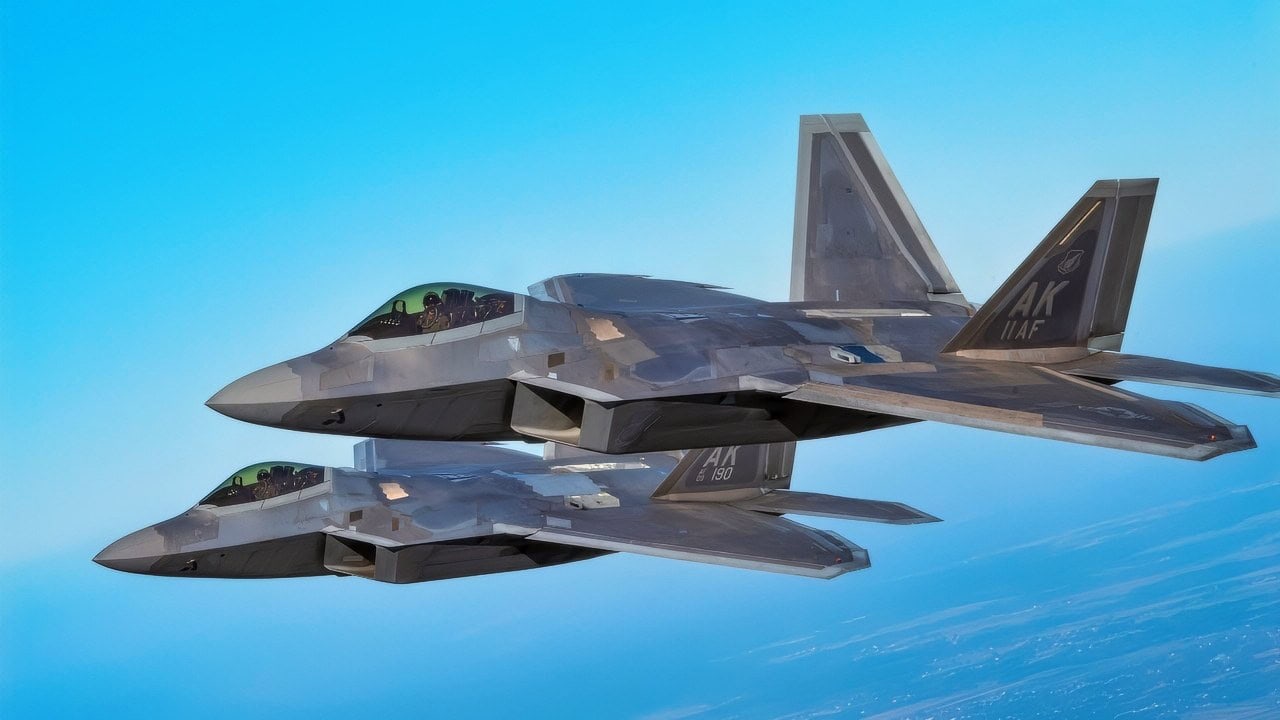
Two U.S. Air Force F-22 Raptors assigned to the 90th Expeditionary Fighter Squadron conduct a two-ship formation during the NATO Air Shielding media day, Oct. 12, 2022 at Łask Air Base, Poland. The Raptors uphold the Air Shielding mission alongside Polish F-16s and Italian Eurofighter Typhoons. The event showcased the importance of NATO’s Air Shielding mission and the interoperability among the U.S. and NATO Allies to international media through trilateral aerial demonstrations and interviews with service members. The U.S. remains dedicated to our security commitments with our NATO Alliance and postured to defend NATO territory. (U.S. Air Force photo by Staff Sergeant Danielle Sukhlall)
Aerospace manufacturing giant Pratt and Whitney recently announced that its fifth-generation F119 engine has officially passed one million flight hours. Operating as the main engines of the F-22 Raptor, the F119 engines were the world’s first of their class and capability, entering service more than 20 years ago. The engines are an underappreciated component of the highly capable stealth fighter.
They provide the perfect balance of thrust, efficiency, and low observability that makes the F-22 an unmatched presence on the battlefield. Few other engines on the planet match the capabilities of the F119, with nations like China and Russia taking decades to develop a comparable counterpart.
The First Fifth-Generation Engines in the World
The F119-PW-100 is an afterburning twin-spool turbofan engine in the 35,000-pound-thrust class. Each F-22 is powered by two of these engines, providing the aircraft with approximately 70,000 pounds of combined thrust when operating with afterburners. This enormous power output contributes significantly to the Raptor’s acceleration, climb rate, and overall combat performance. The engine was designed to maximize efficiency and reliability while minimizing weight and maintenance. The engineers at Pratt & Whitney achieved this goal through advanced aerodynamic designs and sophisticated manufacturing methods that reduced the total number of parts.
In June 2017, Pratt and Whitney announced that the F119 engines had reached 500,000 flight hours. Nine years later, the engines have doubled that amount, cementing them as an important pioneer in the realm of fifth-generation engines. “The F119 engine plays a critical role in maintaining air dominance for the U.S. Air Force, as it enables the F-22 mission,” said Jill Albertelli, president of Military Engines for Pratt and Whitney. “Having powered the F-22 Raptor since it launched over 20 years ago,” she continued, “the engine continues to provide unmatched capability, safety and readiness rates. This milestone demonstrates Pratt & Whitney’s commitment to delivering for our customers. ”
Enabling Supercruise Capabilities
The F-22 is especially unique in that it is the only fighter in the USAF capable of supercruise. Supercruise refers to sustained supersonic flight without using afterburners.
Most fighter aircraft can exceed the speed of sound only by engaging afterburners, which inject additional fuel into the exhaust stream, dramatically increasing fuel consumption. While this method produces tremendous thrust, it is inefficient and reduces combat endurance. The F119 was designed specifically to overcome this limitation. With its highly efficient core and high thrust, the engine allows the F-22 to cruise at supersonic speeds without relying on afterburners. This capability gives the aircraft a major tactical advantage by enabling it to travel rapidly over long distances while conserving fuel and reducing thermal signatures. According to some estimates, the Raptor can supercruise at speeds between Mach 1.2 and Mach 1.8 under ideal conditions.
The Raptor’s engines were designed to reduce the aircraft’s visibility as well. Stealth aircraft require careful management of radar and infrared signatures, and the propulsion system plays a major role in achieving this goal. The engine’s distinctive rectangular exhaust nozzles differ markedly from the circular nozzles found on most fighter aircraft. Their shape and design help reduce radar reflections and manage exhaust flow.
Because the aircraft can often operate at supersonic speeds without afterburners, they inherently produce less heat than those that require afterburners. Obviously, the solution isn’t perfect. The engines are still detectable by modern IRST sensors, but the F119 helps minimize the aircraft’s visibility.
Unmatched Maneuverability
Another feature unique to the F-22 is its thrust-vectoring capabilities. Unlike conventional jet engines that direct exhaust straight backward, the F119 uses a unique two-dimensional nozzle that can tilt up or down by as much as 20 degrees. This movement allows the engine’s thrust to be redirected during flight, providing additional control authority beyond what the aerodynamic control surfaces alone can offer. The nozzle’s movement is integrated directly into the F-22’s flight control system and is managed through an advanced Full-Authority Digital Electronic Control system, or FADEC. This integration allows the aircraft to perform remarkable maneuvers while maintaining stability and control.
The thrust-vectoring capability contributes significantly to the F-22’s extraordinary maneuverability. The F119 allows the Raptor to execute aggressive pitch maneuvers, maintain control at very high angles of attack, and perform dramatic post-stall maneuvers that would be impossible for most other fighters. Combined with the aircraft’s aerodynamic design and advanced flight-control software, the engine’s thrust-vectoring technology helps make the F-22 one of the most agile combat aircraft in existence.
The F119 incorporates numerous advanced engineering features. The engine employs a three-stage integrally bladed fan and a compact six-stage high-pressure compressor that uses highly refined aerodynamic designs.
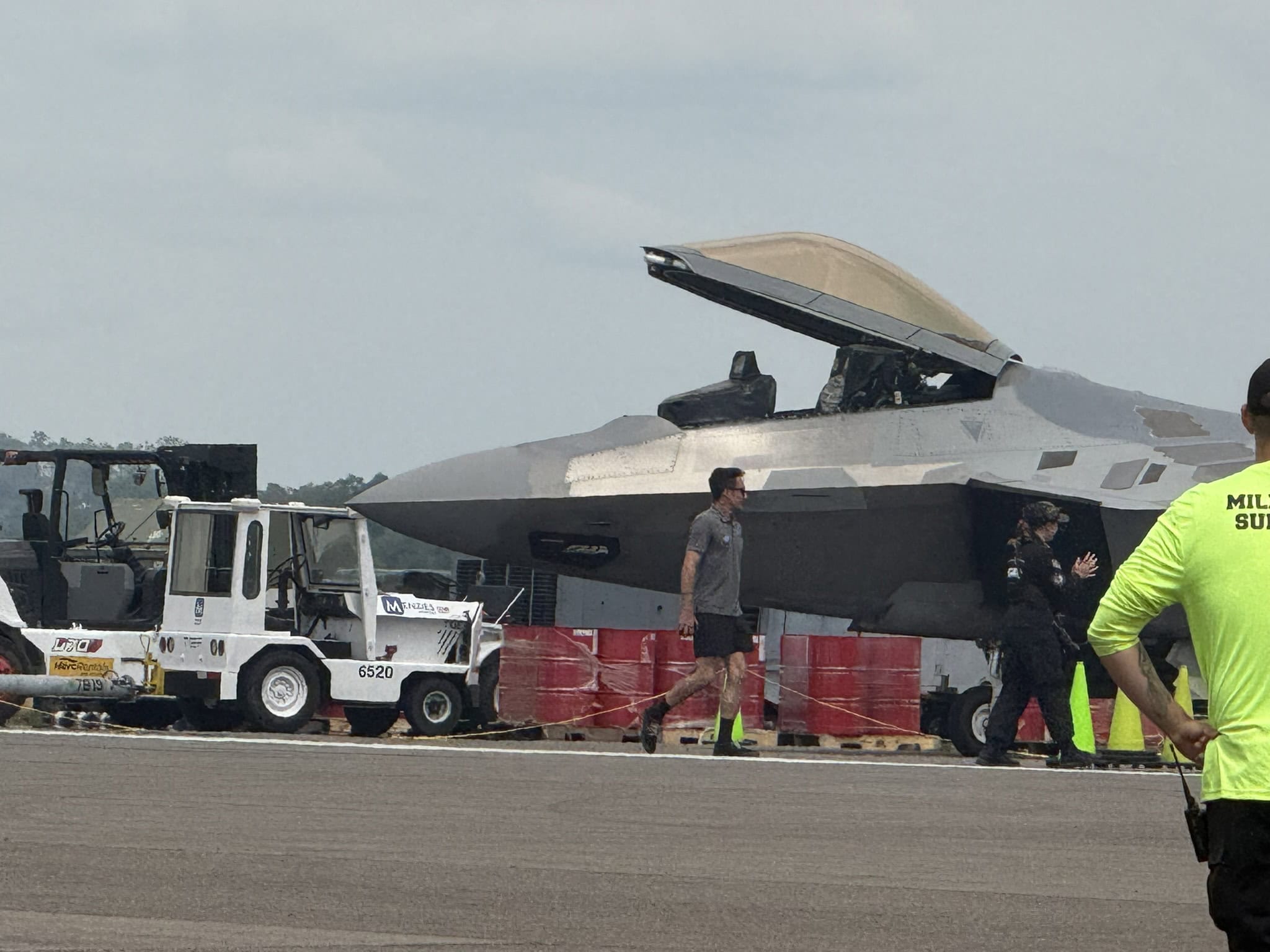
F-22 at Lakeland Airshow in April. 19FortyFive.com Image.
Advanced manufacturing techniques were used to create integrally bladed rotor disks, commonly known as blisks, which reduce weight and improve efficiency.
The engine also utilizes cutting-edge cooling technologies and single-crystal superalloy turbine blades capable of surviving extremely high operating temperatures.
These features allow the F119 to deliver performance levels that would have been extremely difficult with earlier technology.
About the Author: Isaac Seitz
Isaac Seitz, a Defense Columnist, graduated from Patrick Henry College’s Strategic Intelligence and National Security program. He has also studied Russian at Middlebury Language Schools and has worked as an intelligence Analyst in the private sector.