
Summary and Key Points: Saab signed a contract on June 30 to supply Ukraine with 16 new-build JAS 39 Gripen E fighters, a deal worth about $2.5 billion under an October framework that could reach 150 aircraft, with deliveries in 2029 and 2030 financed through the European Union’s Ukraine loan facility and 16 donated Gripen C/Ds from Swedish stocks arriving from early 2027. The Gripen is the fifth generation of Saab’s fighter lineage, following the Saab 29 Tunnan, the Saab 32 Lansen, the Saab 35 Draken, and the Saab 37 Viggen, a 78-year run of Swedish designs built around dispersed highway basing, rapid turnaround, and licensed engines, most recently General Electric’s F414.
Introduction: Saab Was Ready for a Russia War
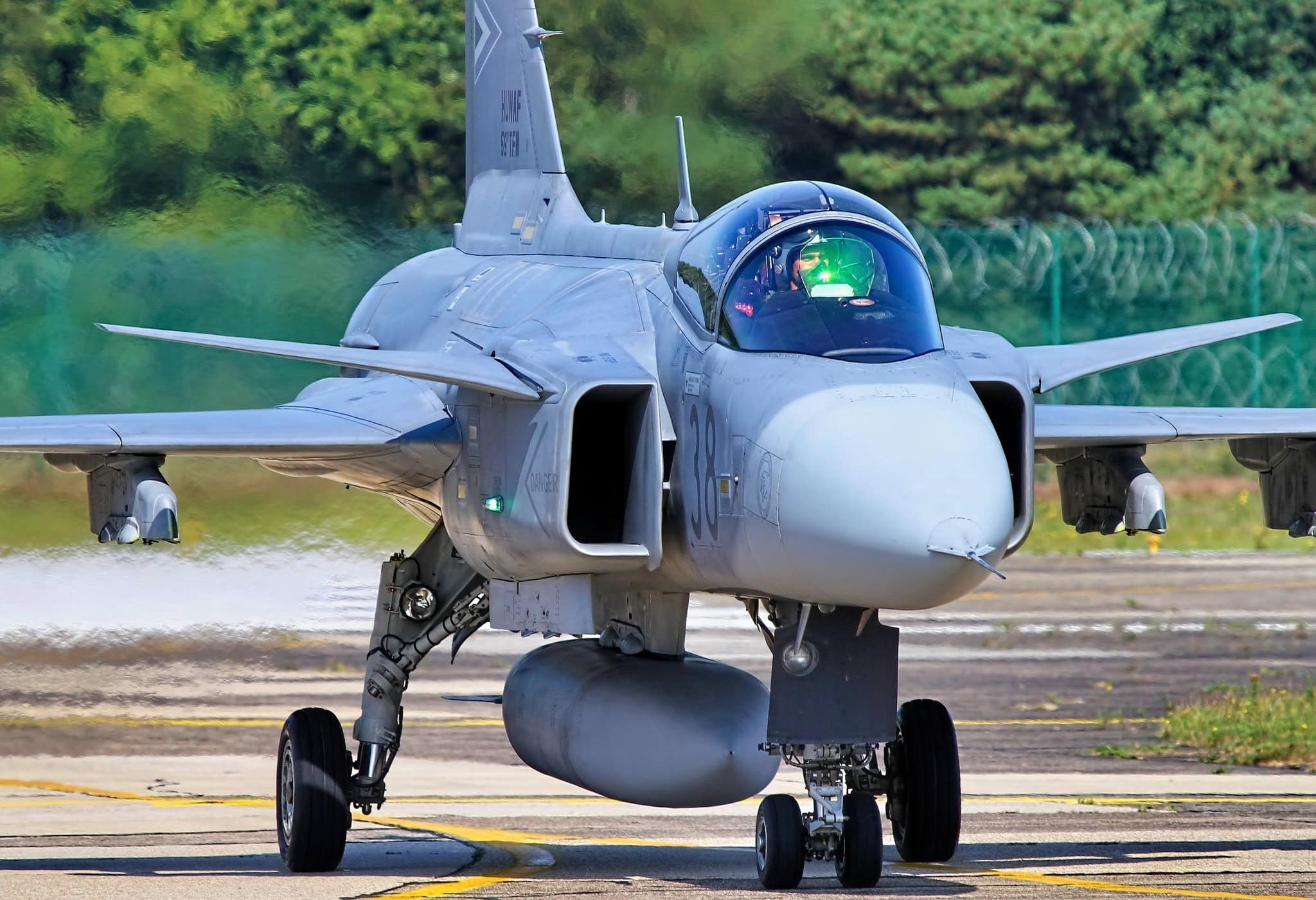
JAS 39 Gripen on Runway. Image Credit: Creative Commons.
On June 30, Saab signed the contract: 16 Gripen E fighters for Ukraine, worth about $2.5 billion, the first firm order under a framework that could reach 150 aircraft. Every line of the sales pitch — a jet that flies from highways, hides in forests, and gets rearmed by minimally trained crews in ten minutes — was written decades ago, for a Soviet invasion of Sweden that never happened.
Four Cold War fighters built that doctrine before the Gripen existed, and almost nobody outside Sweden remembers them. The war those jets were designed for finally arrived. It just wasn’t Sweden’s.
The signing happened in the presence of Ukraine’s president and Sweden’s defense minister, and it converted last October’s letter of intent into steel: 16 new-build Gripen Es, roughly SEK 24.6 billion, deliveries in 2029 and 2030, financed through the European Union’s Ukraine loan facility, with Saab chief executive Micael Johansson calling it “a world-class fighter that will transform the Ukrainian Air Force’s capability.”
Sixteen donated Gripen C/Ds from Swedish stocks arrive far sooner, beginning in early 2027, and Ukrainian pilots and technicians are already training in Sweden. The October framework contemplates 100 to 150 aircraft, which would rank among the largest fighter exports in Saab’s history.
A company from a nation of ten million outselling giants is a strange enough story.
The stranger one is how long it took the world to want what Sweden was building. The Gripen is the fifth act of a lineage that spent the Cold War producing some of the most inventive fighters ever flown, for an audience of one country, against an invasion that never came.
Saab 29 Tunnan: The Flying Barrel That Went to War for the UN
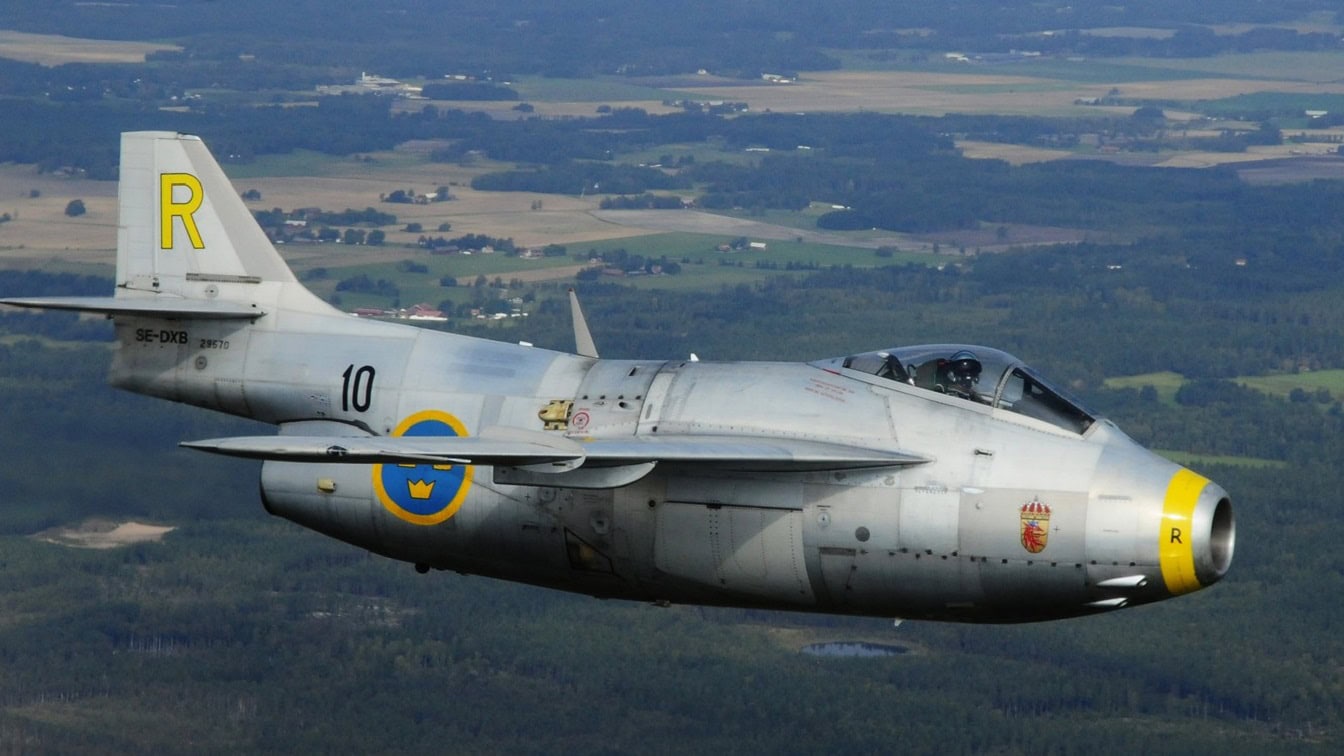
Saab J-29 Tunnan
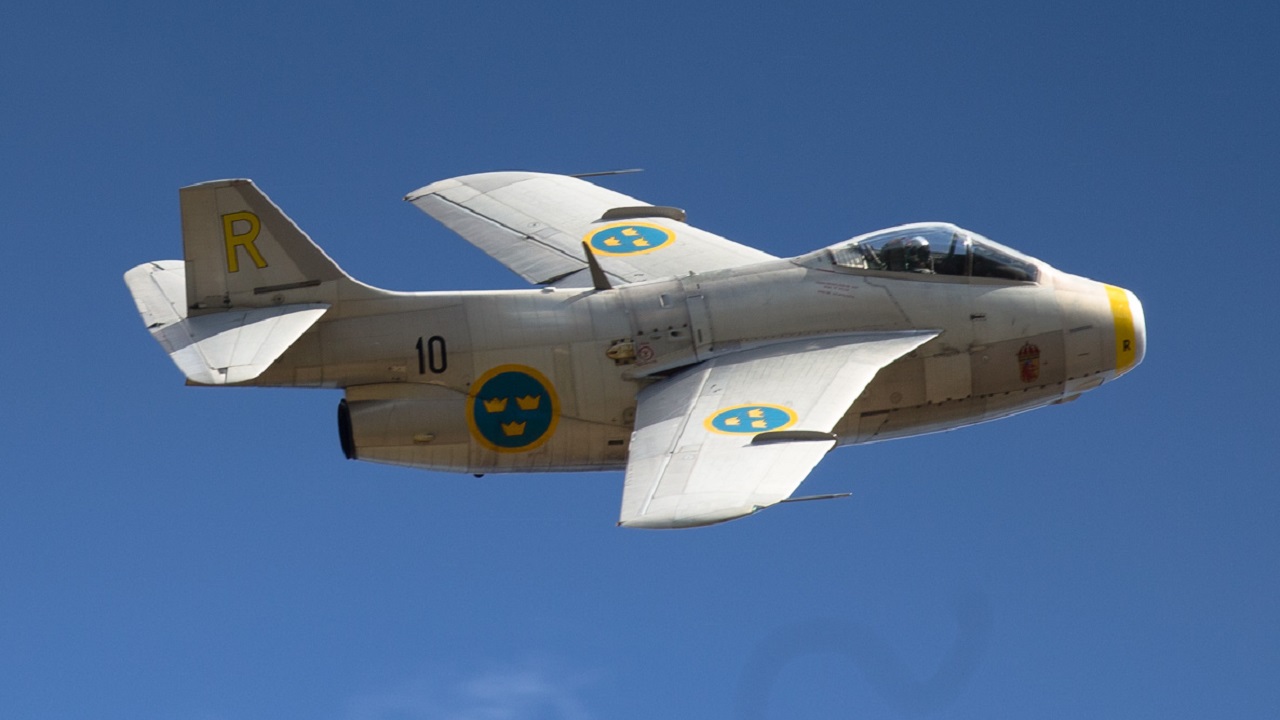
J-29 Tunnan. Image Credit: Creative Commons.
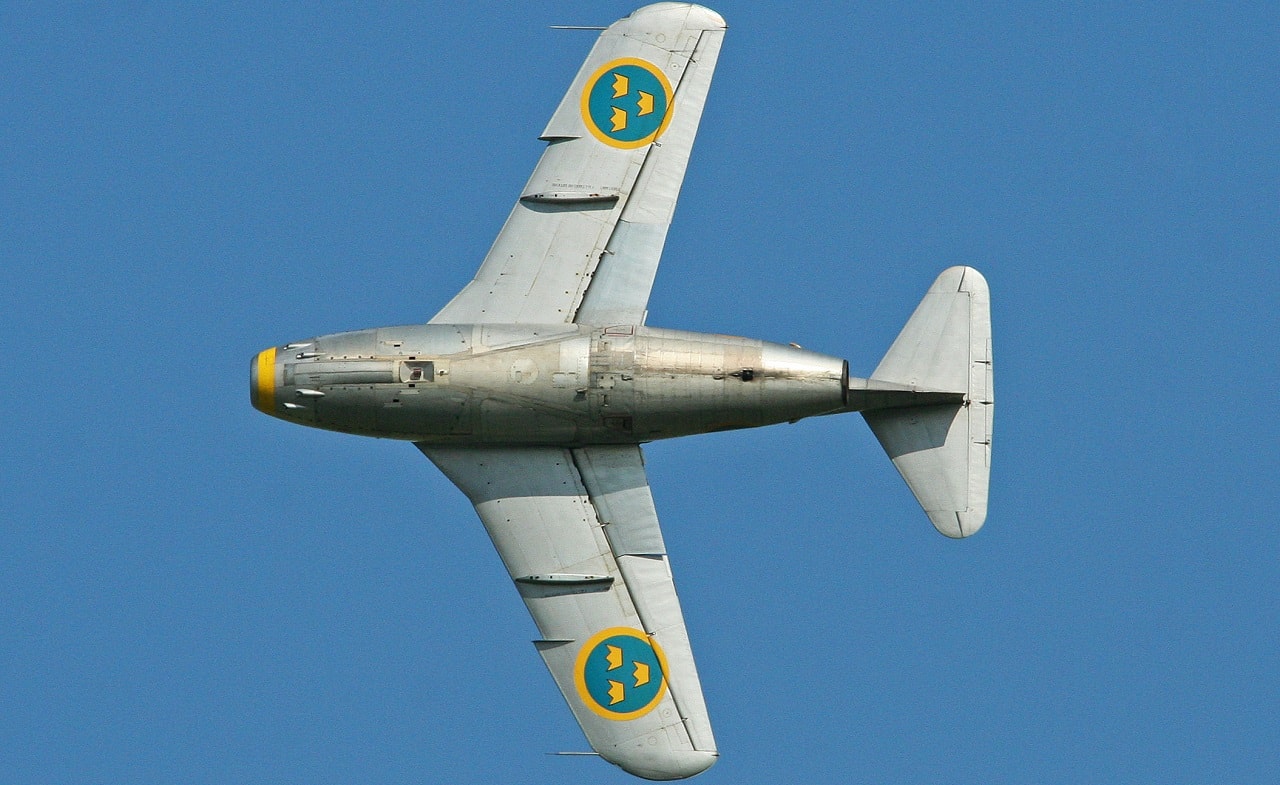
Saab J-29 Tunnan. Image Credit: Creative Commons.
The lineage’s founding jet looked like a joke and flew like a threat. The Saab 29 Tunnan — the Flying Barrel, named for the rotund fuselage wrapped around its de Havilland Ghost engine — first flew on September 1, 1948, and became the first swept-wing fighter produced in Western Europe after the war, putting neutral Sweden in the same technological generation as the F-86 and the MiG-15.
Saab built 661 of them; the type set a world speed record over a closed circuit in 1954, and its landing gear was designed from the start for rough strips, the first expression of the assumption that would define every Swedish fighter after it: the real runways would not survive the first morning of a war.
Then the Tunnan did something no other Swedish fighter ever has. It went to war.
When the United Nations appealed for airpower during the Congo crisis, Sweden sent J 29Bs to form UN Fighter Squadron 22, with the first four jets landing at Leopoldville on October 4, 1961, eventually joined by reinforcements and two reconnaissance variants. Their war escalated from escorting UN transports to offensive strikes: on December 9, 1961, the Tunnans and Indian Canberra bombers hit the Katangese airfields at Kolwezi and Jadotville and knocked out most of Katanga’s small air arm on the ground, and the fiercest fighting came a year later when the squadron flew rocket attacks in support of besieged UN ground troops.
Despite heavy ground fire, not one was lost in combat. The ending is the detailed history that should be kept: when the mission wound down, Sweden judged it too expensive to fly the jets home and scrapped several of them on-site in Africa. The only Swedish fighters ever to fire shots in anger never came back.
Saab 32 Lansen: The Missile Pioneer That Outlived Everything
The second act rarely makes anyone’s list, which is an injustice with numbers attached.
The requirement behind the Saab 32 Lansen, first flown on November 3, 1952, was brutally Swedish: a strike aircraft able to attack any point along the country’s 1,245 miles of coastline within one hour of launch, in any weather, day or night.
Saab delivered a sleek two-seater that broke the sound barrier in a shallow dive within a year of entering testing, and whose fuselage was the first defined line by line through mathematical calculation, an early marriage of computers and airframe design. Its real claim on history hangs under the wings: the Rb 04, among the first anti-ship cruise missiles in Western service, pairing with the Lansen’s mapping radar to threaten any invasion fleet in the Baltic while most air forces were still aiming iron bombs by eye.
The attack variant was also earmarked, for a time, as the delivery aircraft for the nuclear and chemical weapons Sweden’s secret programs studied and never built. The service record carried a heavy price — roughly a third of all Lansens were lost in accidents across the type’s career, killing 100 crew members — and an afterlife nothing else in this story matches: converted Lansens towed targets and flew electronic warfare into the late 1990s, and the last pair worked into the 2010s taking high-altitude samples for Sweden’s radiation safety authority, including scooping volcanic ash out of the sky during the 2010 Icelandic eruption.
A 1950s-era strike jet, in the end, retired as a science aircraft.
Saab 35 Draken: The Double-Delta That Did the Cobra First
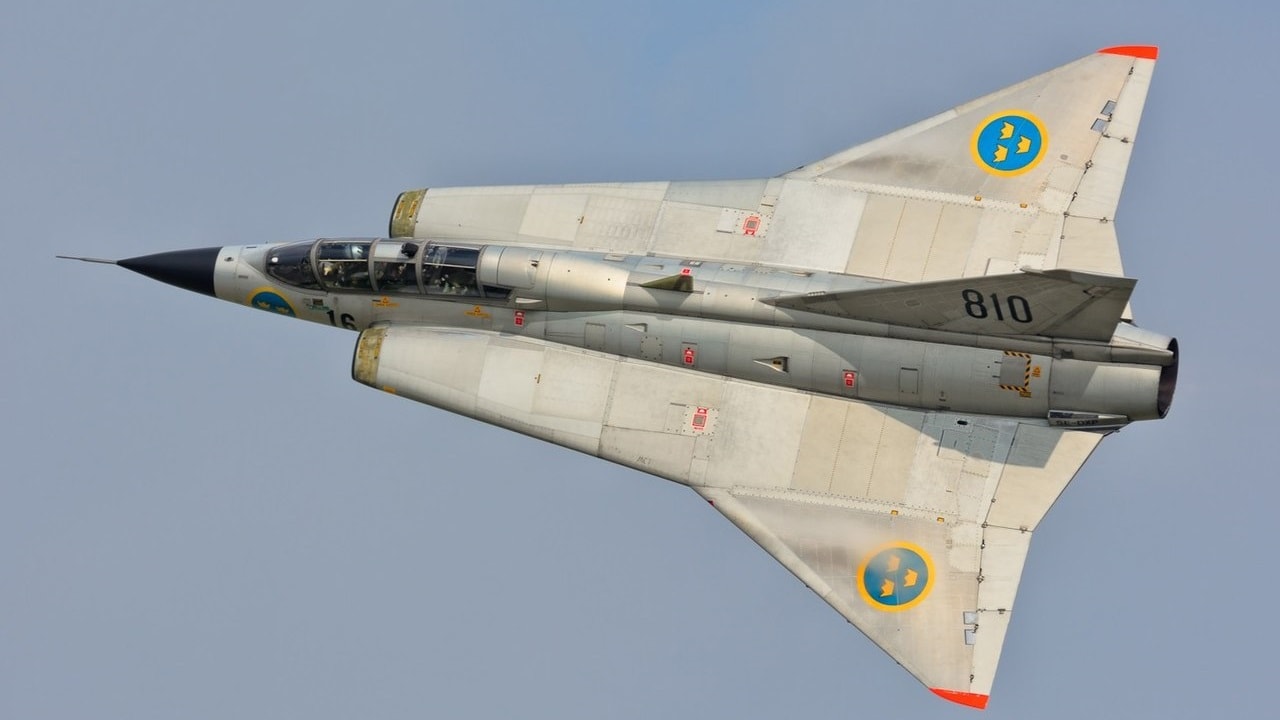
The third act is the one that should be famous. Facing a requirement to intercept Soviet bombers at twice the speed of sound while still operating from short road strips, Saab bet the program on a wing shape nobody had flown: the double delta, an inner wing swept at 80 degrees for speed blended into an outer wing at 60 degrees for low-speed lift.
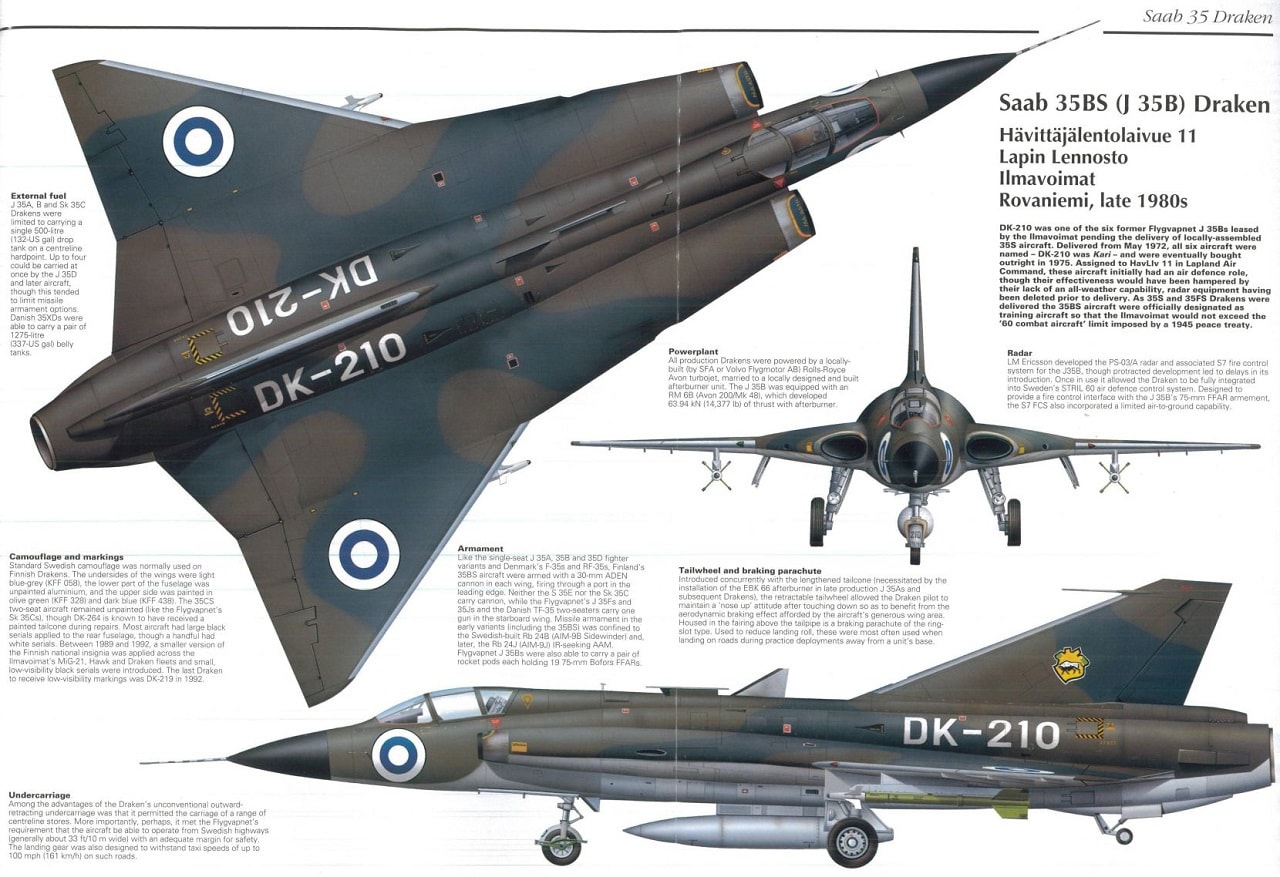
Saab 35 Draken. Image Credit: Creative Commons.
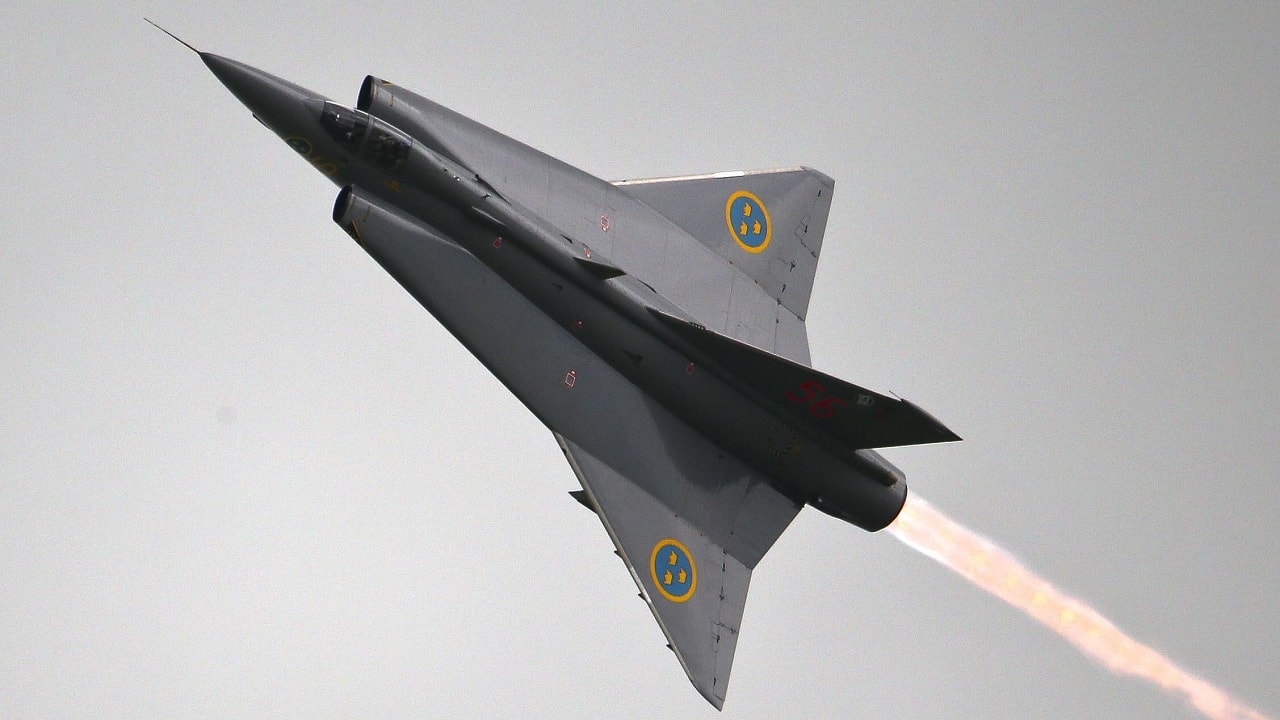
Saab 35 Draken. Image Credit: Creative Commons.
The gamble was so far outside the data that Saab built a subscale proving aircraft first, the little Saab 210, which flew roughly a thousand test flights before the full-size Draken’s first flight in October 1955 — during which program the second prototype broke the sound barrier by accident, in a climb, on its maiden flight. In service from March 1960, the Draken gave a neutral country in the mid-1950s a Mach 2 interceptor that conscripts could turn around on a highway in about ten minutes.
The wing had a temper, and taming it produced the maneuver everyone credits to the wrong air force.
The Draken’s high angle-of-attack “superstall” could kill, and Swedish pilots developed a violent nose-up, nose-down recovery they called kort parad — the short parry — which doubled as a combat trick that made pursuing aircraft overshoot; the Swedish record holds that their pilots were performing it decades before a Sukhoi made the Cobra famous at Paris in 1989, and film exists of a Draken using it to force a pursuing Viggen to overshoot in a mock dogfight.
Jan Jorgensen’s history of the type counts the legend’s price: 179 superstall incidents between 1959 and 1987, 35 aircraft destroyed, and four pilots killed. Denmark, Finland, and Austria all bought the Draken, and Austria flew it until 2005 — a 45-year service life for a fighter designed when Stalin was recently dead.
Saab 37 Viggen: Canards, Thrust Reversers, and the Jet That Locked Up the SR-71
The fourth act built the doctrine into the airframe more literally than anything before or since. The Saab 37 Viggen, first flown in February 1967, was the first modern fighter to enter service with canards, the small foreplanes ahead of the wing that gave it the lift to leave a 500-meter stretch of road, and it carried a thrust reverser, a transport plane’s landing trick on a Mach 2 fighter, so it could stop on one too.
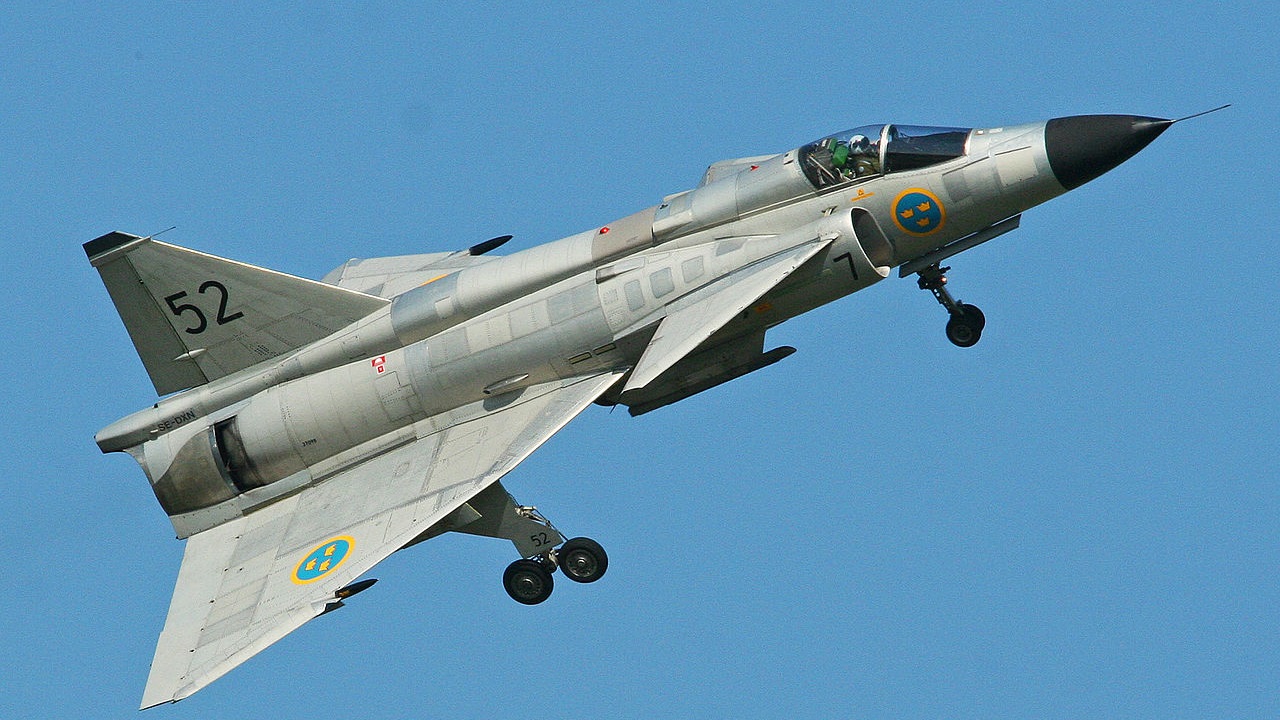
Making its first UK Airshow appearance, this amazing Saab 37 Viggen is operated by the Swedish AF Heritage Flight in genuine F7 markings. Seen during its solo routine. c/n 37-098. 2013 Waddington Airshow. 6-7-2013
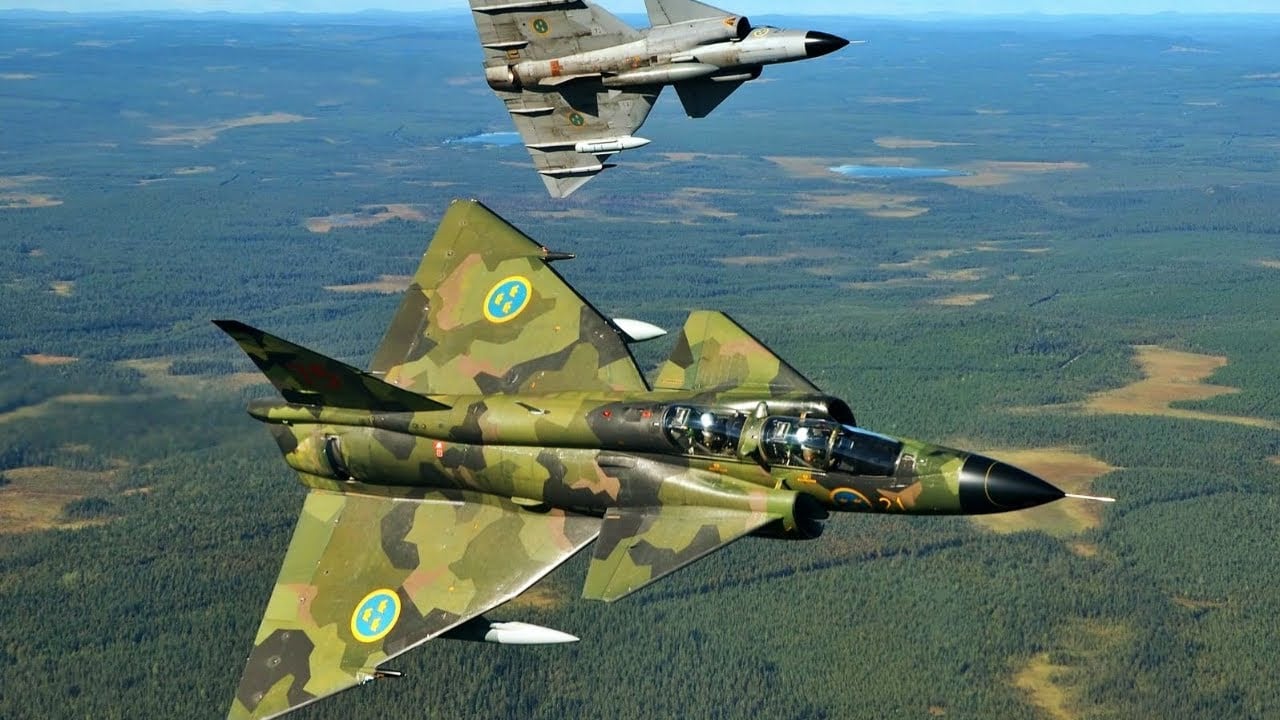
Saab 37 Viggen. Image Credit: Creative Commons.
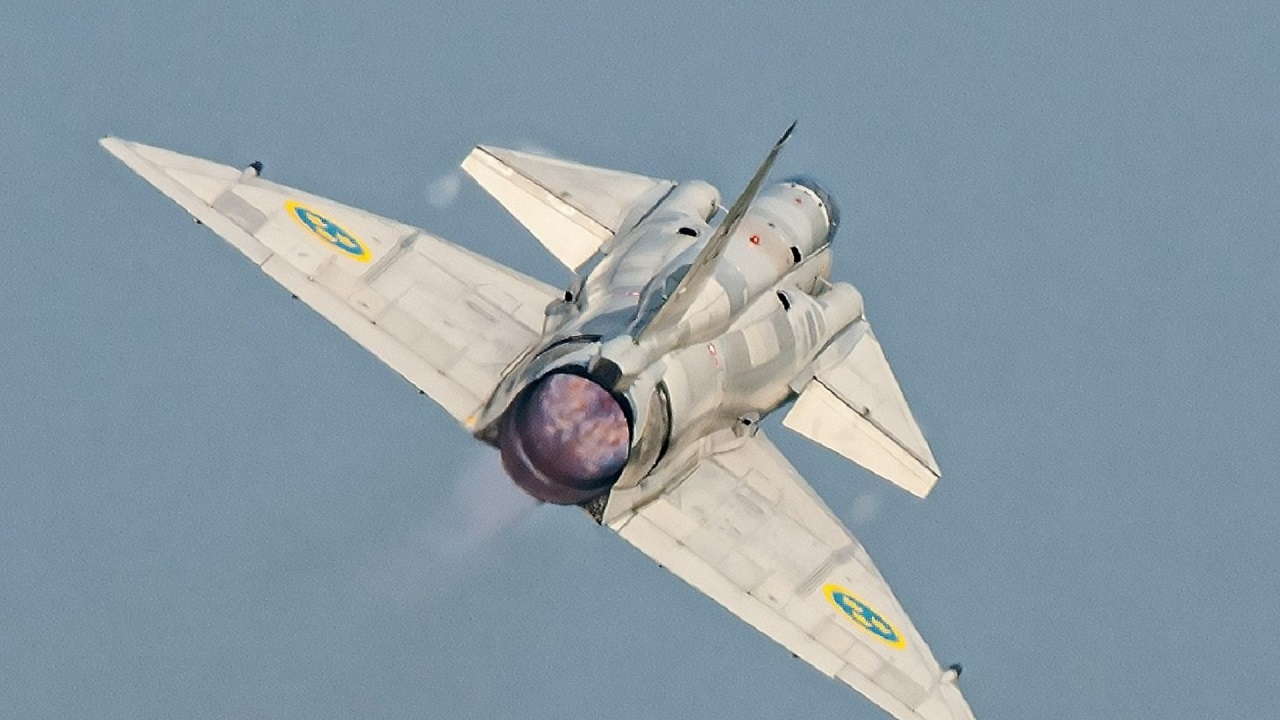
Saab 37 Viggen. Image Credit: Creative Commons.
It was built around a central digital computer and datalinks years before that was normal, all in service of Sweden’s dispersed-basing system of highway strips and rock shelters. It’s great what-if came in January 1975, when four NATO countries chose the F-16 over the Viggen’s export variant in the “sale of the century”; Swedish aviation went home and kept perfecting a system nobody else wanted yet.
What the Viggen could do was demonstrated against the fastest aircraft ever built in squadron service. Flying head-on intercept geometries against the SR-71’s regular Baltic runs, Viggen pilots became the only fighter crews ever acknowledged to have achieved missile lock on a Blackbird at speed.
And on June 29, 1987, the relationship turned protective: an SR-71 blew its right engine over the Baltic and fell to 25,000 feet, deep in range of Soviet interceptors, and pairs of Swedish Viggen fighters formed around the crippled jet and escorted it through the gauntlet until it crossed toward Danish airspace and landed at Nordholz in West Germany.
The mission stayed classified for three decades; in November 2018, the US Air Force awarded Air Medals to four Swedish pilots in Stockholm, with Maj. Gen. John Williams said, “We can always count on our Swedish partners in times of great peril.” A neutral country’s interceptor, decorated by the superpower it spent a career practicing against.
JAS 39 Gripen: The Inheritance Ukraine Just Purchased
The fifth act was designed in the 1980s as all of it distilled: JAS, for fighter, attack, and reconnaissance in one airframe, sized small, priced to survive Swedish budgets, and built explicitly for the road bases, the conscript ground crews, and the ten-minute turnaround.
For most of its life, the Gripen was the connoisseur’s fighter that lost competitions to the F-35.
Then a war arrived that looked exactly like the one Sweden had always planned for — an enemy hunting airfields with ballistic missiles and drones, an air force surviving by scattering — and the order book turned over.
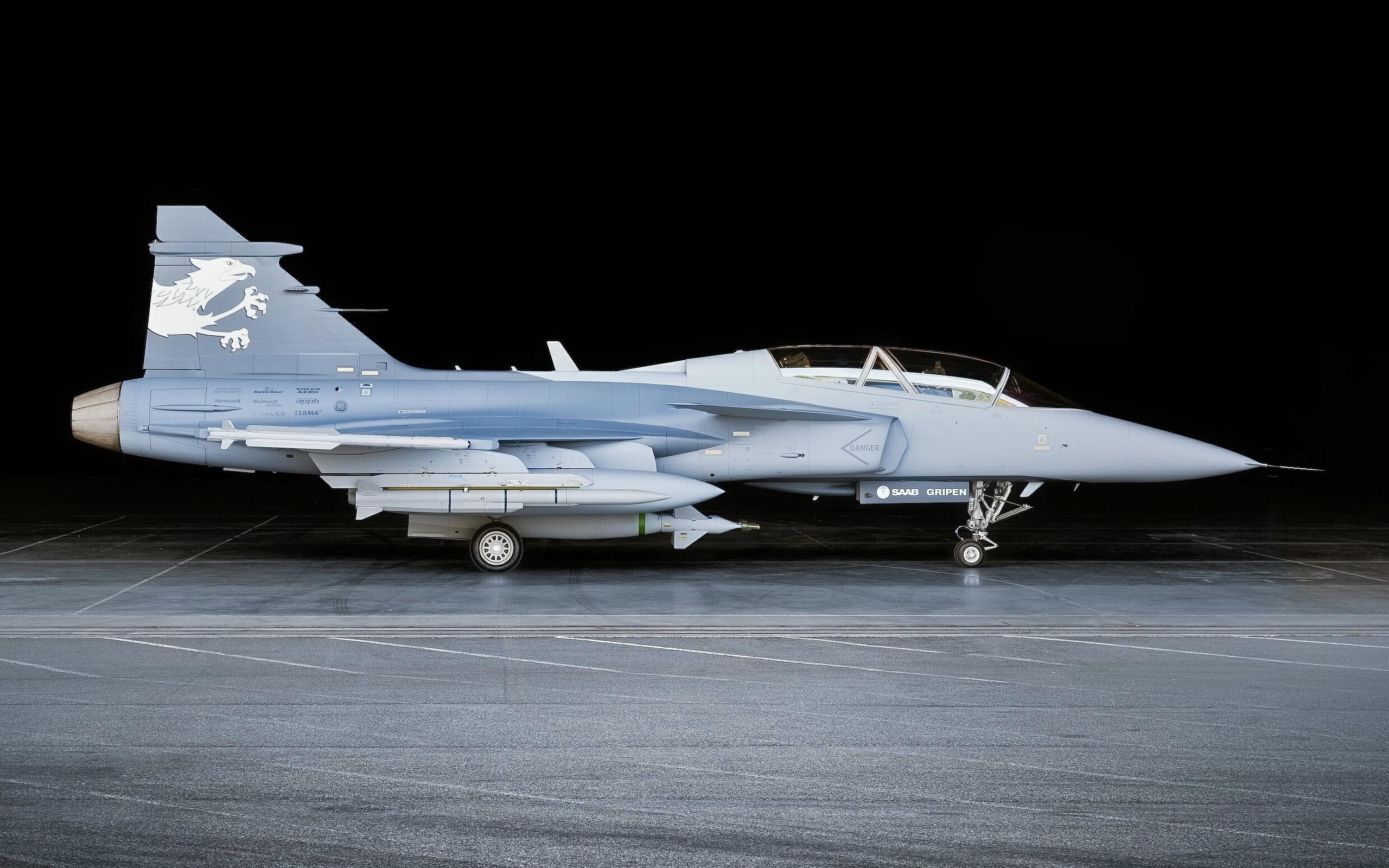
JAS 39 Gripen. Image Credit: Creative Commons.
Colombia signed for 17 at €3.1 billion this year, per Saab; Brazil rolled out its first locally assembled Gripen E and wants 20 more; Canadian interest, by Ukrainian trade-press accounting, could run to 72 jets in a potential book of 242. Sweden’s own air force took delivery of its first Gripen E in October, and the donated C/Ds reaching Ukraine next year are expected to arrive configured for NATO-standard weapons.
The June 30 contract’s financing and structure — an EU loan facility, British support, a two-step introduction from donated C/Ds to new-build Es — turned a political promise into a production schedule.
One honest asterisk belongs on the whole seventy-eight-year run. Sweden designed every airframe, radar philosophy, and doctrine in this story itself, but never the engine at the center of it: the Tunnan flew on a licensed de Havilland Ghost, the Lansen and Draken on licensed Rolls-Royce Avons, the Viggen on a Swedish-reworked American airliner engine, and the Gripen E Ukraine just bought runs on General Electric’s F414.
Total self-reliance was always one component short, which makes the achievement stranger, not smaller: a small neutral country built world-class fighters around other people’s engines for three-quarters of a century because depending on anyone for the whole airplane was unacceptable.
The fighters Sweden built for its own war ended up in museums, target-tug hangars, and a bedrock bunker outside Göteborg turned exhibition hall.
The doctrine they were built around is about to fly its first real war — under another country’s roundels, off another country’s highways, against the successor of the enemy every one of them was designed to meet.
About the Author: Harry J. Kazianis
Harry J. Kazianis (@Grecianformula) was the former Senior Director of National Security Affairs at the Center for the National Interest (CFTNI), a foreign policy think tank founded by Richard Nixon based in Washington, DC. Harry has over a decade of experience in think tanks and national security publishing. His ideas have been published in the NY Times, The Washington Post, The Wall Street Journal, CNN, and many other outlets worldwide. He has held positions at CSIS, the Heritage Foundation, the University of Nottingham, and several other institutions related to national security research and studies. He is the former Executive Editor of the National Interest and the Diplomat. He holds a Master’s degree focusing on international affairs from Harvard University.