
Synopsis: William Tecumseh Sherman, famous for declaring “War is hell,” remains one of the Civil War’s most complex figures.
-Overcoming early career struggles and accusations of insanity, Sherman forged a pivotal partnership with Ulysses S. Grant that led to Union victories at Vicksburg and Shiloh.
-He is best remembered for his 1864 “March to the Sea,” a campaign of total war designed to break the Confederacy’s economic and psychological backbone.
-After the war, Sherman served as Commanding General during westward expansion but famously refused all calls to run for political office.
The March to the Sea: Inside General Sherman’s Controversial Campaign That Destroyed the Old South
“I am tired and sick of war. Its glory is all moonshine. It is only those who have neither fired a shot nor heard the shrieks and groans of the wounded who cry aloud for blood, for vengeance, for desolation. War is hell.” – William Tecumseh Sherman
William Tecumseh Sherman is a complicated, but important figure in the American Civil War.
Many view his efforts as one of the reasons why the Confederacy was so soundly defeated in the later years of the war.
Sherman was no stranger to war.
He knew what needed to be done to end wars, and yet he understood the moral baggage that such actions carry.
Early Life and Career
Sherman was born on February 8, 1820, in Lancaster, Ohio, to a family of modest means. His father, Charles Sherman, was a lawyer and Ohio Supreme Court justice, but his early death in 1829 left the family financially strained. At the age of nine, William was sent to live with Thomas Ewing, a prominent Ohio politician and US senator. Ewing became a surrogate father figure, providing Sherman with stability, education, and political connections that would later prove valuable.
Named “Tecumseh” after the Shawnee leader admired by his father, Sherman grew up in an atmosphere steeped in politics and public service. His education under the Ewings was rigorous, and his aptitude for learning was evident from an early age.
At sixteen, Sherman secured an appointment to the United States Military Academy at West Point. He graduated in 1840, ranking sixth in a class of forty-two. Although he did not distinguish himself academically in engineering or tactics, he demonstrated strong organizational skills and leadership potential.
Sherman’s early army career was uneventful by comparison to his later fame. He served in Florida during the Second Seminole War and in California during the Mexican-American War, though he saw no direct combat. Instead, much of his time was spent in administrative roles, which sharpened his logistical skills that would later become one of his greatest strengths. Nevertheless, he was incredibly frustrated by the slow pace of promotions and left the service to pursue several civilian careers, all of which ended in failure.
The Civil War and Rise to Prominence
At the outbreak of the Civil War, Sherman returned to military service as a colonel in the Union Army.
His early performance was uneven. Following the First Battle of Bull Run in July 1861, Sherman expressed doubts about his leadership skills, despite performing well personally during the battle. After the battle, he frequently complained to Washington about shortages in manpower and materials.
He frequently exaggerated the forces of the Confederacy, leading many in the press to label him as insane. After being put on leave for two months, Sherman recuperated before returning to the field.
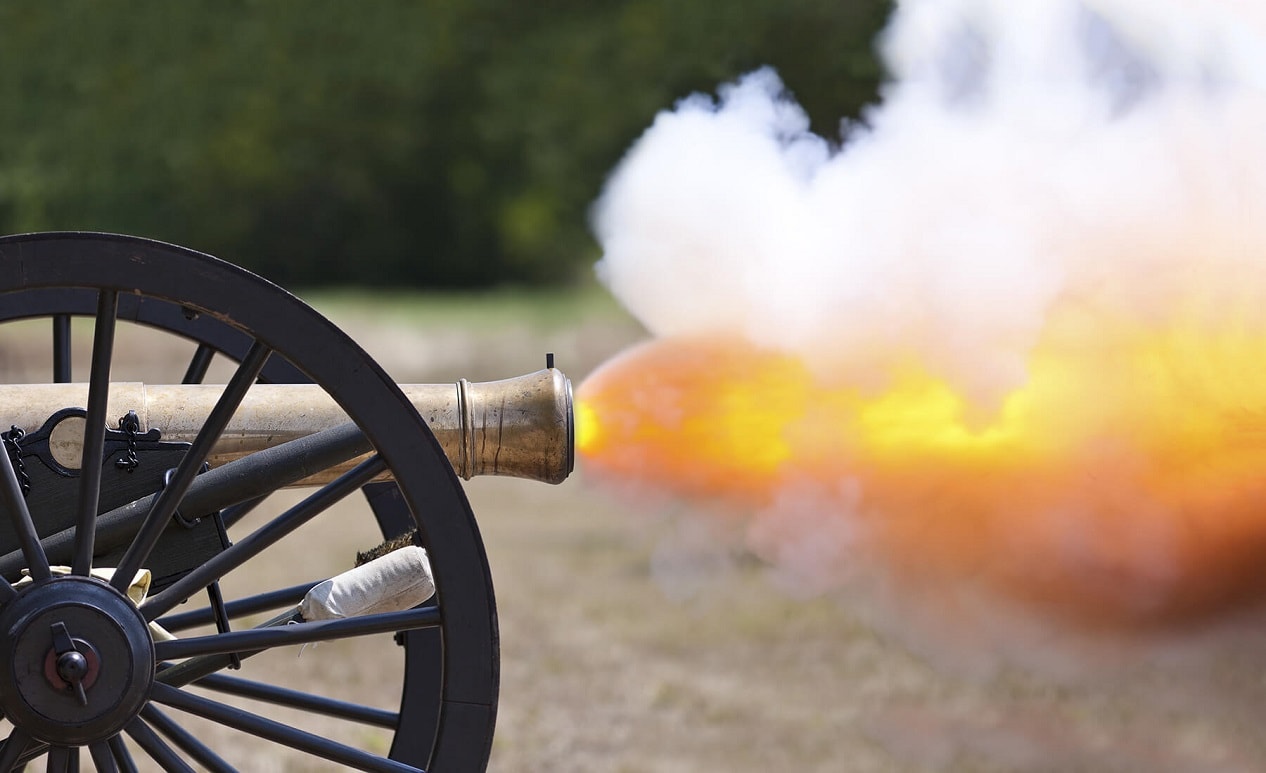
Cannon Firing. Image Credit: Creative Commons.
Sherman’s fortunes changed dramatically when he forged a close working relationship with Ulysses S. Grant. The two men shared similar views on total war and the necessity of relentless pressure on Confederate forces. Sherman performed admirably at the Battle of Shiloh in 1862 and played a key role in the Vicksburg Campaign, one of the war’s decisive victories.
By capturing Vicksburg in July 1863, the Union gained control of the Mississippi River and split the Confederacy in two.
The March to the Sea
Sherman’s most famous and controversial achievement came in 1864 during his campaign from Atlanta to Savannah, known as the March to the Sea. After capturing Atlanta, on General Grant’s orders, Sherman led approximately 60,000 soldiers on a 300-mile march through Georgia. Rather than focusing solely on enemy armies, he targeted the Confederacy’s economic and psychological capacity to wage war. Sherman ordered his troops to destroy railroads, factories, crops, and infrastructure that supported the Southern war effort.
While civilians were generally spared physical harm, the widespread destruction of property made this campaign deeply traumatic for the South. Sherman believed that by breaking civilian morale and disrupting logistics, the war could be shortened and ultimately made less bloody.
Following the capture of Savannah, Sherman moved north through the Carolinas in early 1865. His campaign through South Carolina was especially destructive, fueled in part by the state’s role as the first to secede. By this stage of the war, Confederate resistance was collapsing. Sherman accepted the surrender of Confederate General Joseph E. Johnston in April 1865, shortly after Lee’s surrender at Appomattox.
Sherman briefly became embroiled in controversy when he offered Johnston generous surrender terms without consulting Grant, the newly installed President Johnson, or the cabinet. Washington rejected his terms, forcing Johnston to surrender unconditionally, which frustrated Sherman immensely.
Postwar Life and Legacy
After the war, Sherman remained in the army, eventually becoming Commanding General of the United States Army in 1869, a position he held until 1883. In this role, he oversaw military operations during westward expansion, including campaigns against Plains tribes.
Although not directly commanding many of these campaigns, Sherman supported policies that contributed to the displacement and suffering of Native American populations.
Sherman was an outspoken critic of American expansionism abroad and refused multiple proposals to run for political office, famously declaring, “If nominated, I will not run; if elected, I will not serve.”
His commitment to professional military service over political ambition further distinguished him among Civil War generals. Sherman died on February 14, 1891, in New York City at the age of seventy-one.
He was buried in St. Louis, Missouri. By the time of his death, he had become both revered and reviled. In the North, he was revered as a hero who saved the Union. In the South, he was hated as a harbinger of destruction.
About the Author: Isaac Seitz
Isaac Seitz, a Defense Columnist, graduated from Patrick Henry College’s Strategic Intelligence and National Security program. He has also studied Russian at Middlebury Language Schools and has worked as an intelligence Analyst in the private sector.