
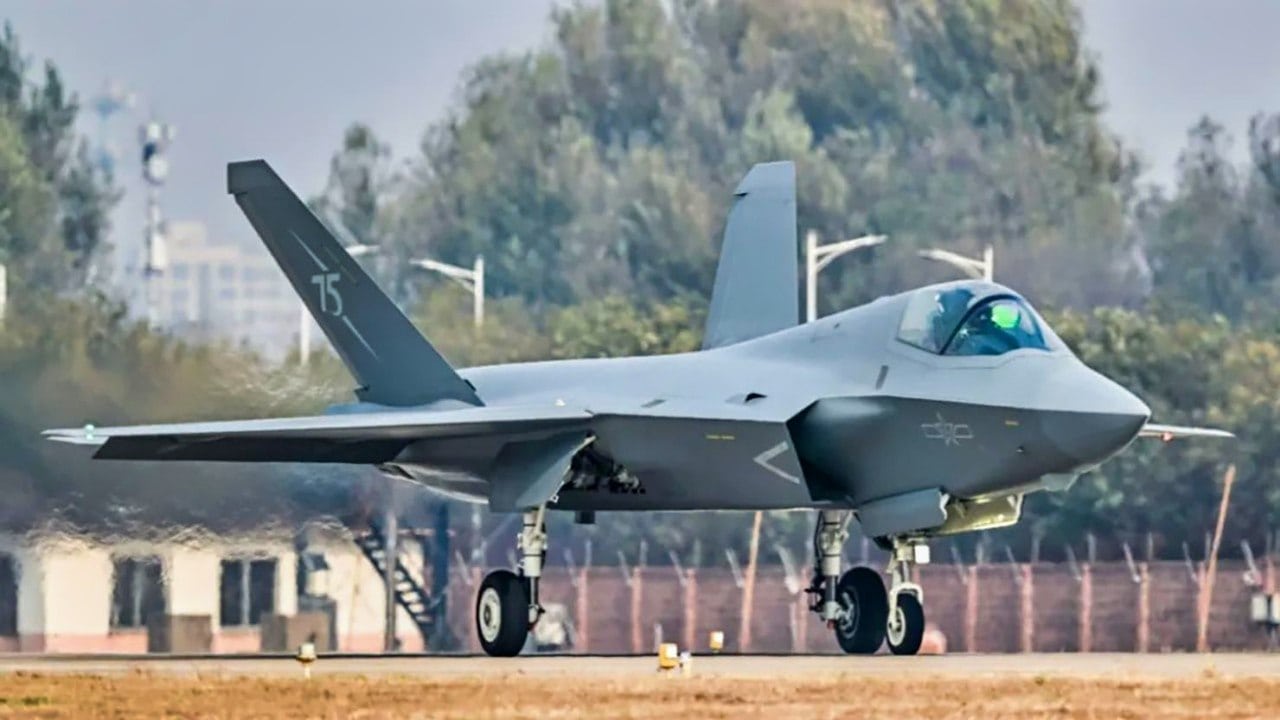
Summary and Key Points: Christian D. Orr, a Senior Defense Editor and former Air Force Security Forces officer, analyzes the critical engine failure of the Shenyang J-35 naval stealth fighter.
-Recent reports from The Chosunilbo reveal that despite a $40 billion investment, the J-35 remains tethered to the aging WS-21 engine rather than the promised WS-19 Huangshan.
-Operating from the electromagnetic catapults of the Fujian (CV-18), the jet reportedly faces a measly 7-minute combat endurance at a 900km radius.
-This 19FortyFive analysis explores how this propulsion gap mirrors the MiG-25 Foxbat’s historical limitations, potentially leaving China’s carrier air wing vulnerable to the F-35C Lightning II.
The J-35’s 7-Minute Crisis: Is China’s New Stealth Fighter a “Paper Tiger”?
In Western culture, 7 is considered a lucky number, especially in gambling, which explains why Elvis Aaron Presley—The King of Rock’ n’ Roll—sang the line “Let me shoot a 7 with every shot” in “Viva Las Vegas.”
(Yes, I know, ZZ Top did a fine version of that song too, but I’m personally biased in favor of the original, especially since it was my maternal uncle Jack Cummings who co-produced the movie of the same title.)
7 is also a lucky number in Chinese culture. As explained by sonofchina.com, “One reason why the number 7 is considered lucky in China is that it sounds similar to the Chinese word for ‘togetherness’ or ‘unity’.
In Mandarin Chinese, the word for 7 is ‘qī’, which sounds similar to ‘qì’, meaning ‘life energy’ or ‘vital energy’.
This association with life energy and unity has made the number 7 a popular choice for weddings and other auspicious occasions.”
Which brings us to the subject of the Shenyang J-35, the People’s Republic of China’s (PRC’s) second entry into the 5th Generation stealth fighter race (the first, of course, being the Chengdu J-20 Weilong [“Mighty Dragon“]).
35 is a multiple of 7 (admittedly, math was my Achilles heel in school, but even I can figure out that much), so by superstition, the J-35 should be quintuple-lucky, right?
Well, when it comes to new reports of the vaunted warbird’s measly 7-minute combat endurance, that number suddenly starts looking not so lucky.
Bottom Line Up Front (BLUF)
This shocking news comes to us from reporter Choi Yoo-sik (who served as a Beijing correspondent for five years) of The Chosunilbo in an article reshared on MSN in mid-February 2026 titled “J-35’s 7-minute combat limit exposes engine gap with F-35.”
To wit: “Chinese state broadcaster CCTV faced backlash after airing a program at the start of the year to promote Fujian, its third aircraft carrier commissioned in November of last year. The issue was not the Fujian itself but a video clip showing a stealth fighter jet, the J-35, developed to counter the U.S. F-35, taking off and landing from the carrier. This backfired…Chinese military experts had anticipated the J-35 would be powered by the new WS-19 engine, under development since 2017. Instead, the aircraft appeared with the older WS-21 engine. One critic noted, ‘With this setup, the J-35 can operate for only seven minutes at a distance of 900 kilometers [559 statute miles, 485 nautical miles] from the carrier.'”
Mr. Choi concludes his article by noting that “Despite investing over 40 billion dollars in aircraft engine development, China still lags significantly behind the U.S. in technology, a gap so wide that even domestic analysts refer to it as a ‘heart disease.'” That closing clause is especially telling; given the totalitarian nature of the Chinese Communist Party (CCP), wherein there is zero tolerance for criticism of the all-mighty government (no glasnost types need apply), such open criticism of the ChiCom military project at the domestic level is borderline shocking.
J-35 & F-35 Parallels
The J-35 is considered a knockoff of America’s Lockheed Martin F-35 Lightning II, which is true to form for Beijing’s longstanding knack for violating intellectual property rights (IPR).
And that’s not just because of the “35” appellation or the fact that the F-35 is, in turn, America’s second entry into the Gen 5 race (the first being another “Skunk Works” product, the F-22 Raptor), but also because of its appearance and (supposed) capabilities.
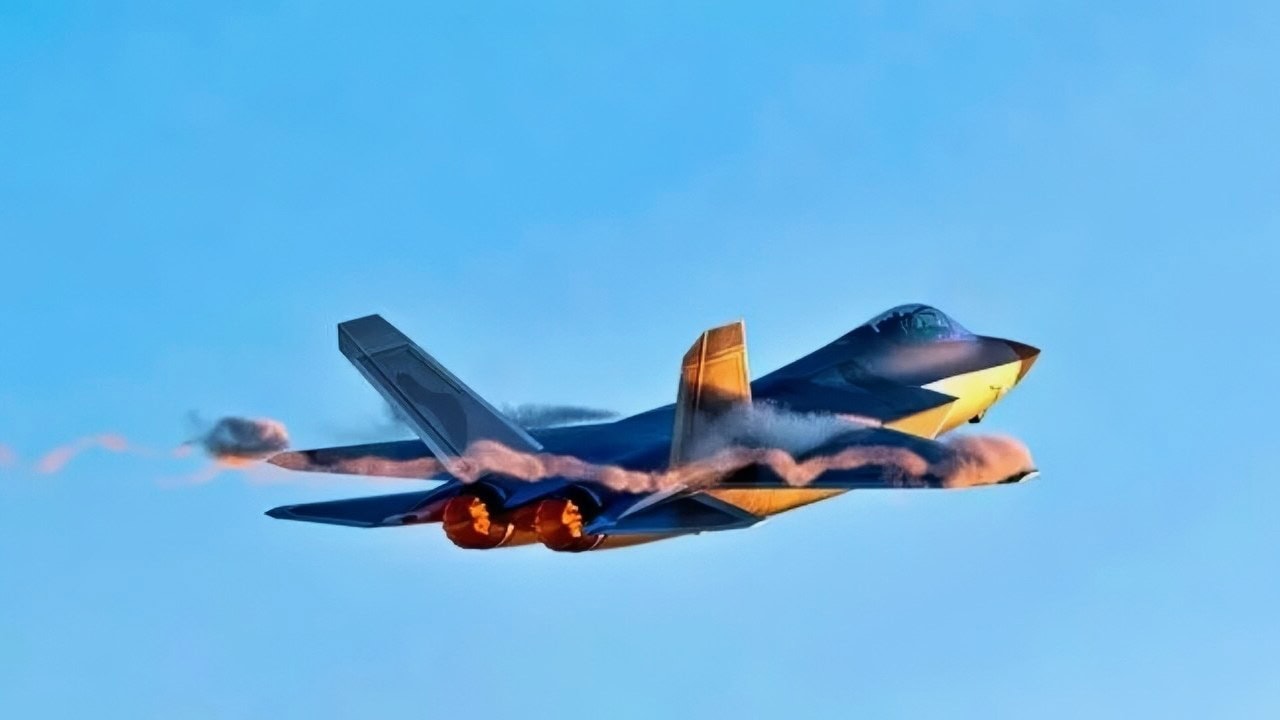
J-35A Fighter from China PLAAF. Image Credit: Creative Commons.
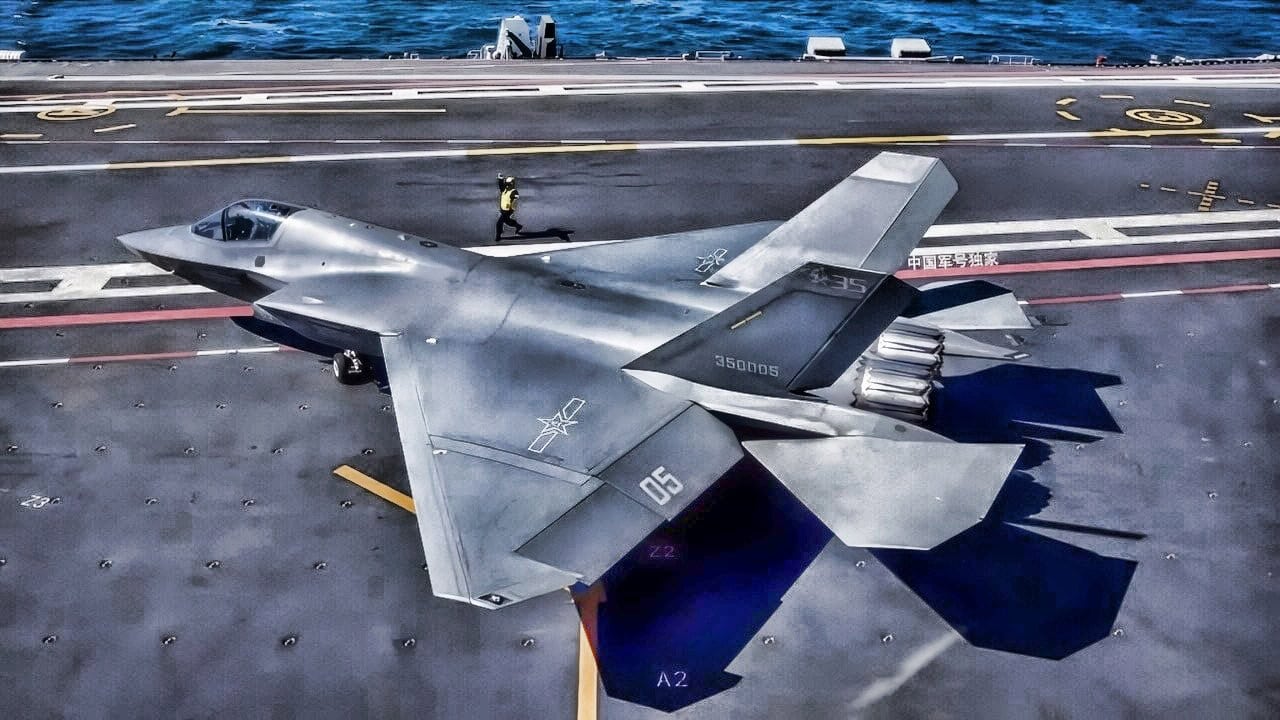
China J-35 Naval Stealth Fighter. Image Credit: PLAN.
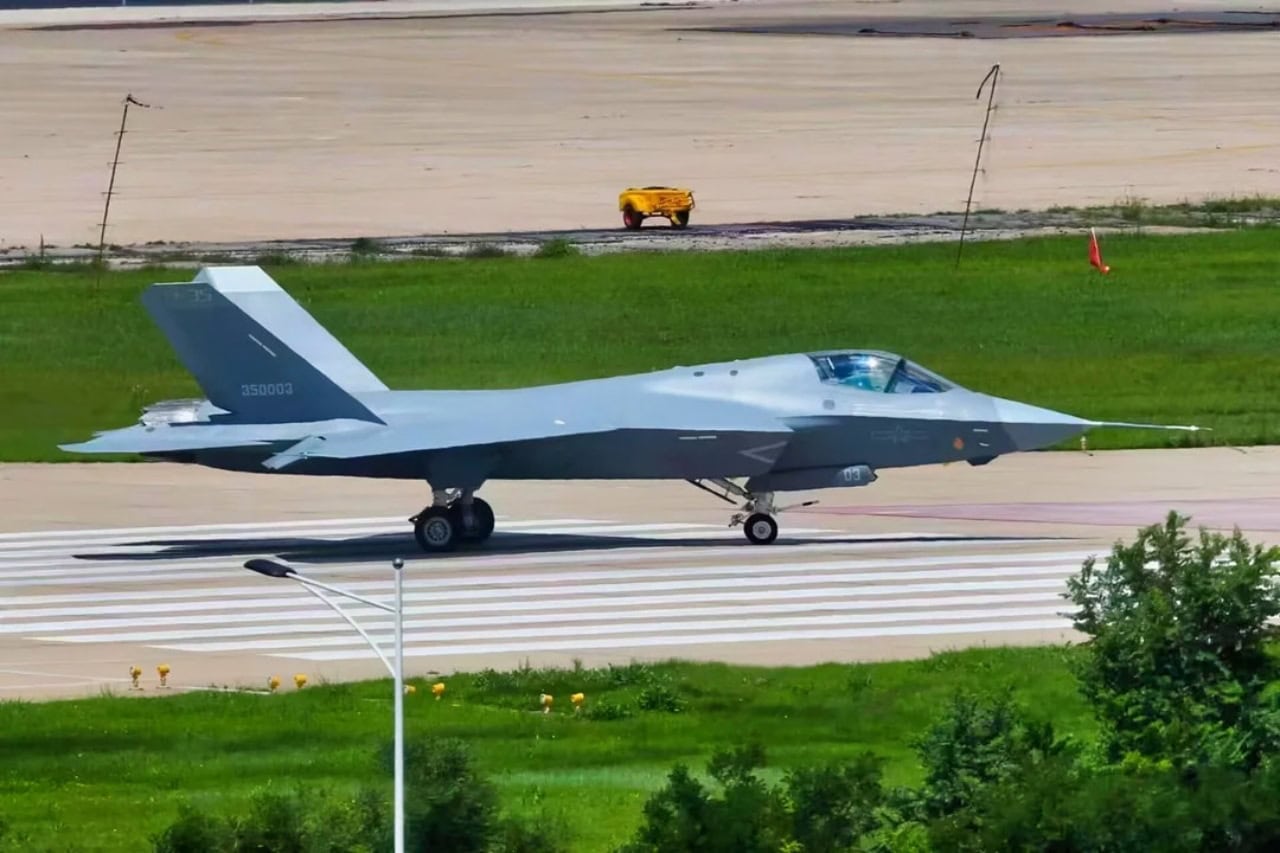
J-35 Fighter. Image Credit: Chinese Internet.
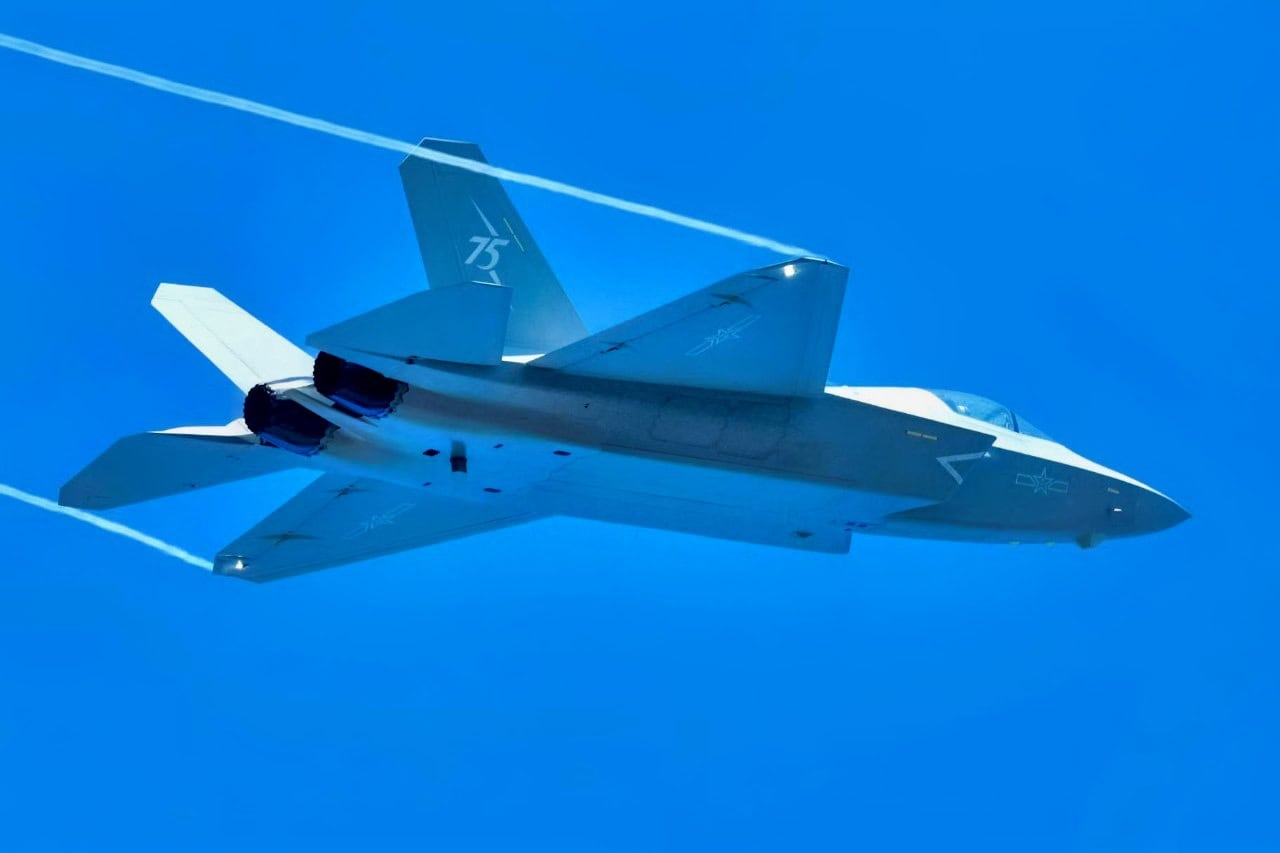
J-35 Fighter. Image Credit: Chinese State Media.
The J-35 is also copying one of the F-35’s weaknesses.
Case in point: the U.S. Navy’s F-35B variant with full tanks has a combat radius of a paltry 600 nautical miles (690 statute miles, 1,111 kilometers). Meanwhile, the Israelis have apparently figured out a way to double the effective range of their F-35I Adir (“Mighty One”) variant via some fancy new fuel tanks. Still, since Israel wouldn’t be joining America in a presumptive regional war with China, that’s a moot point.
Shades of the MiG-25 Foxbat?
The short-range woes of the J-35 bring to mind those of an old-school, Cold War-era 4th Generation fighter-interceptor made by a now-defunct former Communist superpower (that, even in its post-Communist iteration, is now very much on cahoots with Communist China): the Soviet Union’s MiG-25 (NATO reporting name “Foxbat”).
When the Foxbat first arrived on the scene in 1970 (its official operational debut year; it had actually made its maiden flight back in March 1964), it absolutely scared the heck out of American and NATO aerial warfare planners, due to its (hypothetical) Mach 3.2 max airspeed, ability to climb to 98,425 feet in just over 4 minutes, and an absolute altitude record of 123,520 feet.
However, on September 6, 1976, the daring defection of MiG-25 pilot Lieutenant Viktor Belenko to Hakodate Airport in Japan laid bare the sordid weaknesses of the formerly feared Foxbat. (To use a cinematic analogy, the “man behind the curtain” of the seemingly all-powerful Wizard of Oz was exposed). Among other things, the practical (for safety reasons, that is) airspeed of the warbird was actually Mach 2.83.
Moreover, and more germane to our current discussion, Wiley Stickney points out in a May 6, 2025, article for Bolt Flight that the much vaunted plane was “highly restricted in operational altitude and endurance. Though officially rated for 89,000 feet, a fully armed Foxbat could barely reach 68,900 feet and sustain under 79,000 feet for two minutes with only two missiles aboard.” [author’s original emphases]
(NOTE: For a superbly detailed and deeply moving account of Viktor Belenko’s life story—before, during, and after his defection—read the excellent 1983 book “MIG Pilot: The Final Escape of Lt. Belenko” by John Barron.)
J-35 Bottomline
So then, is the J-35 merely a 5th Generation ChiCom MiG-25? Time will tell, but even if this turns out to be the case, that doesn’t mean America’s combat aviators can afford to take it lightly.
After all, it was a Foxbat driver—that being then-Mulazim (2nd Lieutenant) Zuhair Dawoud—who scored the only air-to-air kill for the Saddam Hussein-era Iraqi Air Force (IqAF) during the 1991 Persian Gulf War, shooting down Lt Cdr Scott “Spike” Speicher’s F/A-18 Hornet on the first night of the conflict and thus inflicting America’s first combat casualty of Operation Desert Storm.
About the Author: Christian D. Orr
Christian D. Orr is a Senior Defense Editor. He is a former Air Force Security Forces officer, Federal law enforcement officer, and private military contractor (with assignments worked in Iraq, the United Arab Emirates, Kosovo, Japan, Germany, and the Pentagon). Chris holds a B.A. in International Relations from the University of Southern California (USC) and an M.A. in Intelligence Studies (concentration in Terrorism Studies) from American Military University (AMU). He is also the author of the newly published book “Five Decades of a Fabulous Firearm: Celebrating the 50th Anniversary of the Beretta 92 Pistol Series.”