

Summary and Key Points: Jack Buckby, a New York-based defense researcher and national security analyst, evaluates the strategic paradox of Operation Epic Fury in 2026.
-While U.S. and Israeli forces successfully neutralized 2,000 targets and ‘knocked out’ the Iranian navy, Buckby argues this victory against a Cold War-era fleet of F-14s and MiG-29s masks systemic vulnerabilities.
-The analysis contrasts current dominance with a potential peer conflict against China, whose advanced A2/AD and anti-ship missiles target a struggling American shipbuilding industrial base.
-He concludes that while today’s stealth-led projection is unmatched, tomorrow’s readiness against technologically advanced adversaries remains a critical, unproven gamble. war.
The 2,000-Target Blitz: The Iran War Success Masks a Deeper 2026 Readiness Crisis and a China Challenger
The ongoing U.S. and Israeli military campaign against Iran has demonstrated something that analysts sometimes forget when describing America’s military-industrial problems: the United States still possesses unmatched global power projection capabilities.
Since the opening strikes on February 28, American and Israeli aircraft and missile systems have carried out large-scale attacks against Iranian military infrastructure and missile bases, and taken out the Iranian regime’s most senior leaders.
Operation Epic Fury began with coordinated strikes across multiple Iranian cities, including Tehran, Isfahan, and Kermanshah, targeting missile launchers and air defense systems, as well as compounds used by the regime’s leadership. American and Israeli forces have also reportedly struck thousands of targets while dismantling parts of Iran’s military infrastructure – and according to President Donald Trump, completely “knocked out” Iran’s naval capabilities.
The early stages of the conflict showed the advantages that define modern American military power: the use of stealth aircraft and long-range precision weapons, supported by the ability to coordinate large-scale operations across multiple theaters simultaneously. But the Iran war also raises some complicated questions about the future of U.S. military strength.
The campaign has been successful so far, yes, but it’s important to note that it is unfolding against a relatively weak opponent whose air force and conventional forces are decades behind Western standards. Iran may have a large arsenal of missiles, yes, but those are useless if its launch infrastructure has been knocked out. The question, then, is whether the systems that make today’s victories possible would hold up in a larger conflict – particularly one against a peer competitor like China.
The war in Iran may be a good demonstration of American military dominance, but it should also be a reminder that the Pentagon’s deep structural challenges have not gone away, and that the successes like that won’t always be guaranteed.
The Iran War and U.S. Power Projection
Stealth aircraft and long-range strike systems have played a central role in the campaign so far. B-2 stealth bombers and advanced fighter jets, cruise missiles, and drones have all been used to strike missile sites and strategic infrastructure targets.
The scale of the operation has been significant, too. U.S. and Israeli forces reportedly struck more than 2,000 targets in Iran during the opening phase of the war, including naval assets and missile production facilities.
Iran has responded in the only way it could, with missile and drone attacks against Israel and U.S. bases across the region rather than with large-scale airpower, which would have been impossible. That response illustrates one of the most important dynamics of this conflict so far: Iran simply doesn’t possess the kind of modern air force capable of challenging American air superiority. Remember, much of Tehran’s fighter fleet still consists of Cold War-era aircraft such as F-14 Tomcats, MiG-29s, and aging F-4 Phantoms.
Iran Is A Weak Opponent Despite Its Size
Despite its regional influence, Iran is not a peer military competitor to the United States. Its air force remains outdated, sanctions have limited modernization, and much of its conventional equipment dates back decades. That does not mean Iran lacks advantages. The country has a population of roughly 90 million people and controls a geographically complex landscape dominated by mountains and deserts that would complicate any large-scale ground invasion.
Iran has also invested heavily in asymmetric capabilities such as ballistic missiles and drones, and bolsters its abilities through proxy forces throughout the region. Those tools allow (or allowed) Tehran to retaliate against U.S. bases and allied countries without relying on conventional airpower.
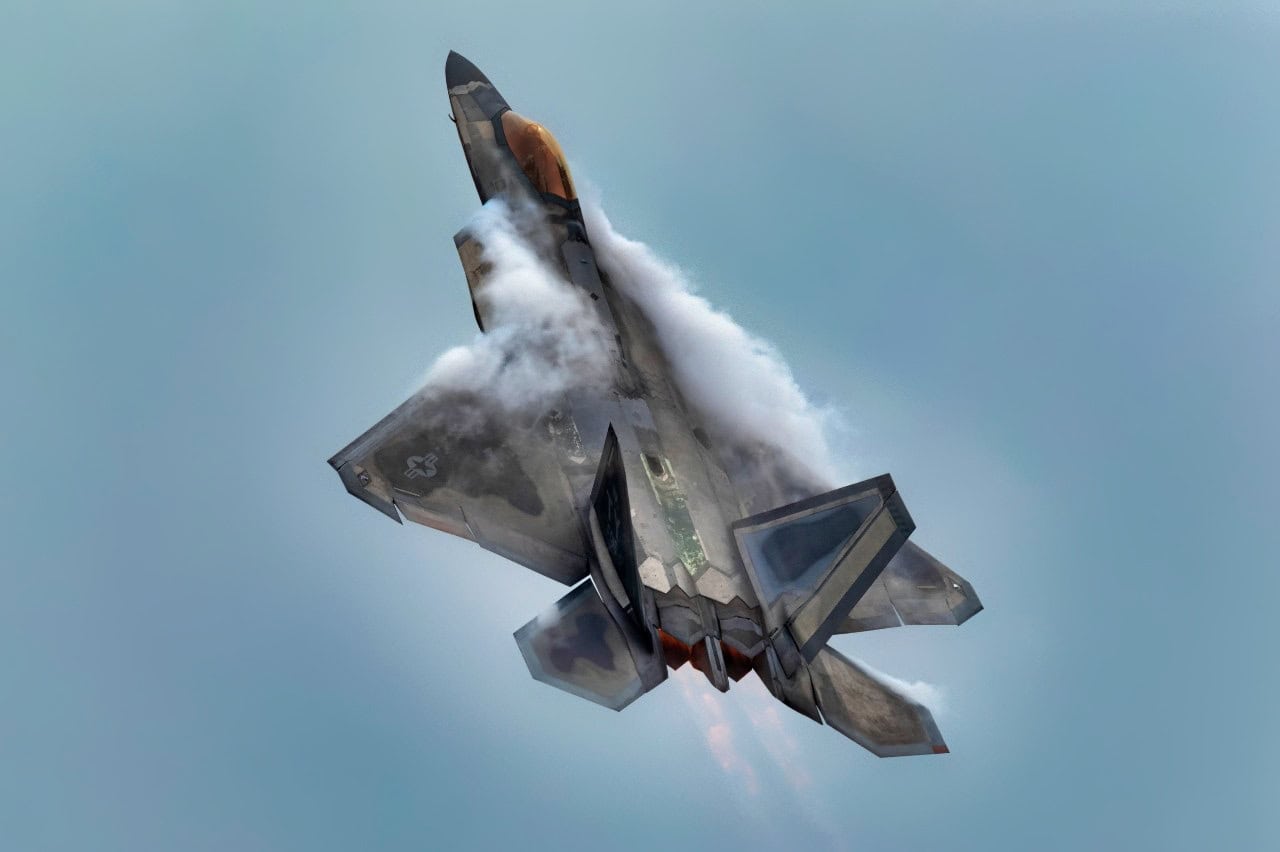
U.S. Air Force Maj. Josh Gunderson, F-22 Demo Team commander, performs maximum power takeoff during a demonstration for the 67th National Security Forum at Maxwell-Gunter Air Force Base, Montgomery, Alabama, May 11, 2021. The F-22 Raptor’s two Pratt and Whitney F119 Turbofan engines bring a combined 70,000 pounds of thrust, allowing the aircraft to takeoff straight into the vertical. (U.S. Air Force photo by Staff Sgt. Don Hudson)
Still, the overall balance of power in the current conflict remains in Washington’s favor, Iran’s inability to contest the air campaign directly means the United States can operate largely on its own terms: precision strikes and stealth aircraft, supported by their intelligence networks, allow American forces to strike targets across Iran while limiting exposure to Iranian air defenses.
But the outcome of the conflict, and the progress so far, says as much about Iran’s weakness as it does American strength.
Thinking Past Iran to China: The Real Test Would Be a Peer Conflict
The Iran war demonstrates the effectiveness of U.S. power projection—but it does not necessarily reveal how the American military would perform against a technologically advanced adversary. A conflict with China, for example, would present an entirely different strategic environment.
Beijing fields modern fighter aircraft, advanced air defense systems, large missile forces, and sophisticated electronic warfare capabilities designed specifically to challenge U.S. forces. China has also built military infrastructure intended to deny access to large parts of the western Pacific through anti-ship missiles and integrated air defenses that use modern, long-range sensors.
In a conflict like that, the United States would face an opponent that is capable of contesting air superiority and striking American bases – but unlike Iran, it would be capable of targeting naval forces at long range with more than just a few small submarines attempting to slip through defensive screens.
That scenario would put far greater pressure on the Pentagon’s ability to replace lost equipment and maintain supply chains – which is far from ideal at a time when Washington is grappling with delays and backlogs in its struggling shipbuilding industrial base.
The Iran campaign demonstrates that American power projection is formidable today, but it raises harder strategic questions about tomorrow.
Is the United States truly prepared for a large-scale war against a peer adversary, or is Washington counting on the reality that such a conflict would be so grinding and destructive for all sides that it effectively buys time to repair the very industrial and acquisition problems now becoming impossible to ignore?
About the Author: Jack Buckby
Jack Buckby is a British researcher and analyst specialising in defence and national security, based in New York. His work focuses on military capability, procurement, and strategic competition, producing and editing analysis for policy and defence audiences. He brings extensive editorial experience, with a career output spanning over 1,000 articles at 19FortyFive and National Security Journal, and has previously authored books and papers on extremism and deradicalisation.