
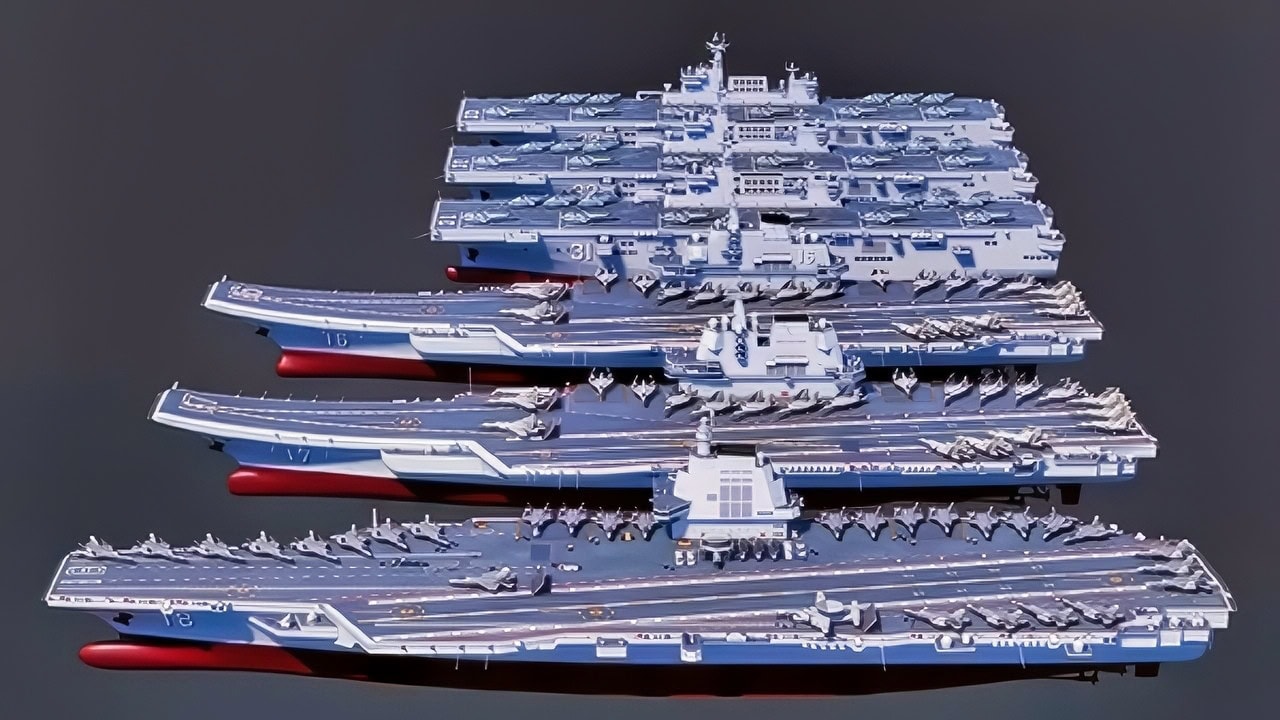
China operates three aircraft carriers today. The Pentagon believes it intends to operate nine within a decade, and the ship that would anchor that fleet — a nuclear-powered supercarrier rivaling the largest the United States has ever built — is already under construction at a shipyard in northeastern China. That trajectory, the fastest carrier build-up in the Indo-Pacific since the Second World War, is the clearest measure of how directly Beijing now intends to challenge American naval dominance in the Pacific. The number nine is a goal rather than a guarantee, and hull count alone overstates the threat. But the direction is unmistakable, and the gap between the two navies is narrowing on a timeline the United States cannot afford to dismiss.
Three Aircraft Carriers Now: Liaoning, Shandong, and Fujian
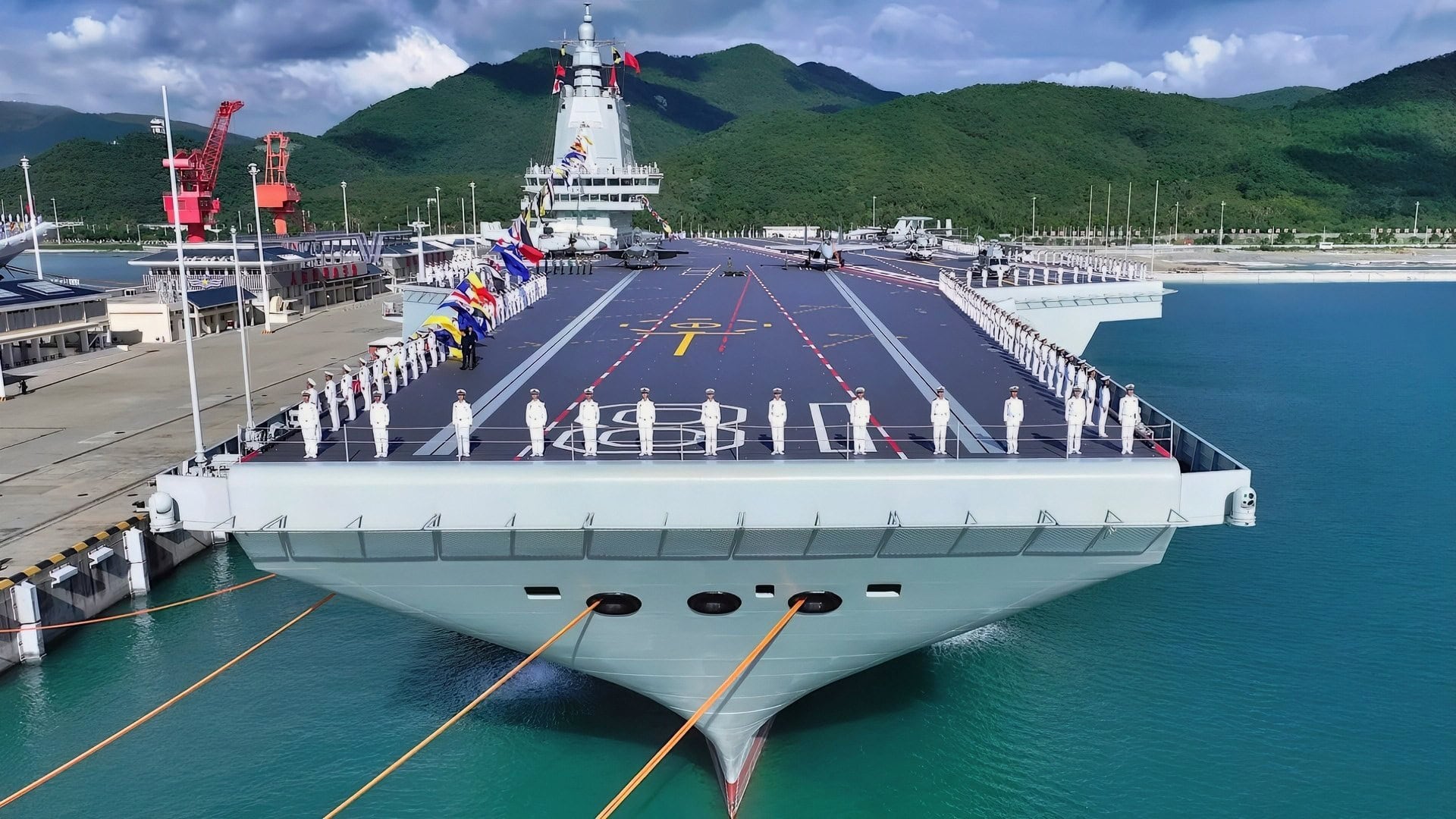
China Aircraft Carrier PLAN Image
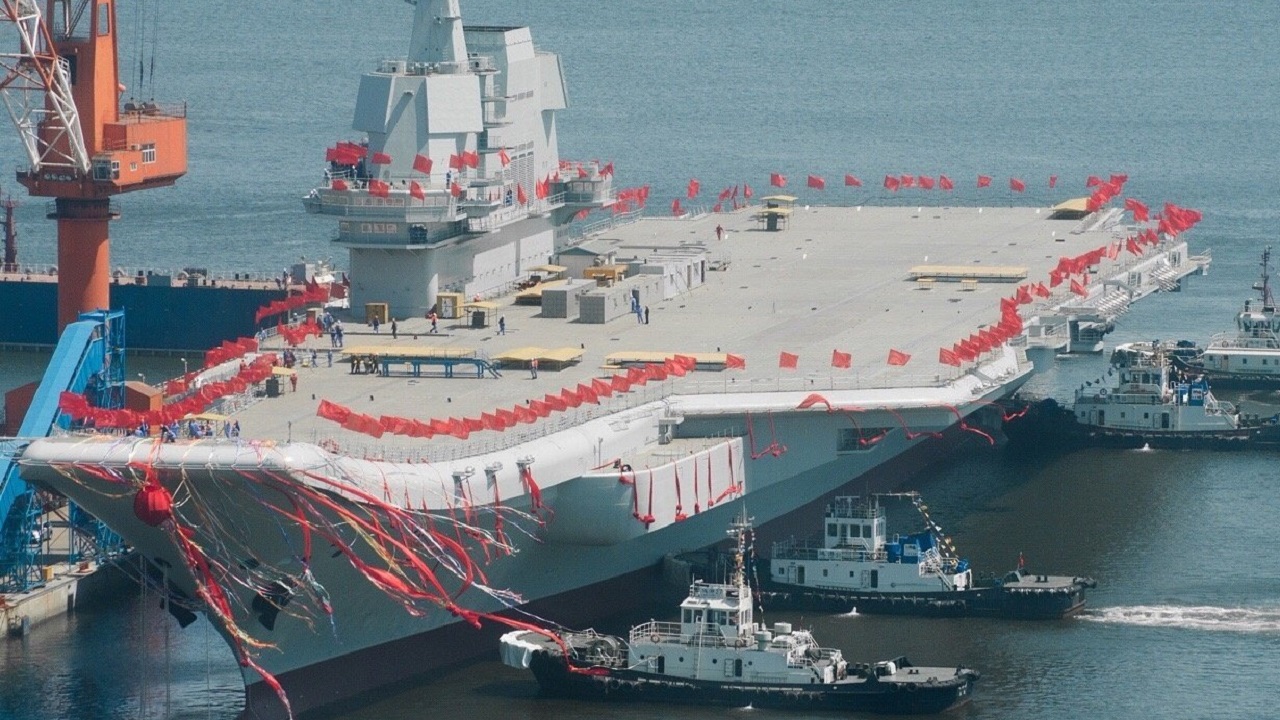
China’s current fleet traces the entire arc of its naval ambition in three ships.
The Liaoning, a Type 001, began as an unfinished Soviet hull that China purchased and rebuilt, entering service as a training and proof-of-concept carrier with a ski-jump bow and no catapults.
The Shandong, a Type 002, was the first carrier designed and built in China, though it retained the same ski-jump configuration that limits how heavily aircraft can launch. The third ship is the one that changed the conversation.
The Fujian, a Type 003, entered service in November 2025 as China’s first indigenously designed and most advanced carrier, and it carries electromagnetic catapults rather than a ski-jump. That single feature put China into a category occupied by only one other navy on earth: the Fujian and the USS Gerald R. Ford are the only two carriers in the world equipped with electromagnetic launch systems, the technology that lets a carrier launch heavier aircraft, fuller fuel loads, and a faster tempo of sorties.
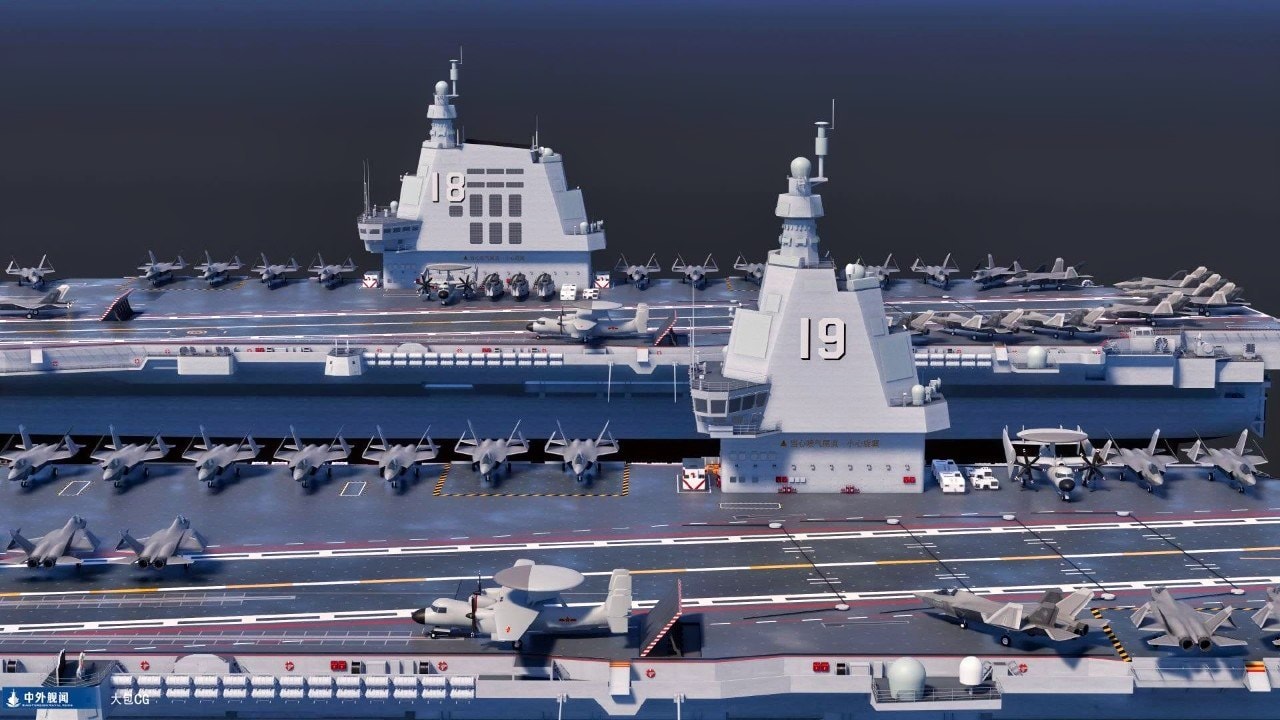
China Aircraft Carrier Models. Image Credit: Creative Commons.
China went from rebuilding a secondhand Soviet hull to fielding catapult technology the United States only recently mastered, in a little over a decade. The Fujian still carries a smaller air wing than an American supercarrier and is conventionally powered, which limits its range, but its commissioning marked the point at which China’s carrier program stopped imitating and started competing.
The Pentagon’s Number: Nine By 2035
The figure driving Western assessments comes from the Pentagon’s own annual report on Chinese military power.
According to that report, the PLAN aims to build six additional aircraft carriers by 2035, for a total of nine — an expansion the Pentagon characterizes as the largest carrier build-up effort in the Indo-Pacific since World War II, averaging roughly one new carrier every twenty months. U.S. defense officials, cited as believing China plans to field a total of nine within a decade, treat that goal as a central feature of Beijing’s drive toward a world-class navy by 2049.
The number deserves a caveat, and an honest piece has to state it. Nine by 2035 is the high end of the range, and not every assessment endorses it; some Pentagon projections and independent analysts put China at a more modest five to six carriers by the 2030s, and shipbuilding goals routinely slip even for navies with deep experience.
Fujian, China’s new aircraft carrier. Image Credit: Chinese Internet.
China’s own embassy has declined to confirm specific plans, saying its military development is calibrated to national defense needs and directed at no third party. The nine-carrier fleet is therefore a stated ambition and an American projection rather than a fact already in the water.
What is not in doubt is the pace: China is launching warships of every class faster than any other country, and a carrier roughly every twenty months is consistent with what its shipyards have already demonstrated they can build.
The Type 004: A Nuclear Supercarrier To Rival The Ford
The ship that would define the fleet is the Type 004, China’s fourth carrier and its first nuclear-powered one, and it is no longer a rumor.
Satellite imagery from May 2026 showed a hull under construction at the Dalian shipyard measuring roughly 286 meters at a stage when it was already larger than the Fujian had been at a comparable point, with analysts assessing that the finished ship could rival or exceed the 337-meter Ford-class.
The evidence for nuclear propulsion is now substantial: imagery shows two large compartments believed to house reactor containment systems, and researchers have linked China’s naval reactor work to a land-based prototype facility built specifically to test this kind of propulsion.
Estimates put the Type 004 at 110,000 to 120,000 tons, larger than any carrier outside the U.S. fleet, with as many as four electromagnetic catapults instead of the Fujian’s three and an air wing exceeding 100 aircraft.
The construction is moving fast. Open-source analysis indicated the hull was roughly 25 percent complete in early 2026, with sea trials projected between mid-2028 and early 2029 and entry into service around 2030.
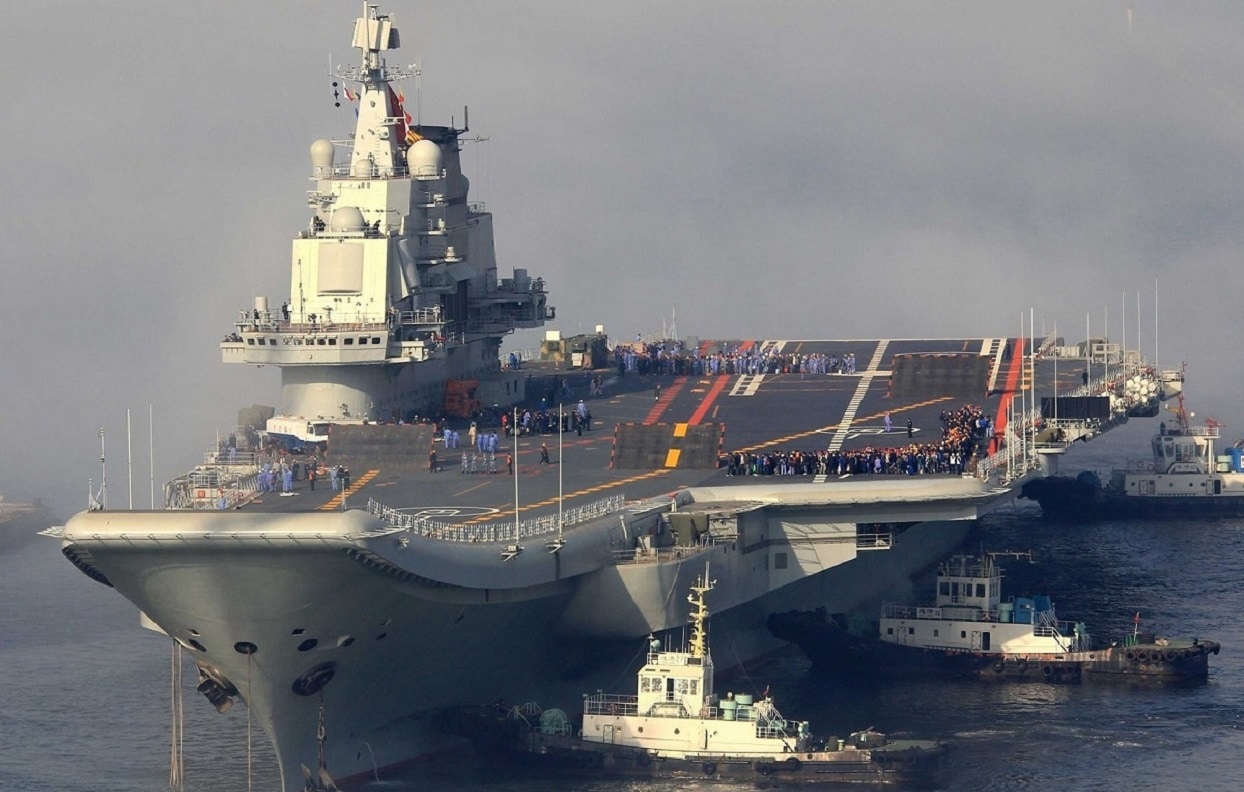
Chinese Aircraft Carrier. Image: Chinese Internet.
Nuclear propulsion is the leap that matters most, because it removes the constraint that most limits China’s current carriers: a nuclear carrier has effectively unlimited range, does not depend on a vulnerable train of oilers to cross an ocean, and generates the abundant electrical power that advanced radars, sensors, and future directed-energy weapons require.
China has invested heavily in the small and modular reactor technology underpinning the effort, and while Beijing has not officially confirmed the Type 004 will be nuclear, the PLAN’s long-term plans have long pointed toward a fleet of up to six carriers built around exactly this kind of ship. If the Type 004 performs as its hull suggests, China will have closed much of the technological distance to the Ford in a single design generation.
The Fleet Around The Fleet: Submarines And Escorts
A carrier is only as survivable as the force that screens it, and China is scaling that force in parallel. In March 2026 testimony to the U.S.-China Economic and Security Review Commission, Rear Admiral Mike Brookes said the PLAN is accelerating production of nuclear submarines from fewer than one a year to substantially higher rates, upgrading three key facilities to sustain the push.
Those submarines would operate ahead of China’s carrier strike groups in the Pacific, scouting, gathering intelligence, and engaging the forces most dangerous to the carriers — the screen that turns a collection of expensive ships into a deployable strike group.
The supporting build-up matters because it addresses the exact weaknesses that still limit China’s carriers.
A nuclear-submarine screen and a growing fleet of modern escorts begin to compensate for the thin replenishment fleet and the vulnerability of conventionally-powered carriers operating far from home.
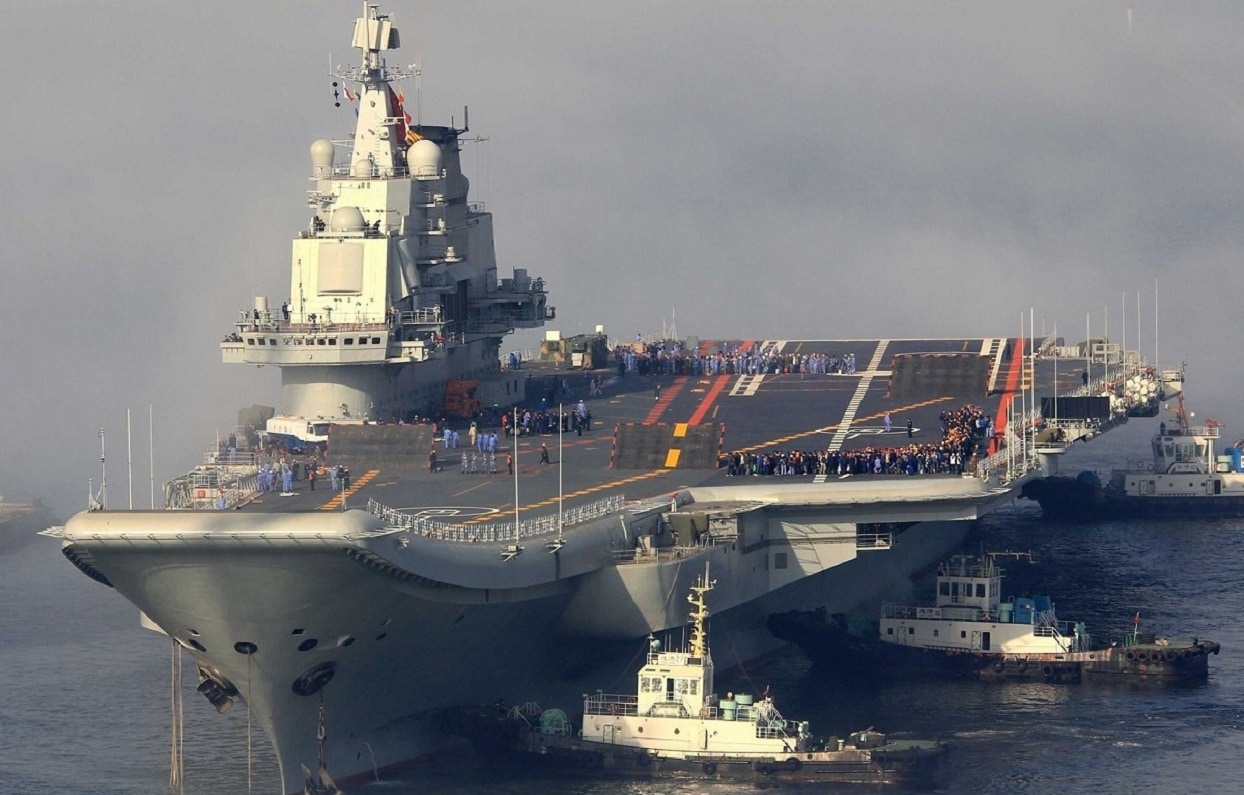
Image: Chinese Internet.
China appears to be building toward a high-low force mix — the older ski-jump carriers for regional duties, the catapult-equipped and nuclear ships for blue-water power projection — protected by a layered shield of submarines and surface combatants. The carrier program is not a vanity project bolted onto an otherwise unchanged navy; it is the visible centerpiece of a coordinated expansion across every category of warship.
Business & Industry Questions: Why Quantity Is Not Yet Capability
The case for perspective is as important as the case for concern, and it cuts against the raw numbers. A larger carrier fleet is not the same as a more capable one, and China remains years behind the United States in the things that do not show up in a hull count. A retired U.S. Navy officer assessed the Fujian at roughly 60 percent of the capability of a Nimitz-class carrier.
China’s carriers embark on smaller air wings than American supercarriers, its naval aviators lack the decades of accumulated blue-water and combat flight experience that U.S. carrier crews possess, and the proficiency required to surge and sustain carrier air operations in wartime is built over many years of operations that China has not yet logged.
The American advantage in numbers also remains real. The United States operates eleven carriers today — ten Nimitz-class ships and the Ford — every one of them nuclear-powered, and the U.S. Navy is the only force on earth with a combat-proven supercarrier fleet and the global network of bases, escorts, replenishment ships, and experience to employ it.
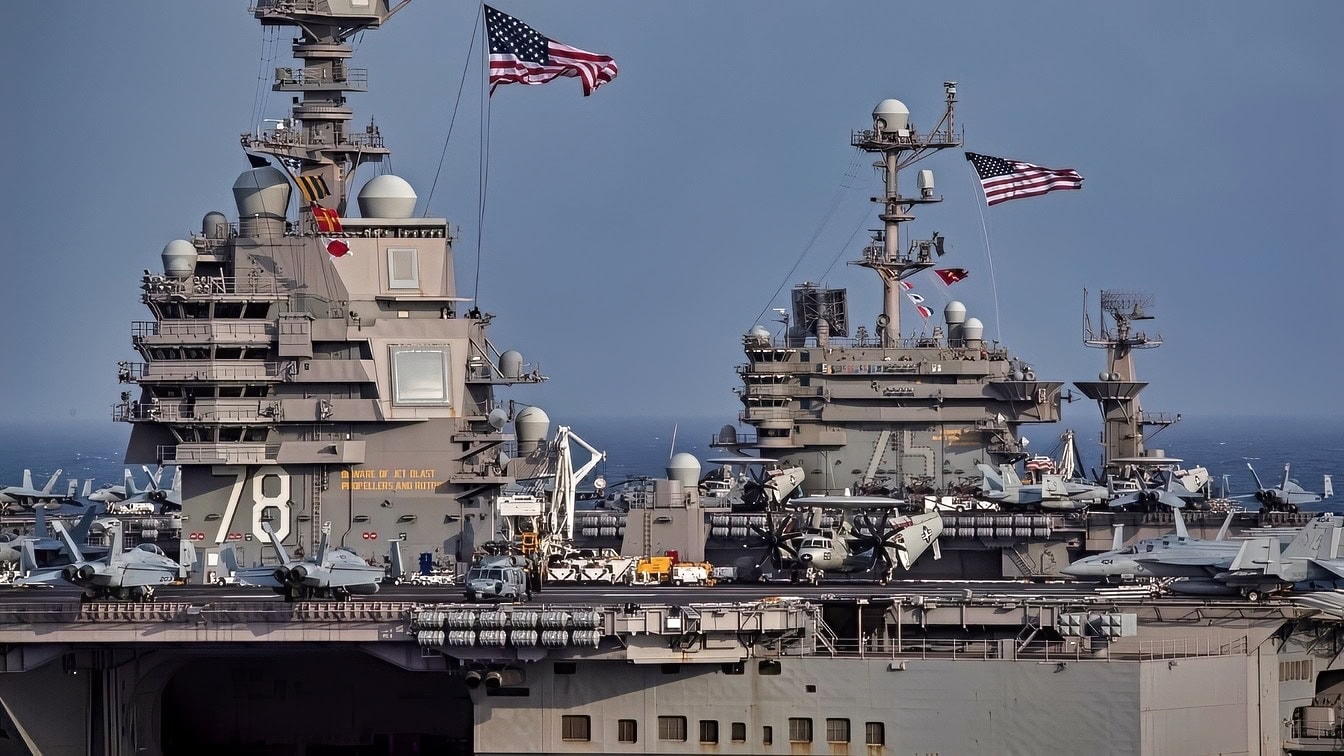
The Ford-class aircraft carrier USS Gerald R. Ford (CVN 78) and the Nimitz-class aircraft carrier USS Harry S. Truman (CVN 75) transit the Atlantic Ocean June 4, 2020, marking the first time a Ford-class and a Nimitz-class aircraft carrier have operated together underway. Ford is underway conducting integrated air wing operations, and the Harry S. Truman Carrier Strike Group remains at sea in the Atlantic as a certified carrier strike group force ready for tasking in order to protect the crew from the risks posed by COVID-19, following their successful Day 295. The Ford’s crew has been at sea since June. The Vietnam-era record is next. A laundry fire forced repairs in Crete and Croatia. Reports say 12-14 months to fix. In 1942, the Yorktown was repaired in 3 days after a 551-pound bomb plunged 50 feet into the ship. Admiral Nimitz demanded it. They delivered.
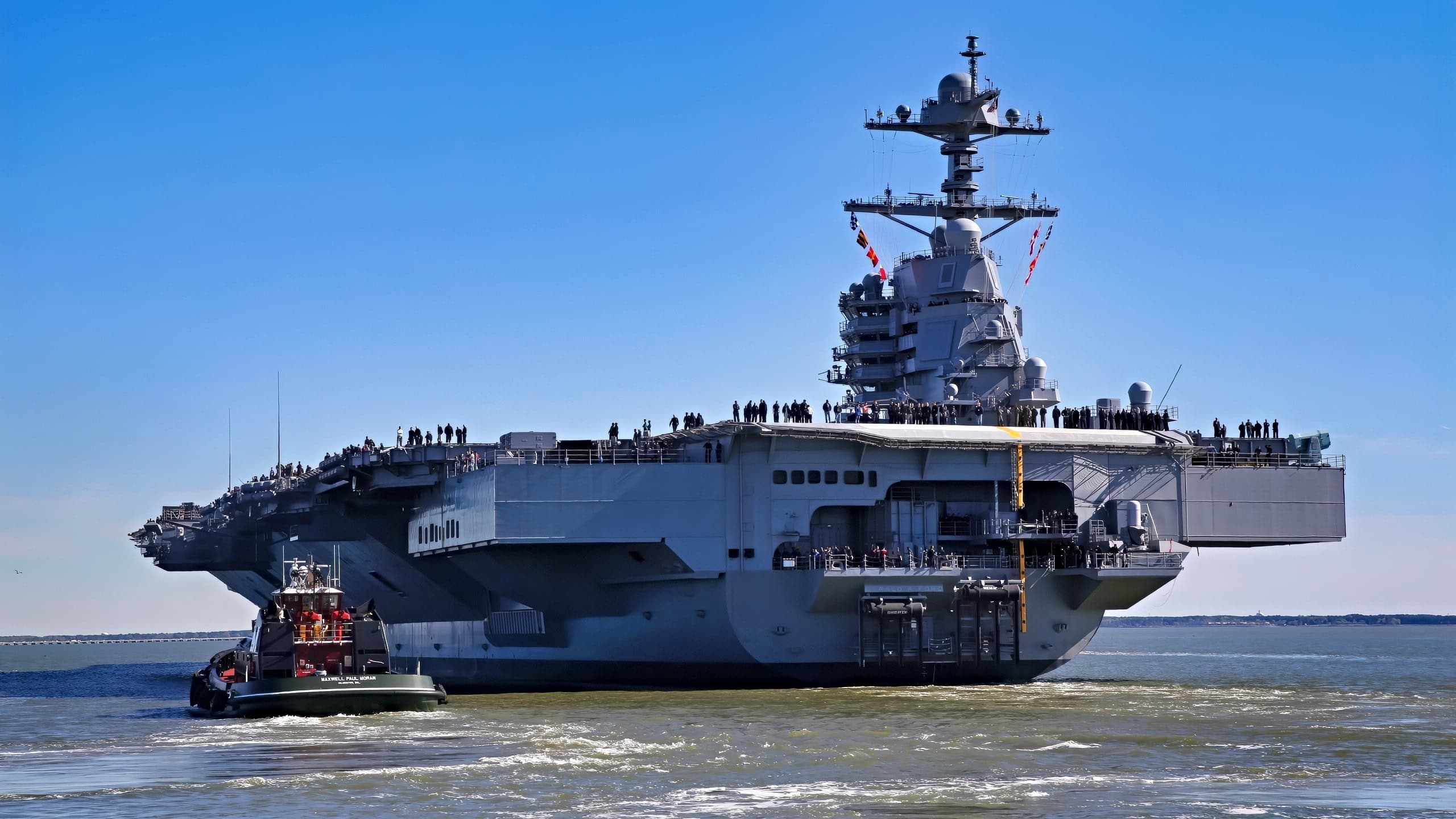
(April 8, 2017) – Pre-Commissioning Unit Gerald R. Ford (CVN 78) departs Huntington Ingalls Industries Newport News Shipbuilding for builder’s sea trials off the coast. The first- of-class ship—the first new U.S. aircraft carrier design in 40 years—will spend several days conducting builder’s sea trials, a comprehensive test of many of the ship’s key systems and technologies. (U.S. Navy photo by Mass Communication Specialist 2nd Class Ryan Litzenberger)
Even if China reaches nine carriers by 2035, it would still trail the United States in total hulls, aggregate tonnage, operational experience, and the maturity of the logistics and escort ecosystem that makes carriers usable in a sustained fight. Nine Chinese carriers in 2035 would not be nine American carriers, and treating the numbers as equivalent misreads the gap.
The Verdict: Trajectory Is The Threat, Not The Snapshot
The honest assessment lives in the direction of travel rather than the current balance. China today fields three carriers to America’s eleven, and the qualitative gap in experience, air wings, and supporting capability is wide. But the trajectory is the steepest any navy has shown in generations: a nuclear supercarrier rivaling the Ford taking shape at Dalian, a stated goal of nine carriers within a decade, and a submarine and escort fleet expanding fast enough to make those carriers survivable in the Pacific.
The United States is responding from a position of strength that is nonetheless eroding, and its own shipbuilding troubles sharpen the contrast — the same decade in which China may add six carriers is one in which American yards are struggling to deliver attack submarines and carriers on schedule at all.
The challenge to U.S. naval dominance is therefore real, rising, and measured in years rather than decades, but it is not yet a reversal. China is closing the distance at a pace that should command serious attention in Washington, and the Type 004 will mark the moment the technological gap narrows to something close to parity in hardware.
What China cannot build as quickly is the experience, the proven air wings, and the logistical depth that turn carriers into sea power, and those remain American advantages for now.
The number that matters is not nine, and it is not eleven. It is the rate at which the gap is shrinking, and on current evidence, that rate favors Beijing.
About the Author: Harry J. Kazianis
Harry J. Kazianis (@Grecianformula) was the former Senior Director of National Security Affairs at the Center for the National Interest (CFTNI), a foreign policy think tank founded by Richard Nixon based in Washington, DC. Harry has over a decade of experience in think tanks and national security publishing. His ideas have been published in the NY Times, The Washington Post, The Wall Street Journal, CNN, and many other outlets worldwide. He has held positions at CSIS, the Heritage Foundation, the University of Nottingham, and several other institutions related to national security research and studies. He is the former Executive Editor of the National Interest and the Diplomat. He holds a Master’s degree focusing on international affairs from Harvard University.