
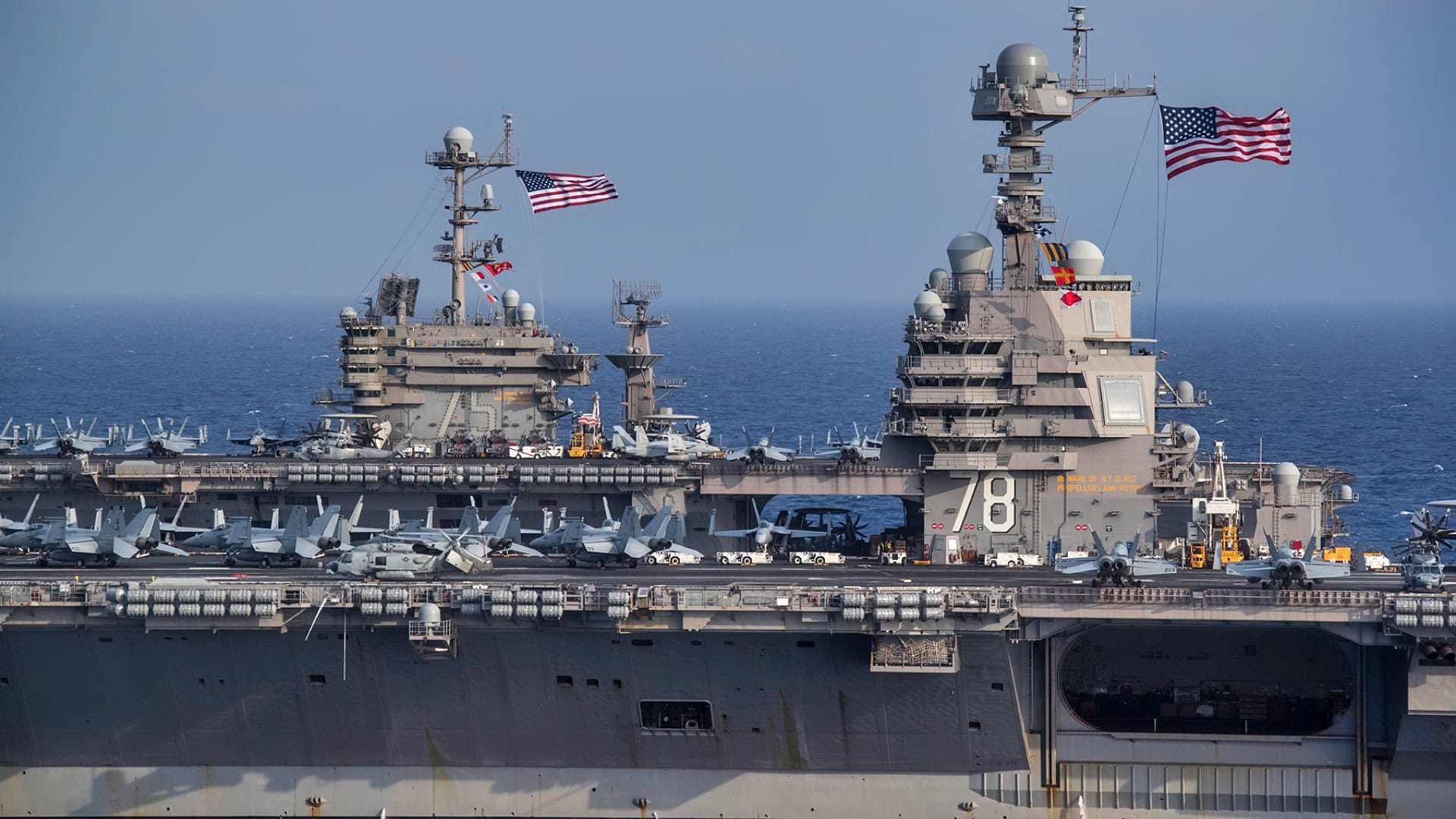
Why can’t the U.S. Navy build aircraft carriers and submarines fast enough to keep pace with China?
The answer is neither money nor will.
It is that the United States has only two shipyards capable of building nuclear-powered warships, both are short of skilled workers and critical materials, and one of them is now so physically crowded that it cannot fit the next aircraft carrier into the yard.
The Navy’s own fiscal 2027 budget book, released in early May, delivered the latest evidence: the future carrier USS Doris Miller slipped two more years, to 2034, because there is no room to build her, and the fifty-year-old USS Nimitz had to be kept in service past her retirement date to cover the gap.
While China launches a new carrier roughly every twenty months, America is losing years it cannot get back, and the cause is the same industrial bottleneck on both ends of the fleet.
The Aircraft Carrier Cascade: Kennedy, Enterprise, And A Ship That Will Not Fit
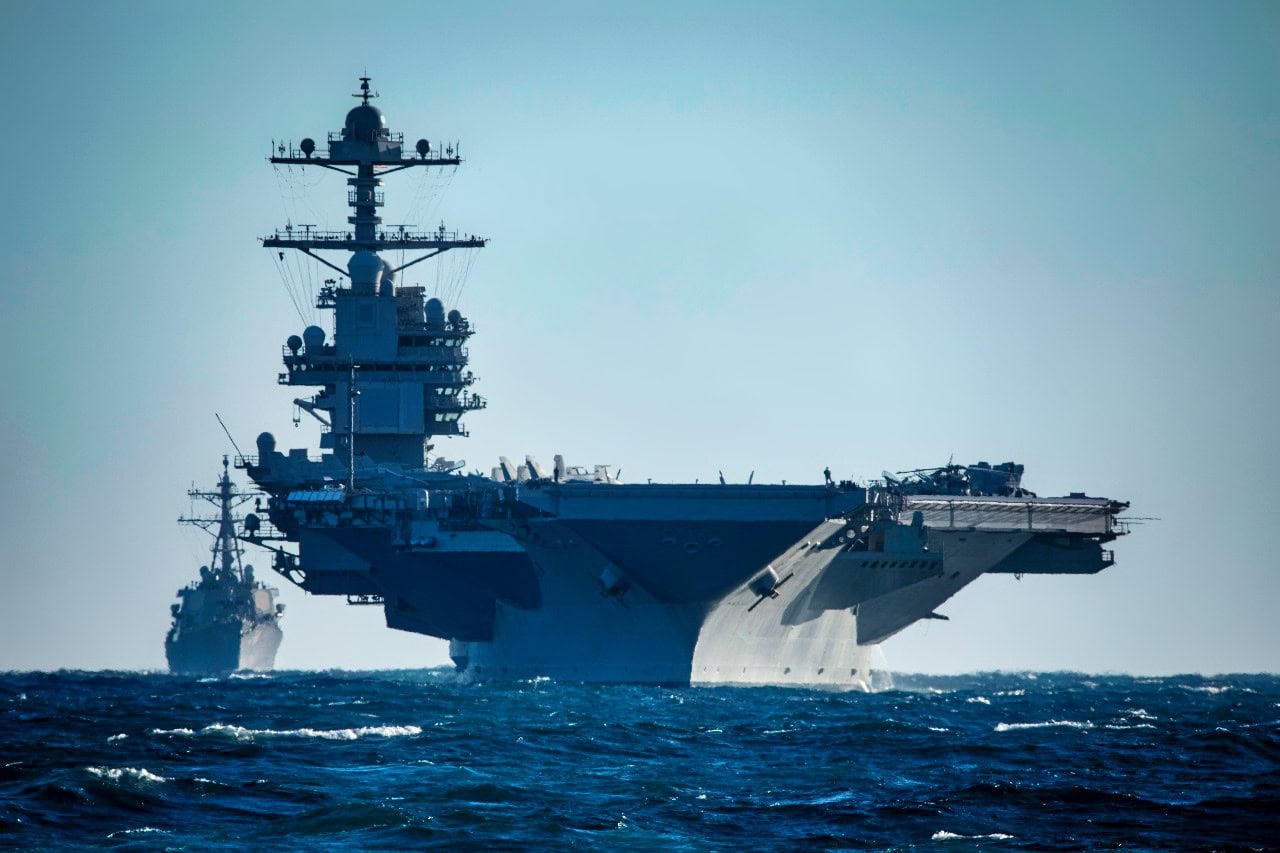
A view from the Ticonderoga-class guided missile cruiser USS Normandy (CG 60) of the first-in-class aircraft carrier USS Gerald R. Ford (CVN 78) and the Arleigh Burke-class guided missile destroyers USS Thomas Hudner (DDG 116), USS Ramage (DDG 61) and USS McFaul (DDG 74) as the ships steam in formation during a drill while underway as part of the Gerald R. Ford Carrier Strike Group March 5, 2023. Ford Carrier Strike Group is underway in the Atlantic Ocean executing its Composite Training Unit Exercise (COMPTUEX), an intense, multi-week exercise designed to fully integrate a carrier strike group as a cohesive, multi-mission fighting force and to test their ability to carry out sustained combat operations from the sea. As the first-in-class ship of Ford-class aircraft carriers, CVN 78 represents a generational leap in the U.S. Navy’s capacity to project power on a global scale. (U.S. Navy photo by Mass Communication Specialist 2nd Class Malachi Lakey)
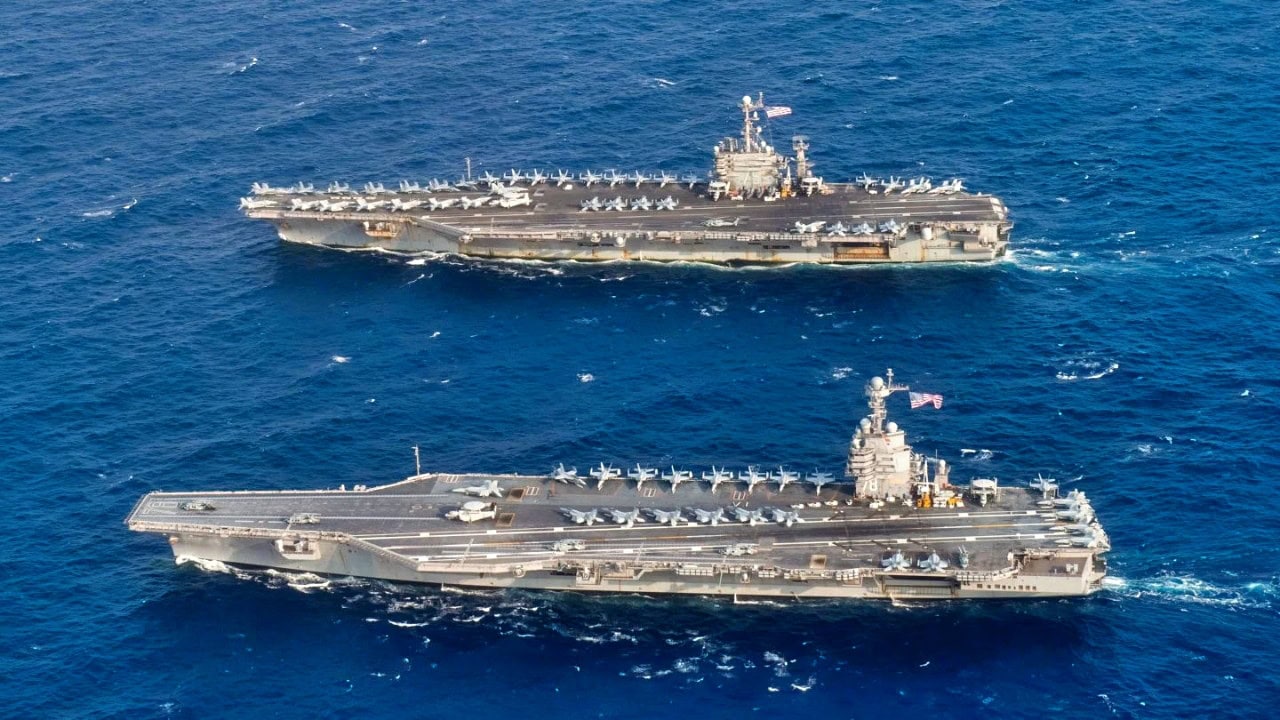
Ford-Class Aircraft Carrier U.S. Navy. Image Credit: Creative Commons.
The delays run down the entire Ford-class production line, each one feeding the next. The future USS Doris Miller, the fourth Ford-class carrier, had its delivery pushed from February 2032 to February 2034 in the FY2027 shipbuilding book, and the Navy’s stated reason is as concrete as a procurement problem gets: construction-footprint constraints limiting the shipbuilder’s ability to build the ship’s modules.
There is not enough physical space in the yard to assemble her, so she waits. From the start of construction to delivery, Doris Miller will take roughly fifteen years.
The crowding traces to the ship ahead of her. The future USS Enterprise, the third Ford-class carrier, slipped from July 2030 to March 2031 due to a delay in critical-path construction required to launch the ship, caused by the late delivery of large, sequence-critical equipment that held up the initial structural build in the dry dock.
Enterprise will take just over twelve years to build, and because she is occupying the space Doris Miller needs, her delay cascades directly into the fourth carrier’s. The second ship in the class, the future USS John F. Kennedy, is now expected to deliver in March 2027, pushed back from July 2025 to finish certification of the Advanced Arresting Gear and continued work on the Advanced Weapons Elevators — the same systems that delayed the lead ship, the USS Gerald R. Ford, for years. Kennedy’s construction will have run for about sixteen years.
Three carriers, three slips, one production line that cannot move them through fast enough. The delays are not isolated failures of individual ships; they are symptoms of a single yard trying to build more nuclear carriers at once than it has the room, workers, and parts to handle.
The Nimitz Gap: Keeping A 50-Year-Old Carrier At Sea To Cover The Hole
The cascade has already forced the Navy into an awkward improvisation. The USS Nimitz, the oldest carrier in the fleet at roughly 50 years, was scheduled to retire in 2025, which would have reduced the Navy from 11 carriers to 10 until Kennedy delivered.
With Kennedy slipping to March 2027, the Navy rolled the Nimitz’s retirement back twice, and she is now scheduled for decommissioning in March 2027 — the same month Kennedy is supposed to be commissioned to replace her. The service is keeping a half-century-old warship on the line precisely because the ship meant to succeed her is years behind.
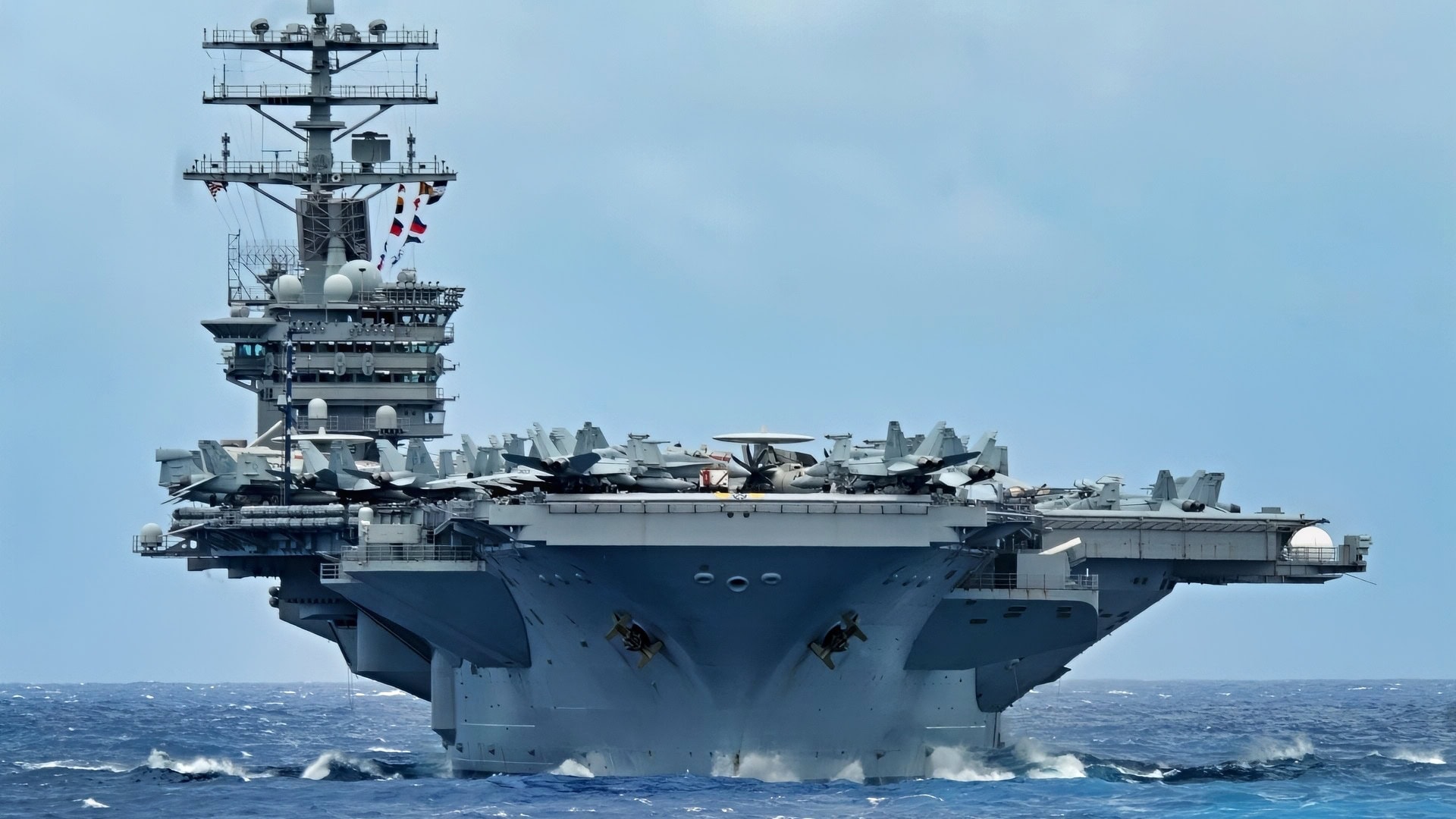
(July 18, 2012) – The aircraft carrier USS Nimitz (CVN 68) moves into formation for a photo exercise during the Great Green Fleet Demonstration as part of Rim of the Pacific (RIMPAC) 2012. Nimitz is currently underway participating in RIMPAC. Twenty-two nations, more than 40 ships and submarines, more than 200 aircraft and 25,000 personnel are participating in RIMPAC exercise from Jun. 29 to Aug. 3, in and around the Hawaiian Islands. The world’s largest international maritime exercise, RIMPAC provides a unique training opportunity that helps participants foster and sustain the cooperative relationships that are critical to ensuring the safety of sea lanes and security on the world’s oceans. RIMPAC 2012 is the 23rd exercise in the series that began in 1971. (U.S. Navy photo by Mass Communication Specialist 2nd Class Eva-Marie Ramsaran/RELEASED)

A U.S. Sailor prepares to launch a F/A-18E Super Hornet, attached to the “Kestrels” of Strike Fighter Squadron (VFA) 137, from the flight deck of Nimitz-class aircraft carrier USS Nimitz (CVN 68) in the Pacific Ocean, April 8, 2026. Nimitz is deployed as part of Southern Seas 2026 which seeks to enhance capability, improve interoperability, and strengthen maritime partnerships with countries throughout the region through joint, multinational and interagency exchanges and cooperation. (U.S. Navy photo by Mass Communication Specialist 2nd Class Jaron Wills)
The improvisation does not end with the Nimitz. The next carrier due to retire, the USS Dwight D. Eisenhower, commissioned in 1977, was slated to leave service in 2026, and the Navy has pushed that date into the early 2030s to wait for Enterprise. The pattern is the same at every step: aging carriers held past their planned retirements because their replacements cannot arrive on time, a fleet propped up at the top end by ships that should already be gone.
Former Navy Secretary John Phelan acknowledged in April that the service was reviewing the cost-effectiveness of the future Ford-class carriers still to come, the USS William J. Clinton and the USS George W. Bush, to make sure they still made sense — the sound of a Navy rattled enough by the delays to question its own plan.
The Submarine Shortfall: 1.2 Boats A Year Against A Requirement Of Two
The carrier story repeats underwater, and there the numbers are even starker. The Navy’s requirement is to deliver two Virginia-class attack submarines a year, alongside one Columbia-class ballistic missile boat — the “2+1” formula it calls its top industrial-base priority. The actual delivery rate has never reached 2 and has remained near 1.2 boats per year since 2022, according to the Congressional Research Service, leaving a growing backlog of submarines bought by Congress but not yet built. As detailed in the case for why this is the industrial problem the Navy cannot buy its way out of, the recovery date keeps receding rather than approaching.
The slip is the alarming part. In May, Chief of Naval Operations Admiral Daryl Caudle told appropriators that the yards would not hit the two-a-year rate until around 2032, four years later than the 2028 target his predecessor named in 2023.
The attack-submarine fleet is meanwhile heading toward roughly 46 boats against a requirement of 66, as older Los Angeles-class submarines retire faster than Virginias arrive, and the Navy has committed to selling three to five Virginias to Australia under AUKUS — boats it does not have the capacity to spare. The Navy needs to build about 2.33 submarines per year to cover its own fleet and its AUKUS commitment. It cannot reliably build 1.2.
The Root Cause: Two Shipyards, And No Way To Conjure More
Carriers and submarines share the same bottleneck, and naming it explains why money has not fixed the problem. Only two shipyards in the United States can build nuclear-powered warships: Huntington Ingalls’ Newport News Shipbuilding in Virginia, which builds carriers and submarines, and General Dynamics Electric Boat in Connecticut, which builds submarines.
Both are running at capacity, both are short of the skilled tradespeople — the nuclear-certified welders, machinists, and electricians — that the work requires, and both depend on the same strained network of specialized suppliers for critical components. When a yard runs out of physical space, as Newport News has, or when a sequence-critical part arrives late, as it did for Enterprise, the entire schedule stalls, because there is nowhere else to route the work.
This is why the spending has not moved the rate. Congress approved a $1.9 billion plus-up for the Virginia program in the 2026 appropriations act to avert a stop-work order, on top of multibillion-dollar submarine-industrial-base investments and $6.2 billion in the long-range plan, and Australia is contributing billions more under AUKUS to expand American capacity — and the rate is still 1.2.
Money funds the training pipelines, supplier development, and facility upgrades, but it cannot compress the years it takes. A nuclear shipyard cannot be built quickly, a master shipfitter cannot be trained in a budget cycle, and a graving dock cannot be poured and certified on a wartime schedule. The constraint is physical capacity and skilled labor, not dollars, which is exactly why throwing dollars at it has not closed the gap.
The Mirror Image Of China’s Rise
This is the other half of the story of the war at sea, and it is the precise inverse of China’s. Beijing is building toward nine aircraft carriers by 2035, launching warships at a pace no other navy can match, with its first nuclear supercarrier taking shape at Dalian and its submarine production accelerating across multiple expanded facilities.
China has shipyard capacity and is scaling it; the United States has demand but cannot scale its yards. The same decade in which China may add six carriers and a fleet of submarines is the decade in which American yards are slipping carrier deliveries to 2034 and pushing the two-submarine-a-year rate to 2032.
The contrast is not about which navy is better today, because the United States is plainly still ahead. It is about which direction each is moving, and their trajectories point toward each other.
Every Ford-class slip and every year the submarine rate stays stuck is a year the gap narrows, not because China has caught up in capability, but because America cannot build fast enough to hold its lead in numbers. The bottleneck that limits the U.S. fleet is the one advantage China does not share, and it is the reason the timelines are converging.
The Honest Balance: America Still Leads, For Now
The gap is real and closing, but it is not yet closed, and the case for perspective is as important as the case for alarm. The United States operates eleven aircraft carriers today, every one nuclear-powered, against China’s three, and the American advantage in tonnage, in combat-proven crews, and in the global network of bases, escorts, and replenishment ships that make carriers usable in a sustained fight remains decisive.
The Virginia-class submarine is a generation ahead of anything China builds in terms of quietness and capabilities, and the U.S. submarine force remains the clearest military advantage America holds in the Pacific. Eleven carriers slipping their successors is a stronger position than three carriers racing to build six more, and the experience gap between the two fleets is measured in decades that money cannot buy on either side.
MORE – The F-16XL Fighter Was the Masterpiece the Air Force Passed On
MORE – Russia’s Nuclear Battlecrusier Took 3 Decades to Get a Refit
MORE – Dark Eagle: The Army Has a Mach 17 Missile
The good news: The United States still has the most powerful navy on earth. The question the shipyards pose is whether they can build the next one before the gap they open becomes one they cannot close.
About the Author: Harry J. Kazianis
Harry J. Kazianis (@Grecianformula) was the former Senior Director of National Security Affairs at the Center for the National Interest (CFTNI), a foreign policy think tank founded by Richard Nixon based in Washington, DC. Harry has over a decade of experience in think tanks and national security publishing. His ideas have been published in the NY Times, The Washington Post, The Wall Street Journal, CNN, and many other outlets worldwide. He has held positions at CSIS, the Heritage Foundation, the University of Nottingham, and several other institutions focused on national security research and analysis. He is the former Executive Editor of the National Interest and the Diplomat. He holds a Master’s degree focusing on international affairs from Harvard University.

